Indoor air can affect sleep, comfort, and long-term health more than many people realize. The right monitor helps you spot rising CO2, fine particles, VOCs, humidity issues, and other hidden problems before they become a bigger concern.
We narrowed the field to the best options for home use, balancing accuracy, alerts, app support, and ease of reading the data at a glance.
Best 10 Air Quality Monitor for Home Health Picks for 2026
Precision CO2 Focus
Aranet4 Indoor Air Quality Monitor
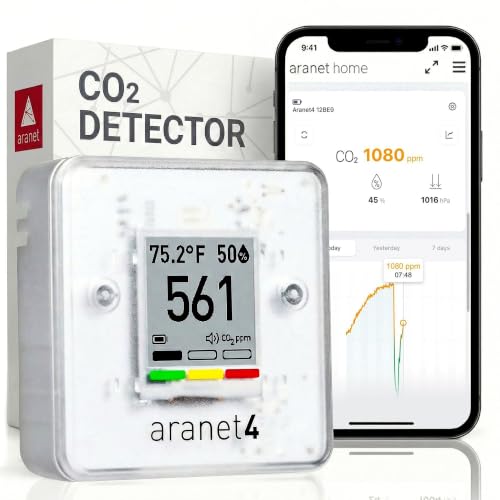
- NDIR CO2 sensor for precise readings
- Tracks temperature, humidity, and pressure
- E-ink display supports up to 4-year battery life
Best For: Home users who want a simple, dependable CO2 monitor
Alexa-Ready Whole-Home Monitor
Amazon Smart Air Quality Monitor

- Tracks PM2.5, VOCs, CO, humidity, and temperature
- Alexa alerts and announcements for poor air quality
- Can automate compatible fans, purifiers, and dehumidifiers
Best For: Alexa users who want easy alerts and home automation
Professional Multi-Sensor Pick

- Tracks CO2, PM1/2.5/10, TVOC, and formaldehyde
- App includes alerts, 90-day history, and export
- Rechargeable and portable for short-term use
Best For: Shoppers who want detailed multi-pollutant monitoring
Data-Heavy Home Monitor
CF-60PP SMART Air Quality Monitor

- 16-in-1 tracking with pollen and AQI
- Cloud-synced history plus local charts
- USB export and custom alarm thresholds
Best For: Users who want detailed reporting and long-term trend tracking
Premium Whole-Home Air Monitoring

- Tracks radon, PM2.5, CO2, VOCs, humidity, and temperature
- Battery-powered with WiFi and app-based live monitoring
- Cloud data, alerts, and optional 5-year warranty
Best For: Homeowners wanting always-on radon and indoor air tracking
Portable Multi-Sensor Pick
16-in-1 Indoor Air Quality Monitor

- Checks PM1.0, PM2.5, PM10, TVOC, HCHO, temp, and humidity
- HD color screen with simple one-button control
- Portable design with USB-C charging and included adapter
Best For: Portable room-to-room air checks at home or on the go
High-Alert 7-Inch Monitor
16 in 1 Air Quality Monitor Indoor

- 7-inch display with clear real-time readings
- Tracks CO2, PM2.5, PM1.0, PM10, HCHO, TVOC
- 7 AQI alerts plus mute control
Best For: Families wanting a large, alert-heavy indoor monitor
Quiet Multi-Scenario Monitor
16-in-1 Indoor Air Quality Monitor
- Easy single-tap controls with quiet mode
- HD color screen with real-time updates
- Tracks PM, CO2, TVOC, HCHO, temp, humidity
Best For: Users who want a simple monitor for bedrooms and shared spaces
Precision CO2 Focus – Aranet4 Indoor Air Quality Monitor
If you’re shopping for an air quality monitor for home health and want a dependable read on ventilation, the Aranet4 is built around accurate CO2 tracking. It also measures temperature, relative humidity, and atmospheric pressure, giving you a clear picture of the indoor conditions that affect comfort and freshness. The wireless, battery-powered design makes it easy to place where you need it most.
Best For: Homeowners who want a reliable, portable CO2 monitor with long battery life.
Pros:
- Measures CO2, temperature, humidity, and atmospheric pressure in real time
- Uses NDIR sensor technology for precise and reliable CO2 readings
- E-ink display helps extend battery life up to 4 years
- App stores up to 90 days of historical data with graphs
Cons:
- Focuses more on CO2 and comfort metrics than broader pollutant categories
- Requires two AA batteries, which are included but still need replacement eventually
The Aranet4 is a strong fit if your main goal is checking whether a room needs better ventilation. It keeps the interface simple while still offering enough history to spot patterns over time.
Alexa-Ready Whole-Home Monitor – Amazon Smart Air Quality Monitor
The Amazon Smart Air Quality Monitor is a practical air quality monitor for home health if you want quick insight into several common indoor pollutants. It tracks PM2.5, VOCs, carbon monoxide, humidity, and temperature, then turns that information into an easy-to-read air quality score in the Alexa app. Plug it in, set it up in minutes, and start getting alerts when conditions change.
Best For: Alexa households that want simple, connected monitoring with automation options.
Pros:
- Monitors 5 key factors: PM2.5, VOCs, CO, humidity, and temperature
- Color-coded LED plus air quality score in the Alexa app
- Phone notifications and Echo announcements when air quality drops
- Can trigger Alexa routines for fans, purifiers, or dehumidifiers
Cons:
- Works best for users already invested in the Alexa ecosystem
- Needs constant plug-in power, so it is not portable
This model is a solid choice if you want a low-friction way to monitor indoor air and automate response devices. It is especially useful in busy homes where fast alerts matter more than advanced data analysis.
Professional Multi-Sensor Pick – BREATHE Airmonitor Plus Gen 2
For buyers who want a more detailed air quality monitor for home health, the BREATHE Airmonitor Plus Gen 2 covers far more than basic CO2 readings. It tracks CO2, PM1, PM2.5, PM10, TVOC, formaldehyde, temperature, and humidity, giving you a fuller view of what may be affecting your indoor space. The compact design and app-based history make it useful for rooms where conditions change throughout the day.
Best For: Users who want a feature-rich monitor with broad pollutant coverage and app history.
Pros:
- 8-in-1 monitoring includes CO2, particle counts, TVOC, formaldehyde, temperature, and humidity
- NDIR CO2 measurement plus laser particle sensing
- Free app offers alerts, 90-day history, and data export
- Rechargeable design supports up to 6 hours of portable use
Cons:
- Portable runtime is limited compared with always-plugged desktop monitors
- More features may be more than needed if you only want basic CO2 tracking
This is a strong option if you want a deeper look at both gases and particles in your home. It gives you enough detail to connect spikes in air quality with everyday activities like cooking or cleaning.
Data-Heavy Home Monitor – CF-60PP SMART Air Quality Monitor
The CF-60PP SMART is a strong air quality monitor for home health if you want broad tracking and detailed records. It measures PM1.0, PM2.5, PM10, CO2, TVOC, HCHO, pollen, AQI, temperature, humidity, date, and time, then syncs that information to a smart app. With local charts and cloud history, it is designed for people who want both instant readings and long-term trend analysis.
Best For: Users who want extensive data tracking, cloud history, and report-style monitoring.
Pros:
- 16-in-1 sensor suite covers dust, gases, pollen, AQI, temperature, and humidity
- App syncs live readings and stores historical data in the cloud
- Custom alarms for CO2, PM2.5, or VOCs with push notifications
- USB data export and up to one year of stored historical data
Cons:
- Feature set is more complex than simpler home monitors
- Best suited to users who will actually use the charts, exports, and alerts
If you want the most information possible from a single monitor, the CF-60PP delivers a very broad snapshot of indoor conditions. It is especially appealing for users who like reviewing patterns and comparing room-by-room changes over time.
Premium Whole-Home Air Monitoring – Airthings View Plus
If you want an air quality monitor for home health that tracks more than just dust, the Airthings View Plus is built for broad indoor insight. It continuously measures radon, PM2.5, CO2, VOCs, humidity, temperature, and air pressure, then syncs with the Airthings app for live readings and trend tracking.
Best For: Homeowners who want always-on, app-connected monitoring with radon tracking and long-term trend data.
Pros:
- Measures radon plus PM2.5, CO2, VOCs, humidity, temperature, and pressure.
- Battery-powered design supports cable-free placement anywhere indoors.
- WiFi-connected with live data, cloud saving, and app alerts.
- Five-year warranty available with free registration.
Cons:
- The Airthings app and internet access are required for full use.
- Requires account setup before you can use the device.
- Higher-scope monitoring may be more than some buyers need for simple room checks.
For buyers who want a more complete picture of indoor conditions, this model stands out because it combines radon with key comfort and pollution metrics in one compact unit. It is a strong fit when long-term monitoring matters more than a basic spot check.
Portable Multi-Sensor Pick – 16-in-1 Indoor Air Quality Monitor
For shoppers looking for an air quality monitor for home health that can also move from room to room, this 16-in-1 tester offers broad coverage in a portable format. It checks PM1.0, PM2.5, PM10, TVOC, HCHO, temperature, and humidity, giving you a quick read on air conditions in bedrooms, offices, cars, and other spaces.
Best For: Families and everyday users who want a portable multi-parameter monitor with a clear display and simple controls.
Pros:
- Measures PM1.0, PM2.5, PM10, TVOC, HCHO, temperature, and humidity.
- HD color screen shows readings clearly with color-coded levels.
- Simple one-button operation and optional audio prompt mute.
- Rechargeable with USB-C and includes adapter and cable.
Cons:
- Battery runtime is limited to about 4-5 hours per charge.
- It is geared toward spot monitoring rather than always-on installation.
- No app connectivity or cloud-based history is mentioned.
This is a practical pick if you want flexible, on-the-go testing without a complicated setup. It is especially useful when you need a portable monitor that can help you compare air quality across different rooms or enclosed spaces.
Budget Smart Detection Option – zemeollo 10-in-1 Air Monitor
If you want an air quality monitor for home health with a straightforward display and broad gas detection, this 10-in-1 model is aimed at simple everyday use. It monitors CO2, HCHO, TVOC, benzene, PM2.5, PM10, and related conditions on a color screen, making it easy to spot changes at a glance.
Best For: Buyers who want a portable, easy-to-read monitor for basic whole-room air checks.
Pros:
- Detects CO2, HCHO, TVOC, benzene, PM2.5, and PM10.
- HD LED color screen highlights abnormal readings clearly.
- Rechargeable 2000mAh battery supports up to 20 hours of use.
- One-click operation keeps setup simple.
Cons:
- It is a portable tester, not a fixed always-on home monitor.
- Temperature is shown in Celsius by default.
- Brand support and ecosystem details are limited in the supplied information.
This model makes sense if you want broad detection without extra complexity. It focuses on fast readings, easy operation, and long battery life, which can be a strong fit for quick checks around living spaces, cars, or pet areas.
High-Alert 7-Inch Monitor – 16 in 1 Air Quality Monitor Indoor
If you want an air quality monitor for home health that shows a lot of data at once, this 7-inch model is built for quick at-a-glance checks. It tracks CO2, PM2.5, PM1.0, PM10, HCHO, TVOC, temperature, humidity, and AQI, so it’s suited to households that want broad indoor air visibility in one device.
Best For: Families who want a large-screen indoor monitor with multiple pollutant readings and audible alerts.
Pros:
- 7-inch display makes readings easy to see without menu digging
- Tracks 9 key parameters, including CO2, PM2.5, HCHO, and TVOC
- Includes 7 AQI alert buzzers plus a mute button
- External high-precision sensors are designed for direct air sampling
Cons:
- The product uses a dense feature set that may be more than casual users need
- Accuracy notes caution against touching sensors or exposing them to strong odors
- Best suited for indoor stationary use rather than ultra-portable carrying
Overall, this is a strong pick if you want a home-focused air quality monitor with a bigger screen and active alerting. It’s especially useful when you want frequent visibility into multiple air factors at once.
Portable Color-Display Tester – Air Quality Monitor Indoor
This air quality monitor for home health is designed for people who want a portable, easy-to-read tester with broad indoor coverage. It measures CO2, HCHO, TVOC, PM2.5, PM1.0, PM10, temperature, humidity, and AQI, and its color screen changes when readings move beyond safety thresholds.
Best For: Users who want a compact monitor for bedrooms, living spaces, cars, and other flexible locations.
Pros:
- Portable design works well across home, car, office, and travel settings
- Color screen helps make changing air conditions easier to spot
- Measures CO2, HCHO, TVOC, PM2.5, PM1.0, PM10, temp, humidity, and AQI
- Bluetooth time calibration adds a convenient setup detail
Cons:
- Smaller portable format may be less screen-focused than larger desktop units
- Operation relies on button presses for modes like sound, calibration, and sleep
- Black finish and compact design are practical, but not as feature-visual as larger displays
For buyers who value portability and quick visual feedback, this is a practical all-around option. It fits well when you want one monitor that can move between rooms or ride along in a vehicle.
Quiet Multi-Scenario Monitor – 16-in-1 Indoor Air Quality Monitor
If you’re comparing an air quality monitor for home health and want something simple to use, this model focuses on easy operation and continuous reading updates. It tracks PM1.0, PM2.5, PM10, CO2, TVOC, HCHO, temperature, and humidity, while the HD color screen shows data in real time.
Best For: People who want an easy-to-use monitor for bedrooms, offices, vehicles, and general indoor use.
Pros:
- Simple single-tap controls make it approachable for everyday use
- Quiet sampling mode helps reduce sound distractions at night
- High-precision sensor system updates readings every 1.5 seconds
- Type-C charging and included adapter make power setup straightforward
Cons:
- Battery runtime is listed at 4–5 hours, so it’s not an all-day cordless monitor
- It focuses on core indoor indicators rather than extra smart-home features
- The feature set may still be more than needed for users who only want a basic CO2 checker
This is a good fit if you want a calm, readable indoor monitor with quick sampling and flexible placement. Its straightforward controls and quiet mode make it especially useful in shared or sleep-sensitive spaces.
How We Picked the Best Air Quality Monitor for Home Health
For this roundup, we focused on the factors that matter most in an Air Quality Monitor for Home Health: sensor breadth, measurement usefulness, alerting, readability, and overall value. We prioritized models that can help you respond to everyday indoor air problems, not just display numbers.
We also considered whether a monitor is better suited for a bedroom, nursery, living area, home office, or whole-home use. Portable units, app-connected monitors, and more advanced multi-parameter devices each serve different needs.
Quick Comparison
If you want the simplest setup, a compact monitor with clear CO2 and humidity readings is often enough for bedrooms and smaller rooms. If you want broader visibility, choose a multi-sensor model that tracks PM2.5, VOCs, temperature, and humidity in one display. App-enabled monitors are best when you want alerts and longer-term trend tracking.
Key Buying Factors for Air Quality Monitor for Home Health
What It Measures
Look for the pollutants and conditions that match your concerns. CO2 is useful for ventilation, PM2.5 helps track particles from cooking or smoke, VOCs can point to off-gassing or cleaning products, and humidity matters for comfort and mold prevention. Some homes may also benefit from radon monitoring.
Display, Alerts, and Data Access
A large screen helps you check readings quickly, while app notifications make it easier to react when air quality changes. If you plan to review patterns over time, choose a model with history tracking, CSV export, or clear trend graphs.
Accuracy and Ease of Use
For home use, a monitor should be easy to place, easy to calibrate if needed, and easy to interpret. The best units give reliable readings without requiring constant setup or technical knowledge.
Power and Placement
Battery-powered models offer flexibility, while plug-in units are ideal for always-on monitoring. Place the device where people actually spend time, away from windows, vents, and direct cooking or cleaning sources unless you want to measure those conditions specifically.
Who Should Buy Which Air Quality Monitor for Home Health?
Buy a simple CO2-focused monitor if your main goal is better ventilation in bedrooms or offices. Choose a multi-sensor monitor if you want broader protection from particles, VOCs, and humidity problems. If you manage a larger home, want app alerts, or need more detailed reporting, a connected model with logging features is the better fit. For families focused on overall indoor wellness, the best Air Quality Monitor for Home Health is the one you will actually check regularly and use to make meaningful changes.