Choosing the right support gear can make or break a night-sky session. The best astrophotography mounts for mirrorless cameras help you track stars more accurately, reduce blur, and make long exposures far more usable.
This roundup focuses on practical options for mirrorless shooters, from telescope adapters and camera interfaces to accessories that help you mount and align gear with less frustration.
Best 10 Astrophotography Mounts for Mirrorless Cameras Picks for 2026
Mirrorless Telescope Connection

- Fits Sony E-mount mirrorless bodies
- Works with Celestron T-adapters
- Aluminum body with secure bayonet flange
Best For: Sony E users connecting a mirrorless camera to a telescope
Ultra-Wide Milky Way Lens

- 105° ultra-wide view for night skies
- F2 aperture supports low-light shooting
- Manual-focus prime with filter holder
Best For: Fuji X astrophotographers focused on Milky Way and night landscapes
Mirrorless Telescope Adapter

- Fits Nikon Z mirrorless bodies
- Rigid aluminum alloy construction
- Helps keep telescope alignment secure
Best For: Nikon Z users doing basic telescope-to-camera astrophotography
Autofocus Wide-Angle Pick

- 92° wide-angle view on APS-C
- STM autofocus with eye/animal/car focus
- Lightweight 98g design
Best For: Fuji X users who want a portable autofocus wide-angle lens
Guide Camera
SVBONY SV905C 1.23MP Autoguiding Camera

- 1.23MP 1/3" CMOS sensor in a 1.25-inch body
- USB 2.0 and ST4 guide interfaces
- Compatible with PHD2, NINA, and similar software
Best For: Users who need a sensitive guide camera for autoguiding
T-Mount Adapter
Astromania Sony NEX T2 Ring Adapter

- Made for Sony NEX E-mount mirrorless cameras
- All-metal aluminum construction
- Includes Allen key for angle adjustment
Best For: Sony NEX users needing a simple telescope adapter
Hotshoe Dovetail Adapter
Finder Scope to Camera Hotshoe Adapter

- Finder dovetail on top with camera hotshoe on bottom
- Knurled locking ring and rubber pad
- Includes 1/4-inch threaded hole for bracket mounting
Best For: Mirrorless users mounting a finder or guide scope to a hotshoe
Compact Wide-Angle Option

- 14mm prime for wide landscapes and Milky Way shots
- F3.5 aperture supports low-light shooting
- Compact manual lens for Fujifilm X mirrorless cameras
Best For: Fujifilm X users wanting a lightweight manual wide-angle lens
Mounting Accessory Pick
Telescope Finder Dovetail Camera Adapter

- Mounts into a standard finder dovetail base
- Uses a 1/4-inch screw for camera attachment
- Rubber pads help improve grip and protection
Best For: Users who need a simple camera-to-telescope dovetail adapter
Ultra-Wide Astro Lens
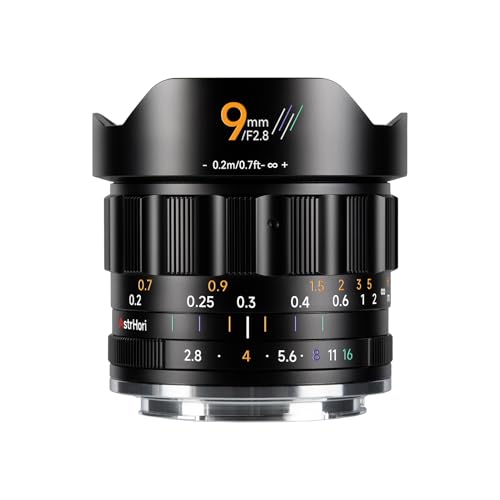
- 9mm ultra-wide lens with a 111.4° angle of view
- F2.8 aperture is geared toward starry-sky shooting
- 14-spike starburst effect adds a distinct night look
Best For: Fujifilm X users seeking a bright ultra-wide manual lens for astro scenes
Mirrorless Telescope Connection – Sony E Camera T-Ring
If you already have a telescope setup and need a direct way to connect Sony E mirrorless bodies, this Celestron T-ring is a practical accessory for astrophotography mounts for mirrorless cameras. It is designed to attach securely to E-mount bodies and work with Celestron T-adapters that use a 42mm female thread.
Best For: Sony E-mount photographers who want a simple, secure telescope-to-camera connection for astrophotography.
Pros:
- Built for Sony E-mount mirrorless camera bodies
- Works with Celestron T-adapters using a 42mm female thread
- Sturdy bayonet flange helps lock in a secure fit
- Aluminum construction with black anodized finish
Cons:
- T-ring only; it does not include a telescope adapter
- Designed specifically around Sony E-mount compatibility
This is a straightforward fit-and-shoot solution for Sony users who want a dependable mechanical connection rather than a more complex imaging accessory. If your telescope setup already matches the T-adapter standard, it keeps the path to the sensor simple.
Ultra-Wide Milky Way Lens – Fuji X 10mm F2
For astrophotography mounts for mirrorless cameras, a fast ultra-wide lens can be just as important as the mount itself, and this TTArtisan 10mm F2 is aimed at that kind of night-sky work. Its 105° angle of view, large aperture, and low-coma design notes make it well suited to capturing the Milky Way and other dark-scene subjects on Fuji X bodies.
Best For: Fuji X shooters who want an ultra-wide manual lens for Milky Way and night landscape photography.
Pros:
- 105° angle of view for expansive night scenes
- F2 aperture helps pull in more light in low-light conditions
- Notes highlight less coma and rounder star shapes
- Includes a 72mm circular filter holder for outdoor shooting
Cons:
- Manual focus only
- Designed for Fujifilm X APS-C cameras, not full-frame bodies
This lens makes sense if your priority is sky coverage and low-light performance rather than autofocus convenience. It is a strong choice for photographers who want a compact wide prime specifically tuned for starry skies and night scenes.
Mirrorless Telescope Adapter – Nikon Z 1.25-Inch
If your goal is direct telescope imaging with a Nikon Z body, this 1.25-inch adapter is a simple way to integrate a mirrorless camera into an astrophotography setup. It is made for Nikon Z-mount cameras and is described as a secure-fit accessory for connecting the camera body and telescope for moon and planet imaging.
Best For: Nikon Z owners who want a rigid telescope adapter for basic astrophotography imaging.
Pros:
- Compatible with Nikon Z5, Z50, Z6, Z6 II, Z7, and Z7 II
- Aluminum alloy construction with oxidized anti-rust surface
- Secure fit helps maintain alignment during observation and imaging
- Designed for moon, Saturn, Jupiter, and similar targets
Cons:
- Not compatible with Nikon F-mount cameras
- Basic adapter function only, without extra imaging controls
For Nikon Z users, this is a practical no-frills bridge between the camera and telescope. It focuses on mechanical stability and compatibility, which are the essentials when you want consistent alignment for astronomy images.
Autofocus Wide-Angle Pick – Fuji X 14mm F3.5
When you want a compact wide prime for astrophotography mounts for mirrorless cameras, the TTArtisan AF 14mm F3.5 offers a practical balance of field of view, autofocus, and light weight. It is aimed at APS-C Fujifilm X users who want a 92° view and a lens that can also handle general wide-angle shooting.
Best For: Fuji X photographers who want a lightweight autofocus wide lens for stars, landscapes, and general use.
Pros:
- 92° wide-angle view with a 21mm full-frame equivalent
- Autofocus STM motor with eye, animal, and car focus support
- Lightweight 98g design
- Close focusing distance of 0.25m
Cons:
- F3.5 aperture is not as fast as dedicated ultra-bright night-sky lenses
- Designed for Fujifilm X APS-C cameras only
This lens is the most flexible option in the group if you want autofocus and portability over extreme astrophotography speed. It should appeal to Fuji shooters who also want a wide everyday lens that can still handle night scenes.
Guide Camera – SVBONY SV905C 1.23MP Autoguiding Camera
If you’re researching astrophotography mounts for mirrorless cameras, the SVBONY SV905C is not the mount itself but a useful guiding camera that can help your rig track more accurately. Its compact 1.25-inch body, 1.23MP sensor, and ST4 guide interface are aimed at autoguiding and planetary imaging rather than primary camera support.
Best For: Imaging setups that need a sensitive guide camera for PHD2-compatible autoguiding.
Pros:
- 1/3" CMOS sensor with 1280×960 resolution for guide-star capture
- High peak QE and low read noise for tracking faint stars
- USB 2.0 and ST4 interface support with PHD2, NINA, and other software
- 1.25-inch form factor fits many guide lenses and OAG guide stars
Cons:
- Not a camera mount for mirrorless bodies
- Not compatible with ASI AIR
- Requires driver setup before use
For a mirrorless deep-sky setup, this makes sense as the guiding piece of the system, not the primary camera support. It is best viewed as a tracking aid for users building a more precise astrophotography rig.
T-Mount Adapter – Astromania Sony NEX T2 Ring Adapter
For astrophotography mounts for mirrorless cameras, a solid T-ring is the bridge between your Sony NEX body and telescope accessories. This Astromania adapter is built for Sony NEX E-mount cameras and lets you attach T2 accessories directly, with an all-metal aluminum design for long-term use.
Best For: Sony NEX mirrorless users who want a simple, durable camera-to-telescope adapter.
Pros:
- Compatible with Sony NEX E-mount models listed in the notes
- All-metal aluminum construction
- Includes Allen key for angle adjustment
- Straight grooves make screwing on and off easier
Cons:
- Only fits Sony NEX E-mount cameras, not all mirrorless systems
- Basic adapter only, with no extra spacing or focusing features
This is a practical pick if you want a straightforward mount interface for telescope imaging. It focuses on secure attachment and simple usability rather than added flexibility.
Hotshoe Dovetail Adapter – Finder Scope to Camera Hotshoe Adapter
If you are comparing astrophotography mounts for mirrorless cameras, this adapter is a helpful support accessory for adding a finder scope or guide scope to a camera hotshoe. It combines a standard finder dovetail base with a male flash shoe, plus a 1/4-inch threaded hole for broader bracket mounting.
Best For: Mirrorless shooters who want to mount a finder or guide scope through the camera hotshoe.
Pros:
- Standard finder dovetail base on top
- Male flash shoe fits most camera hotshoe/coldshoe mounts
- Knurled locking ring for hand tightening
- Rubber pad helps grip and protect the shoe
Cons:
- Not a primary camera mount
- Designed for accessory mounting rather than direct imaging support
- Uses a compact adapter format, so load requirements should be kept modest
In practice, this is a smart utility piece for building a more organized mirrorless astrophotography setup. It is best suited to accessory attachment, not as the main connection between camera and telescope.
Compact Wide-Angle Option – JINTU 14mm F3.5 for Fuji X
If you’re building an affordable kit for astrophotography mounts for mirrorless cameras, the JINTU 14mm F3.5 gives Fujifilm X users a simple manual wide-angle prime for Milky Way and landscape work. Its 14mm focal length, F3.5 aperture, and compact design make it a practical choice when you want a lightweight lens for travel and low-light shooting.
Best For: Fujifilm X photographers who want a compact manual wide-angle lens for Milky Way, cityscape, and travel shooting.
Pros:
- 14mm focal length is well suited to expansive landscapes and Milky Way compositions.
- F3.5 aperture helps gather light and can reduce noise in low-light scenes.
- Compact build makes it easy to carry on trips or night shoots.
- Compatible with many Fujifilm X-mount mirrorless bodies.
Cons:
- Manual focus only, so it is less convenient for fast-moving subjects.
- No image stabilization is listed.
- Maximum aperture is not as bright as faster astrophotography primes.
Overall, this is a straightforward budget-friendly wide-angle lens for mirrorless shooters who value portability and simple manual control. It is best viewed as a versatile entry option for wide night-sky framing rather than a specialized premium astro lens.
Mounting Accessory Pick – Telescope Finder Dovetail Camera Adapter
For astrophotography mounts for mirrorless cameras, this camera adapter is a simple hardware solution that lets you secure a camera in a telescope finder dovetail base. It is built from aluminum and stainless steel, uses a standard 1/4-inch mounting screw, and includes rubber pads to help protect the camera while improving grip.
Best For: Mounting a camera to a telescope finder dovetail base for recording or tracked night-sky setups.
Pros:
- Fits standard finder dovetail bases in the 33-36mm range.
- 1/4-inch screw works with many cameras and other threaded accessories.
- Rubber pads add grip and help protect the camera body.
- Lightweight aluminum and stainless steel construction.
Cons:
- It is an adapter, not a camera support or tracking mount by itself.
- Compatibility depends on the finder base size and a 1/4-inch thread.
This is a useful utility accessory if you need a secure way to attach a mirrorless camera to telescope hardware. It makes sense for observers and astrophotographers who already use finder dovetail systems and want a compact mounting bridge.
Ultra-Wide Astro Lens – AstrHori 9mm F2.8 for Fuji X
If you’re comparing astrophotography mounts for mirrorless cameras and also want an ultra-wide lens for the night sky, the AstrHori 9mm F2.8 is built for dramatic framing. Its 111.4° angle of view, bright F2.8 aperture, and manual prime design make it a strong fit for starry skies, Milky Way scenes, and other low-light compositions.
Best For: Fujifilm X shooters who want an ultra-wide manual lens for starry sky, Milky Way, and creative wide-angle photography.
Pros:
- 9mm focal length and 111.4° angle of view capture very expansive scenes.
- F2.8 aperture is better suited to low-light and astro work than slower lenses.
- 14-spike starburst effect adds a distinctive look to point light sources.
- 20cm close focusing distance supports creative wide-angle compositions.
Cons:
- Manual focus only, which may not suit all users.
- No image stabilization is listed.
- Ultra-wide perspective may be too extreme for everyday general-purpose shooting.
This lens stands out if you want a compact, specialized ultra-wide option for night scenes and creative framing. For Fujifilm X mirrorless owners, it offers a strong mix of brightness, field of view, and visual character.
How We Picked the Best Astrophotography Mounts for Mirrorless Cameras
We focused on gear that makes mirrorless astrophotography easier to set up and more dependable in the field. That means compatibility with popular mirrorless mounts, solid build quality, practical telescope or hotshoe integration, and features that support stable night-sky imaging rather than general-purpose use.
Because Astrophotography Mounts for Mirrorless Cameras can serve different roles, we also considered whether each option is better suited to direct camera attachment, telescope coupling, guiding, or accessory mounting.
Quick Comparison
If you want a simple telescope connection, choose a T-ring or T-adapter matched to your camera mount. If you need better framing and wider sky coverage, a fast wide-angle lens can be the better fit. For tracking and guiding workflows, camera guide accessories and dovetail-mounted solutions are more relevant than lens adapters alone.
Key Buying Factors for Astrophotography Mounts for Mirrorless Cameras
Mount Compatibility
Start with your camera system. Sony E, Fujifilm X, Nikon Z, and similar mounts all require the correct adapter or lens mount. A precise fit matters because even slight play can affect alignment and focus at long focal lengths.
Tracking and Stability
If your goal is deep-sky imaging, stability is critical. Look for rigid construction, secure locking points, and accessories that minimize flex between the camera, adapter, and telescope or mount head.
Optical Use Case
Some buyers need a direct telescope connection, while others need a wider lens for Milky Way shots. Wide-angle APS-C lenses can be a better choice for landscape astrophotography, while T-adapters and T-rings are more appropriate for telescope-based imaging.
Field Workflow
Think about how fast you can assemble, balance, and adjust the system in the dark. Simple, tool-light setups are often more useful than complex rigs if you move between locations often.
Who Should Buy Which Astrophotography Mounts for Mirrorless Cameras?
If you already own a telescope and want to connect a mirrorless body, prioritize the proper T-ring or telescope adapter for your mount. If you mainly shoot wide Milky Way scenes, a fast ultrawide lens may be the smarter purchase. If you are building a guided imaging rig, look at guide cameras and mounting accessories that support alignment and repeatability.
In short, the best choice depends on your workflow: direct telescope imaging, wide-field night photography, or a hybrid setup that can do both. For most buyers, the right Astrophotography Mounts for Mirrorless Cameras are the ones that match your gear, keep the system rigid, and reduce setup friction under the stars.