Small teams need storage that is fast, simple to deploy, and easy to scale. The right enclosure can turn spare SSDs into portable project drives, backup media, or shared work storage without adding complexity.
We reviewed options for different business needs, from budget 2.5-inch SATA models to high-speed NVMe and multi-bay enclosures built for heavier workloads.
Best 10 SSD Enclosures for Small Businesses Picks for 2026
Portable NVMe/SATA Pick
SABRENT Tool-Free M.2 Enclosure
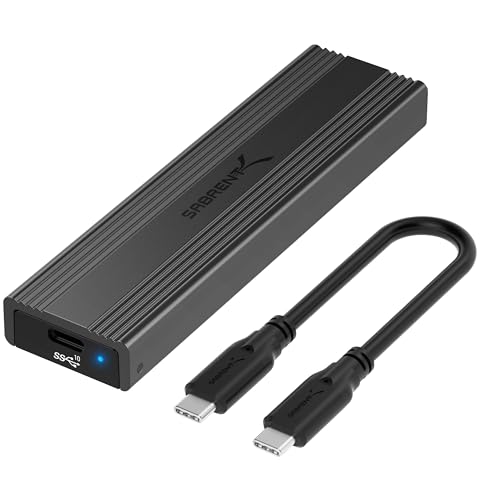
- Tool-free M.2 install
- Fits NVMe and SATA drives
- USB 3.2 Type-C, 10Gbps
Best For: Compact, simple drive swapping in mixed M.2 environments
Multi-Drive Office Storage Pick
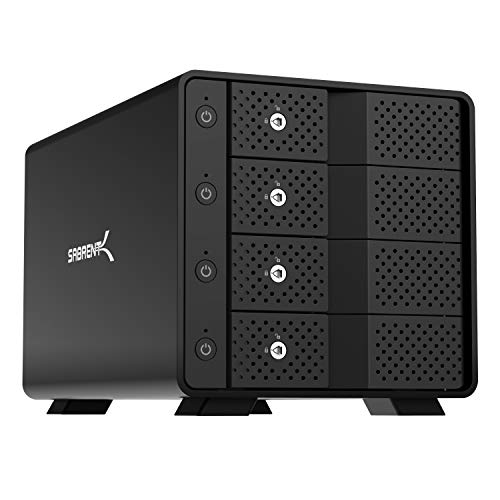
- Four independent drive bays
- Trayless hot-swap design
- Active cooling for 24/7 use
Best For: Small teams needing easy multi-drive access
Premium Gen5 Speed Pick

- Up to 80Gbps with Thunderbolt 5
- LCD shows temperature and fan status
- Active cooling for NVMe drives
Best For: Power users with Thunderbolt 5 systems
Tool-Free SATA Starter
SABRENT 2.5in SATA to USB 3.0 Tool-Free SSD/HDD Enclosure
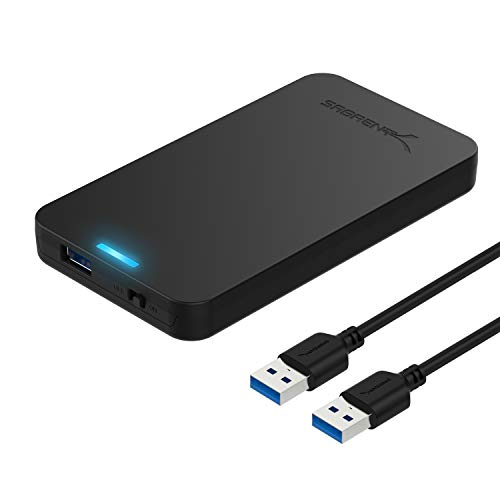
- Tool-free installation for quick drive swaps
- USB 3.0 with up to 5 Gbps transfer rates
- Supports 2.5-inch SATA SSDs and HDDs
Best For: Teams that need a simple enclosure for standard 2.5-inch SATA drives
Portable NVMe Speed Pick
Hagibis SSD Enclosure, Floppy Disk Style USB 3.2 Gen2 10Gbps

- USB 3.2 Gen2 with up to 10Gbps transfer speed
- Fits NVMe 2230 and 2242 SSDs
- Slim aluminum body for easy carry
Best For: Users who need a compact enclosure for fast NVMe 2230/2242 storage
Durable USB-C Workhorse
UGREEN USB C Hard Drive Enclosure for 2.5" SATA SSD HDD
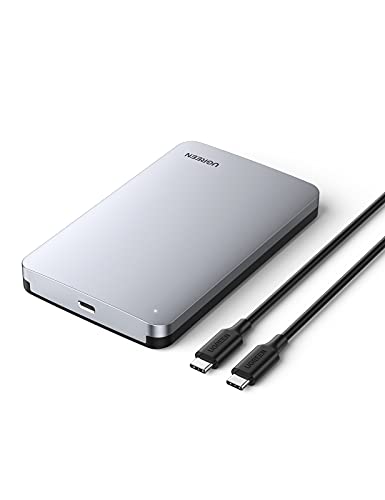
- Aluminum shell with built-in chipset
- Supports 2.5-inch SATA SSDs and HDDs
- USB-C, plug-and-play, tool-free setup
Best For: Teams that want a durable, easy-to-use SATA enclosure with broad compatibility
Best Simple Single-Drive Option
BENFEI Tool-Free SATA to USB Enclosure

- Tool-free 2.5-inch SATA enclosure
- UASP support for faster transfers
- USB-C and USB-A cable included
Best For: portable single-drive SSD backups and transfers
Best Multi-Bay Value
CENMATE 4-Bay SATA HDD/SSD Enclosure

- Four-bay SATA enclosure for 2.5/3.5-inch drives
- Hot-swappable, tool-free drive access
- USB 3.0 with 5Gbps transfer support
Best For: multi-drive backups and rotating SATA storage
Portable NVMe/SATA Pick – SABRENT Tool-Free M.2 Enclosure
If you want one of the more flexible ssd enclosures for small businesses, this SABRENT model is a straightforward choice for occasional drive swaps, laptop bag portability, and fast external storage. It supports both M.2 NVMe and M.2 SATA drives, so it can fit into mixed-workload setups without needing a separate enclosure for each drive type.
Best For: Teams that need a compact, tool-free enclosure for either NVMe or SATA M.2 drives.
Pros:
- Tool-free installation makes drive changes quick and simple.
- Supports both M.2 NVMe and M.2 SATA drives in 2242/2260/2280 lengths.
- USB 3.2 Type-C with up to 10Gbps transfer speed.
- Slim aluminum body with a thermal pad for basic heat transfer.
Cons:
- Does not support 2.5-inch SATA drives or mSATA.
- No room for M.2 drives with a pre-installed heatsink.
- Single-drive use only.
For small-business users who value simplicity over maximum speed, this enclosure covers the essentials well. It is best viewed as a dependable everyday M.2 adapter rather than a high-end workflow tool.
High-Speed Backup Pick – TERRAMASTER D1 SSD Plus
For small-business workflows that move large files often, this enclosure is built to be one of the faster ssd enclosures for small businesses. The TERRAMASTER D1 SSD Plus supports Thunderbolt 5/4/3 and USB connections, and its fanless aluminum design is aimed at keeping NVMe drives cool during sustained transfers.
Best For: Fast backups, large file transfers, and Mac mini storage expansion with NVMe drives.
Pros:
- Very high transfer performance, with up to 40Gbps interface support.
- Works with Thunderbolt 5/4/3 and USB 4/3.2/3.1/3.0/2.0.
- Fanless all-aluminum design with extra heat dissipation.
- Supports M.2 NVMe 2280 drives up to 8TB.
Cons:
- NVMe only; not for SATA M.2 drives.
- Best results depend on using a compatible high-speed port.
- More focused on performance than basic portability.
This is a strong pick when speed matters more than price or simplicity. It fits well in a small office that regularly backs up large projects or needs fast external expansion.
Multi-Drive Office Storage Pick – SABRENT 4-Bay USB-C Dock
If your office needs shared local storage rather than a single portable drive, this is one of the more practical ssd enclosures for small businesses. The SABRENT 4-bay unit is a direct-attached storage dock for up to four 3.5-inch SATA HDDs or SSDs, with independent connections per bay and a trayless hot-swap design.
Best For: Small teams that need multi-drive storage with individual drive access and simple hot-swapping.
Pros:
- Four independent bays with dedicated controllers for stable drive access.
- Trayless, tool-free hot-swap design for quick drive changes.
- Per-bay power switches and activity LEDs add control and visibility.
- Active cooling with a 92mm fan for 24/7 operation.
Cons:
- Uses 3.5-inch SATA drives, not M.2 SSDs.
- Not hardware RAID; each drive mounts individually.
- Large and heavy compared with single-drive enclosures.
This dock makes sense when you want simple, expandable storage without building a NAS. It is best for an office bench, workstation, or lab environment where drive access and reliability matter more than compact size.
Premium Gen5 Speed Pick – MOKiN 80Gbps NVMe Enclosure
For demanding workflows, this enclosure is built for users who want maximum bandwidth from ssd enclosures for small businesses. The MOKiN 80Gbps NVMe enclosure supports PCIe Gen5 SSDs, includes active cooling, and adds an LCD status display so you can monitor temperature and fan behavior while transferring large files.
Best For: Power users who need ultra-fast NVMe transfers with live status monitoring.
Pros:
- Supports up to 80Gbps throughput with Thunderbolt 5.
- LCD display shows temperature and fan status in real time.
- Built-in fan helps reduce thermal throttling.
- Supports NVMe M.2 drives up to 8TB in multiple lengths.
Cons:
- 80Gbps speed requires a Thunderbolt 5 port and cable.
- NVMe only; not compatible with SATA M.2 drives.
- Best suited to high-end systems rather than basic office use.
This is the most advanced option in the group, but only if your setup can take advantage of it. For businesses with modern Thunderbolt hardware and large transfer jobs, it offers strong performance and useful monitoring.
Tool-Free SATA Starter – SABRENT 2.5in SATA to USB 3.0 Tool-Free SSD/HDD Enclosure
If you need one of the simplest ssd enclosures for small businesses, this Sabrent model keeps setup fast and low-friction. It is built for 2.5-inch SATA SSDs and HDDs, supports UASP, and connects over USB 3.0 for up to 5 Gbps, making it a practical option for quick backups, drive swaps, and portable storage.
Best For: Small teams that want an easy, tool-free enclosure for 2.5-inch SATA drives.
Pros:
- Tool-free design makes installation quick
- Supports 2.5-inch SATA and SATA II drives, optimized for SSDs
- USB 3.0 support with up to 5 Gbps transfer rates
- Hot-swappable and plug-and-play with no drivers needed
Cons:
- Built for one 2.5-inch drive only
- Plastic enclosure instead of metal
- Uses SATA, so it is not for NVMe SSDs
For basic office storage tasks, this enclosure is a straightforward fit when you want fast access without extra setup steps. It is a good match for teams working with standard 2.5-inch SATA drives and Windows or Mac systems.
Portable NVMe Speed Pick – Hagibis SSD Enclosure, Floppy Disk Style USB 3.2 Gen2 10Gbps
For ssd enclosures for small businesses that need compact, high-speed NVMe storage, this Hagibis model is designed around 2230 and 2242 drives. Its USB 3.2 Gen2 connection supports up to 10Gbps, and the enclosure is slim enough to carry easily while still targeting fast transfers and mobile workflows.
Best For: Mobile teams that want a compact USB-C NVMe enclosure for 2230/2242 drives.
Pros:
- USB 3.2 Gen2 interface with up to 10Gbps speed
- Supports NVMe 2230 and 2242 SSDs
- Slim, lightweight aluminum design for portability
- Compatible with phones, tablets, laptops, and desktops
Cons:
- Limited to 2230/2242 size drives
- Only works with single-sided SSDs under 2.5mm thick
- Not intended for standard 2.5-inch SATA drives
This is a strong fit when portability matters more than broad drive compatibility. If your team uses compact NVMe media and wants fast USB-C performance for backups or direct storage, it is a focused solution.
Durable USB-C Workhorse – UGREEN USB C Hard Drive Enclosure for 2.5" SATA SSD HDD
If you are comparing ssd enclosures for small businesses and want a dependable 2.5-inch option, this UGREEN enclosure focuses on speed, compatibility, and heat management. It supports 2.5-inch SATA SSDs and HDDs, includes a USB-C to USB-C cable, and uses an aluminum shell with a built-in chipset for efficient cooling.
Best For: Office users who want a durable 2.5-inch SATA enclosure with broad device compatibility.
Pros:
- Supports 2.5-inch SATA III/II/I SSDs and HDDs
- USB-C connection with up to 6Gbps SATA transfer support
- Aluminum housing and built-in chipset help with heat dissipation
- Tool-free, plug-and-play installation with no driver needed
Cons:
- Limited to 2.5-inch SATA drives
- Single-drive enclosure only
- Top speed depends on the SATA drive and connected host device
This enclosure makes sense for teams that want a sturdy, portable SATA solution without extra setup hassle. Its broad compatibility and included USB-C cable make it especially practical for mixed office environments.
Best Simple Single-Drive Option – BENFEI Tool-Free SATA to USB Enclosure
If you need one of the more straightforward SSD enclosures for small businesses, this BENFEI model is a practical choice for quick drive swaps and simple file transfers. It supports 2.5-inch SATA SSDs and HDDs, includes USB Type-C/Type-A 10Gbps cable support, and is designed for tool-free, plug-and-play use.
Best For: Small teams that want a portable enclosure for 2.5-inch SATA SSD backups, file transport, or drive cloning tasks.
Pros:
- Tool-free, hot-swappable design makes drive changes fast and easy.
- Supports UASP SATA III and up to 6Gbps transfer rates for better performance.
- Includes USB Type-C and Type-A cable support for broader compatibility.
- Works with Windows, Linux, and MacOS 8.0+.
Cons:
- Only supports 2.5-inch drives, so it is not for 3.5-inch storage.
- Single-drive enclosure limits capacity for more complex storage setups.
- Not intended for users who need multi-bay expansion.
Overall, this is a simple, dependable enclosure for businesses that mainly need fast access to a single SATA SSD or HDD. It keeps the setup lightweight while still offering useful speed and cross-platform support.
Best Hybrid Expansion Choice – CENMATE 1 SATA + 3 NVMe Hybrid Enclosure
For businesses that want more than a basic SSD enclosure, this CENMATE hybrid model combines one SATA bay with three M.2 NVMe slots in a single external system. It is built for users who need both large-capacity storage and faster SSD access, with USB 3.2 Gen 2 performance and tool-free installation.
Best For: Small businesses that need a high-capacity mixed-drive enclosure for expanding storage across SATA and NVMe drives.
Pros:
- Hybrid design supports 1 SATA HDD/SSD plus 3 M.2 NVMe SSDs.
- Up to 46TB total capacity, including support for large drives.
- USB 3.2 Gen 2 interface provides up to 10Gbps connectivity.
- Built-in aluminum alloy body and silent fan help manage heat.
Cons:
- The always-on fan may not suit users who are sensitive to noise.
- Larger and heavier than a simple single-drive enclosure.
- More complex than a basic SSD dock if you only need one drive.
This is a strong fit when storage growth matters more than portability. It offers a lot of flexibility for teams that need mixed-drive support and higher aggregate capacity in one enclosure.
Best Multi-Bay Value – CENMATE 4-Bay SATA HDD/SSD Enclosure
If your small business needs multiple SSD enclosures in one unit, this CENMATE 4-bay model is built for simple expansion and frequent drive changes. It supports 2.5-inch and 3.5-inch SATA HDDs and SSDs, offers hot-swappable convenience, and uses a tool-free design for faster setup.
Best For: Offices that want a four-drive enclosure for rotating SATA SSDs, backups, or shared storage workflows.
Pros:
- Four-bay design supports up to 4 SATA drives.
- Hot-swappable and tool-free for easier drive replacement.
- USB 3.0 connection provides up to 5Gbps transfer rates.
- Compatible with Windows, Mac, and Linux systems.
Cons:
- Slower than USB 3.2 Gen 2 enclosures at 5Gbps.
- Bulkier than a compact single-bay SSD enclosure.
- Primarily suited to SATA drives, not NVMe storage.
This model is the most flexible of the group for teams that want multiple bays without moving to a more specialized setup. It is a practical choice for basic multi-drive storage, even though it is not the fastest option here.
How We Picked These SSD Enclosures for Small Businesses
We focused on practical business use: transfer speed, drive compatibility, build quality, tool-free access, thermal design, and value. For small businesses, the best enclosure is usually the one that matches your workflow without creating support headaches. That means looking beyond raw speed to include reliability, portability, and ease of swapping drives.
Quick Comparison of the Main Enclosure Types
Single-drive NVMe enclosures are the best fit for fast portable editing, field work, and high-speed file transfers. 2.5-inch SATA enclosures are better for affordable backups, older SSD reuse, and basic office storage. Multi-bay options make more sense when you want to manage several drives at once, whether for archiving, duplication, or shared storage tasks.
Key Buying Factors for SSD Enclosures for Small Businesses
Interface and Speed
Choose USB 3.2 Gen 2 for most everyday business uses, Gen 2×2 or faster for heavier NVMe workloads, and 40Gbps-class models only when your computers actually support them. An enclosure is only as fast as the slowest part of the chain, including cable, port, and drive.
Drive Compatibility
Confirm whether the enclosure supports SATA, NVMe, or both, and check the supported sizes. Some compact models only fit certain M.2 lengths, while hybrid and multi-bay designs may support a mix of 2.5-inch and 3.5-inch drives.
Thermals and Durability
Metal housings, fins, and fans help protect performance during longer transfers. For SSD Enclosures for Small Businesses that will see frequent use, cooling matters because sustained heat can slow drives down and shorten their useful life.
Ease of Use
Tool-free installation, hot-swapping, clear status indicators, and stable connections save time for busy teams. If multiple staff members will use the enclosure, simple operation is often more valuable than a small speed boost.
Who Should Buy Which SSD Enclosures for Small Businesses?
If you need a low-cost backup or a way to reuse old drives, a basic 2.5-inch SATA enclosure is usually the best value. If you regularly move large files, edit media, or work from portable projects, an NVMe enclosure is the smarter choice. Teams managing several drives, local archives, or frequent drive swaps should look at multi-bay models with better cooling and easier access.
In short, the best choice depends on your workload: budget, portability, and speed all matter, but for most small businesses, simplicity and compatibility are just as important as performance.