Good ventilation matters every time you solder. The right desktop solder fume extractor helps reduce smoke, odor, and airborne particles so you can work more comfortably at the bench.
In this roundup, we focus on compact models that balance filtration quality, airflow, and everyday usability for hobbyists, makers, and repair work.
Best 10 Desktop Solder Fume Extractors Picks for 2026
Compact Smoke Trap
KOTTO Yellow Desktop Fume Extractor
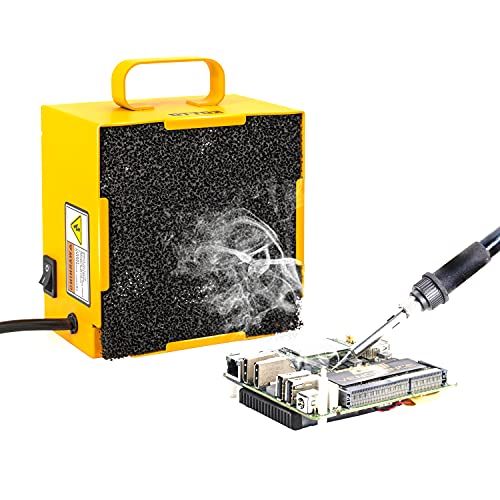
- 0.4-inch activated carbon filter
- 3000 RPM fan targets fumes 5-6 inches away
- Includes replacement filter and carrying handle
Best For: Small soldering benches and light DIY use
High-Capacity HEPA
FumeClear FC-2001A Solder Extractor

- True H13 HEPA and activated carbon filtration
- Brushless motor extends working range to 15 cm
- Filter life claimed to last 3 times longer
Best For: Regular soldering and users wanting stronger filtration
Budget Carbon Trap
KOTTO Black Desktop Fume Extractor
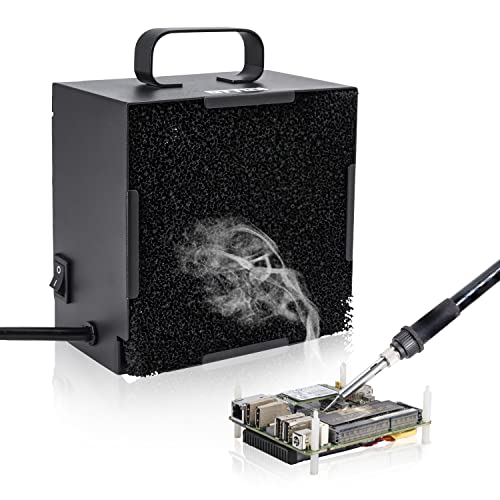
- 0.4-inch activated carbon filter
- 3000 RPM fan with low-noise positioning
- Includes replacement filter, handle, and rubber feet
Best For: Budget-minded hobbyists who want a compact extractor
Space-Saving HEPA
NT-M1 Adjustable Desktop Extractor
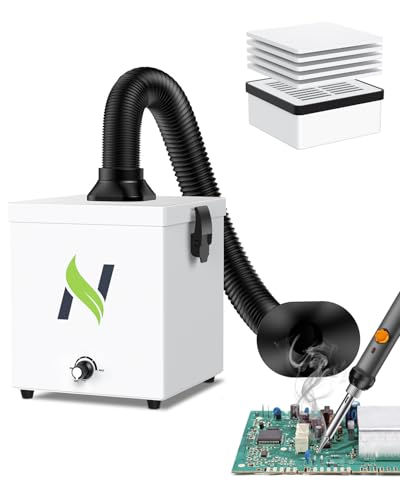
- Compact 5.1 x 5.1 x 6.3 inch design
- 168m³/h airflow with adjustable speed
- H13 HEPA, carbon powder, and 10mm pre-filter
Best For: Small workbenches and users who want adjustable suction
Compact Dual-Filter Desktop Extractor
YIHUA 948DQ-I with Tiltable Stand

- 8 filtration adsorbers for front and rear filtering
- 30° tiltable stand helps aim the intake
- Side fenders and 5-blade fan support steady extraction
Best For: small bench soldering and light wood burning
Portable Multi-Stage Option

- 3-stage filtration with HEPA and activated carbon
- Extendable hose supports flexible positioning
- Universal voltage works on 110V and 220V
Best For: precision soldering in compact workspaces
Desktop Extractor with Helping Hands

- Dual filtration with 8 adsorbers included
- Detachable helping hands hold PCBs or wires
- 30° tiltable stand supports close-range extraction
Best For: users who want smoke removal and part holding in one unit
Compact High-Suction Pick
KQZ W1 168m³/h HEPA Smoke Absorber

- 168 m³/h airflow for fast smoke capture
- H13 HEPA plus coal-based activated carbon
- Compact metal body with 360° gooseneck
Best For: Small soldering stations that need strong, flexible suction
Quiet Precision Choice
YC60 3-Stage Desktop Fume Extractor
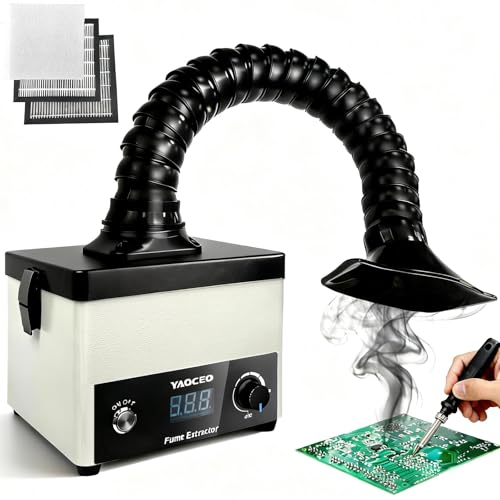
- 120-180 m³/h airflow with speed control
- 3-stage pre-filter, HEPA, and activated carbon
- Quiet sub-50 dB operation with digital display
Best For: Desktop users who want quiet, adjustable, long-life filtration
Best Adjustable Value
DX50 180 m³/h Desktop Smoke Absorber

- 180 m³/h airflow with 3 speed settings
- HEPA + carbon filter with 5 pre-filters
- 20-inch 360° gooseneck and side exhaust design
Best For: Light-duty soldering and PCB repair with easy airflow control
Compact Smoke Trap – KOTTO Yellow Desktop Fume Extractor
This KOTTO unit is a straightforward option in desktop solder fume extractors if you want basic smoke capture for a small bench. It uses a 0.4-inch activated carbon filter and a 3000 RPM fan to pull in solder, flux, and chemical fumes from about 5 to 6 inches away.
Best For: Hobby soldering stations and small workspaces that need a simple, portable smoke absorber.
Pros:
- Activated carbon filter helps absorb solder and flux fumes
- 3000 RPM fan is designed for low-noise operation
- Compact unit includes a carrying handle and non-slip rubber feet
- Comes with one replacement smoke trap filter
Cons:
- Works best when positioned close to the smoke source
- Basic design does not include HEPA filtration
For buyers who want an uncomplicated desktop extractor, this KOTTO model focuses on the essentials: carbon filtration, easy movement, and simple maintenance. It is a practical fit for light soldering work where portability matters more than advanced filtration.
High-Capacity HEPA – FumeClear FC-2001A Solder Extractor
Among desktop solder fume extractors, the FumeClear FC-2001A is built for users who want more filtration depth and stronger suction than a tiny fan-style unit. Its all-metal housing, True H13 HEPA filter, and activated carbon system are aimed at capturing solder fumes and reducing odor in the work area.
Best For: Soldering users who want HEPA-level filtration, wider working range, and longer filter life.
Pros:
- True H13 HEPA plus activated carbon filtration
- High-speed brushless motor extends effective working range to 15 cm
- Air purification capacity rated at 120-180m³/h
- Filter is designed to last 3 times longer than compact alternatives
Cons:
- Larger and heavier than compact desktop units
- Higher-capability design may be more than needed for very light use
This is a strong pick if you want a more serious desktop extractor with multi-stage filtration and broader coverage. The included pre-filters, main filter, hose, and hood make it a more complete setup for regular soldering work.
Budget Carbon Trap – KOTTO Black Desktop Fume Extractor
This black KOTTO model is a compact choice for buyers comparing desktop solder fume extractors on simple, bench-friendly features. It uses a 0.4-inch activated carbon filter and a 3000 RPM fan to absorb solder, flux, chemicals, and gases while helping keep fumes from spreading into the room.
Best For: Small soldering setups that want the same basic KOTTO design in a black finish.
Pros:
- Activated carbon filter captures solder-related fumes
- 3000 RPM fan is positioned as low-noise and effective nearby
- Includes a replacement smoke trap filter
- Rubber feet and carrying handle improve stability and portability
Cons:
- Small capture zone requires close positioning to the source
- Does not offer HEPA filtration
Functionally, this model mirrors the yellow KOTTO version and keeps the focus on portability and simple smoke absorption. It makes sense if you want a no-fuss extractor for occasional soldering without moving up to a larger filtration system.
Space-Saving HEPA – NT-M1 Adjustable Desktop Extractor
The NT-M1 is a compact pick among desktop solder fume extractors, especially if bench space is limited. It combines 168m³/h suction, H13 HEPA filtration, and a flexible hose so you can place the capture point where smoke is actually being generated.
Best For: Hobbyists and makers who need a small desktop extractor with adjustable suction and hose positioning.
Pros:
- Compact 5.1″ x 5.1″ x 6.3″ footprint and 3 lb weight
- 168m³/h airflow with adjustable speed control
- H13 HEPA plus carbon powder and 10mm pre-filter
- Flexible hose extends to 25.6 inches and bends 360°
Cons:
- Smaller size means it is aimed at everyday DIY use, not industrial jobs
- Flexible hose setup adds a bit more adjustment than fixed-nozzle units
This model stands out for blending portability with more refined filtration and control than a basic smoke trap. It is a good match for soldering, PCB repair, and other bench tasks where a compact but more capable extractor is useful.
Compact Dual-Filter Desktop Extractor – YIHUA 948DQ-I with Tiltable Stand
If you want a straightforward desktop solder fume extractor for small bench work, the YIHUA 948DQ-I focuses on the basics: dual filtration, a 5-blade fan, and a tiltable stand to help place the intake where fumes are concentrated. It’s aimed at soldering and wood burning tasks where keeping smoke closer to the source matters more than adding extras.
Best For: Hobbyists who want a compact, simple extractor with adjustable positioning for soldering or light wood burning.
Pros:
- Includes 8 filtration adsorbers for front and rear filtration.
- 30° tiltable stand helps adjust the filtering area.
- Side fenders help reduce disruptive airflow.
- 5-blade fan is designed for effective extraction with relatively lower noise.
Cons:
- Designed for 110-127V US-standard power only.
- Best performance is within about 10 cm of the smoke source.
- No hose or advanced multi-stage filter system.
Overall, this is a practical pick if you want an uncomplicated desktop unit with adjustable angle support and basic dual-stage filtering. It fits best on close-up work where the extractor can be positioned right near the fumes.
Portable Multi-Stage Option – FumeClear FC-2001S with Hose
The FumeClear FC-2001S is built for buyers who want a more portable desktop solder fume extractor with stronger filtration depth. Its compact body, extendable hose, and triple-layer system make it a good fit for precision soldering setups where you can place the nozzle directly at the smoke source.
Best For: Soldering enthusiasts who want a compact extractor with multi-stage filtration and flexible hose positioning.
Pros:
- 3-stage filtration combines pre-filter, H12 HEPA, and activated carbon.
- Compact design with airflow up to 128-168m³/h.
- Extendable hose gives more flexible layout options.
- Universal voltage design works in both 110V and 220V environments.
Cons:
- Best results require aligning the nozzle directly with the smoke source.
- Uses a small desktop form factor rather than a larger capture system.
- Sound level is listed at 55 dB.
This is a strong choice if you value filtration depth and layout flexibility over a basic fan-only setup. The hose and multi-stage filter stack make it especially useful for careful bench work in compact spaces.
Desktop Extractor with Helping Hands – YIHUA 948DQ-I Upgraded Style
This upgraded YIHUA 948DQ-I is a practical desktop solder fume extractor for people who want smoke removal plus a built-in way to hold small parts. It keeps the same dual-filter, tiltable design as the basic version, while adding detachable helping hands for more flexible soldering tasks.
Best For: Solderers who want a compact extractor with integrated helping hands for holding wires or PCBs.
Pros:
- Includes 8 filtration adsorbers for front and rear filtering.
- 30° tiltable stand helps direct extraction where needed.
- Detachable helping hands can hold PCBs or wires while soldering.
- Side fenders help reduce disruptive airflow around the work area.
Cons:
- Best suited to close-range fumes within about 10 cm.
- Requires 110-127V US-standard power.
- Helping hands may not be necessary if you already use a separate holder.
For bench users who want one compact tool to handle both fume capture and light workholding, this upgraded model makes sense. It stays focused on simple, near-source extraction while adding a useful soldering convenience.
Compact High-Suction Pick – KQZ W1 168m³/h HEPA Smoke Absorber
The KQZ W1 is a practical option for desktop solder fume extractors if you want strong suction in a compact metal body. Its 168 m³/h airflow, H13 HEPA filter, and coal-based activated carbon are aimed at capturing solder smoke, fine particles, dust, odors, and some chemical vapors while keeping the unit easy to position at a workbench.
Best For: Small workspaces, soldering, 3D printing, and light-duty bench work where a flexible gooseneck and strong filtration matter.
Pros:
- 168 m³/h airflow with instant suction for quick smoke capture
- Dual-layer filtration with 9mm pre-filter plus H13 HEPA and carbon media
- 66mm 360° adjustable gooseneck helps aim suction precisely
- Compact metal build is easy to carry and save space on the bench
Cons:
- Uses a DC power source, so it may not fit every setup
- Best suited to compact, light-duty use rather than heavier industrial work
Overall, the KQZ W1 is built for users who want a straightforward, space-saving smoke absorber with strong airflow and layered filtration. It balances portability with a more complete filter setup than basic fan-style units.
Quiet Precision Choice – YC60 3-Stage Desktop Fume Extractor
The YC60 is a strong fit for desktop solder fume extractors when you want adjustable suction and a more complete filtration stack. It combines 120 m³/h to 180 m³/h airflow, a 3-stage pre-filter/HEPA/carbon system, and a digital speed display to help keep fumes under control during soldering, welding, or other bench tasks.
Best For: Makers who want a metal-bodied extractor with quiet operation, wide voltage support, and longer-lasting filters.
Pros:
- Strong airflow up to 180 m³/h with speed control
- 3-stage filtration targets particles and gases down to 0.3 microns
- All-metal frame and brushless motor are built for durability
- Digital display and quiet sub-50 dB operation improve day-to-day use
Cons:
- Heavier than smaller compact desktop models
- Designed for desktop work, so it is not the most portable option
In practice, the YC60 stands out for users who want more control over suction and a filtration setup that is built to last longer. It is a well-rounded choice for bench work where comfort, visibility, and air quality all matter.
Best Adjustable Value – DX50 180 m³/h Desktop Smoke Absorber
The DX50 is a capable option among desktop solder fume extractors for users who want strong airflow and simple speed adjustment. With 180 m³/h suction, a HEPA plus activated carbon filter, and a 20-inch 360° gooseneck, it is designed to pull smoke away from the work area while keeping the hood positioned exactly where you need it.
Best For: Desktop soldering, PCB repair, jewelry soldering, and light-duty bench work that benefits from adjustable suction.
Pros:
- 180 m³/h airflow with 3 adjustable speeds
- HEPA + activated carbon filtration with 5 pre-filters
- 20-inch flexible gooseneck holds position for precise hood placement
- Side exhaust design helps maintain a stable suction path
Cons:
- Explicitly intended for light-duty desktop use, not high-volume laser engraving
- At 9.15 pounds, it is less lightweight than smaller units
The DX50 is a solid pick if you want a desktop smoke absorber with straightforward controls and strong benchmark-style specs. Its combination of airflow, filtration, and a flexible hose makes it practical for focused bench tasks.
How We Picked These Desktop Solder Fume Extractors
We looked for models that make sense on a real workbench: enough suction to capture smoke close to the source, filtration that helps with fine particles and odor, and a size that does not crowd your soldering area. We also considered filter availability, airflow controls, noise expectations, and features that improve day-to-day use, such as adjustable angles or integrated helpers.
Quick Comparison: What Matters Most
For Desktop Solder Fume Extractors, the best choice is rarely the one with the biggest spec sheet alone. Higher airflow can help, but only if the capture area is positioned well and the filter stack is suitable for the contaminants you create. If you solder occasionally, a simpler activated carbon unit may be enough. If you work longer sessions or handle denser smoke, look for H13 HEPA plus carbon filtration and stronger, adjustable suction.
Key Buying Factors for Desktop Solder Fume Extractors
Filtration Type
HEPA helps trap fine particulate, while activated carbon is useful for reducing odors and some fumes. A multi-stage design is often the most practical choice for general electronics soldering.
Airflow and Capture Range
Airflow ratings can be helpful, but placement matters just as much. A unit with adjustable direction or angle can capture smoke more effectively than a stronger fan aimed poorly.
Noise and Desk Footprint
Since these tools sit near your hands, compact size and tolerable noise are important. Choose the smallest unit that still offers enough pull for your typical soldering tasks.
Filter Maintenance
Replacement filters affect long-term cost and convenience. If you solder often, prioritize units with easy-to-source pre-filters and main filters so performance stays consistent.
Who Should Buy Which Desktop Solder Fume Extractors?
If you are a casual hobbyist, a straightforward desktop fume extractor with carbon filtration may be the most affordable fit. For frequent electronics work, choose one of the Desktop Solder Fume Extractors with HEPA plus carbon and adjustable airflow. If you also need stability for repairs, craft work, or hands-free positioning, look for models that add helping hands or tiltable support.
For most buyers, the best option is the one that captures smoke close to the solder joint, fits your bench, and uses filters you are willing to replace regularly. That combination will do more for comfort and cleanliness than chasing specs alone.