The best electronic loads make it easier to verify power supplies, measure battery capacity, and test USB equipment under controlled conditions. This roundup covers compact USB testers, programmable bench loads, and higher-power models for laboratory work.
Before choosing, compare voltage and current limits, power handling, operating modes, dynamic response, controls, and connectivity. The right model depends on whether you need portable discharge testing or repeatable engineering measurements.
Best 10 Electronic Loads Picks for 2026
Best USB Load Tester
Compact 25W Electronic Load Module
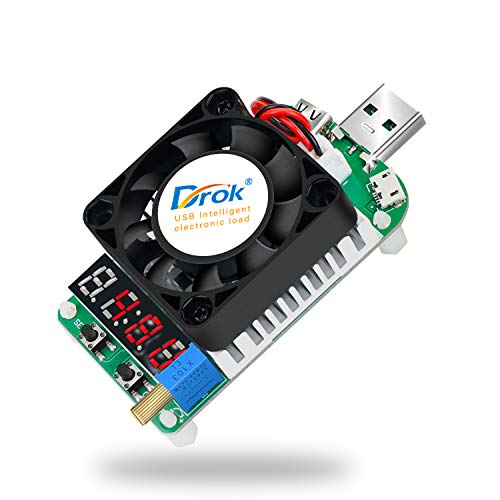
- 0.25A–4A adjustable constant-current testing
- Four-digit voltage, current, and power display
- Fan cooling plus multiple protection functions
Best For: USB and Type-C charger, cable, and small power-source testing
Best Programmable Bench Load
200W SDL1020X-E DC Electronic Load

- 150V/30A single-channel operating range
- Four static modes plus dynamic testing
- 100-step list function and adjustable rise time
Best For: Programmable power-supply and converter bench testing
Best High-Speed Lab Load
Rigol DL3021 200W Programmable Load

- 150V/40A/200W DC testing capability
- 15kHz dynamic mode with fast rise control
- LAN, USB, RS232, and SCPI remote control
Best For: R&D and automated transient-response testing
Compact Capacity Testing
Adjustable 5A Electronic Load Tester

- 5A, 35W adjustable constant-current load
- Displays and records discharge measurements
- Automatic capacity, time, and fan controls
Best For: Battery capacity testing and low-power discharge experiments
Connected Lab Testing
OWON OEL3020 Programmable DC Load

- 300V, 20A, and 300W operating range
- USB, RS232, RS485, and SCPI control
- 5kHz dynamic testing plus battery analysis
Best For: Automated lab testing and transient power-source characterization
High-Power Programmable Testing
ET5410A+ 400W Programmable DC Load

- Handles up to 150V, 40A, and 400W
- Six operating modes for varied DC tests
- USB control, dynamic testing, and battery analysis
Best For: Higher-power testing of supplies, chargers, batteries, and LED drivers
Precision Bench Pick
Ransanx EL15 150W Electronic Load

- 150W, 60V, 12A capacity with fine 1mV/1mA resolution
- CC, CV, and CP programmable modes
- Compact aluminum housing with dual cooling fans
Best For: Detailed battery and power-supply testing
High-Power Testing Choice
ET5410A+ 400W Electronic Load Tester
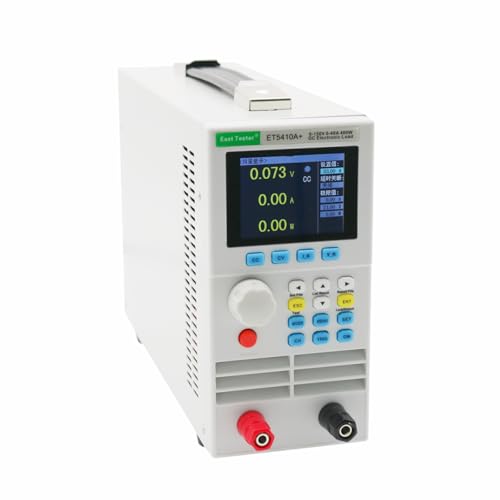
- Handles up to 150V, 40A, and 400W
- Six basic modes including CC+CV and CR+CR
- Adds battery, dynamic, scanning, list, and USB functions
Best For: High-current battery, charger, and power-supply testing
Best USB Load Tester – Compact 25W Electronic Load Module
If you need electronic loads for checking USB chargers, cables, or small power sources, this Drok module offers adjustable constant-current testing from 0.25A to 4A. Its four-digit display shows voltage, current, and power, while the temperature-controlled fan helps manage heat during testing.
Best For: USB and Type-C charger testing, cable checks, and compact discharge or aging-test setups.
Pros:
- Adjustable 0.25A–4A constant-current load with up to 25W and 25V capability.
- Displays voltage, current, and power on a four-digit LED screen.
- Includes overvoltage, overpower, and overtemperature protection with automatic fan control.
Cons:
- Its 25W, 25V, and 4A limits cannot be exceeded.
- There is no reverse-connection protection; incorrect polarity can permanently damage the unit.
This is a practical, specialized choice for low-voltage USB work rather than a general-purpose bench load. Its compact design and clear readout make routine charger and cable testing straightforward, provided polarity and operating limits are observed.
Best Programmable Bench Load – 200W SDL1020X-E DC Electronic Load
Siglent Technologies SDL1020X-E Programmable DC Electronic Load,1 Channel,150 V/30 A, 200 W
Check Price On AmazonFor lab users comparing electronic loads, the Siglent SDL1020X-E provides a higher-voltage, higher-power programmable platform than compact USB modules. It supports 150V, 30A, and up to 200W, along with static CC, CV, CR, and CP modes and dynamic testing.
Best For: Bench testing of power supplies, converters, and other DC sources that require programmable static or dynamic loads.
Pros:
- Supports up to 150V, 30A, and 200W on a single channel.
- Offers constant-current, constant-voltage, constant-resistance, and constant-power modes.
- Provides dynamic modes, 100-step list programming, and adjustable current rise time.
Cons:
- Its 15-pound weight and listed 19 x 14 x 9-inch dimensions make it less portable.
- It is a single-channel electronic load.
The SDL1020X-E is suited to structured bench work where programmable behavior matters. Its broad operating range and dynamic-mode support make it more capable than basic discharge testers, though its larger format is better for a stationary lab.
Best Battery Capacity Tester – 150W Color-Display Electronic Load
When evaluating electronic loads for battery work, this adjustable DC unit combines discharge testing with capacity monitoring. It handles up to 150W and 20A, and its 2.4-inch TFT display shows electrical values, capacity, internal resistance, operating mode, and protection settings.
Best For: Battery capacity and discharge testing where clear on-screen data and multiple load modes are useful.
Pros:
- Supports up to 150W and 20A for direct-current load testing.
- Provides constant-current, constant-voltage, constant-power, and constant-resistance modes.
- Allows stop-voltage and time-limit settings while displaying capacity and internal resistance.
Cons:
- Requires a 12V DC minimum operating voltage according to the supplied details.
- It is battery powered, which may be less convenient for fixed bench installations.
This model is a strong fit when battery capacity information is as important as applying a controlled load. The color display and configurable shutdown conditions make it more informative for discharge work than a simple constant-current module.
Best High-Speed Lab Load – Rigol DL3021 200W Programmable Load
The Rigol DL3021 is a capable choice among electronic loads for precision battery, power-supply, and transient-response testing. It supports 150V, 40A, and 200W, with CC, CV, CR, and CP modes, a 15kHz dynamic mode, and interfaces for automated control.
Best For: R&D labs and production test benches needing dynamic loading, visual monitoring, and programmable remote operation.
Pros:
- Supports constant-current, voltage, resistance, and power modes.
- Offers 15kHz dynamic testing with adjustable current rise speed up to 5A/µs.
- Includes a 4.3-inch TFT display, LAN, USB, RS232, SCPI support, and multiple protections.
Cons:
- Its listed weight is 7.34kg, so it is intended primarily for bench use.
- The supplied specifications list 150V and 200W limits, which must be respected.
With fast dynamic response and built-in remote-control interfaces, the DL3021 is designed for repeatable engineering workflows rather than casual testing. It is especially compelling when transient behavior and automated test integration are priorities.
Compact Capacity Testing – Adjustable 5A Electronic Load Tester
This compact option is a practical starting point for electronic loads used in battery discharge checks, capacity measurements, and basic component testing. It supports adjustable constant-current operation up to 5A and 35W, while displaying voltage, current, power, capacity, and discharge time.
Best For: Battery capacity testing, unattended discharge experiments, and makers who need an affordable benchtop load module.
Pros:
- Displays current, voltage, power, capacity, and discharge time.
- Automatically records discharge capacity and duration.
- Supports maximum capacity and time limits for unattended testing.
- Temperature-controlled fan starts automatically above specified heat or power thresholds.
Cons:
- 35W and 5A limits make it less suitable for higher-power sources.
- It is a corded unit rather than a portable battery-powered tester.
- Its feature set is more focused on basic capacity testing than programmable automation.
Choose this model when straightforward battery discharge data matters more than high power or advanced computer control. The automatic limits and fan add convenience for longer tests.
Connected Lab Testing – OWON OEL3020 Programmable DC Load
The OWON OEL3020 is a versatile choice for electronic loads in development labs and automated test setups. It handles up to 300V, 20A, and 300W, with USB, RS232, and RS485 connectivity, four operating modes, and dynamic testing up to 5kHz.
Best For: Engineers testing power supplies, batteries, and components who need programmable control, transient testing, and PC-based data collection.
Pros:
- Supports constant current, constant voltage, constant resistance, and constant power modes.
- Provides USB, RS232, and RS485 connectivity with SCPI support.
- Offers Level A/B dynamic testing up to 5kHz with adjustable current rise rate.
- Includes battery charge/discharge testing and multiple protective functions.
Cons:
- Its 300W and 20A ratings may not cover higher-current applications.
- PC automation features may be more than casual users need.
- Operation is limited by a stated minimum operating point of 0.9V at 20A.
This is the strongest fit of the three for repeatable lab workflows and automated characterization. Its broad interfaces and dynamic mode make it more capable than a basic manual load, especially when transient behavior matters.
High-Power Programmable Testing – ET5410A+ 400W Programmable DC Load
The ET5410A+ is designed for electronic loads that need more power and flexible test sequences. Its single-channel design supports up to 150V, 40A, and 400W, with six load modes, dynamic and battery testing, a TFT display, and USB control.
Best For: Testing DC power supplies, chargers, batteries, LED drivers, and other equipment requiring up to 400W of programmable loading.
Pros:
- Provides a higher 400W load capacity with up to 150V and 40A input.
- Offers CC, CV, CR, CP, CC+CV, and CR+CV modes.
- Includes dynamic, scan, list, short-circuit, and battery test functions.
- Supports USB control, external triggering, and battery capacity measurements up to 9999Ah.
Cons:
- It is a single-channel tester.
- Its 150V maximum input is lower than the OWON model’s 300V rating.
- The larger capability may be unnecessary for simple low-power battery checks.
Consider this model when current and wattage headroom are priorities. It combines broad operating modes with battery and dynamic testing, making it a capable middle ground between basic loads and more specialized high-end equipment.
Precision Bench Pick – Ransanx EL15 150W Electronic Load
The Ransanx EL15 is a compact choice among electronic loads for users who need fine control during battery capacity testing, power-supply characterization, and component evaluation. Its 150W, 60V, and 12A ratings, combined with 1mV/1mA resolution, support detailed bench measurements.
Best For: Lab and hobbyist work requiring programmable CC, CV, and CP testing with live readings.
Pros:
- Offers 150W, 60V, and 12A capacity with 1mV/1mA resolution.
- Supports constant current, constant voltage, and constant power modes.
- Includes a 1.9-inch LCD, list-mode programming, 4mm banana sockets, and XT30 plugs.
- Aluminum housing and dual cooling fans support continuous operation.
Cons:
- Its 12A and 150W limits may not suit higher-power testing.
- It does not list constant-resistance mode among the supplied features.
Choose the EL15 when measurement resolution and a portable, durable design matter more than maximum current or power capacity.
Versatile Desktop Value – DH-801 120W Programmable Electronic Load
The DH-801 is a practical desktop option among electronic loads, covering a broad voltage range for batteries, power supplies, and DC sources. It handles up to 150V and 20A, with 120W maximum power and built-in timing for amp-hour and watt-hour measurements.
Best For: Desktop users who want multiple load modes and straightforward front-panel operation.
Pros:
- Supports CC, CV, CR, CP, and short-circuit testing modes.
- Covers 0–150V, 0–20A, and 0.1–999.9 ohms.
- Integral timing measures watt-hours and amp-hours for battery testing.
- LED display, dedicated buttons, adjustment knobs, and included test cables simplify operation.
Cons:
- Maximum power is 120W, lower than some higher-capacity electronic loads.
- Its upper temperature rating is listed as 40°C.
The DH-801 stands out for mode flexibility and its 150V input range, making it a sensible fit for varied desktop testing where 120W is sufficient.
High-Power Testing Choice – ET5410A+ 400W Electronic Load Tester
The ET5410A+ is the high-capacity option in this group of electronic loads, rated for up to 400W, 150V, and 40A. Its large TFT display and broad selection of measurement and function modes make it suited to more involved battery, charger, and power-supply testing.
Best For: Users testing higher-current DC sources, batteries, chargers, and switching or linear power supplies.
Pros:
- Provides 0–150V, 0–40A, and 0–400W operating capacity.
- Offers CC, CV, CR, CP, CC+CV, and CR+CR modes.
- Includes battery, LED, dynamic, scanning, list, and internal-resistance testing functions.
- Features a 2.8-inch TFT screen, USB port, and protection functions.
Cons:
- At 2.8 kg, it is less portable than compact electronic loads.
- The supplied notes do not specify included accessories.
If your testing requires substantially more current and power than a small bench load can provide, the ET5410A+ offers the broadest capacity and function set here.
How We Picked These Electronic Loads
We focused on the specifications that most affect real-world testing: maximum voltage, current, and wattage; constant-current accuracy; available operating modes; display and controls; dynamic-load performance; cooling; and computer connectivity. The selection spans compact USB load testers, midrange programmable DC loads, and higher-power units for power-supply development or battery-capacity work.
Because product configurations and listings can vary, confirm the exact model, included cables, software support, and safety protections before ordering. A load should never be operated beyond its stated voltage, current, or power limits.
Quick Comparison
| Best For | What to Prioritize | Typical Choice |
|---|---|---|
| USB and portable testing | USB-C support, adjustable current, compact cooling | Small 25W or 35W load tester |
| Bench power supplies | Programmable modes, clear display, protection features | 120W–200W programmable DC load |
| Battery capacity testing | Stable constant current, logging, thermal management | 150W–300W electronic load |
| Power-supply development | High wattage, dynamic response, remote control | 300W–400W programmable load |
Key Buying Factors for Electronic Loads
Voltage, Current, and Power Limits
Check all three ratings rather than relying on wattage alone. A 200W unit may support high current only at lower voltages, while its maximum voltage may be available at a much smaller current. Leave thermal headroom for continuous testing.
Operating Modes
Constant current is useful for batteries and basic supply checks. Constant resistance, constant voltage, and constant power modes provide more realistic tests for different circuits. Some models combine these modes with programmable ramps or timed shutdowns.
Dynamic Performance and Cooling
For transient testing, look for a specified dynamic response, switching frequency, and adjustable slew rate. Fans and heatsinks matter during long tests; confirm that the noise level and ventilation requirements suit your workspace.
Controls, Measurement, and Connectivity
A readable display and responsive knobs simplify manual testing. USB, RS-232, or other computer interfaces are valuable for automated test sequences, data logging, and repeatable battery measurements. Also look for overvoltage, overcurrent, overpower, overtemperature, and reverse-polarity protection.
Who Should Buy Which Electronic Loads?
Choose a compact USB load if you mainly test chargers, power banks, USB-C sources, or small batteries. A 120W–200W programmable model is a better all-purpose bench choice for electronics hobbyists and technicians working with adapters and DC supplies. For frequent battery-capacity testing or higher-output supplies, step up to a 300W–400W unit with stronger cooling and computer control. Engineers validating fast-changing power supplies should prioritize programmable dynamic operation and documented transient specifications over a simple high-wattage rating.