Choosing the right hot air rework station can make PCB repair, component removal, and SMD soldering faster and more controlled. Digital controls, stable heat, adjustable airflow, and useful accessories all affect how confidently you can work.
We compare 10 digital hot air rework stations across power, temperature range, controls, safety features, included tools, and overall versatility so you can match a station to your repair bench and experience level.
Best 10 Digital Hot Air Rework Stations Picks for 2026
High-Power Preset Pick
YIHUA 959D Digital Hot Air Rework Station

- 120L airflow and temperatures up to 932°F
- Three preset channels for repeatable settings
- Includes mat, tweezers, and three nozzles
Best For: High-airflow standalone rework
Complete 2-in-1 Kit
WEP 882D SMD Hot Air Rework Station

- Combines soldering iron and hot air functions
- PID control with variable hot air volume
- Includes tips, nozzles, solder, and hand tools
Best For: Compact all-in-one electronics work
Multi-Function Workshop Choice
Aoyue 968A+ SMD Rework Station
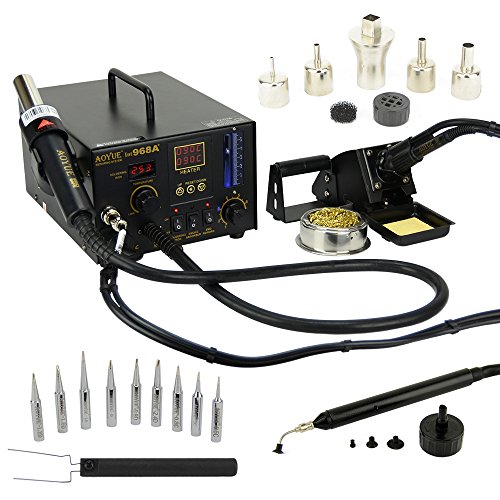
- Four functions in one station
- Includes a 70W soldering iron
- Adds vacuum pickup and smoke absorption
Best For: Multi-function repair workbenches
Precision Dual-System Pick

- Combines hot air and soldering functions
- PID control with dual displays
- Includes 10 tips and four hot air nozzles
Best For: Precise combined soldering and rework
Fast-Heating Pick
LRT 858D 700W Digital Hot Air Rework Station

- 700W heating for quick heat-up and recovery
- LED display with adjustable temperature and airflow
- Brushless fan and compact ergonomic design
Best For: PCB, SMD, USB-C, and mobile-device repair
All-in-One Choice
YIHUA 862BD+ 2-in-1 Rework Station
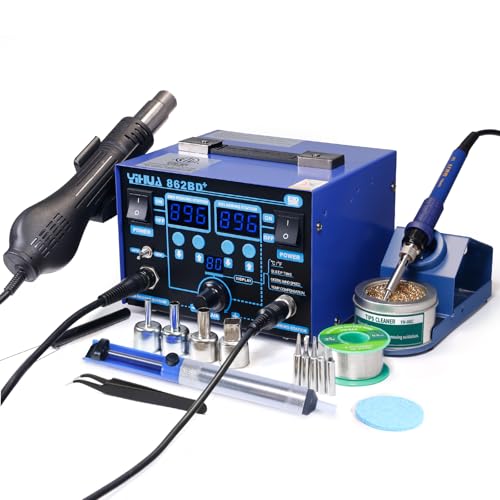
- Combines hot-air rework with a 75W soldering station
- PID control with three digital displays
- Includes nozzles, tips, solder, tweezers, and repair tools
Best For: Multi-purpose PCB repair and soldering work
Preset-Control Pick
WEP 2009D-II Digital Hot Air Rework Station

- Four preset channels for faster setting changes
- PID stabilization with adjustable air volume from 1 to 10
- Detachable gun, auto standby, and cool-air mode
Best For: Repeatable PCB repair and dedicated electronics workbenches
Compact Precision Pick
LRT 8858 Digital Hot Air Rework Station

- 100°C–500°C digital temperature control
- F1–F10 adjustable airflow
- Six nozzles plus tweezers and IC extractor
Best For: Compact electronics repair benches and mobile technicians
Fast-Heating Workhorse
WEP 858D Hot Air Rework Station
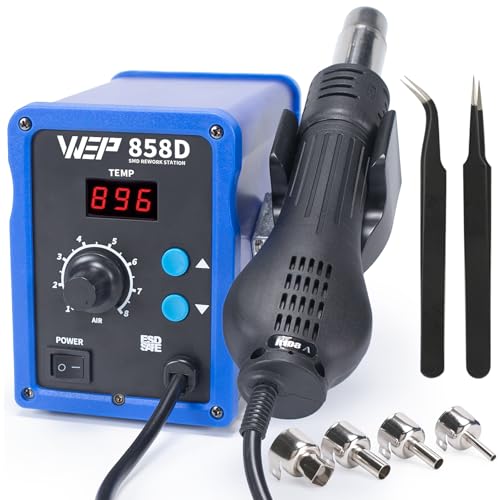
- 700W ceramic heating with PID stabilization
- 212°F–896°F adjustable temperature range
- Automatic standby cooling and four nozzles
Best For: SMD rework users adding hot air to an existing soldering setup
Complete Safety-Focused Kit
GOORY 8858-V Digital Rework Station

- PID-controlled 700W ceramic heating core
- °F/°C display with temperature calibration
- Includes pump, tweezers, four nozzles, and holder
Best For: Organized phone repair and electronics work, especially for beginners
High-Power Preset Pick – YIHUA 959D Digital Hot Air Rework Station
The YIHUA 959D is a practical choice for users comparing digital hot air rework stations with strong airflow and repeatable settings. It heats quickly, reaches up to 932°F, and lets you save three frequently used temperature and airflow configurations.
Best For: Electronics rework that benefits from high airflow, quick heating, and preset temperature channels.
Pros:
- 120L airflow output and a maximum stabilized temperature of 932°F.
- Three preset channels make it easier to switch between commonly used settings.
- In-holder standby cooling and a hot air gun fail-safe function add practical protection.
- Includes a silicone work mat, ESD-safe tweezers, and three hot air nozzles.
Cons:
- Designed for 110–127V US-standard power, so it is not suitable for direct 220V use.
- Its 18°F listed temperature stability is less precise than some competing models in this roundup.
Choose this station when airflow capacity and convenient presets matter more than having an integrated soldering iron. Its durable brushed-aluminum control panel and included accessories make it a well-equipped standalone hot air option.
Complete 2-in-1 Kit – WEP 882D SMD Hot Air Rework Station
The WEP 882D combines a soldering iron and hot air tool in one compact unit, making it a versatile entry point among digital hot air rework stations. Independent displays and controls let you adjust the iron and hot air temperatures separately while the included accessories support common electronics tasks.
Best For: Users who want soldering and hot air rework in one compact, accessory-rich station.
Pros:
- Combines a soldering station with a variable-airflow hot air rework station.
- PID temperature control covers 212–896°F for hot air and 392–896°F for the iron.
- Includes two solder spools, five tips, three nozzles, tweezers, a tip cleaner, and a desoldering pump.
- Sleep, standby, automatic shutdown, Celsius/Fahrenheit conversion, and calibration functions are built in.
Cons:
- Rated for 110–127V US specifications and should not be connected to a 220V socket.
- With one listed channel, it lacks the multi-preset convenience of the YIHUA 959D.
For buyers who need both contact soldering and hot air work without purchasing two stations, the WEP 882D is an efficient package. Its broad accessory set also means less additional setup for basic repair projects.
Multi-Function Workshop Choice – Aoyue 968A+ SMD Rework Station
The New Aoyue 968A+ stands out among digital hot air rework stations by combining four functions in one base unit. Along with hot air, it provides a 70-watt soldering iron, vacuum pickup, and smoke absorption for a broader repair workflow.
Best For: Workbenches that need hot air, soldering, vacuum pickup, and smoke absorption from one station.
Pros:
- Four-in-one design combines hot air, soldering, vacuum pickup, and smoke absorption.
- Includes a 70-watt soldering iron function.
- Provides a wider set of integrated capabilities than a standalone hot air station.
- Uses a 110V configuration and includes a one-year manufacturer warranty description.
Cons:
- The supplied information does not specify temperature ranges, airflow output, or included nozzles and tips.
- At 11 pounds, it is substantially heavier than the other listed stations.
- The listing identifies one channel, so there are no documented multiple preset channels.
The Aoyue 968A+ is best considered when integrated workshop functions are more important than detailed temperature and accessory specifications. Buyers who need precise published hot air performance data may prefer a model with clearer operating figures.
Precision Dual-System Pick – YIHUA 8786D I Rework Station
The YIHUA 8786D I is a dual-system option for shoppers seeking digital hot air rework stations with a soldering iron included. Its PID temperature control, dual displays, ESD-safe design, and hot air fail-safe protection support controlled electronics repair work.
Best For: Component rework requiring a combined soldering and hot air station with precise temperature monitoring.
Pros:
- Combines hot air rework and soldering with separate displays and power switches.
- PID control monitors and corrects actual temperatures for fast compensation.
- Hot air protection can sound an alarm and cut heater power if airflow stops unexpectedly.
- Includes 10 soldering tips, four hot air nozzles, an IC extractor, pump, and lead-free solder.
Cons:
- Designed for 110–127V US-standard power.
- The listed hot air temperature range starts at 200°C, rather than the lower 212°F starting point listed for the WEP 882D.
- Only one channel is specified, so it does not offer documented preset memory channels.
This YIHUA model is a strong fit for users who value temperature regulation and safety features alongside dual-function capability. Its generous selection of tips and nozzles makes it especially convenient for varied soldering and component-removal tasks.
Fast-Heating Pick – LRT 858D 700W Digital Hot Air Rework Station
The LRT 858D is a practical choice for shoppers comparing digital hot air rework stations for PCB, SMD, and general electronics repair. Its 700W heating system, LED display, and adjustable temperature and airflow controls are suited to tasks such as IC removal, USB-C port replacement, and mobile-device repair.
Best For: SMD repair, PCB work, DIY electronics, and repair benches that need fast heating in a compact station.
Pros:
- 700W system supports rapid heat-up and temperature recovery.
- LED display with adjustable temperature and airflow settings.
- Brushless fan is designed for stable, quieter airflow and longer service life.
- Compact design and ergonomic hot air handle support extended repair sessions.
Cons:
- It is a hot-air-only station rather than a combined soldering-iron and hot-air unit.
- The single-channel design offers fewer dedicated presets than some multi-function stations.
- Its 110V specification is intended for compatible US-style power supplies.
Choose the LRT 858D if straightforward hot-air performance and quick heating matter more than integrated soldering tools or preset-channel convenience.
All-in-One Choice – YIHUA 862BD+ 2-in-1 Rework Station
The YIHUA 862BD+ stands out among digital hot air rework stations by combining hot-air rework with a soldering iron in one ESD-safe setup. PID temperature control, dual-core stabilization, multiple displays, and a broad accessory package make it a versatile option for electronics repair and soldering work.
Best For: Users who want one station for hot-air rework, soldering, desoldering, and routine PCB work.
Pros:
- 2-in-1 design combines a hot-air station and 75W soldering station.
- PID control and dual-core processing support stable soldering-iron temperature.
- Three digital displays show soldering temperature, hot-air temperature, and simulated air volume.
- Includes nozzles, solder, tips, tweezers, desoldering pump, holder, and other accessories.
Cons:
- The combined design is larger and heavier than a basic hot-air-only station.
- Its 110–127V US-standard power specification limits use with incompatible outlets.
- The extensive accessory set may be more than needed for simple hot-air repairs.
The YIHUA 862BD+ is the stronger fit when flexibility and included tools are priorities, especially for users who regularly alternate between component rework and conventional soldering.
Preset-Control Pick – WEP 2009D-II Digital Hot Air Rework Station
The WEP 2009D-II is one of the more workflow-focused digital hot air rework stations, offering four preset channels, PID temperature stabilization, adjustable air volume, and an auto-standby function. It is designed for repeatable repair work where quick setting changes and controlled cooldown are useful.
Best For: Repair users who handle recurring jobs and want preset temperatures, adjustable airflow, and replaceable hot-air components.
Pros:
- Four preset channels speed up changes between commonly used settings.
- PID control, digital calibration, and adjustable air volume from 1 to 10 support controlled rework.
- Detachable hot-air gun can be replaced without replacing the complete station.
- Auto-standby cooling, cool-air mode, and Fahrenheit/Celsius conversion add operating convenience.
Cons:
- The package includes three nozzles but does not list a soldering iron.
- Users must ensure the power cord is fully inserted for the unit to power on.
- The 110–127V rating is intended for USA specifications and should not be connected to 220V.
Consider the WEP 2009D-II if repeatable settings and serviceability are more valuable than an integrated soldering station, particularly for a dedicated repair bench.
Compact Precision Pick – LRT 8858 Digital Hot Air Rework Station
The LRT 8858 is a compact choice among digital hot air rework stations for SMD repair, PCB work, and heat-shrink applications. Its 100°C–500°C temperature range, LED display, adjustable F1–F10 airflow, and 680-watt output provide useful control for varied bench tasks.
Best For: Repair benches, mobile technicians, and users who want a compact station with a broad temperature range and included accessories.
Pros:
- Adjustable 100°C–500°C temperature range with digital LED display.
- F1–F10 airflow adjustment supports chip removal, rework, and heat-shrink jobs.
- Automatic cooling and sleep behavior helps protect the tool when placed in its holder.
- Includes six nozzles, two anti-static tweezers, an IC extractor, and a stand.
Cons:
- The station has a single channel.
- Its 110-volt specification may not suit outlets outside the intended electrical system.
Choose the LRT 8858 when workspace efficiency and accessory coverage matter. Its compact 0.7-kilogram design is convenient, while the adjustable airflow and wide temperature range support more than one type of electronics repair.
Fast-Heating Workhorse – WEP 858D Hot Air Rework Station
The WEP 858D is one of the digital hot air rework stations to consider when quick heat-up and temperature consistency are priorities. Its 700-watt ceramic heating element, PID stabilization, adjustable air volume, and 212°F–896°F range cover SMD rework, coating removal, and heat-shrink work.
Best For: Electronics hobbyists and repair technicians who already have a soldering station and need dependable hot-air capability.
Pros:
- PID temperature stabilization is designed to compensate quickly and maintain the set temperature.
- Cylindrical ceramic heating element is intended to provide consistent heating.
- Automatic standby cooling begins when the gun is returned to its holder.
- Includes four hot-air nozzles and one year of USA technical support.
Cons:
- The temperature range is specified in Fahrenheit as 212°F–896°F.
- The 110–127V USA-rated unit should not be connected to a 220V outlet.
- At 1.59 kilograms, it is heavier than the other listed options.
The WEP 858D makes a practical addition to an existing soldering setup. Its PID control and automatic standby function are useful for repeated SMD work, while the included nozzle sizes provide flexibility for different component dimensions.
Complete Safety-Focused Kit – GOORY 8858-V Digital Rework Station
The GOORY 8858-V combines a compact design with PID control, adjustable temperature and airflow, and a switchable °F/°C display. Among digital hot air rework stations, it stands out for its organized nozzle storage and broad accessory package for phone repair, SMD work, and general electronics servicing.
Best For: Beginners and repair technicians who want a compact, organized kit with calibration, standby cooling, and multiple accessories.
Pros:
- PID-controlled 700-watt ceramic core supports temperature control from 212°F–896°F.
- Dedicated knobs and °F/°C display make temperature and airflow adjustments straightforward.
- Automatic standby activates cooling and stops airflow when the gun is returned to the holder.
- Includes four nozzles, a desoldering pump, two ESD tweezers, and a nozzle holder.
Cons:
- The 110–127V specification is not intended for 220V outlets.
- The kit has a single channel.
The GOORY 8858-V is a strong all-in-one option for users who value convenience and organization. Its calibration function, compact 0.68-kilogram body, ETL listing, and flame-retardant handle add practical appeal for regular electronics and phone-repair work.
How We Picked the Best Digital Hot Air Rework Stations
We evaluated these stations by focusing on the features that matter during real SMD repair: temperature adjustment, airflow control, display readability, heat-up behavior, preset or memory functions, ergonomic design, and included nozzles or soldering accessories. We also considered whether each model combines hot air with a soldering iron, supports both Fahrenheit and Celsius, and includes practical protections such as auto standby, ESD-safe construction, or cool-down functions.
Specifications can vary by seller and production revision, so confirm the listed voltage, temperature range, included accessories, and warranty before ordering.
Quick Comparison
| Feature | Why It Matters |
|---|---|
| Temperature control | Helps protect pads, boards, and heat-sensitive components. |
| Adjustable airflow | Lets you use gentler air for small components and stronger flow for larger parts. |
| Digital display | Makes settings easier to repeat than a basic analog dial. |
| Combination station | Adds a soldering iron for desoldering, rework, and general bench work. |
| Presets or memory | Speeds up repeated jobs with commonly used settings. |
Key Buying Factors for Digital Hot Air Rework Stations
Temperature Range and Stability
A broad range is useful, but stable heat is more important than a high maximum number. Look for responsive digital controls and a display that is easy to read while working. PID-style regulation can help reduce temperature swings, particularly on delicate boards.
Airflow Control and Nozzle Selection
Adjustable airflow gives you better control over how heat reaches the board. Excessive airflow can move nearby components or spread heat unnecessarily. Multiple nozzle sizes are valuable because they let you focus heat on a small IC or cover a wider component evenly.
Station Format and Accessories
A 2-in-1 station is a practical choice if you also perform conventional soldering. Check the iron’s tip compatibility, included tips, handle design, and whether the hot air gun has a stable holder. Extra solder, brass wool, and spare nozzles add convenience but should not outweigh performance and safety.
Safety, Power, and Workspace Fit
Verify that the station matches your local voltage and has enough power for your typical work. ESD-safe features are especially helpful around sensitive electronics. Auto-cool, standby, and shutoff functions can reduce heat exposure and make the station safer between jobs. Also check the unit’s footprint and cable length for your bench.
Who Should Buy Which Digital Hot Air Rework Stations?
Choose a compact digital heat gun if you mainly need occasional component removal or light hobby repairs and already own a separate soldering iron.
Choose a 2-in-1 station if you repair boards regularly and want one bench unit for hot air and iron soldering. These models generally offer the best versatility for hobbyists, students, and electronics technicians.
Choose memory presets or advanced controls if you repeat the same repair jobs. Preset channels can shorten setup time and improve consistency across batches.
Prioritize ESD protection and precise regulation if you work on sensitive components or expensive boards. Regardless of model, practice on scrap hardware first, use suitable airflow, and protect nearby components from unnecessary heat.