The best 3D printers in 2026 make it easier to move from a digital model to a reliable physical part. This roundup covers approachable starter machines, fast enclosed printers, and multicolor systems for creative projects.
Use the buying guide below to compare setup, speed, materials, automation, and long-term value before choosing the printer that fits your workspace and goals.
Best 10 3d Printers Picks for 2026
Best Beginner 3D Printer

- Automatic calibration simplifies setup
- Quiet, fast, and precise FDM printing
- Optional multicolor printing with AMS lite
Best For: Beginners, families, and everyday makers
Best High-Speed 3D Printer

- Up to 600 mm/s printing speed
- Automatic leveling and quick nozzle changes
- Remote monitoring through Flash Studio
Best For: Rapid prototyping and frequent printing
Best Enclosed 3D Printer

- Enclosed design for advanced filaments
- Fast printing with automatic bed leveling
- Optional multicolor support with Bambu Lab AMS
Best For: Makers seeking enclosed, versatile FDM printing
Best Multicolor 3D Printer
ELEGOO Centauri Carbon 2 Combo
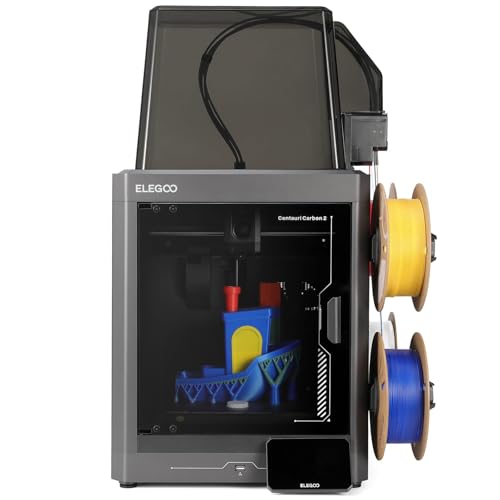
- Integrated four-color CANVAS printing
- Automated calibration and filament monitoring
- Up to 500 mm/s CoreXY performance
Best For: Multicolor projects and versatile material printing
Best Beginner Pick

- Fully assembled and designed to start printing quickly
- Auto leveling with WiFi and TF card printing
- Compact size with beginner-focused learning tools
Best For: Beginners, families, STEM learning, and small projects
Best Multi-Color Starter
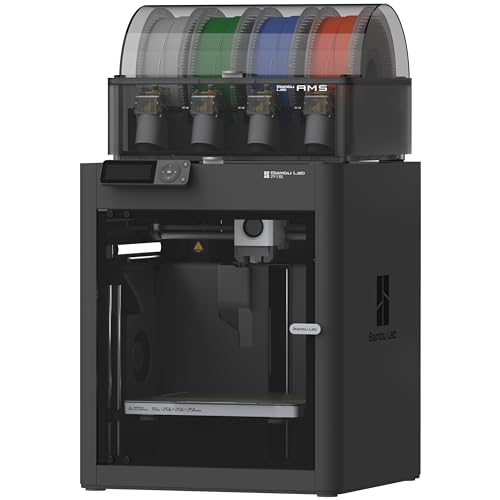
- AMS enables multi-color and multi-material printing
- Up to 500 mm/s printing with automatic bed leveling
- Enclosed design supports a range of filaments
Best For: Fast multi-color projects and enclosed printing
Best Large-Format Combo

- 260 × 260 × 260 mm build volume
- CFS enables four colors and can expand to 16
- AI camera, auto leveling, and 600 mm/s speed
Best For: Larger projects, multi-color work, and advanced makers
Best Multi-Material Pick

- Four independent toolheads with 5-second changes
- Supports multi-color and mixed-material printing
- 500 mm/s CoreXY printing with automatic calibration
Best For: Makers and professionals printing functional, multi-material parts
Best Compact Speed Value

- Up to 600 mm/s CoreXY printing
- Four-color support with automatic filament handling
- One-click leveling and 300°C direct-drive extruder
Best For: Fast, convenient multi-color prototyping in a compact footprint
Best Smart Enclosed Workflow

- Up to 600 mm/s with flowrate compensation
- AMS 2 Pro enables multi-color printing and filament drying
- AI detection and automatic calibration simplify printing
Best For: Users wanting an automated, connected multi-color workflow
Best Beginner 3D Printer – Bambu Lab A1
The Bambu Lab A1 is a ready-to-use choice for beginners and kids who want capable 3d printers without a complicated setup. Automatic calibration, active flow rate compensation, and quiet operation make it practical for everyday projects.
Best For: Beginners, families, and makers who want easy, quiet FDM printing with optional multicolor capability.
Pros:
- Automatic calibration handles Z-offset and bed leveling.
- Fast, precise printing with up to 10,000 mm/s² acceleration.
- Quiet operation, a simplified touchscreen, and a quick-swap nozzle.
- Supports multicolor printing when paired with AMS lite.
Cons:
- AMS lite is required for multicolor printing and may need to be purchased separately.
The A1 is a strong entry point for users who value convenience over manual tuning. Its automated setup and maintenance features help keep the learning curve manageable.
Best High-Speed 3D Printer – FLASHFORGE Adventurer 5M
The FLASHFORGE Adventurer 5M is built for users who want high-speed 3d printers with a hands-off workflow. Its CoreXY structure, automatic leveling, direct-drive extruder, and remote monitoring features suit rapid prototyping and frequent printing.
Best For: Makers and small production workflows that prioritize speed, automatic leveling, and remote monitoring.
Pros:
- Print speeds reach up to 600 mm/s with 20,000 mm/s² acceleration.
- Automatic bed leveling helps produce consistent first layers.
- Quick three-second nozzle changes and a fast warm-up to 200°C.
- Remote monitoring and alerts are available through Flash Studio.
Cons:
- Multicolor printing is not identified among the supplied features.
- The standard print area is limited to 220 x 220 x 220 mm.
This model emphasizes production efficiency, combining rapid motion with practical maintenance features. It is a particularly sensible fit when reducing print time matters more than a larger build volume.
Best Enclosed 3D Printer – Bambu Lab P1S
The Bambu Lab P1S is an enclosed FDM option for shoppers comparing versatile 3d printers. It combines fast printing, automatic bed leveling, and a setup designed to take about 15 minutes, while the enclosure improves performance with advanced filaments.
Best For: Makers who want fast enclosed printing and the option to add multicolor or multimaterial capability.
Pros:
- Enclosed design supports printing with advanced filaments.
- Up to 500 mm/s speed and 20,000 mm/s² acceleration.
- Automatic bed leveling helps simplify successful prints.
- Supports a range of materials including PLA, PETG, TPU, PVA, PET, ABS, ASA, PA, and PC.
Cons:
- Bambu Lab AMS is required for multicolor or multimaterial printing.
- Carbon- or glass-fiber-reinforced polymer is not recommended.
The P1S is a balanced choice for users who want speed without giving up an enclosed build design. Its material range is broad, but the recommended filament guidance should be checked before choosing specialty composites.
Best Multicolor 3D Printer – ELEGOO Centauri Carbon 2 Combo
The ELEGOO Centauri Carbon 2 Combo is a multicolor-focused option among modern 3d printers. Its CANVAS system supports four-color printing, while automated calibration, material controls, and vibration compensation aim to make complex projects easier to manage.
Best For: Makers who want automated four-color printing alongside broad material versatility and high-speed CoreXY performance.
Pros:
- CANVAS enables four-color printing with instant switching and smart filament detection.
- Auto refill and tangle detection help support uninterrupted multicolor printing.
- Fully automated calibration and monitoring simplify operation.
- Reaches up to 500 mm/s with 20,000 mm/s² acceleration.
Cons:
- The combo’s larger footprint and 42.6-pound weight may require dedicated space.
- The supplied notes do not specify the print volume or supported filament list.
The Centauri Carbon 2 Combo stands out for shoppers who want multicolor printing integrated into the package. Its automation and CoreXY design make it appealing for users who want speed and color flexibility with less manual intervention.
Best Beginner Pick – Tina2C Mini 3D Printer
If you are shopping for 3d printers that are easy to start with, the Entina Tina2C emphasizes guided setup, compact dimensions, and beginner-friendly controls. It is fully assembled, supports app and WiFi printing, and can reportedly be ready to print in as little as eight minutes.
Best For: Beginners, families, STEM learning, and small home projects.
Pros:
- Fully assembled design with guided setup through the Poloprint Cloud app.
- Auto leveling, power-loss recovery, and a flexible magnetic build plate simplify printing.
- Compact 3.9 × 3.9 × 3.9-inch print volume suits small creative projects.
- Offers WiFi and TF card printing, plus access to a 3,500-plus model library and creative modules.
Cons:
- The small build volume limits the size of projects you can print.
- Its beginner-focused feature set may be less suitable for advanced, larger-scale work.
The Tina2C is a practical entry point among 3d printers, particularly if simple setup, quiet home operation, and educational features matter more than large prints.
Best Multi-Color Starter – Bambu Lab P1S Combo
The Bambu Lab P1S Combo is a strong option for shoppers comparing 3d printers with fast printing and enclosed multi-color capability. Its included AMS supports multi-color or multi-material workflows, while automatic bed leveling and a 15-minute setup are aimed at reducing hands-on preparation.
Best For: Creators who want high-speed printing, an enclosed machine, and multi-color projects.
Pros:
- Supports up to 16 colors when connected to Bambu Lab AMS units.
- High-speed printing rated at up to 500 mm/s with 20,000 mm/s² acceleration.
- Enclosed design supports advanced filaments and helps improve print performance.
- Automatic bed leveling and a user-friendly setup simplify operation.
Cons:
- Multi-color printing requires the AMS connection.
- Carbon- or glass-fiber-reinforced polymers are not recommended.
- At 40.8 pounds, it is substantially less portable than compact printers.
Choose the P1S Combo if speed and colorful, enclosed printing are priorities. Its broad filament support and automatic leveling make it versatile, while the AMS is central to its multi-color appeal.
Best Large-Format Combo – Creality K2 Combo
For buyers seeking capable 3d printers with more room for larger models, the Creality K2 Combo combines a 260 × 260 × 260 mm build volume with a CFS unit for multi-color printing. It arrives 95% pre-assembled and adds AI camera monitoring, auto leveling, and a direct-drive extruder.
Best For: Makers who need a larger build area, multi-color capability, and monitoring features.
Pros:
- Included CFS supports up to four colors, with expansion to as many as 16 colors using four CFS units.
- 260 × 260 × 260 mm build volume accommodates a wide range of projects.
- Pre-assembled design, smart auto leveling, and an AI camera support a streamlined workflow.
- Supports materials including PLA, PETG, ABS, and PLA-CF.
Cons:
- The printer is large and weighs 65.9 pounds, so it needs a dedicated location.
- The included combo provides one CFS unit; reaching 16 colors requires additional units.
- Its extensive features may be more than casual users need.
The K2 Combo is a compelling choice when build volume and material flexibility outweigh compactness. Its pre-assembled design and monitoring tools make the feature-rich platform easier to put into service.
Best Multi-Material Pick – Snapmaker U1
The Snapmaker U1 stands out among 3d printers for true multi-color and multi-material printing. Its four independent toolheads, 5-second tool changes, and 270 x 270 x 270 mm build volume make it well suited to detailed models, functional prototypes, and more efficient workshop production.
Best For: Makers, small businesses, and professionals who want fast multi-color or mixed-material printing with minimal waste.
Pros:
- Four independent toolheads support multi-color and mixed-material prints without manual filament changes.
- Automatic tool changes take about 5 seconds and can reduce filament waste.
- Automatic calibration, AI print monitoring, remote app control, and a built-in model library simplify operation.
- CoreXY motion and speeds up to 500 mm/s combine with a generous 270 mm cubed build volume.
Cons:
- At 59 pounds, it is relatively heavy for a desktop 3D printer.
- Its larger footprint may require dedicated workspace.
The U1 is the most capable choice here for users prioritizing four-material flexibility and reduced purge waste. Its automated workflow also makes a feature-rich setup more approachable for beginners.
Best Compact Speed Value – FLASHFORGE AD5X
The FLASHFORGE AD5X is one of the more compact 3d printers for fast multi-color work. It combines a CoreXY frame, speeds up to 600 mm/s, four-color support, and one-click auto leveling in a practical package for rapid prototyping and batch printing.
Best For: Users who want high-speed, four-color printing and straightforward automatic setup in a smaller machine.
Pros:
- Supports up to four colors simultaneously for more creative printing options.
- CoreXY construction reaches up to 600 mm/s with 20,000 mm/s² acceleration.
- One-click auto leveling, automatic filament feeding, and power-loss resume support easier operation.
- 300°C direct-drive extruder and four available nozzle sizes provide printing flexibility.
Cons:
- The 220 x 220 x 220 mm build volume is smaller than the Snapmaker U1’s.
- Remote monitoring and control require the Flash Maker mobile app.
The AD5X is a strong fit when speed, multi-color capability, and ease of use matter more than a larger build area. Its nozzle options also let users prioritize fine detail or faster production.
Best Smart Enclosed Workflow – Bambu Lab P2S Combo
The Bambu Lab P2S Combo is a polished option among 3d printers, pairing high-speed printing with the AMS 2 Pro multi-color system. Automatic calibration, AI failure detection, active flow compensation, and filament drying help streamline the path from model selection to finished print.
Best For: Beginners and experienced users seeking fast, automated multi-color printing with improved filament preparation.
Pros:
- Prints at up to 600 mm/s with servo extrusion and active flowrate compensation for consistent layers.
- AMS 2 Pro supports multi-color and multi-material printing while drying filament at up to 65°C.
- Automatic calibration, quick-swap nozzles, and AI failure detection simplify setup and monitoring.
- Adaptive airflow can cool overhangs or maintain a 50°C chamber for engineering materials.
Cons:
- Multi-color printing requires the Combo version with AMS 2 Pro; the standalone P2S does not support it.
- At 47.5 pounds, it is not especially lightweight.
The P2S Combo is appealing for users who value automation and an integrated software ecosystem. Its active airflow and filament-drying features make it particularly versatile for varied materials.
How We Picked These 3d Printers
We focused on features that affect the everyday printing experience: setup time, automatic leveling, extrusion design, build volume, enclosure, print speed, material compatibility, software, and multicolor options. The selection spans compact beginner machines, general-purpose FDM printers, and more advanced CoreXY models so different types of makers can find a suitable option.
Advertised speed is only one part of performance. A printer that maintains consistent first layers, handles filament reliably, and offers useful monitoring can be more valuable than one with the highest headline speed.
Quick Comparison
| Best For | What to Prioritize | Models to Consider |
|---|---|---|
| First-time users | Simple setup, auto leveling, and guided software | Bambu Lab A1, Entina Tina2C |
| Fast everyday printing | CoreXY motion, automatic calibration, and direct drive | FLASHFORGE Adventurer 5M, Bambu Lab P1S |
| Multicolor projects | Reliable filament management and adequate ventilation | Bambu Lab P1S Combo, P2S Combo, Creality K2 Combo |
| Advanced experimentation | Tool changing, broad material support, and expansion options | Snapmaker U1, ELEGOO Centauri Carbon 2 Combo |
Key Buying Factors for 3d Printers
Build Volume and Printer Layout
Check the maximum model size you expect to print. Compact printers save desk space but limit large parts, while CoreXY machines can combine a larger build area with faster motion. An enclosed design also helps reduce drafts and may make temperature-sensitive materials easier to print.
Materials and Extruder Design
Most models use 1.75mm filament and support common materials such as PLA and PETG. A direct-drive extruder is useful for flexible filament, while a hardened nozzle may be important for abrasive composites. Confirm the supported nozzle temperature and whether replacement parts are easy to obtain.
Automation, Software, and Monitoring
Auto leveling, filament sensors, camera monitoring, and recovery features reduce failed prints. Wi-Fi or app control can simplify file transfer, but check whether the printer also supports dependable local control. A clear slicer workflow matters just as much as the hardware for beginners.
Speed, Noise, and Maintenance
High-speed printing is valuable for prototypes and repeated parts, but acceleration, cooling, and model geometry still determine real-world results. Consider fan noise, access to moving components, belt adjustment, nozzle replacement, and the cost of consumables.
Who Should Buy Which 3d Printers?
Choose the Bambu Lab A1 or Entina Tina2C if you want an approachable first printer with minimal setup. The FLASHFORGE Adventurer 5M and Bambu Lab P1S are stronger fits for users who print regularly and want more speed or enclosure benefits.
For multicolor work, select a combo package with an integrated filament-management system, such as the Bambu Lab P1S Combo, Bambu Lab P2S Combo, or Creality K2 Combo. The ELEGOO Centauri Carbon 2 Combo and FLASHFORGE AD5X suit buyers seeking multicolor capability at different feature and workflow levels.
Choose the Snapmaker U1 if tool-changing flexibility is more important than a conventional single-tool workflow. Before buying any of these 3d Printers, measure your available space, budget for filament and spare parts, and confirm that the required software and connectivity match your preferences.