Large-format 3D printers make it possible to produce bigger prototypes, functional parts, props, and models without splitting them into multiple pieces. The right choice depends on more than build volume: material support, chamber temperature, tool changing, automation, and workflow simplicity can matter just as much.
This roundup compares 10 notable FDM printers, from spacious single-material machines to multi-toolhead and multi-color systems. Use the guide below to match printer capabilities with your projects, workspace, and budget.
Best 10 Large Format 3d Printers Picks for 2026
Best Large-Format Multicolor Pick

- 350 x 350 x 350 mm build volume
- Up to 600 mm/s CoreXY printing
- Included four-color printing, expandable to 16
Best For: Large multicolor models and engineering projects
Best Industrial Multimaterial Pick

- Four independent toolheads with seven-second changes
- 65°C heated chamber for ABS, PC, and PA
- Near-zero-waste switching and integrated filtration
Best For: Advanced engineering and production-oriented printing
Best High-Speed Large-Volume Pick
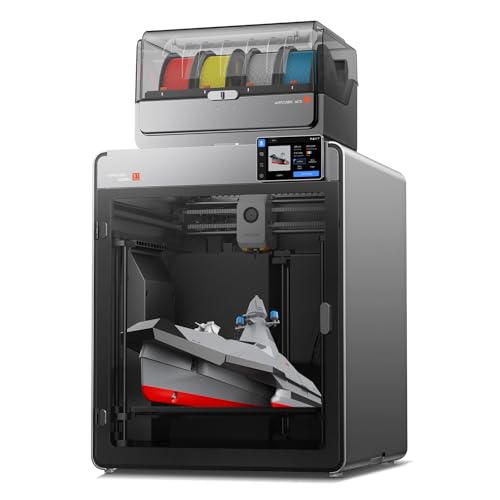
- 350 x 350 x 350 mm workspace
- Up to 600 mm/s and 20,000 mm/s² acceleration
- Four-color printing with expansion to 16 colors
Best For: Large prototypes, enclosures, and fast batch production
Best Fast Tool-Changing Pick

- Four toolheads with five-second changes
- Mixed-material printing with minimal purge waste
- Up to 500 mm/s CoreXY printing
Best For: Multimaterial prototypes and low-waste color printing
Best for Industrial-Grade Materials
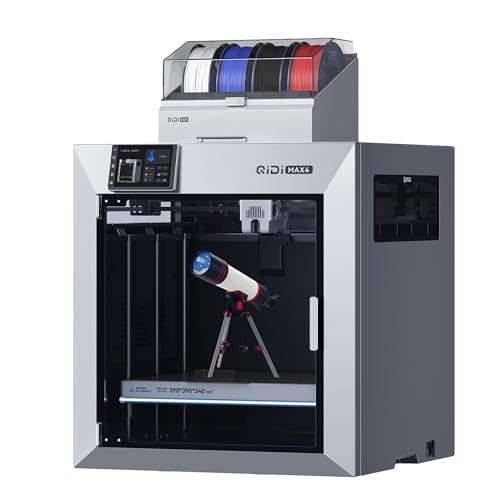
- 390 × 390 × 340mm build volume
- 65°C heated chamber and high-flow hotend
- Expandable to 16-color printing with QIDI BOX
Best For: Large prototypes and demanding engineering materials
Best Ready-to-Use Option

- Setup takes about 15 minutes
- Enclosed design with automatic bed leveling
- Up to 16 colors with optional AMS
Best For: Convenient everyday printing with supported filaments
Best for Print Farms

- 400 × 400 × 400mm build volume
- 700mm/s CoreXY printing system
- WLAN control for multiple printers
Best For: Batch production, oversized models, and print farms
Best for High-Density Color Production

- Native four-color printing, expandable to 19 colors
- 81.25% shorter filament changes reduce purge waste
- 260mm cubed build area with fleet-management features
Best For: Print farms and multicolor custom-order production
Best Enclosed Multicolor Workhorse
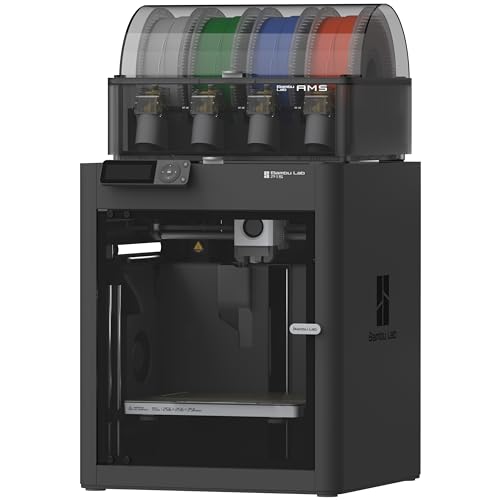
- AMS enables printing with up to 16 colors
- Enclosed design and 500mm/s maximum speed
- Automatic leveling and 15-minute setup
Best For: Fast enclosed multicolor printing with common filaments
Best for Smart High-Speed Materials Handling

- Up to 600mm/s with active flow-rate compensation
- AMS 2 Pro dries filament up to 65°C
- AI detection, automatic calibration, and adaptive airflow
Best For: High-speed, automated printing across colors and materials
Best Large-Format Multicolor Pick – Anycubic Kobra S1 Max Combo
For shoppers comparing large format 3d printers, the Anycubic Kobra S1 Max Combo combines a 350 x 350 x 350 mm build volume with fast CoreXY motion and included four-color printing. Its enclosed design, heated chamber, and broad filament support make it suited to both large models and demanding everyday projects.
Best For: Makers, engineers, and creators who want large prints, multicolor capability, and support for flexible or abrasive filaments.
Pros:
- Large 350 x 350 x 350 mm build volume supports one-piece models and batch printing.
- Up to 600 mm/s printing with vibration compensation for smoother high-speed results.
- ACE 2 Pro enables four-color printing out of the box and expansion up to 16 colors.
- 65°C heated chamber, 350°C hotend, hardened extrusion components, and auto-leveling support varied materials and long prints.
Cons:
- Its 78.8-pound weight and large 21 x 23 x 19-inch footprint require substantial workspace.
- The full feature set may be more than casual users need for simple single-color prints.
The Kobra S1 Max Combo is a strong all-around choice when build size, speed, and multicolor flexibility matter together. It is particularly compelling for users who regularly print large parts or work with engineering-oriented materials.
Best Industrial Multimaterial Pick – FLASHFORGE Creator 5 Pro
Among large format 3d printers focused on production work, the FLASHFORGE Creator 5 Pro stands out for its four independent toolheads and near-zero-waste material changes. Its enclosed CoreXY platform, 65°C active heated chamber, and filtration system are aimed at engineering materials and controlled workshop use.
Best For: Industrial-minded makers and small production environments that need efficient multicolor or multimaterial printing with reduced purge waste.
Pros:
- Four independent toolheads and a seven-second changer avoid filament flushing during changes.
- Supports ABS, PC, and PA with a 65°C active heated chamber.
- CoreXY construction, linear rails, and high-torque belts support speeds up to 600 mm/s.
- Dual HEPA 13 and activated-carbon filtration, camera monitoring, and remote control add workshop convenience.
Cons:
- The feature set is geared toward advanced users rather than basic hobby printing.
- Its 16 x 14 x 18-inch footprint may still require dedicated workspace.
The Creator 5 Pro is a practical pick for users who value material versatility and lower waste over a simple, entry-level workflow. Its toolhead system is especially useful for repeated multicolor or multimaterial jobs.
Best High-Speed Large-Volume Pick – Anycubic Kobra S1 Max Combo
This Anycubic Kobra S1 Max Combo is one of the more capable large format 3d printers for full-scale prototypes and oversized enclosures. It pairs a 350 x 350 x 350 mm workspace with 600 mm/s printing, four-color output, and a heated chamber for a broad range of materials.
Best For: Engineers and makers who prioritize maximum build space, rapid production, and hands-free multicolor printing.
Pros:
- 350 x 350 x 350 mm volume can accommodate large parts without splitting or gluing.
- Up to 600 mm/s speed and 20,000 mm/s² acceleration target shorter print times.
- ACE 2 Pro provides native four-color printing and can expand to 16 colors.
- 49-point auto-leveling, flow calibration, and a 65°C heated chamber simplify demanding prints.
Cons:
- The printer weighs 77.8 pounds and needs a sturdy, spacious setup.
- Its advanced speed, chamber, and color systems may be unnecessary for straightforward PLA projects.
Choose this configuration when large-format capacity and production speed are the main priorities. It offers a particularly broad feature set for users moving between large prototypes, functional parts, and colorful models.
Best Fast Tool-Changing Pick – Snapmaker U1
The Snapmaker U1 offers a different approach to large format 3d printers, using four independent toolheads instead of repeated filament purging. With a 270 x 270 x 270 mm build volume, five-second tool changes, and support for rigid, flexible, soluble, and engineering materials, it is built for efficient mixed-material projects.
Best For: Makers and small businesses producing multicolor models, functional parts, flexible designs, or complex prints with soluble supports.
Pros:
- Four preloaded toolheads switch in about five seconds without manual filament swaps or purging.
- Supports mixed materials such as PLA, TPU, PVA, PETG, ABS, ASA, PA, and PC.
- Automatic calibration, vibration compensation, monitoring, and remote app control simplify operation.
- CoreXY motion reaches up to 500 mm/s across the 270 x 270 x 270 mm build volume.
Cons:
- Its build volume is smaller than the 350 mm-class printers in this roundup.
- At 22.6 x 13 x 14.2 inches, its footprint is relatively long for its build capacity.
The U1 is a strong choice when rapid, low-waste material changes are more important than the largest possible build volume. Its combination of automation and broad material support makes it approachable for beginners while still useful for advanced prototypes.
Best for Industrial-Grade Materials – QIDI Max4 Combo
The QIDI Max4 Combo is one of the more capable large format 3d printers for users who need a spacious build area and dependable support for demanding materials. Its 390 × 390 × 340mm volume accommodates large parts, molds, and prototypes without splitting, while the enclosed design and heated chamber support high-temperature filament workflows.
Best For: Professionals, advanced enthusiasts, and makers producing large prototypes or parts from materials such as ABS-CF, PC, and PPS-CF.
Pros:
- Large 390 × 390 × 340mm build volume for oversized prints.
- 65°C active heated chamber and high-flow hotend support demanding materials.
- Closed-loop X/Y motors, anti-backlash Z hardware, and AI failure monitoring improve reliability.
- Can expand to 16-color and multi-material printing with the separately purchased QIDI BOX.
Cons:
- At 120 pounds, it is a substantial printer to place and move.
- The Polar Cooler is not included and must be purchased separately.
- Its advanced material support may be more than casual users need.
Choose the Max4 Combo when material versatility and chamber control matter as much as build size. It is particularly compelling for technical workflows, though its size and accessory requirements should be considered before buying.
Best Ready-to-Use Option – Bambu Lab P1S
The Bambu Lab P1S is a practical choice among large format 3d printers for users who value quick setup, an enclosed frame, and automated calibration. It is ready to use in about 15 minutes and combines automatic bed leveling with high-speed printing for a streamlined everyday workflow.
Best For: Beginners and makers who want an enclosed, easy-to-start printer for PLA, PETG, TPU, ABS, ASA, and similar materials.
Pros:
- Ready-to-use setup takes about 15 minutes.
- Enclosed design helps improve performance with advanced filaments.
- 500mm/s printing speed and 20,000mm/s² acceleration support fast output.
- Can handle up to 16 colors or materials when connected to a Bambu Lab AMS.
Cons:
- Multi-color and multi-material printing requires a separately connected Bambu Lab AMS.
- Carbon- and glass-fiber-reinforced polymers are not recommended.
- Its build volume is less suited to truly oversized parts than the other printers here.
The P1S makes the most sense when convenience and speed are priorities rather than maximum build capacity. Its enclosed design and automation lower the barrier to entry, while AMS compatibility leaves room to expand later.
Best for Print Farms – Creality Ender 5 Max
The Creality Ender 5 Max is built for high-throughput large format 3d printing, with a 400 × 400 × 400mm build volume and a CoreXY system rated for speeds up to 700mm/s. Its large platform supports oversized prototypes or multiple smaller parts, while WLAN controls help coordinate multiple printers in a production environment.
Best For: Print farms, studios, and businesses that need large parts, batch production, and centralized multi-printer control.
Pros:
- 400 × 400 × 400mm build volume supports oversized models and batch printing.
- CoreXY motion system and up to 700mm/s speed suit high-throughput workflows.
- WLAN multi-printer control and grouped management help organize print farms.
- 64-point auto leveling, automatic Z-offset, and a dual-gear extruder simplify production.
Cons:
- Its 70.4-pound weight requires a sturdy, dedicated setup.
- The 1000W heated bed may increase power demands during operation.
- Its production-focused features may be unnecessary for occasional hobby printing.
For scaled output, the Ender 5 Max offers the strongest combination of build capacity, speed, and network management in this group. It is a better fit for organized production than for users seeking the smallest or simplest desktop setup.
Best for High-Density Color Production – Kobra X
The ANYCUBIC Kobra X is a practical choice among large format 3d printers for print farms and small businesses that need native four-color printing, expansion up to 19 colors, and a space-efficient 260mm cubed build area. Its 49-point auto-leveling and production-focused monitoring features reduce hands-on intervention.
Best For: Print farms, custom-order businesses, and users prioritizing multicolor production with efficient use of workshop space.
Pros:
- Supports native four-color printing and expansion up to 19 colors with four ACE 2 Pro units.
- Shortens filament change length by 81.25%, helping reduce purge waste and material costs.
- Includes 49-point auto-leveling, AI camera monitoring, object detection, and recovery features.
- Top-mounted spool design and a 260mm x 260mm x 260mm build volume suit high-density setups.
Cons:
- Expanded 19-color printing requires additional ACE 2 Pro units.
- The 260mm cubed build volume may be limiting for especially large single-piece projects.
The Kobra X stands out when color flexibility, reduced waste, and fleet-friendly management matter more than maximum build size. Its automation and compact layout make it well suited to repeat production.
Best Enclosed Multicolor Workhorse – P1S Combo
The Bambu Lab P1S Combo is a capable option among large format 3d printers for users who want enclosed printing, fast output, and multicolor or multimaterial capability. The included AMS supports up to 16 colors, while automatic bed leveling and a 15-minute setup keep the workflow approachable.
Best For: Creators and makers who want a fast, enclosed printer for multicolor projects and common engineering-oriented filaments.
Pros:
- Supports multicolor or multimaterial printing with the included AMS, up to 16 colors.
- Prints at up to 500mm/s with 20,000mm/s² acceleration.
- Enclosed design supports materials including PLA, PETG, TPU, PVA, PET, ABS, and ASA.
- Automatic bed leveling and a stated 15-minute setup simplify operation.
Cons:
- Multi-color printing requires the Bambu Lab AMS, included with this Combo configuration.
- Carbon- and glass-fiber-reinforced polymers are not recommended.
The P1S Combo balances speed, enclosure benefits, and color capability in a relatively straightforward package. It is a strong fit for users who want to move quickly from setup to repeatable multicolor printing.
Best for Smart High-Speed Materials Handling – P2S Combo
The Bambu Lab P2S Combo is designed for demanding large format 3d printer workflows that combine speed, automatic calibration, and material management. It reaches up to 600mm/s, while the AMS 2 Pro adds multicolor printing and filament drying up to 65°C.
Best For: Users who want high-speed printing with automated monitoring, dried filament storage, and broader material-handling options.
Pros:
- Prints at up to 600mm/s with active flow-rate compensation and a PMSM servo extruder.
- AMS 2 Pro supports multicolor or multimaterial printing and filament drying up to 65°C.
- AI failure detection, automatic calibration, and quick-swap nozzles streamline operation.
- Adaptive airflow can cool overhangs or maintain a 50°C chamber, with carbon filtration.
Cons:
- The standard P2S does not support multicolor printing; the Combo configuration is required.
- Its advanced feature set and 47.5-pound weight may be more than casual users need.
The P2S Combo is the most automation-focused option here, combining high speed with active airflow control and filament drying. It makes particular sense for users printing frequently across varied materials and colors.
How We Picked the Best Large Format 3d Printers
We selected models representing the main buying priorities in today’s large-format market: generous build volume, fast printing, automated calibration, enclosed or heated chambers, multi-color capability, and practical ease of use. The list includes machines suited to home workshops, makerspaces, small businesses, prototyping, and more demanding production environments.
Because specifications can vary by material, nozzle, slicer profile, and firmware, treat advertised speed and capacity as maximum figures rather than guaranteed everyday performance. A printer’s complete workflow—including setup, maintenance, drying, slicing, and material changes—is often more important than one headline specification.
Quick Comparison
| Priority | Look for | Best fit |
|---|---|---|
| Maximum print size | Build volumes around 350 mm or larger per axis | Props, enclosures, furniture-scale components, and large prototypes |
| Multi-color printing | AMS, ACE, or multiple toolheads | Models, signage, demonstrations, and color-coded parts |
| Engineering materials | Enclosure, heated chamber, hardened components | ABS, ASA, nylon, PC, and other temperature-sensitive filaments |
| Simple operation | Auto-leveling, sensor monitoring, remote control, and mature profiles | First-time users and repeatable daily printing |
Key Buying Factors for Large-Format 3D Printers
Build Volume and Printer Footprint
Confirm the usable build volume, not just the advertised exterior dimensions. A larger machine also needs clearance for doors, filament systems, ventilation, and maintenance. Measure the intended location before buying.
Materials and Thermal Control
Open-frame printers are generally easiest with PLA, PETG, and similar materials. An enclosure improves temperature stability, while an actively heated chamber is more useful for demanding materials such as ABS, ASA, nylon, and polycarbonate. Check whether the hot end, extruder, and build surface are rated for the filaments you plan to use.
Speed, Reliability, and Automation
High-speed motion is valuable only when extrusion, cooling, input shaping, and calibration keep pace. Features such as automatic bed leveling, flow calibration, clog detection, power-loss recovery, and remote monitoring can reduce failed prints, especially on long jobs.
Color and Tool-Changing Systems
Multi-color systems differ in waste, changeover time, supported materials, and maintenance. Tool-changing printers can reduce purge waste and separate material types more effectively, while spool-based systems may be simpler for occasional color work. Review the included accessories and software workflow before choosing.
Who Should Buy Which Large Format 3d Printers?
Choose a large-build single-material printer if your priority is producing big, durable parts with the fewest moving parts. These machines are a practical fit for functional prototypes, replacement components, cosplay work, and workshop projects.
Choose a multi-color or multi-toolhead model if appearance, material separation, or unattended color changes are central to your work. They are especially useful for educational models, product demonstrations, signage, and complex prototypes, but require more planning and consumables.
A compact enclosed printer can be the better choice when reliability, office-friendly operation, and a smaller footprint matter more than maximum size. Before purchasing, compare the machine’s real clearance, noise, ventilation needs, software support, warranty, and ongoing accessory costs—not just its build-volume number.