The best 3D printers for artists make it easier to turn digital designs into colorful sculptures, display pieces, props, jewelry, and functional art. This lineup focuses on accessible multicolor printers as well as faster, more capable machines for demanding creative workflows.
When choosing among them, consider more than print speed. Color-change waste, material compatibility, build volume, automation, noise, and the quality of the software ecosystem can have a major impact on the final result and your day-to-day experience.
Best 10 3d Printers for Artists Picks for 2026
Best Overall

- Up to 600 mm/s with precision-focused extrusion control
- AMS 2 Pro enables multicolor and multimaterial printing
- Automatic calibration and AI failure detection
Best For: Artists seeking a fast, automated multicolor workflow
Best for Color Expansion

- Native four-color printing with expansion up to 19 colors
- 600 mm/s maximum speed and reduced purging paths
- Supports rigid and flexible filaments
Best For: Creative spaces planning ambitious multicolor projects
Best for Decorative Projects

- Includes an LED Lamp Kit for compatible illuminated models
- AMS lite supports accessible multicolor printing
- Automatic calibration and quiet operation
Best For: Artists making colorful décor, lamps, and creative gifts
Best for Material Versatility
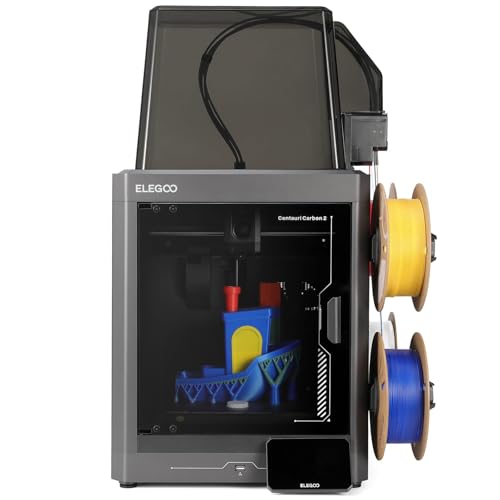
- CANVAS system provides four-color printing
- Supports basic through engineering-grade materials
- Automated calibration and monitoring
Best For: Makers combining multicolor art with material experimentation
Best Multi-Material Choice

- Four independent toolheads for multicolor printing
- 5-second tool changes help reduce waste
- 270 mm cubed build volume and broad material support
Best For: Artists creating multicolor, mixed-material models and prototypes
Best High-Speed Color Option

- Up to 600 mm/s printing speed
- Expandable to 16 colors with four CFS units
- Pre-assembled with auto leveling and AI monitoring
Best For: Artists wanting fast, monitored multicolor production
Best Enclosed Starter Combo
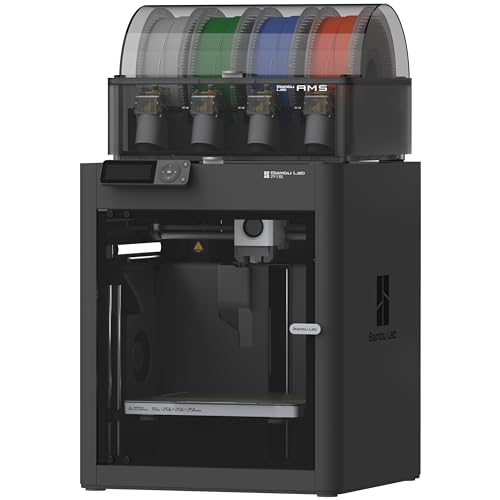
- AMS supports up to 16-color printing
- Enclosed design and automatic bed leveling
- 500 mm/s speed with a 15-minute setup
Best For: Artists seeking a user-friendly enclosed multicolor printer
Industrial Color Studio

- Four independent toolheads reduce multicolor purge waste.
- 65°C heated chamber supports ABS, PC, and PA.
- CoreXY system delivers speeds up to 600mm/s.
Best For: Artists producing durable multicolor work with advanced filaments
AI Creative Workbench

- AI tools can convert portraits into 3D models.
- Preassembled setup targets a first print in under five minutes.
- Automatic calibration and monitoring simplify printing.
Best For: Artists seeking easy personalized and multicolor creations
Compact Multicolor Maker

- Prints with up to four colors simultaneously.
- IFS automates filament detection and refilling.
- CoreXY design reaches speeds up to 600mm/s.
Best For: Artists needing flexible, colorful printing in a smaller setup
Best Overall – Bambu Lab P2S Combo
For artists who want a fast, polished workflow, the Bambu Lab P2S Combo is a strong choice among 3d printers for artists. It combines high-speed FDM printing with the AMS 2 Pro for multicolor and multimaterial projects, plus automatic calibration and AI failure detection.
Best For: Artists creating detailed multicolor models who value speed, automation, and a streamlined design-to-print workflow.
Pros:
- Prints at speeds up to 600 mm/s while emphasizing sharp, smooth layers.
- AMS 2 Pro supports multicolor and multimaterial printing with filament drying up to 65 °C.
- Automatic calibration, quick-swap nozzles, and AI failure detection simplify operation.
- Adaptive airflow supports both crisp overhangs and materials needing a chamber temperature up to 50 °C.
Cons:
- The printer alone does not support multicolor printing; the Combo version is required.
- At 47.5 pounds, it is a substantial machine to position.
The P2S Combo is especially appealing for artists who want repeatable results without spending much time on setup and tuning. Its integrated software ecosystem and large MakerWorld model library further support an accessible creative workflow.
Best for Color Expansion – Anycubic Kobra X
The Anycubic Kobra X stands out for artists who want native four-color printing with room to expand. It pairs a 260 mm cubed build volume with fast operation, automatic leveling, and support for both common and flexible materials.
Best For: Artists, makerspaces, and schools that want accessible multicolor printing and the option to build a larger color palette.
Pros:
- Includes native four-color printing and can expand to up to 19 colors with four ACE 2 Pro units.
- Prints at speeds up to 600 mm/s and reduces filament purging and travel paths by a claimed 81.25%.
- 49-point LeviQ 3.0 automatic bed leveling helps simplify first-layer setup.
- Supports PLA, PETG, TPU, PVA, and ASA with a nozzle temperature up to 300 °C.
Cons:
- Filament is not included and must be purchased separately.
- The larger color expansion requires additional ACE 2 Pro units.
With remote control, AI monitoring, and a broad material range, the Kobra X offers flexibility for creative spaces. It is a practical pick when color variety and material experimentation matter more than a minimal footprint.
Best for Decorative Projects – Bambu Lab A1 Combo
The Bambu Lab A1 Combo is a user-friendly option for 3d printers for artists, particularly those making decorative objects and illuminated designs. Its included LED Lamp Kit works with compatible lamp models, while AMS lite adds accessible multicolor printing.
Best For: Artists and hobbyists designing custom lamps, décor, gifts, and other colorful functional pieces.
Pros:
- Included LED Lamp Kit supports compatible illuminated 3D-printing projects.
- AMS lite enables multicolor printing for more expressive designs.
- Automatic calibration handles functions such as Z-offset and bed leveling.
- Active flow-rate compensation, quick-swap nozzles, and motor noise canceling support convenient printing.
Cons:
- Multicolor printing requires the AMS lite, so the Combo configuration is important.
- The LED kit is intended for compatible lamp designs rather than every printed model.
The A1 Combo focuses on reducing technical friction so artists can spend more time designing. Its included lighting accessory gives it a distinct advantage for decorative projects and creative gifts.
Best for Material Versatility – ELEGOO Centauri Carbon 2
The ELEGOO Centauri Carbon 2 Combo is built for artists who want multicolor capability alongside broader material experimentation. Its CANVAS system supports four-color printing, while process and temperature controls are designed for materials ranging from basic filaments to engineering-grade options.
Best For: Experienced creative makers who need multicolor output and flexibility across different filament types.
Pros:
- CANVAS provides four-color printing with instant switching and smart filament detection.
- Auto refill and tangle detection help maintain multicolor print jobs.
- CoreXY mechanics, a rigid aluminum frame, and speeds up to 500 mm/s support fast printing.
- Fully automated calibration, monitoring, and active vibration compensation promote consistent results.
Cons:
- At 42.6 pounds, it requires a stable, dedicated setup area.
- Its broader material capabilities may be more than needed for artists who only print basic PLA projects.
The Centauri Carbon 2 Combo is a compelling fit for artists whose work spans colorful prototypes, functional pieces, and more demanding materials. Its automation and integrated ecosystem help balance versatility with a relatively hands-off workflow.
Best Multi-Material Choice – Snapmaker U1
For artists seeking 3d printers for artists with efficient color and material changes, the Snapmaker U1 combines four independent toolheads with a rapid 5-second tool changer. Its 270 × 270 × 270 mm build volume, automatic calibration, and broad material compatibility make it suitable for detailed models, prototypes, and functional creative work.
Best For: Artists and makers producing multicolor models, mixed-material pieces, or functional prototypes.
Pros:
- Four independent toolheads enable true multicolor and multi-material printing.
- Fast tool changes can reduce printing time and filament waste.
- Automatic calibration, monitoring, and remote app control simplify operation.
- Supports materials including PLA, TPU, PETG, ABS, ASA, PA, and PC.
Cons:
- At 59 pounds, it is a substantial printer to position.
- The listed build volume may be limiting for especially large sculptures.
The U1 stands out when color variety and material flexibility matter more than a compact footprint. Its automated toolhead system can help artists spend less time managing filament changes and more time developing finished pieces.
Best High-Speed Color Option – Creality K2 Combo
The Creality K2 Combo is a strong option among 3d printers for artists who want fast, colorful output with minimal setup. It arrives 95% pre-assembled, offers a 260 × 260 × 260 mm build volume, and can support up to 16 colors when paired with as many as four CFS units.
Best For: Artists who prioritize rapid multicolor printing, plug-and-play setup, and real-time print monitoring.
Pros:
- Supports up to 16 colors with four connected CFS units.
- Print speeds reach up to 600 mm/s.
- Pre-assembled design makes setup quicker.
- Auto leveling and an AI camera monitor print progress and failures.
Cons:
- The included Combo has one CFS unit; additional units are needed for up to 16 colors.
- Its 65.9-pound weight makes it less convenient to relocate.
With its high speed, quiet mode, and color expansion potential, the K2 Combo suits artists who want a streamlined workflow. The sturdy frame and step-servo motors are also designed to support consistent extrusion and accurate prints.
Best Enclosed Starter Combo – Bambu Lab P1S Combo
The Bambu Lab P1S Combo is a practical pick among 3d printers for artists who want a relatively quick setup and enclosed printing. The printer and AMS support multicolor or multimaterial work, while automatic bed leveling and speeds up to 500 mm/s help simplify production.
Best For: Artists who want an enclosed, user-friendly printer for colorful models and everyday creative projects.
Pros:
- AMS-enabled printing can support up to 16 colors.
- Enclosed design improves performance with advanced filaments.
- Automatic bed leveling supports easier, more consistent setup.
- Advertised 15-minute setup and 500 mm/s speed suit fast workflows.
Cons:
- Multicolor printing requires the Bambu Lab AMS.
- Carbon- and glass-fiber-reinforced polymers are not recommended.
- Its 180 × 180 × 180 mm build volume is smaller than the other listed options.
The P1S Combo balances convenience, enclosure, and color capability in a compact 40.8-pound package. It is particularly appealing for artists who value an accessible workflow and do not need the larger build areas offered by the Snapmaker U1 or Creality K2.
Industrial Color Studio – Creator 5 Pro
For artists who need advanced materials and efficient color changes, the FLASHFORGE Creator 5 Pro is a powerful choice among 3d printers for artists. Its four independent toolheads, heated chamber, and high-speed CoreXY design support detailed, durable work with less purge waste.
Best For: Artists and designers creating multicolor pieces, robust prototypes, or larger projects with ABS, PC, and PA filaments.
Pros:
- Four toolheads and a 7-second changer reduce purge waste and speed up multicolor printing.
- Active heated chamber reaches 65°C for improved performance with advanced filaments.
- CoreXY motion system supports speeds up to 600mm/s while reducing vibration and ghosting.
- Dual HEPA 13 and activated carbon filtration helps manage particles and fumes.
Cons:
- Its industrial feature set and 39-pound weight may be more than casual users need.
- The 16 x 14 x 18-inch footprint requires substantial workspace.
- Advanced materials and multicolor workflows may involve a steeper learning curve.
The Creator 5 Pro stands out when material range, color efficiency, and production stability matter more than a compact desktop setup. Automated calibration, a chamber camera, and remote controls further support repeatable creative work.
AI Creative Workbench – SPARKX i7 Combo
The Creality SPARKX i7 Combo is designed for artists who want a fast, approachable path from idea to multicolor print. As one of the more user-friendly 3d printers for artists, it combines automatic setup, AI-assisted creation, and a 260 x 260 x 255mm build volume.
Best For: Creators making personalized models, tabletop displays, gifts, and multicolor projects with minimal manual calibration.
Pros:
- Preassembled design aims to get users printing in under five minutes.
- CubeMe AI can turn portraits into personalized 3D models.
- CFS Lite reads filament information and helps apply print settings automatically.
- AI camera detection monitors for issues such as spaghetti, air printing, and entanglement.
Cons:
- Its 16.5 x 17.9 x 18.5-inch footprint is relatively large for a desktop printer.
- The printer weighs 39.6 pounds, making relocation less convenient.
- AI-assisted features may be less important for artists who prefer fully manual workflows.
The SPARKX i7 Combo is a strong fit for creators who value convenience and personalized output. Automatic leveling, Z-offset calibration, and input shaping reduce setup demands while the multicolor system expands presentation options.
Compact Multicolor Maker – AD5X
The FLASHFORGE AD5X offers a more compact route into multicolor creative work. For artists comparing 3d printers for artists, its four-color capability, automatic filament management, and 220mm cubed build area provide a practical balance of speed, versatility, and workspace efficiency.
Best For: Artists, designers, and hobbyists making colorful models, functional prototypes, and flexible TPU projects.
Pros:
- Supports up to four colors for more vivid and intricate designs.
- Intelligent Filament System automatically detects and refills filament.
- CoreXY construction and up to 600mm/s printing support fast, stable production.
- Supports flexible TPU as well as other project materials.
Cons:
- The 220 x 220 x 220mm build volume is smaller than the larger printers in this roundup.
- Its 300°C nozzle specification does not include a heated-chamber feature in the supplied details.
- Multicolor printing still adds system complexity compared with single-color printing.
The AD5X is a versatile option for artists who want multicolor capability without stepping up to a heavier industrial machine. Its 24.3-pound weight and moderate footprint make it easier to accommodate while retaining high-speed CoreXY performance.
How We Picked the Best 3d Printers for Artists
We evaluated these printers around the needs of artists, designers, makers, and small creative studios. Priority went to reliable FDM systems with multicolor or multi-material capabilities, straightforward setup, automatic calibration, useful software, and enough build volume for creative projects. We also considered tool-changing designs, enclosed chambers, waste reduction, camera and AI features, and the availability of replacement parts and accessories.
Because artistic workflows vary, this list includes both beginner-friendly options and more specialized machines. A printer that is ideal for colorful figurines may not be the best choice for large props, engineering-grade materials, or frequent production work.
Quick Comparison
| Best For | What to Look For |
|---|---|
| Beginners and hobby artists | Automatic leveling, guided setup, dependable slicer software, and an enclosed or easy-to-maintain design |
| Multicolor models | Reliable material handling, accurate color changes, and manageable purge waste |
| Large artwork and props | A generous build volume, stable frame, and consistent long-print performance |
| Professional studios | Tool-changing hardware, heated chambers, strong material support, and low downtime |
| Small-batch production | High speed, remote monitoring, repeatable calibration, and accessible maintenance |
Key Buying Factors for 3d Printers for Artists
Color and Material Handling
Multicolor printing can use an automatic material system or several independently mounted toolheads. Material systems are often more approachable, while tool-changing printers can reduce purge waste and switch between materials more efficiently. Check whether the printer supports the filament types you expect to use, including PLA, PETG, TPU, or specialty composites.
Build Quality and Detail
Look for a rigid motion system, accurate first-layer calibration, dependable extrusion, and a stable heated bed. Fine layer heights matter for small sculptures and miniatures, but surface quality also depends on nozzle size, cooling, filament quality, and slicer settings.
Build Volume, Speed, and Noise
Choose a build area based on your typical work rather than the maximum number alone. High-speed printing is valuable for prototypes and production, but acceleration and vibration control affect surface finish. If the printer will share a home studio, consider enclosure design, fan noise, and ventilation.
Software and Maintenance
A capable slicer, remote monitoring, automatic calibration, and easy access to consumable parts can save significant time. Artists who want to focus on design should favor a reliable workflow over headline speed or experimental features.
Who Should Buy Which 3d Printers for Artists?
Choose an easy-to-use multicolor combo model if you are new to 3D printing or primarily create decorative objects, figures, and gifts. These machines typically offer the quickest path from a finished digital file to a colorful physical piece.
Choose a faster enclosed printer if you make larger props, prototypes, or repeated batches and want better control over temperature, dust, and long prints. A tool-changing model is worth considering when minimizing purge waste, combining materials, or using several colors frequently matters more than the lowest purchase price.
For professional artists and studios, prioritize reliability, serviceability, material flexibility, and workflow automation. The best fit is the printer that matches your materials, project scale, and production volume—not necessarily the one with the highest advertised speed.