Choosing among the best telescopes for astrophotography depends on more than aperture. Your camera, tracking needs, portability, and experience level all shape which setup will produce satisfying results.
This roundup spans automated smart telescopes, beginner-friendly Newtonians, and advanced optical tubes so you can match your goals with a practical imaging platform.
Best 10 Telescopes for Astrophotography Picks for 2026
Best Smart Telescope for Beginners
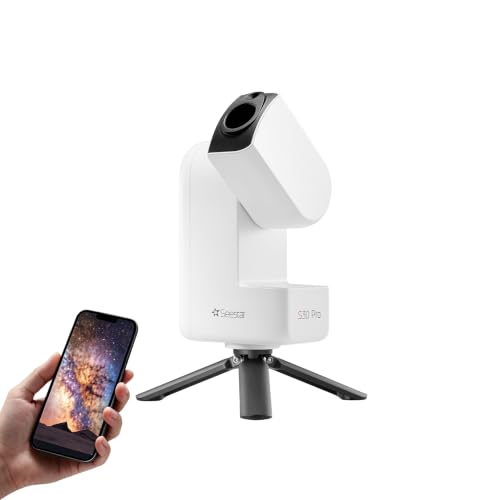
- Automatic GoTo tracking and app control
- 4K dual-camera deep-sky imaging
- Portable, urban-friendly design
Best For: Beginners seeking easy, one-tap astrophotography
Best Refractor for Detailed Imaging

- 102mm f/7 ED refractor optics
- Dual-speed focuser with 90mm travel
- Supports imaging and visual observing
Best For: Hands-on astrophotographers building an accessory-ready setup
Best Portable Smart Telescope

- Backpack-friendly 3-pound design
- Dual lenses for astronomy and daytime imaging
- 4K tracking with app processing
Best For: Travelers wanting automated night-sky and wildlife imaging
Best Large-Aperture GoTo Scope

- 6-inch Schmidt-Cassegrain optics
- GoTo database with over 40,000 objects
- SkyAlign simplifies setup
Best For: Users wanting guided access to lunar, planetary, and deep-sky targets
Lightweight APO Pick
Askar 71F Flat-Field Refractor

- 71mm quadruplet APO flat-field optics
- Lightweight 2.5kg optical tube
- 360-degree rotatable focuser
Best For: Portable deep-sky imaging and visual observing
Automated Deep-Sky Choice

- 8-inch Schmidt-Cassegrain optics
- GoTo access to 40,000+ objects
- SkyAlign simplifies alignment
Best For: Automated observing and astroimaging-ready use
Beginner Equatorial Option
MEEZAA 150EQ Newtonian Telescope
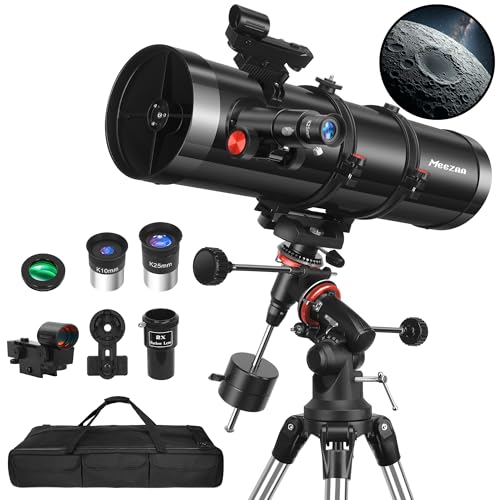
- 150mm aperture and 650mm focal length
- Equatorial mount with slow-motion controls
- Phone adapter and carry bag included
Best For: Beginners learning manual observing and introductory imaging
Best Guided Tabletop Pick
150mm StarSense Explorer Dobsonian

- Large 150mm reflector for bright deep-sky views
- StarSense app guides beginners to targets
- Stable portable tabletop Dobsonian base
Best For: Beginners prioritizing aperture and guided visual observing
Best Equatorial Beginner Value

- 130mm Newtonian optics for lunar and deep-sky views
- Equatorial mount with slow-motion controls
- Includes two eyepieces and StarPointer
Best For: Beginners learning hands-on equatorial observing
Best App-Guided Tripod Setup
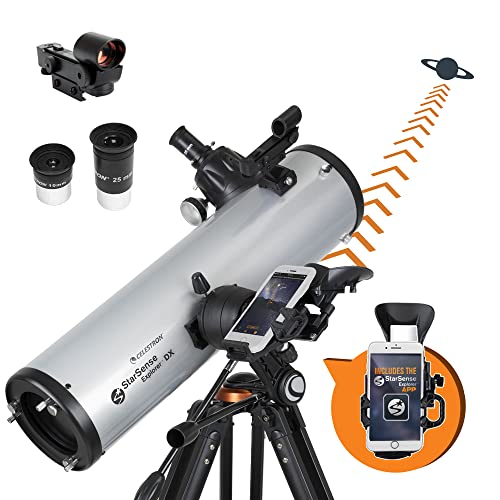
- Smartphone StarSense navigation simplifies target finding
- 130mm reflector supports planetary and deep-sky viewing
- Tripod mount includes dual-axis slow-motion controls
Best For: Backyard observers wanting guided setup and tripod flexibility
Best Smart Telescope for Beginners – ZWO Seestar S30 Pro
The ZWO Seestar S30 Pro is one of the most approachable telescopes for astrophotography, combining automatic GoTo targeting, tracking, focusing, and app-based image capture. Its compact design and built-in light-pollution filters make it especially practical for beginners imaging from urban locations.
Best For: Beginners who want one-tap deep-sky and wide-field astrophotography without a complex setup.
Pros:
- Automatic GoTo targeting and tracking simplify celestial imaging.
- Dual-camera 4K imaging supports deep-sky objects and wide night landscapes.
- Built-in filters, AI processing, and apochromatic optics help produce clearer images.
- Lightweight 3.6-pound design is convenient for travel and camping.
Cons:
- Designed for deep-sky and wide-field imaging rather than planetary observation.
- Deep-sky imaging requires the device to remain stationary for stable tracking.
- App and software settings are central to operation.
Choose the Seestar S30 Pro if convenience matters more than traditional manual control. It is a particularly strong fit for quick, portable imaging sessions, though advanced users may prefer a larger optical tube with more accessory flexibility.
Best Refractor for Detailed Imaging – SVBONY SV503 102mm ED
The SVBONY SV503 102mm ED is a traditional optical-tube choice for telescopes for astrophotography, pairing a 102mm aperture with a 714mm f/7 focal length. Its ED glass, dual-speed focuser, and generous focus travel suit photographers building a more configurable camera-and-accessory setup.
Best For: Astrophotographers who want a manual-focus refractor for planetary, deep-sky, and visual observing.
Pros:
- 102mm aperture gathers light for brighter, higher-contrast views.
- S-FPL51 ED glass helps reduce chromatic aberration and color fringing.
- Dual-speed 1:10 focuser supports precise critical focusing.
- 90mm focus travel accommodates accessories such as filter wheels and field flatteners.
Cons:
- Manual focus and a separate tripod or mount require more setup than a smart telescope.
- At approximately 3.95kg, it is less travel-friendly than the compact smart models.
- No finderscope is included.
The SV503 is a sensible foundation for users who want hands-on control and room to add astrophotography accessories. Its optical features favor careful focusing and image quality, but it is not an all-in-one computerized imaging system.
Best Portable Smart Telescope – DWARFLAB Dwarf 3
The DWARFLAB Dwarf 3 is a highly portable option among telescopes for astrophotography, weighing about 3 pounds and fitting in a standard backpack. Its dual-lens system, automatic tracking, and app-based processing make it useful for both night-sky imaging and daytime subjects.
Best For: Travelers and beginners who want automated astrophotography plus wildlife, landscape, and panorama imaging.
Pros:
- Ultra-light 3-pound design is well suited to spontaneous trips.
- Dual lenses cover telephoto subjects and wide-angle Milky Way or star-trail scenes.
- 4K auto-tracking and Auto GOTO simplify target capture.
- Cloud-powered app processing reduces the need for a computer or complex software.
Cons:
- Its 35mm objective lens is smaller than the SVBONY and Celestron options.
- Cloud-powered processing depends on the dedicated app workflow.
- Altazimuth operation is listed, with EQ mode available, so users seeking a traditional mount may want more control.
The Dwarf 3 stands out when portability and versatility are priorities. It is easier to carry and operate than a conventional telescope, while its dual imaging system broadens its usefulness beyond astronomy.
Best Large-Aperture GoTo Scope – Celestron NexStar 6SE
The Celestron NexStar 6SE is a substantial computerized option for telescopes for astrophotography, pairing a 6-inch Schmidt-Cassegrain optical tube with an automated GoTo mount. Its large aperture and 40,000-plus-object database make it a strong choice for users who want guided access to lunar, planetary, and deep-sky targets.
Best For: Observers moving up to a computerized, large-aperture telescope with camera and smartphone compatibility.
Pros:
- 6-inch aperture gathers light for lunar, planetary, and deep-sky observing.
- Computerized GoTo mount automatically locates and tracks selected objects.
- SkyAlign supports alignment using three bright stars or planets.
- Compatible with cameras, smartphones, and additional Celestron accessories.
Cons:
- At 21 pounds, it is considerably less portable than the smart telescopes.
- Power sources such as AA batteries, a 12V adapter, or PowerTank are not included.
- Manual focusing and an altitude-azimuth single-fork mount may require additional planning for imaging.
The NexStar 6SE offers considerably more aperture than the compact smart models and a familiar computerized observing experience. It is best suited to users prepared for a larger setup and possible accessory upgrades rather than casual grab-and-go imaging.
Lightweight APO Pick – Askar 71F Flat-Field Refractor
For astrophotographers seeking a portable optical tube, the Askar 71F combines a 71mm quadruplet air-spaced APO design with a flat-field configuration. Its compact build, manual focus, and camera and smartphone compatibility make it a practical option among telescopes for astrophotography, especially when portability matters.
Best For: Portable deep-sky astrophotography and visual observing, including birds and scenery.
Pros:
- 71mm ED-glass quadruplet APO optics with a flat-field design.
- Lightweight 2.5kg optical tube and approximately 3kg setup with hoop and dovetail plate.
- 360-degree rotatable focuser supports convenient photographic composition.
- Matte-black interior and CNC-machined barrel help reduce stray-light reflections.
Cons:
- Manual focusing and a manual/mechanical operating design require hands-on adjustment.
- An altazimuth mount is listed, so a suitable tracking mount may be needed for longer-exposure imaging.
The Askar 71F is a versatile OTA for buyers who value manageable weight and flat-field imaging in a compact package. It is particularly appealing when one telescope needs to serve both imaging and daytime visual use.
Automated Deep-Sky Choice – Celestron NexStar 8SE
The Celestron NexStar 8SE is a computerized telescope for astrophotography and visual astronomy, pairing an 8-inch Schmidt-Cassegrain optical system with automated GoTo positioning. Its large aperture, SkyAlign setup, and extensive object database make it a convenient choice for users who want guided access to lunar, planetary, and deep-sky targets.
Best For: Visual observing and astroimaging-ready setups that prioritize automated target finding and tracking.
Pros:
- 8-inch Schmidt-Cassegrain optics gather light for lunar, planetary, and deep-sky views.
- Computerized GoTo mount provides access to a database of more than 40,000 objects.
- SkyAlign can align the system using any three bright stars or planets.
- Includes a 25mm eyepiece, StarPointer red-dot finder, tripod, and NexStar+ hand control.
Cons:
- The complete setup weighs 10.88kg, making it less portable than smaller optical tubes.
- Power options such as 8 AA batteries or a 12V adapter are specified, but the power sources are not included.
- Its 0.75-degree listed field of view is relatively narrow for expansive targets.
The NexStar 8SE is a strong fit for observers who want substantial aperture without manually locating every target. Its automated alt-azimuth system is convenient, while dedicated imaging users should consider their accessory and power requirements before buying.
Beginner Equatorial Option – MEEZAA 150EQ Newtonian Telescope
The MEEZAA 150EQ offers a generous 150mm aperture and 650mm focal length in a beginner-friendly Newtonian package. Among telescopes for astrophotography, it is best viewed as an accessible manual setup for learning equatorial tracking, with a phone adapter and a broad set of included accessories.
Best For: Beginners and families who want an affordable manual telescope for lunar, planetary, and introductory imaging.
Pros:
- 150mm aperture provides strong light-gathering capability for the Moon, planets, and deep-sky viewing.
- German equatorial mount includes precision dials and slow-motion control knobs.
- Includes 25mm and 10mm eyepieces, a 2X Barlow lens, moon filter, and phone adapter.
- Carry bag, adjustable tripod, and no-tool assembly support storage and transport.
Cons:
- Manual focusing and tracking require more hands-on operation than a computerized mount.
- The listed Kellner eyepieces and included phone adapter are better suited to entry-level use than advanced imaging.
- The complete kit includes many components, so setup and balancing may take practice.
The MEEZAA 150EQ delivers useful aperture and a learning-oriented equatorial mount at the expense of automation. It is a sensible starting point for newcomers who want to experiment with smartphone photography while building manual observing skills.
Best Guided Tabletop Pick – 150mm StarSense Explorer Dobsonian
For beginners comparing telescopes for astrophotography and visual astronomy, the Celestron StarSense Explorer 150mm combines a large aperture with smartphone-assisted navigation. Its tabletop Dobsonian base is manual, but the StarSense app helps you locate targets such as planets, nebulae, galaxies, and star clusters.
Best For: Beginners who want bright deep-sky views and guided object-finding from a stable tabletop setup.
Pros:
- Large 150mm reflector gathers light for vivid lunar, planetary, and deep-sky views.
- StarSense sky recognition and curated target lists simplify navigation.
- Stable, portable tabletop Dobsonian base requires no external power.
- Includes 25mm and 10mm eyepieces plus a StarPointer red-dot finderscope.
Cons:
- Manual altazimuth operation does not provide automated tracking.
- Requires a suitable table or other stable elevated surface.
Choose this model if aperture and easy target discovery matter more than motorized tracking. It is especially appealing for visual observing and learning the sky, while astrophotography users should note its manual tabletop design.
Best Equatorial Beginner Value – AstroMaster 130EQ
The Celestron AstroMaster 130EQ is a practical starting point for shoppers evaluating telescopes for astrophotography and general backyard astronomy. Its 130mm Newtonian reflector pairs with a German equatorial mount and slow-motion controls for deliberate manual pointing at lunar, planetary, and deep-sky targets.
Best For: Beginners who want a traditional equatorial mount, solid aperture, and manual control practice.
Pros:
- 130mm coated Newtonian optics provide useful light-gathering ability for deep-sky viewing.
- German equatorial mount includes right-ascension and declination slow-motion controls.
- Quick, tool-free setup with an adjustable tripod.
- Includes 20mm and 10mm eyepieces, StarPointer, and astronomy software.
Cons:
- Manual mount requires users to learn equatorial positioning and controls.
- Does not include motorized tracking or automated object location.
This is a sensible choice for beginners who want hands-on control and an equatorial platform. It can support learning the fundamentals, but its manual operation means astrophotography applications are limited compared with tracking-equipped systems.
Best App-Guided Tripod Setup – StarSense Explorer DX 130AZ
The Celestron StarSense Explorer DX 130AZ offers a convenient middle ground for those comparing telescopes for astrophotography and visual use. Its 130mm parabolic Newtonian reflector sits on a tripod-mounted altazimuth mount with dual-axis slow-motion controls, while the StarSense app helps identify and locate worthwhile targets.
Best For: Backyard observers who want app-guided navigation with a tripod-mounted telescope.
Pros:
- StarSense technology uses a smartphone to guide users to celestial objects.
- 130mm reflector delivers views of the Moon, planets, Orion Nebula, and Andromeda Galaxy.
- Dual-axis slow-motion controls support smoother manual adjustments.
- Includes 25mm and 10mm eyepieces and a preassembled mount and tripod.
Cons:
- Altazimuth mount is manual and does not provide automated tracking.
- Smartphone guidance depends on having a compatible phone available.
Consider this model when you want easier setup and target-finding than a traditional beginner telescope provides. Its tripod format is more flexible than a tabletop design, though astrophotography buyers should account for the lack of motorized tracking.
How We Picked These Telescopes for Astrophotography
We evaluated the selected models by considering optical design, aperture, focal length, mount or tracking capability, camera compatibility, setup complexity, and portability. Smart telescopes were assessed for their integrated cameras and app-based workflow, while traditional optical tubes were considered for their flexibility with dedicated astronomy cameras and accessories.
Because astrophotography covers everything from quick lunar snapshots to multi-hour deep-sky sessions, no single specification determines the best choice. A telescope with excellent optics may still be frustrating if its mount cannot track accurately, while an automated model may be ideal for convenience but less suitable for hands-on upgrades.
Quick Comparison
| Best For | Recommended Type | What to Prioritize |
|---|---|---|
| Simple, portable imaging | Smart telescope | App control, built-in camera, automated tracking |
| Wide-field deep-sky photography | ED or APO refractor | Color correction, flat field, compatible equatorial mount |
| Moon and planetary imaging | Schmidt-Cassegrain or Newtonian | Aperture, focal length, stable focusing |
| Beginner visual astronomy with phone photos | App-guided Dobsonian or Newtonian | Easy alignment, simple setup, steady base |
| Upgradeable long-exposure imaging | Optical tube with tracking mount | Payload capacity, guiding support, precise tracking |
Key Buying Factors for Telescopes for Astrophotography
Mount and Tracking
For deep-sky images, tracking is often more important than maximum magnification. An equatorial or computerized tracking mount helps keep stars aligned during longer exposures. Tabletop Dobsonians are excellent for visual observing but generally require additional equipment and techniques for serious long-exposure work.
Aperture and Focal Length
Larger apertures collect more light and reveal finer detail, but they also increase weight and setup demands. Shorter focal lengths provide wider views and are more forgiving for beginners, while longer focal lengths suit compact targets such as planets and smaller galaxies.
Optical Design
ED and apochromatic refractors are popular for astrophotography because they offer sharp, high-contrast images with reduced chromatic aberration. Schmidt-Cassegrains provide substantial focal length in a compact package. Newtonian reflectors can deliver strong aperture value, though users should account for collimation and coma at the edges of the frame.
Camera and Accessory Compatibility
Check whether the telescope supports your intended camera, mounting hardware, field flattener, reducer, filters, and focusing system. Smart models simplify the process with integrated imaging hardware, whereas traditional telescopes offer more room for customization but may require a separate camera, mount, and adapters.
Portability and Learning Curve
A telescope that is easy to carry and align is more likely to be used regularly. App-controlled scopes reduce setup time, while computerized systems can provide automated object finding. More modular setups offer greater control but require additional knowledge of alignment, focusing, calibration, and image processing.
Who Should Buy Which Telescopes for Astrophotography?
Choose a smart telescope if you want the fastest route from setup to saved images, minimal accessory shopping, and remote app control. These are especially appealing for casual deep-sky imaging, travel, and beginners who prefer automation.
Choose an ED or APO refractor if image quality, wide-field composition, and future system upgrades matter most. Plan to pair it with a suitable tracking mount and camera.
Choose a computerized Schmidt-Cassegrain if you want a compact, versatile instrument for lunar, planetary, and visual observing, with the option to expand into astrophotography as your skills develop.
Choose a Newtonian, Dobsonian, or app-guided beginner telescope if affordability and straightforward observing are priorities. These models can be excellent starting points, but confirm the mount and tracking limitations before buying specifically for long-exposure imaging.