Accurate color measurement matters when a display, printed package, paint sample, or product finish must match a defined standard. The best spectrophotometer color calibration tools turn subjective visual judgments into repeatable data.
This roundup compares ten options across professional color management, handheld paint matching, industrial analysis, and print or packaging quality control. Use the guide below to narrow your choice by workflow, measurement needs, and budget.
Best 10 Spectrophotometer Color Calibration Tools Picks for 2026
Complete Workflow Choice

- Profiles monitors, projectors, printers, cameras, and scanners
- Includes adaptive display profiling and ambient light measurement
- Comes with ColorChecker Classic Mini for camera profiles
Best For: Photographers managing capture-to-print color consistency
Precision Measurement Pick

- Five apertures support samples from 3 mm to 11 mm
- Offers 30+ measurement parameters and nearly 40 light sources
- Includes Bluetooth/USB ColorExpert software connectivity
Best For: Detailed sample measurement across varied sizes and materials
Professional QC Companion

- Combines spectrophotometer and densitometer functions
- Provides Delta-E, density, CMYK, RGB, and HEX data
- Supports M0, M1, and M2 modes with app-based color libraries
Best For: Portable color quality control in print and graphic arts
Multi-Aperture Precision Pick

- D/8 with SCI/SCE measurement modes
- Camera positioning and automatic whiteboard calibration
- Multiple color spaces, illuminants, and cloud storage
Best For: Versatile industrial color management and quality control
Print-Control Specialist
Nix Spectro 2 for Print Quality

- 2mm design for print control strips
- Includes targeting jig and protective accessories
- Works with Nix Toolkit and optional Print Pro
Best For: Print and packaging color quality control
Industrial Analysis Value

- ΔEab precision rated at ≤0.02
- Nearly 40 selectable evaluation light sources
- Over 30 color and appearance indicators
Best For: Industrial manufacturing and materials analysis
Precision Lab Choice
Three Caliber Spectrophotometer Colorimeter

- dE*ab≤0.02 stated repeatability
- 3 mm, 6 mm, and 11 mm apertures
- 30+ parameters and nearly 40 light sources
Best For: Detailed lab and production color measurement
Best Portable Workflow
Spectro 3 Mobile Color Matching Tool
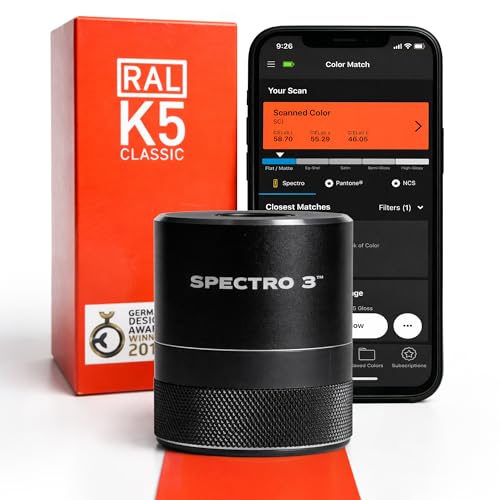
- Color and 60° gloss in one device
- 45/0° and d/8° optical geometries
- 1,000+ measurements per charge
Best For: Portable field and QC color matching
Value Calibration Pick
Portable 4mm Spectrocolorimeter

- Auto calibration with SCI and SCE
- Around 30 test parameters
- 26 selectable illuminants and USB storage
Best For: Routine portable color measurement
Complete Workflow Choice – ColorChecker Studio
The Calibrite ColorChecker Studio is an all-in-one option among spectrophotometer color calibration tools. It supports monitor, projector, printer, paper, camera, and scanner profiling, making it useful for photographers who want more consistent color from capture through final output.
Best For: Photographers and creative users managing camera-to-print color workflows.
Pros:
- Profiles displays, projectors, printers, paper, cameras, and scanners.
- Adaptive iterative profiling helps optimize results for individual displays.
- Includes ambient light measurement for improved print-to-screen comparisons.
- Includes a ColorChecker Classic Mini for custom camera profiling.
Cons:
- Its broad feature set may be more than users who only need monitor calibration require.
- Camera profiling uses the included Mini target, which may not suit every workflow or target size preference.
Choose this model when you need one device for several color-management tasks rather than a display-only solution. Its combination of device profiling and camera support makes it particularly practical for photography and print production.
Precision Measurement Pick – Handheld Colorimeter
This handheld spectrophotometer is a flexible choice among spectrophotometer color calibration tools for measuring samples in different sizes. Its five selectable apertures, horizontal design, broad measurement indicators, and ColorExpert software support detailed color analysis across varied materials.
Best For: Users measuring samples of different sizes who need multiple color metrics and evaluation light sources.
Pros:
- Offers five measuring apertures from 3 mm to 11 mm.
- Claims repeatability accuracy of dE*ab≤0.02.
- Provides more than 30 measurement parameters and nearly 40 evaluation light sources.
- Connects to ColorExpert software through Bluetooth or USB.
Cons:
- The supplied notes identify only the main host as an included component.
- The larger handheld dimensions may be less convenient for highly portable field use.
- Its advanced software and measurement options may require a learning curve.
This model stands out when aperture flexibility and measurement depth matter more than a simple point-and-read workflow. Verify software and connectivity requirements before purchase, especially if your setup depends on a specific computer environment.
Professional QC Companion – Nix Spectro L
The Nix Spectro L combines spectrophotometer and densitometer functions in a compact format. As one of the more portable spectrophotometer color calibration tools, it targets print, packaging, and graphic-arts users who need color identification, density readings, and Delta-E analysis in the field or at the workbench.
Best For: Print, packaging, graphic-arts, and other professional color-quality-control workflows.
Pros:
- Measures CMYK, ink density, RGB, HEX, and other color data.
- Supports Delta-E analysis for evaluating color differences.
- Uses M0, M1, and M2 measurement modes, including workflows involving optical brighteners.
- Works with the Nix Toolkit app and a library of more than 200,000 paint shades.
Cons:
- Enhanced Pantone, RAL, and NCS compatibility requires a subscription.
- Some library and cloud features depend on the Nix Toolkit app.
- The product is oriented toward professional workflows rather than basic display calibration.
The Nix Spectro L is a strong fit when portable color QC and broad data output are priorities. Its compact body and app-based library are convenient, while subscription requirements should be considered when planning ongoing costs.
High-Brightness Display Pick – Display Pro HL
The Calibrite Display Pro HL is a display-focused choice among spectrophotometer color calibration tools, designed for LCD, mini-LED, OLED, Apple XDR, and compatible projector workflows. Its high-luminance sensor measures up to 3000 nits, while PROFILER software adds validation and uniformity checks.
Best For: Photographers, designers, and studios calibrating bright modern displays or multiple monitors.
Pros:
- Measures displays up to 3000 nits, including high-brightness and HDR-oriented panels.
- Supports LCD, mini-LED, OLED, Apple XDR, laptops, desktops, and compatible projectors.
- PROFILER software offers adjustable white point, luminance, contrast ratio, gamma, and presets.
- Includes profile validation, uniformity checks, quick checks, and flare correction.
Cons:
- It is focused on display and projector calibration rather than printer, scanner, or camera profiling.
- Advanced controls and custom patch sets may be unnecessary for casual users.
- USB-C connectivity requires the included USB-A adapter for compatible older ports.
Select this model when your primary concern is accurate calibration across bright or modern displays. Multi-monitor support and validation tools make it especially useful for creative studios and users who need to verify screen consistency.
Multi-Aperture Precision Pick – Handheld Spectrocolorimeter
For buyers comparing spectrophotometer color calibration tools across manufacturing and quality-control workflows, this handheld spectrocolorimeter offers D/8 geometry, SCI/SCE modes, and ΔE*ab repeatability of ≤0.02. Its camera-assisted positioning and automatic whiteboard calibration are useful when repeatable measurements matter.
Best For: Color matching and quality control for coatings, textiles, plastics, food, building materials, and cosmetics.
Pros:
- D/8 optical structure with SCI/SCE measurement modes.
- Supports multiple color spaces and illumination sources.
- Camera positioning, automatic whiteboard calibration, and cloud color-database storage.
- Full-waveband LED plus UV lighting supports fluorescent-material measurements.
Cons:
- Its broad feature set may be more than needed for simple color checks.
- Cloud database and software features may require additional setup.
This is the most feature-rich option of the three for users who need flexible measurement standards, portable operation, and documented calibration support in a range of industries.
Print-Control Specialist – Nix Spectro 2 for Print Quality
Among spectrophotometer color calibration tools, the Nix Spectro 2 stands out as a focused option for print professionals. This 2mm model uses its included targeting jig to measure print control strips and is designed to work with print-quality workflows.
Best For: Print and packaging professionals measuring color for print quality control.
Pros:
- 2mm targeting is tailored to print control strips.
- Includes a targeting jig, ceramic tile, case, USB-C cable, pouch, and lanyard.
- Works with the free Nix Toolkit app and can integrate with Nix Print Pro.
- Offers a portable, cost-conscious alternative to a benchtop device.
Cons:
- The device will not function without the targeting jig.
- Nix Print Pro software is sold separately.
- Pantone, RAL, and NCS library compatibility is available through a subscription.
This is a specialized choice rather than a general-purpose color instrument. Its value is highest when precise 2mm print-strip targeting and a compatible print workflow are priorities.
Industrial Analysis Value – Portable Color Spectrometer
This portable color spectrometer is a practical candidate among spectrophotometer color calibration tools for industrial analysis. It combines stated ΔEab precision of ≤0.02 with an integrated positioning hole, nearly 40 selectable evaluation light sources, and more than 30 measurement indicators.
Best For: Manufacturing quality control and materials or coatings research requiring varied color metrics.
Pros:
- Designed for consistent measurements with ΔEab of ≤0.02.
- Offers nearly 40 selectable evaluation light sources.
- Measures spectrum reflectance, CIE-Lab, opacity, whiteness, and yellowness.
- Low-center horizontal design helps reduce movement during measurement.
Cons:
- The supplied notes do not specify included software or calibration accessories.
- Its 3.89-pound listed package weight may be less convenient for frequent handheld use.
Choose this model when measurement breadth is more important than a print-specific workflow. Its lighting options and extensive indicator set suit users comparing materials, coatings, and production samples.
Precision Lab Choice – Three Caliber Spectrophotometer Colorimeter
For demanding spectrophotometer color calibration tools needs, this horizontal colorimeter emphasizes repeatability, flexible apertures, and extensive evaluation options. It supports 3 mm, 6 mm, and 11 mm measuring apertures, with dE*ab≤0.02 repeatability and Windows ColorExpert software via Bluetooth or USB.
Best For: Laboratories, manufacturing teams, and color professionals handling varied sample sizes and requiring detailed measurement and color-management workflows.
Pros:
- Very high stated repeatability of dE*ab≤0.02.
- Three selectable apertures support different sample sizes.
- Offers more than 30 measurement parameters and nearly 40 evaluation light sources.
- Observation window helps users verify measurement positioning.
Cons:
- Its 3.31-pound, horizontal design is less portable than compact handheld tools.
- The broad feature set may be more than casual users need.
This is the most capability-focused option in the group, especially when repeatability, aperture flexibility, and PC-based color management matter more than portability.
Best Portable Workflow – Spectro 3 Mobile Color Matching Tool
The Spectro 3 is a practical choice among spectrophotometer color calibration tools when measurements need to happen in the field or across production areas. It combines color and 60° gloss measurement, supports multiple optical geometries, and connects to a mobile app for data capture and comparison.
Best For: Field professionals, paint and materials teams, and quality-control users who want portable color and gloss measurements with app-based workflows.
Pros:
- Compact 11.7-ounce design supports portable use.
- Combines color scanning with a 60° gloss meter.
- Supports 45/0° and d/8° optical geometries for varied materials.
- Offers 1,000+ measurements per charge and built-in UV illumination for fluorescence detection.
Cons:
- Advanced QC tracking requires the optional QC Module.
- App connectivity is part of the workflow, so users seeking a fully standalone tool may prefer another format.
Choose this model for mobility and workflow efficiency: it is especially useful when color, gloss, surface variety, and app-connected records are all part of the job.
Value Calibration Pick – Portable 4mm Spectrocolorimeter
This portable spectrocolorimeter offers useful spectrophotometer color calibration tools features in a straightforward package, including auto calibration, SCI and SCE testing, and an IPS full-color touch screen. Its 4 mm aperture and USB data storage function suit routine color checks and recordkeeping.
Best For: Users needing a portable color measurement tool with common material indicators, selectable illuminants, and simple onboard operation.
Pros:
- Supports both SCI and SCE testing for comparing measurement approaches.
- Auto calibration helps simplify setup.
- Provides about 30 test parameters, including opacity, whiteness, and yellowness indexes.
- Includes 26 illuminants and USB data storage.
Cons:
- Stated repeatability of Delta E*ab 0.08 is lower than the Three Caliber model’s specification.
- Requires two AA batteries.
This model is a sensible fit for routine color measurement when portability, automatic calibration, and broad everyday parameter coverage are priorities.
How We Picked These Spectrophotometer Color Calibration Tools
We focused on the capabilities that most affect real-world color work: measurement accuracy and repeatability, supported surfaces and materials, aperture or targeting options, software compatibility, portability, calibration process, and the type of workflow each instrument supports. The selection includes complete display-and-printer profiling systems, compact paint-matching devices, and larger instruments designed for production or quality-control environments.
Because specifications and software support can vary by seller or revision, verify the current documentation before purchase. Pay particular attention to operating-system compatibility, included calibration references, measurement geometry, and whether the required software or databases are included.
Quick Comparison
| Best For | Look For | Typical Product Type |
|---|---|---|
| Monitor and printer profiling | Profiler software, display support, printer or scanner workflows | Complete color-management spectrophotometer |
| Paint matching | Large color libraries, portable design, targeting aids | Handheld spectrophotometer or mobile color tool |
| Print and packaging inspection | Small apertures, repeatability, densitometry, quality-control software | Professional handheld or desktop instrument |
| Industrial color analysis | Multiple apertures, positioning features, data export, rugged construction | Portable or benchtop spectrocolorimeter |
Key Buying Factors for Spectrophotometer Color Calibration Tools
Workflow and Material Compatibility
Start with the surface you measure most often. Display calibration requires an instrument designed for screens, while paint, textiles, plastics, paper, and coatings may need different optics, contact methods, or databases. A device marketed for color matching is not automatically suitable for printer profiling or laboratory-style analysis.
Accuracy, Repeatability, and Measurement Geometry
Accuracy describes closeness to a reference; repeatability describes whether the tool produces the same result each time. Both matter in production. Aperture size also affects results: smaller openings help target tiny areas, while larger apertures can average texture or uneven color. Check the stated ΔE performance, calibration method, and supported measurement geometries rather than relying on marketing labels alone.
Software, Databases, and Connectivity
Hardware is only part of the system. Confirm whether the tool works with your operating system and preferred design, RIP, quality-control, or mobile software. Paint-matching users should check the size and regional availability of the color database. USB, wireless, or app connectivity can simplify data transfer, while export formats matter for repeatable production records.
Portability and Operating Cost
Handheld models suit contractors, retailers, field technicians, and facilities teams. Larger instruments may offer better positioning and workflow control but need a dedicated workspace. Also consider included calibration tiles, replacement references, batteries, warranty coverage, and subscription requirements.
Who Should Buy Which Spectrophotometer Color Calibration Tools?
Choose a complete color-management system if you need to profile monitors, projectors, printers, or scanners from one workflow. Choose a paint-focused handheld model if matching walls, finishes, or coatings is the main task and a built-in library is valuable. For print and packaging inspection, prioritize repeatability, densitometry, small target measurement, and reliable records. Industrial users should favor instruments with flexible apertures, positioning aids, broad material support, and software that integrates with existing quality systems.
For occasional home or studio use, avoid paying for industrial features you will not use. For commercial color-critical work, prioritize documented performance, calibration support, software longevity, and service availability over the lowest initial price.