The best powered docking stations turn a laptop into a more capable desktop workstation, adding display outputs, USB ports, networking, and charging through one organized connection.
We selected 10 options for different needs, from compact USB-C docks to high-output models built for triple 4K monitors and demanding office setups.
Best 10 Powered Docking Stations Picks for 2026
Premium Power Hub
Anker Prime 14-in-1 Dual-Monitor Dock

- 160W total output with charging for up to four devices
- 14 ports with 10Gbps data and dual HDMI
- Windows and ChromeOS dual-display workstation support
Best For: High-powered Windows or ChromeOS desk setups
Triple-Display Workstation

- Supports up to three extended HDMI displays
- 100W USB-C Power Delivery for host charging
- Six USB 3.0 ports plus Ethernet and audio
Best For: Hybrid teams and multi-monitor office workstations
Maximum Expansion
HODO 18-in-1 Triple-Display Dock

- 120W adapter with 30W phone or tablet charging
- Three-display Windows support and single 8K output
- 18 ports including card readers, Ethernet, and 10Gbps USB
Best For: Windows users needing maximum workstation expansion
Business-Ready Choice

- Up to 100W host power delivery
- Native support for up to four high-resolution displays
- Three-year warranty and enterprise manageability features
Best For: Managed business workspaces and office deployments
High-Power Privacy Pick
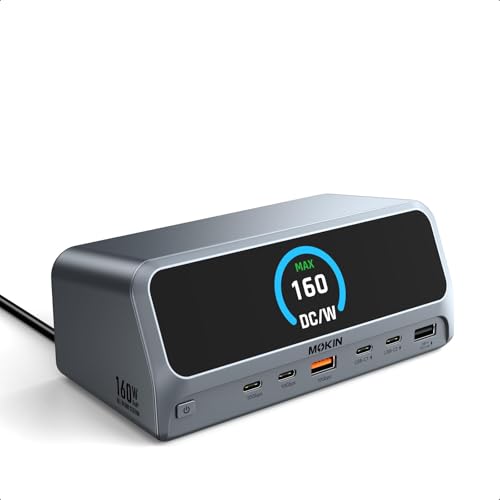
- 160W built-in power with up to 100W laptop PD
- Dual HDMI 4K@60Hz for Windows
- LCD status display and privacy button
Best For: Windows dual-monitor workstations
Most Versatile Setup

- Detachable 6-in-1 hub for travel
- Up to three external displays
- 140W adapter with 100W laptop charging
Best For: Desk-to-travel productivity
Business Desk Classic

- 180W dock with listed 130W PD
- HDMI plus dual DisplayPort outputs
- USB-C dock for Dell-focused setups
Best For: Compatible Dell office workstations
Best All-Around Powered Docking Station
Anker 13-in-1 Triple-Display Dock

- 13 ports with HDMI, DisplayPort, USB, Ethernet, and card readers
- 85W laptop charging with a 135W power adapter included
- Supports up to three 1080p displays on Windows and ChromeOS
Best For: Windows and ChromeOS desk setups needing broad connectivity
Best High-Power Powered Docking Station
Selore&S-Global 13-in-1 150W Dock

- 150W DC power delivery with 100W laptop charging
- Triple-monitor support plus single-monitor 4K@144Hz mode
- Includes HDMI, DisplayPort, USB, Ethernet, card readers, and audio
Best For: Power users needing high charging capacity and display flexibility
Best Port-Rich Powered Docking Station
TobenONE 18-in-1 Triple-4K Dock
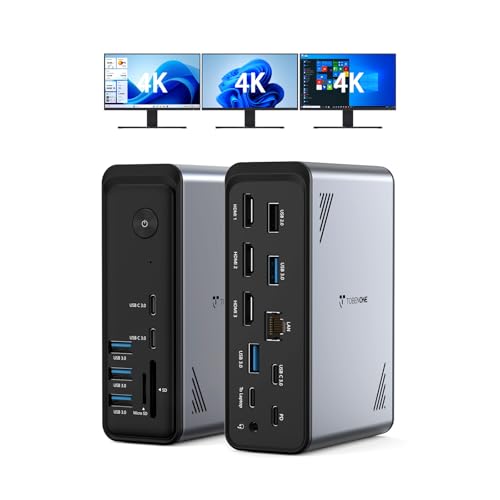
- 18 ports with nine USB connections and three HDMI outputs
- Supports dual or triple 4K@60Hz displays
- Provides up to 100W laptop charging
Best For: Windows and ChromeOS users with many peripherals and multiple 4K monitors
Premium Power Hub – Anker Prime 14-in-1 Dual-Monitor Dock
The Anker Prime is one of the more powerful docking stations for users who need extensive connectivity, fast data transfers, and dual-display support. Its 160W total output and broad USB-C compatibility make it a strong fit for demanding desktop setups, though macOS users should note that both external displays mirror the same content.
Best For: Windows, ChromeOS, and compatible USB-C laptop users building a dual-monitor workstation with high charging capacity.
Pros:
- 14-in-1 design includes dual HDMI, USB, audio, and Ethernet connectivity.
- 160W total output can charge up to four devices simultaneously.
- Supports data speeds up to 10Gbps and dual displays up to 2K at 60Hz with DP 1.4 systems.
- Includes a 24-month warranty.
Cons:
- macOS mirrors the same image on both external monitors.
- Not compatible with Linux.
- Does not support a 5120×1440 monitor.
Choose this dock when charging capacity and a wide selection of ports matter more than macOS display flexibility. It is especially well suited to Windows-based productivity setups.
Triple-Display Workstation – Plugable 12-in-1 USB-C Dock
The Plugable USB-C dock is designed for offices and hybrid teams that need powered docking stations with triple-monitor capability. It combines 100W host charging, three HDMI outputs, wired Gigabit Ethernet, and six USB 3.0 peripheral ports, with DisplayLink support helping extend displays on newer MacBooks.
Best For: Hybrid workstations, managed office deployments, and users who need up to three extended HDMI displays across Windows, macOS, or ChromeOS.
Pros:
- Supports up to three extended HDMI displays, including two 1080p displays at 60Hz through DisplayLink.
- 100W USB-C Power Delivery keeps the host laptop charged.
- Includes six USB 3.0 ports, Gigabit Ethernet, audio, and broad system compatibility.
- Backed by North American-based technical support and a compatibility guarantee.
Cons:
- macOS requires driver installation for DisplayLink functionality.
- Not compatible with Linux.
- HDCP is not supported.
This is a practical choice for multi-monitor productivity, particularly in mixed-device offices. Confirm DisplayLink requirements and application compatibility before deploying it across a fleet.
Maximum Expansion – HODO 18-in-1 Triple-Display Dock
The HODO 18-in-1 dock is a feature-heavy option for powered docking stations, pairing a bundled 120W adapter with multiple display outputs, fast USB ports, card readers, Ethernet, and phone charging. It is particularly flexible for Windows users who want three displays or a single 8K screen from one dock.
Best For: Windows laptop users who need extensive peripheral expansion, triple-display support, and simultaneous laptop and phone charging.
Pros:
- 18-in-1 design includes two HDMI ports, DisplayPort, Ethernet, audio, and SD/TF card readers.
- Included 120W adapter supports laptop power plus 30W USB-C charging for a phone or tablet.
- Windows systems can use triple displays, while single-display setups can reach 8K.
- Includes 10Gbps USB ports and a screen on/off button.
Cons:
- The 120W power adapter must be connected before using the display functions.
- macOS and iPadOS mirror connected displays rather than extending them independently.
- Compatibility depends on a USB-C or Thunderbolt port with DisplayPort support.
Its large port selection makes it attractive for a permanent workstation with storage cards, wired networking, several accessories, and multiple screens. Windows users get the broadest display functionality.
Business-Ready Choice – Dell Pro WD25 Docking Station
The Dell Pro WD25 is a business-focused option among powered docking stations, delivering up to 100W to the host and native support for as many as four high-resolution displays. Its flexible cable routing, enterprise manageability, and broad operating-system support make it suited to standardized office workspaces.
Best For: Business users and IT teams managing Dell or non-Dell PCs across Windows, Ubuntu, Red Hat Enterprise Linux, and ChromeOS environments.
Pros:
- Provides up to 100W of power for compatible Dell and non-Dell PCs.
- Supports up to four high-resolution displays.
- Includes HDMI, DisplayPort, USB, Ethernet, and USB-C connectivity.
- Offers a three-year limited hardware warranty with Advanced Exchange.
Cons:
- Its feature set is oriented toward office deployment rather than card-reader expansion.
- Display and charging performance depend on the connected computer and its supported interfaces.
- The supplied notes specify Windows 10/11, Ubuntu 24.04, Red Hat Enterprise Linux 9.6+, and ChromeOS compatibility rather than universal OS support.
The WD25 is a sensible pick for organizations prioritizing manageability, durability, and broad multi-display support. Its sustainability features and long warranty further reinforce its office-ready focus.
High-Power Privacy Pick – MOKiN LumiNext DD01
The MOKiN LumiNext DD01 is one of the more feature-rich powered docking stations for a Windows workstation. Its built-in power supply, dual 4K HDMI output, smart LCD status display, and privacy button make it suited to users who want broad connectivity without a separate power brick.
Best For: Windows users building a dual-monitor home office or multitasking workstation.
Pros:
- Built-in 160W power supply provides up to 100W laptop charging and supports charging for additional devices.
- Supports dual HDMI displays at up to 4K@60Hz, with Windows extend or mirror modes.
- LCD display shows connection and power-delivery status, while the physical button can cut off data and video transmission.
- Includes 10Gbps USB ports, Gigabit Ethernet, and 13 total ports.
Cons:
- macOS supports mirrored displays only rather than an extended dual-monitor desktop.
- Requires a laptop with a full-function USB-C or Thunderbolt port.
Choose this MOKiN when charging capacity, monitoring, and privacy controls matter as much as port count. It is particularly compelling for Windows-based desks that need two high-resolution screens and fast peripheral connections.
Most Versatile Setup – Anker Nano 13-in-1 Dock
The Anker Nano is a flexible powered docking station that combines a full desktop dock with a detachable 6-in-1 USB-C hub. It can support up to three monitors, wired networking, storage cards, audio, and fast data transfer, while the included 140W adapter provides up to 100W laptop charging.
Best For: Professionals who switch between a fully equipped desk and mobile work.
Pros:
- Detachable design provides both a 13-in-1 desktop dock and a portable 6-in-1 hub.
- Supports up to three displays, with 4K@60Hz single-display output or triple 1080p@60Hz output.
- Offers HDMI, DisplayPort, USB-C, USB-A, Ethernet, audio, and SD/TF card connectivity.
- Includes a 140W power adapter and supports up to 100W Power Delivery to the laptop.
Cons:
- macOS supports mirrored mode only across multiple external displays.
- The dock and its ports activate only when connected to a laptop through the upstream port.
- Compatibility is focused on laptops with full-function USB-C or Thunderbolt connectivity.
The detachable hub is the main reason to choose this Anker model over a conventional dock. It offers a practical balance for users who need substantial desktop connectivity but also want a travel-friendly accessory without buying two separate devices.
Business Desk Classic – Dell WD19S 180W
Dell WD19S 180W Docking Station (130W Power Delivery) USB-C, HDMI, Dual DisplayPort, Black
Check Price On AmazonThe Dell WD19S is a straightforward powered docking station designed around USB-C connectivity and Dell’s business-oriented workspace setup. Its 180W dock power rating and support for HDMI and dual DisplayPort connections make it a sensible option for compatible office laptops and multi-display desks.
Best For: Dell-focused business users who want a conventional desk dock.
Pros:
- Provides a 180W power supply with up to 130W power delivery listed for compatible systems.
- Supports HDMI and dual DisplayPort connections for multi-display setups.
- Uses USB-C connectivity and includes six USB ports according to the supplied specifications.
- Compact black design fits a professional office environment.
Cons:
- The supplied information provides fewer detailed port specifications than the newer multiport models.
- Compatibility is described as particularly suited to Dell USB-C devices, so users should verify laptop support.
- The listed specifications contain differing wattage figures, including 90W and 130W power details.
The WD19S is best considered when dependable Dell ecosystem compatibility is the priority rather than maximum travel flexibility or a large assortment of modern ports. Confirm the exact laptop and display requirements before purchasing.
Best All-Around Powered Docking Station – Anker 13-in-1 Triple-Display Dock
This Anker powered docking station is a practical choice for turning a compatible laptop into a compact desktop workstation. It combines 13 ports, an included 135W power adapter, 85W laptop charging, and support for up to three 1080p displays on Windows and ChromeOS.
Best For: Windows and ChromeOS users who need broad connectivity, triple-display multitasking, and included desktop-grade power delivery.
Pros:
- Includes HDMI, DisplayPort, USB-C, USB-A, Ethernet, SD/microSD, audio, and DC-IN connections.
- Charges a laptop at up to 85W and a phone at up to 18W simultaneously.
- Supports up to three 1080p@60Hz external monitors on compatible Windows and ChromeOS systems.
- Compact vertical design and an 18-month warranty add practical everyday value.
Cons:
- macOS limits connected displays to mirror mode rather than extended desktop mode.
- The host laptop must support full-functional USB-C with DisplayPort Alt Mode and Power Delivery.
Its included power adapter and strong port selection make this a well-rounded powered docking station for a fixed desk setup. Mac users can still use its charging and data features, but should account for the display limitation.
Best High-Power Powered Docking Station – Selore&S-Global 13-in-1 150W Dock
This Selore&S-Global powered docking station emphasizes high power delivery and flexible display support. Its 150W DC input, 100W laptop charging, 30W USB-C output, and 13-port layout suit demanding Windows or Linux workspaces, while its high-refresh-rate support is intended for compatible single-monitor setups.
Best For: Users who prioritize high power delivery, triple-monitor connectivity, or single-monitor 4K high-refresh-rate support.
Pros:
- Provides 150W DC power delivery, with up to 100W for the laptop and 30W for USB-C accessories.
- Offers two HDMI ports, DisplayPort, USB connections, Gigabit Ethernet, card readers, and audio.
- Supports up to three monitors through two HDMI ports and DisplayPort on compatible systems.
- Single-monitor mode can reach 4K@144Hz on Windows through DisplayPort 1.4.
Cons:
- macOS supports screen mirroring rather than an extended desktop.
- 4K@144Hz is limited to a single monitor; using multiple displays requires lower resolutions.
- Power delivery is dynamically allocated when the laptop and USB-C accessories are used together.
This is a strong option when charging capacity and display flexibility matter more than simplicity. Check your operating system, USB-C or Thunderbolt compatibility, and desired multi-monitor resolution before buying.
Best Port-Rich Powered Docking Station – TobenONE 18-in-1 Triple-4K Dock
The TobenONE 18-in-1 powered docking station is designed for Windows and ChromeOS users who need many connections from one cable. It provides nine USB/PD/host connections, three HDMI outputs, card readers, Ethernet, audio, and support for dual or triple 4K@60Hz displays on compatible systems.
Best For: Windows and ChromeOS workstations with numerous peripherals, multiple 4K monitors, and a need for up to 100W laptop charging.
Pros:
- Offers 18 ports, including nine USB connections, three HDMI outputs, Ethernet, SD/microSD, and audio.
- Supports dual or triple 4K@60Hz displays on compatible Windows and ChromeOS laptops.
- Provides up to 100W PD charging for the connected laptop.
- Works with full-featured USB-C, USB4, and Thunderbolt 3/4 Windows and ChromeOS systems.
Cons:
- A power supply is not included; stable operation requires an additional power source rated above 65W.
- The supplied details specify compatibility primarily with Windows and ChromeOS systems rather than macOS.
- Display and charging performance depends on the laptop’s compatible full-featured USB-C or Thunderbolt connection.
With its unusually large port count and triple-4K capability, this powered docking station targets a permanent, peripheral-heavy desk. The missing power supply is the key purchasing consideration, so budget for a suitable adapter.
How We Picked the Best Powered Docking Stations
We evaluated these Powered Docking Stations by looking at the features that matter most in daily use: charging output, display support, port variety, compatibility, connection reliability, and overall setup convenience. We also considered whether each dock includes its own power adapter, since a powered model can deliver more consistent performance than a basic bus-powered hub.
Display capability was another priority. Some docks are suited to one or two external monitors, while others support three displays or higher resolutions. Because operating-system support and video standards vary, buyers should verify the dock’s requirements before ordering.
Quick Comparison
- Best for premium versatility: Anker Prime Docking Station, with a broad selection of ports and dual-monitor support.
- Best for triple-display productivity: Plugable’s 100W model, which offers three HDMI outputs.
- Best for business laptops: Dell Pro WD25 or Dell WD19S, especially for compatible Dell systems and office peripherals.
- Best for high-output setups: The 150W and 160W options, which are designed for systems needing substantial external power.
- Best for maximum connectivity: TobenONE’s 18-in-1 dock, with extensive USB and multi-monitor support.
Key Buying Factors for Powered Docking Stations
Power Delivery and Included Adapters
Check both the dock’s adapter rating and its actual laptop power-delivery output. A larger adapter does not always mean the laptop receives the full wattage. Match the dock to your computer’s charging requirement, particularly for performance laptops.
Monitor Support
Confirm the number and type of outputs—HDMI, DisplayPort, or USB-C—as well as supported resolution and refresh rate. Triple-monitor docks may rely on DisplayLink or another technology, which can require drivers and may behave differently across Windows, macOS, and ChromeOS.
Ports and Connectivity
Count the ports you will use regularly, including USB-A, USB-C, Ethernet, audio, card readers, and dedicated display connections. High-speed USB ports are useful for external SSDs, while Ethernet can provide a steadier connection than Wi-Fi.
Compatibility and Desk Setup
Review operating-system support, host connection requirements, and whether your laptop supports video over USB-C. Also measure cable reach and dock placement so the setup remains tidy and accessible.
Who Should Buy Which Powered Docking Stations?
Choose a compact Anker Nano or similar 13-in-1 model if you want to expand a laptop without taking much desk space. Pick a dual-monitor dock for standard office multitasking, or choose a triple-display model if you manage large spreadsheets, dashboards, editing timelines, or multiple applications at once.
Dell users may benefit from Dell’s WD25 or WD19S for a more integrated business setup, while buyers with mixed-brand laptops should prioritize broadly documented USB-C compatibility. For demanding workstations, favor a dock with strong power delivery, multiple high-resolution outputs, and an included adapter rated for your laptop’s needs.