A docking station with an Ethernet port can turn a laptop into a more capable desktop workstation, adding wired internet, external displays, charging, and useful USB connectivity through one compact setup.
We selected 10 versatile options for home offices, hybrid work, creative tasks, and multi-monitor productivity, with different port layouts, display capabilities, and power-delivery specifications to fit a range of laptops and budgets.
Best 10 Docking Station with Ethernet Port Picks for 2026
Versatile Triple-Display Hub

- Dual HDMI and DisplayPort support
- Gigabit Ethernet and 10Gbps USB
- 100W PD input with 87W laptop charging
Best For: Windows multi-monitor workstations
Compact Everyday Hub

- Gigabit Ethernet in a portable 82g design
- 4K HDMI output at 30Hz
- 65W pass-through charging support
Best For: Travel and basic home-office connectivity
Windows Dual-Screen Dock
WAVLINK 10-in-1 Docking Station
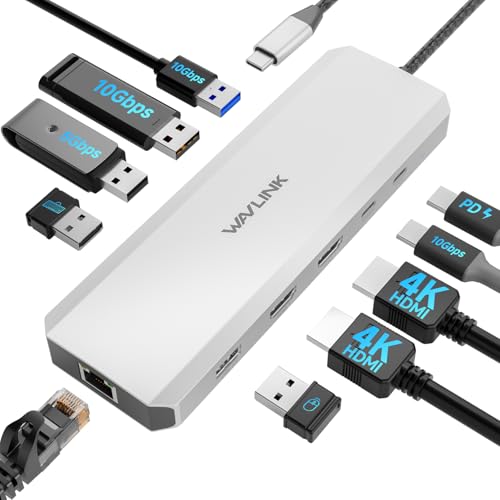
- Dual HDMI for Windows displays
- Three 10Gbps USB ports
- Gigabit Ethernet and up to 85W charging
Best For: Windows dual-monitor workstations
Portable Ethernet Essential

- 1000Mbps Gigabit Ethernet
- 4K HDMI at 30Hz
- Up to 85W pass-through charging
Best For: Portable laptop and MacBook setups
Best for Home and Travel

- Detachable 6-in-1 hub for travel
- Gigabit Ethernet and card readers
- Up to three displays with 100W charging
Best For: Home-office users who also need a portable USB-C hub
Best for Triple 4K Workstations

- Drives three 4K displays at 60Hz
- Six HDMI and DisplayPort outputs
- 100W charging with wired Ethernet
Best For: Demanding office and IT workstations needing three 4K screens
Best for Triple Displays
WAVLINK 12-in-1 Triple-Monitor Dock

- Single 4K or triple 1080p display support
- Gigabit Ethernet plus extensive ports
- Up to 85W laptop power delivery
Best For: Windows multi-monitor workstations needing many connections
Best Dual-HDMI Value
UGREEN 10-in-1 Dual-Monitor Dock

- Dual 4K@60Hz or single 8K@30Hz HDMI
- 1Gbps Ethernet and SD/MicroSD readers
- Up to 85W pass-through charging
Best For: Compact dual-monitor laptop desks
Best for Port Variety
MOKiN 13-in-1 Dual-Monitor Dock

- Dual 4K@60Hz display support
- Four USB-C plus four USB-A ports
- 1Gbps Ethernet and screen-lock button
Best For: Power users needing many USB connections
Versatile Triple-Display Hub – 13-in-1 USB-C Docking Station
If you need a docking station with ethernet port plus extensive display and peripheral support, this 13-in-1 LIONWEI model offers a broad selection of connections. It includes dual HDMI, DisplayPort, multiple USB ports, audio, Gigabit Ethernet, and 100W Power Delivery input.
Best For: Windows users building a multi-monitor workstation with several USB peripherals.
Pros:
- Supports up to three displays on Windows, with HDMI and DisplayPort output up to 4K at 60Hz when supported by the source.
- Includes Gigabit Ethernet, two 10Gbps USB-C ports, USB 3.1, three USB 3.0 ports, and two USB 2.0 ports.
- Offers 100W PD input, with up to 87W available for laptop charging after the dock’s power usage.
- Includes a 3.5mm audio/mic jack and an 18-month warranty.
Cons:
- macOS can extend only one monitor.
- Triple-display and high-resolution modes depend on the host computer and operating system.
This is a feature-rich choice when Ethernet, multiple screens, fast USB connectivity, and audio are all important. Mac users should account for its more limited extended-display support.
Compact Everyday Hub – Anker 6-in-1 Ethernet Adapter
The Anker PowerExpand 6-in-1 is a compact docking station with ethernet port for laptops and tablets that need essential connectivity without a large desktop dock. It combines Gigabit Ethernet, HDMI, USB data ports, and pass-through charging in a lightweight aluminum enclosure.
Best For: Home offices, travel, and users who need wired networking alongside basic USB expansion.
Pros:
- Provides an Ethernet port, HDMI, USB-C data, and two USB-A data ports in a six-port design.
- Supports up to 4K at 30Hz through HDMI for an external display.
- Accepts up to 65W input for pass-through laptop charging.
- Compact 82-gram aluminum design and an 18-month warranty make it convenient for portable use.
Cons:
- HDMI output is limited to 4K at 30Hz.
- Its USB data transfer rate is up to 5Gbps rather than 10Gbps.
- It provides fewer ports and less display expansion than larger docking stations.
This Anker hub is a practical pick for adding reliable wired networking and everyday peripherals to a laptop or tablet. Its modest display and USB specifications are best suited to routine office use.
Windows Dual-Screen Dock – WAVLINK 10-in-1 Docking Station
For Windows users seeking a docking station with ethernet port and dual-monitor support, the WAVLINK 10-in-1 combines Gigabit Ethernet with fast USB connections, dual HDMI, and 100W Power Delivery input. It is designed to organize a workstation around one USB-C connection.
Best For: Windows desk setups that need two external HDMI displays and fast peripheral connectivity.
Pros:
- Includes dual HDMI with support listed as 4K at 60Hz plus 4K at 30Hz for Windows systems.
- Provides Gigabit Ethernet, two 10Gbps USB-A ports, one 10Gbps USB-C port, two USB 3.0 ports, and USB 2.0.
- Supports 100W PD input, with up to 85W available for laptop charging.
- Includes a two-year warranty and aluminum construction.
Cons:
- Not compatible with macOS.
- Charger is not included, and the recommended charger must be 20V/5A/100W.
- Display performance requires compatible host features such as DP 1.4 with DSC.
This dock is particularly compelling for a Windows workstation where dual HDMI monitors and 10Gbps USB ports matter. Confirm laptop compatibility and charging requirements before buying.
Portable Ethernet Essential – UGREEN Revodok 6-in-1 Hub
The UGREEN Revodok is a straightforward docking station with ethernet port for adding wired networking, one external display, USB-A accessories, and laptop charging through a single USB-C connection. Its Gigabit RJ45 port is rated for up to 1000Mbps, while HDMI supports 4K at 30Hz.
Best For: Laptop, tablet, and MacBook users who want dependable Ethernet and essential expansion in a six-port hub.
Pros:
- Offers Gigabit Ethernet with a stated speed of up to 1000Mbps for more consistent wired connectivity.
- Includes 4K at 30Hz HDMI output for meetings, presentations, and media.
- Provides three USB-A 3.0 ports with transfer speeds up to 5Gbps.
- Supports 100W input and up to 85W pass-through charging, with a 24-month warranty.
Cons:
- The USB-C port supports charging only, not data or video.
- HDMI does not support HDR or 3D.
- A charger is not included in the supplied product information.
This compact UGREEN hub covers the core needs of a portable workstation, especially when wired Ethernet is more important than multiple displays. Its single HDMI output and charging-only USB-C port keep the feature set focused.
Best Multi-Display Value – Selore 10-in-1 USB-C Dock
If you need a docking station with ethernet port for a Windows multi-monitor setup, the Selore offers a broad selection of display and connectivity options in a compact aluminum chassis. It includes Gigabit Ethernet, dual HDMI, DisplayPort, VGA, USB ports, and 100W PD input.
Best For: Windows users who want to connect up to three 4K displays, or a single 8K display, while adding wired networking and USB expansion.
Pros:
- Supports up to three independent 4K displays on Windows through dual HDMI and DisplayPort.
- Gigabit Ethernet provides a wired connection for video calls and large file transfers.
- Includes VGA, three USB data ports, 100W PD input, and a monitor-control button.
Cons:
- macOS mirrors the same content across connected external monitors.
- Connected laptops must support DisplayPort Alt Mode over USB-C or Thunderbolt.
The Selore is a flexible choice when display variety matters, particularly for Windows workstations using newer and legacy monitors. Mac users should choose it only if mirrored displays meet their needs.
Best for Home and Travel – Anker Nano 13-in-1 Dock
The Anker Nano is a docking station with ethernet port designed to cover both desk and travel use. Its detachable 6-in-1 USB-C hub separates from the 13-in-1 base, while the full dock adds three display outputs, card readers, audio, USB expansion, Gigabit Ethernet, and 100W laptop charging.
Best For: Users who want one dock for a home office and a detachable hub for mobile work, with flexible triple-display support on compatible laptops.
Pros:
- Detachable 6-in-1 hub provides a convenient portable option.
- Supports one 4K display, dual 2K displays, or triple 1080p displays at 60Hz.
- Includes Gigabit Ethernet, SD/TF card slots, audio, 10Gbps USB-C data, and a 140W power adapter.
Cons:
- macOS supports mirrored mode only across multiple external displays.
- The dock requires an upstream laptop connection to activate its ports.
For a mixed home-office and travel setup, the detachable design is the main advantage. It also offers a particularly complete port selection, although macOS users should account for the mirrored-display limitation.
Best for Triple 4K Workstations – Plugable UD-ULTC4K Dock
The Plugable UD-ULTC4K is a docking station with ethernet port aimed at demanding workstation setups. It combines wired Ethernet, USB expansion, audio, SD cards, 100W laptop charging, and six display outputs, supporting up to three 4K 60Hz monitors on compatible systems.
Best For: Developers, analysts, IT deployments, and office users who need three 4K screens and broad compatibility across Windows, macOS, and ChromeOS.
Pros:
- Supports up to three 4K 60Hz monitors with three HDMI and three DisplayPort outputs.
- Provides up to 100W Power Delivery for the laptop and up to 20W accessory charging.
- Works with supported Windows, macOS, and ChromeOS systems and includes lifetime support.
Cons:
- DisplayLink drivers are required on macOS, along with Screen Recording permission.
- HDCP is not supported, so protected streaming content may not play on connected displays.
This is the strongest fit for a fixed, high-screen-count workstation where display flexibility and wired networking are priorities. Its driver requirement and HDCP limitation make it less convenient for some Mac and streaming-focused setups.
Best for Triple Displays – WAVLINK 12-in-1 Triple-Monitor Dock
If you need a docking station with ethernet port plus broad peripheral support, this WAVLINK model combines Gigabit Ethernet, dual DisplayPort, HDMI, USB ports, card readers, audio, and up to 85W laptop charging in one compact aluminum dock. It can drive a single 4K display or three 1080p displays on compatible Windows setups.
Best For: Windows users building a multi-monitor workstation with extensive USB, storage, networking, and audio needs.
Pros:
- Supports one 4K@60Hz display or three 1080p@60Hz displays under DP1.4.
- Includes Gigabit Ethernet, dual DisplayPort, HDMI, SD/TF readers, USB ports, and audio/mic connectivity.
- Provides up to 85W power delivery from a 100W input.
- Works with a wide range of Windows, macOS, Chrome OS, Linux, iPadOS, HarmonyOS, and Android OTG devices.
Cons:
- Charger and charging cable are not included.
- The host USB-C port must support video output and charging.
- On macOS, connected displays are limited to the same content.
Choose this dock when your priority is maximum connectivity and three-screen expansion, especially on Windows. Verify your laptop’s USB-C capabilities and plan to supply your own compatible charger.
Best Dual-HDMI Value – UGREEN 10-in-1 Dual-Monitor Dock
UGREEN’s compact 10-in-1 dock is a practical docking station with ethernet port for dual-display setups. It adds two HDMI outputs, a 1Gbps RJ45 connection, SD and MicroSD readers, USB data ports, and up to 85W pass-through charging from a 100W USB-C power source.
Best For: Laptop users who want two HDMI monitors, wired networking, card readers, and everyday USB connectivity in a compact dock.
Pros:
- Supports dual 4K@60Hz displays or a single 8K@30Hz HDMI display when the host supports it.
- Includes 1000Mbps Ethernet, SD/MicroSD readers, USB-C data, and USB-A ports.
- Accepts up to 100W input and provides up to 85W pass-through charging.
- Compact aluminum design measures about 4.49 by 1.75 by 0.63 inches.
Cons:
- macOS mirrors the same content across both external monitors.
- The USB-A and USB-C data ports do not provide charging or video output.
- The USB-C PD port supports charging only, not data transfer or video.
This UGREEN dock is a well-rounded choice for a straightforward dual-HDMI desk setup. It is especially appealing if reliable wired networking and memory-card access matter as much as monitor support.
Best for Port Variety – MOKiN 13-in-1 Dual-Monitor Dock
For users who need a docking station with ethernet port and a large selection of USB connections, the MOKiN 13-in-1 dock offers two HDMI outputs, a 1000Mbps RJ45 port, four USB-C 3.0 ports, USB-A ports, and a 100W USB-C charging input. A dedicated lock button can also turn off connected screens quickly.
Best For: Dell, HP, and Lenovo laptop users who need abundant USB connectivity, dual 4K monitors, wired networking, and convenient screen privacy control.
Pros:
- Supports dual 4K@60Hz displays with a compatible DP1.4 USB-C host.
- Offers four USB-C 3.0, two USB-A 3.0, and two USB-A 2.0 ports.
- Includes 1000Mbps Ethernet for stable wired networking.
- Features a screen-lock button and up to 100W USB-C power delivery.
Cons:
- The computer must have a full-function USB-C port or Thunderbolt 3/4 support for the listed capabilities.
- A compatible charger is required for laptop power delivery.
- Its supplied notes do not list SD or MicroSD card readers.
The MOKiN stands out when port count and USB-C expansion are more important than card-reader support. Check your laptop’s USB-C specifications before buying to ensure dual 4K output and charging will work as expected.
How We Picked the Best Docking Station with Ethernet Port
We compared these docking stations by looking at Ethernet performance, port selection, display support, charging capability, operating-system compatibility, and practical design. We also considered whether each model suits a simple single-monitor desk, a dual-display workstation, or a more demanding triple-monitor arrangement.
Because USB-C ports do not all support the same features, compatibility matters as much as the number of ports. A dock may require USB-C DisplayPort Alt Mode, Thunderbolt, a specific driver, or a compatible host laptop to deliver its advertised display setup.
Quick Comparison
- Best for basic wired connectivity: A compact 6-in-1 hub with Gigabit Ethernet, HDMI, and USB ports.
- Best for flexible home offices: A 10-in-1 or 13-in-1 dock with dual-display support, card readers, and several USB connections.
- Best for demanding setups: A triple-monitor dock with higher-wattage power delivery and DisplayPort or HDMI flexibility.
- Best for portability: A detachable or compact USB-C hub that can travel between home, office, and classroom setups.
Key Buying Factors for a Docking Station with Ethernet Port
Ethernet Speed and Stability
Look for Gigabit Ethernet if you regularly transfer large files, use cloud applications, stream high-resolution media, or need consistent video-call performance. A wired connection is generally more stable than Wi-Fi, but actual speeds still depend on your router, network plan, and laptop connection.
Display Outputs
Check the supported resolution and refresh rate for each HDMI or DisplayPort output. Dual-monitor support is not always available on every operating system, and some triple-display docks use DisplayLink technology that may require software. Confirm whether your laptop can drive the number of screens you want.
Power Delivery and Port Selection
Choose a dock that supports enough USB-C power delivery for your laptop. A higher advertised wattage does not always equal the power reaching the computer, since the dock itself uses some power. Also verify the mix of USB-A, USB-C, audio, SD, and microSD ports before buying.
Compatibility and Setup
Review compatibility with Windows, macOS, ChromeOS, and your specific laptop model. Macs may have limitations with extended displays, while some systems need drivers or firmware updates. A permanently installed desk setup can benefit from a larger powered dock; travelers may prefer a bus-powered hub.
Who Should Buy Which Docking Station with Ethernet Port?
Choose a compact hub if you mainly need Ethernet, HDMI, and a few USB ports without a permanent workstation. Choose a 10-in-1 or 13-in-1 dock if you want one-cable access to multiple peripherals, storage cards, displays, and charging. Choose a triple-monitor model if your workflow depends on several screens and your laptop, operating system, and software support the required display technology.
Before ordering, compare the dock’s host connection with your laptop’s specifications, then confirm display resolution, charging needs, and Ethernet speed. Those checks will help you select a Docking Station with Ethernet Port that works reliably rather than simply offering the largest number of connections.