Choosing the right physics lab equipment for students can make the difference between abstract lessons and real understanding. The best kits are durable, accurate, and simple enough for classroom use.
From electricity and magnetism to optics, motion, and simple machines, this roundup highlights versatile tools that support hands-on learning at school, at home, or in a STEM lab.
Best 10 Physics Lab Equipment for Students Picks for 2026
Electricity and Magnetism Starter Kit
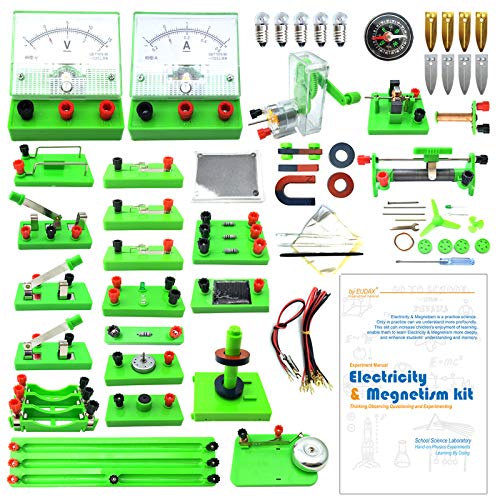
- 56 electricity parts plus 21 magnetism parts
- Includes manual and storage bag
- Builds circuits, electromagnet, and generator projects
Best For: High school beginners studying electricity and magnetism
Slotted Mass Set
Chromium-Plated Balance Weights

- Durable chromed steel construction
- ±2% accuracy for basic lab work
- Good for force, torque, and balance studies
Best For: Mechanics labs that need basic weight sets
Advanced Electricity and Magnetism Kit

- 55 electricity parts and 22 magnetism parts
- Includes sensitive ammeter and magnetic switch
- Double-layer storage box keeps parts organized
Best For: Junior and senior high students exploring circuits and magnetism
Optical Lens and Prism Set

- Six acrylic prisms, lenses, and mirror piece
- Supports refraction and reflection demos
- Compact and easy to store
Best For: Optics lessons and classroom light demonstrations
Dynamics Carts

- Two-cart set for motion and collision labs
- Low-friction wheels and weight wells
- Spring and rubber bumpers included
Best For: Students learning Newton's laws and momentum in classroom or home labs
Optics Set

- Covers refraction and reflection experiments
- Includes lenses, prism, reflector, and light source
- Compact set for classroom demonstrations
Best For: Teachers and students studying basic optics concepts
Hall's Carriage

- Single cart for Newton's law experiments
- Sleeve-bearing wheels reduce vibration
- Built-in mass well and string attachment
Best For: Middle and high school motion and energy demonstrations
Optics Starter Kit
6-Piece Acrylic Lens and Prism Set

- 6 acrylic prisms and lenses for refraction demos
- One-piece molding for durability and easy cleaning
- Includes a storage box for transport and organization
Best For: Student optics demos and classroom light experiments
Electricity & Magnetism Kit
DIY Circuit and Electromagnet Discovery Set

- Full-color manual for basic electromagnet and circuit lessons
- Builds include simple, series, parallel, and magnet car projects
- Made for guided student practice and classroom reinforcement
Best For: Guided electricity and magnetism lessons for students
Motion & Forces Kit
Adjustable Inclined Plane Set with Cart and Block

- Adjustable ramp with built-in angle scale for force studies
- Cart supports added weights for motion exploration
- Includes cart, ramp, and wooden block for simple machine demos
Best For: Hands-on inclined plane and force experiments
Electricity and Magnetism Starter Kit – Hands-On Physics Lab Set
If you’re comparing physics lab equipment for students, this EUDAX kit is a practical way to introduce electricity and magnetism with guided, hands-on experiments. It includes a full-color manual and a wide mix of parts for building simple circuits, exploring electromagnetism, and trying classic classroom activities.
Best For: High school students who need a broad introductory electricity and magnetism kit for guided lab work.
Pros:
- Includes 56 electricity items and 21 magnetism items for many experiment types
- Supports projects like series and parallel circuits, fruit battery, electromagnet, and hand crank generator
- Full-color manual helps students learn, think, and explore step by step
- Comes with a storage bag to keep parts organized
Cons:
- Batteries are not included and require 3 AA batteries
- Best suited to guided learning rather than open-ended advanced lab work
This is a solid starter option when you want a classroom-ready kit that covers a lot of basic electricity and magnetism concepts in one package. The mix of parts and experiments makes it useful for structured labs and student exploration.
Slotted Mass Set – Chromium-Plated Balance Weights
For physics lab equipment for students focused on mechanics, this slotted mass set is a simple tool for balance testing and weight determination. The chromed steel construction is made for classroom or laboratory use, and the set is meant to support experiments with force, pressure, and torque.
Best For: Classroom mechanics labs that need basic slotted weights for force and balance experiments.
Pros:
- Chromed high-quality steel construction is built for durability
- Rated at ±2% accuracy for basic measurement work
- Useful for studying force, torque, pressure, and balance
- Includes 4 sets of weights with hangers for lab use
Cons:
- Each set totals only 100g, so it is limited to lighter demonstrations
- Primarily suited to introductory classroom exercises
This is a straightforward lab accessory rather than a full experiment kit, but it fills an important role in mechanics teaching. If your students need reliable weights for balance and force activities, it is an easy, practical pick.
Advanced Electricity and Magnetism Kit – Double-Layer STEM Box
Among physics lab equipment for students, this electricity and magnetism kit stands out for its larger part count and sturdier storage. It is designed to help junior and senior high school students explore circuits, electromagnetism, and magnetic fields with a detailed manual that explains both the steps and the required equipment.
Best For: Older students who want a more complete hands-on electricity and magnetism lab kit.
Pros:
- Includes 55 electricity items and 22 magnetism items for varied experiments
- Manual explains experiment content, steps, and equipment needed
- Features a sensitive ammeter, magnetic switch, and Joule’s first law module
- Comes in a sturdy double-layer storage box with fixed item positions
Cons:
- Requires 3 AA batteries, which are not included
- May be more than needed for very basic beginner-only use
This kit is a strong choice if you want a more developed classroom set with extra components and better organization. It is especially appealing for students who are ready to go beyond the most basic circuit demonstrations.
Optical Lens and Prism Set – Light Reflection Demo Tools
If you need physics lab equipment for students focused on optics, this six-piece acrylic set is a simple demonstration tool for reflection and refraction. It includes different prism and lens shapes that help students compare how light behaves through each piece during classroom experiments.
Best For: Teachers and students demonstrating basic light, lens, and reflection experiments.
Pros:
- Includes six different pieces: square, semicircular, triangular, biconvex, biconcave, and concave-convex
- Acrylic construction is made for classroom demonstration use
- Supports refraction and reflection experiments with multiple lens shapes
- Compact and easy to carry or store in the included packaging
Cons:
- Designed for demonstrations rather than complex advanced optics labs
- Small size may limit visibility in larger groups without close viewing
This set is best viewed as a teaching aid for core optics concepts rather than a full lab system. For straightforward classroom demonstrations, it gives students a clear way to see how different shapes affect light.
Dynamics Carts – Newton's Law Motion Kit
If you’re comparing physics lab equipment for students, this dynamics cart set is a straightforward way to teach motion, collision behavior, and Newton’s laws with hands-on trials. The low-friction wheels, deep weight well, and interchangeable spring or rubber bumpers make it easy to run different classroom experiments and observe how momentum changes.
Best For: Classroom or home learners studying motion, friction, acceleration, and conservation of momentum.
Pros:
- Teaches velocity, acceleration, Newton’s laws, friction, and momentum through active experiments
- Includes two carts plus spring steel and rubber bumpers for varied collision setups
- Low-friction wheels and deep weight wells support repeatable demonstrations
- Open Sci-Ed approved for classroom or home lab use
Cons:
- Limited to motion and collision-focused activities
- Weights or extra lab accessories are not included
- Best value depends on whether you need a two-cart setup
This is a practical, curriculum-friendly option when you want a compact motion lab kit that students can use for repeated Newton’s law investigations.
Optics Set – Light Refraction Teaching Kit
For physics lab equipment for students focused on light behavior, this optical experiment set covers a broad range of core demonstrations in one package. With lenses, a prism, a reflector, and a linear light source, it supports hands-on study of refraction, reflection, and related optics concepts in a classroom or home learning setting.
Best For: Students and teachers who want a compact optics demonstration kit for refraction and reflection experiments.
Pros:
- Covers refraction, convex lens behavior, prism effects, and multiple mirror reflections
- Includes 8 pieces plus a color box and English color page manual
- Three-way linear light source helps support demonstration-style experiments
- Acrylic construction is described as safe, durable, and practical
Cons:
- Requires 2 AAA batteries, which are not included
- Designed for indoor, manual use rather than advanced lab instrumentation
- More suited to demonstration than precision optics measurement
Overall, this is a versatile starter set for teaching basic optics concepts through visual experiments and guided instruction.
Hall's Carriage – Classroom Physics Cart
If you need physics lab equipment for students that is simple, durable, and ready for motion demos, this Hall’s carriage is built for Newton’s law activities and classroom investigations. Its sleeve-bearing wheels, built-in mass well, and easy string attachment make it a practical cart for ramp pulls, friction tests, and related lab work.
Best For: Middle and high school physics classes working on acceleration, friction, and energy-work demonstrations.
Pros:
- Supports inquiry-based study of Newton’s laws, acceleration, velocity, and friction
- One-piece high-impact plastic body is made for repeated classroom use
- Sleeve-bearing wheels help reduce vibration and support consistent demonstrations
- Built-in mass well and front bumper hole simplify lab setup
Cons:
- Sold as a single carriage, not a complete cart set
- Compatible accessories like inclined planes, weights, and pulleys are sold separately
- Focused on motion labs rather than broader physics topics
For schools that want a dependable cart for repeatable physics demonstrations, this is a focused and easy-to-use lab component.
Optics Starter Kit – 6-Piece Acrylic Lens and Prism Set
If you need physics lab equipment for students that makes light behavior easy to see, this 6-piece acrylic lens and prism set is a practical place to start. The set is designed for demonstrating refraction and other optical effects with simple, durable pieces that are easy to carry and store.
Best For: Student optics demos, classroom teaching, and hands-on light refraction experiments.
Pros:
- Includes 6 different prism and lens styles for showing how light bends through different shapes.
- Made from one-piece acrylic construction for reliable, long-term classroom use.
- Comes with a storage box, making it easy to transport and keep organized.
- Simple to use and clean for quick setup in teaching or lab settings.
Cons:
- Focused on optics, so it does not cover broader physics topics.
- Small parts and clear acrylic pieces may require careful handling during class use.
For teachers and students building a basic optics station, this kit keeps the demonstration straightforward and accessible. It works especially well when the goal is to show refraction and lens effects without complicated equipment.
Electricity & Magnetism Kit – DIY Circuit and Electromagnet Discovery Set
This DIY kit is a solid option for physics lab equipment for students who are learning the basics of electricity and electromagnetism. It uses a full-color manual and hands-on builds to help learners understand circuit principles through simple experiments.
Best For: Classroom practice with electromagnets, simple circuits, and guided science projects.
Pros:
- Teaches basic electromagnet and electricity circuit concepts with a full-color manual.
- Supports multiple builds, including a finished electromagnet, magnet car, simple circuit, series circuit, and parallel circuit.
- Designed to help students consolidate classroom knowledge through practical experimentation.
- Uses a mix of plastic and metal parts in a compact, kid-friendly kit.
Cons:
- Requires careful attention to battery installation and short-circuit avoidance.
- Best suited to guided learning rather than open-ended advanced electronics work.
For schools and learners that want a structured introduction to electricity topics, this kit offers a useful balance of instruction and hands-on activity. It is especially helpful when the goal is to reinforce textbook concepts with simple builds.
Motion & Forces Kit – Adjustable Inclined Plane Set with Cart and Block
For physics lab equipment for students focused on motion and forces, this inclined plane kit makes gravity and mechanical advantage easy to study. The adjustable ramp, cart, and wooden block create a hands-on way to test how angle and weight affect movement.
Best For: Exploring ramps, gravity, force, and motion in classroom or small-group labs.
Pros:
- Includes an adjustable ramp, cart, and wooden block for simple machines experiments.
- Built-in angle scale helps students observe how different incline angles affect movement.
- The cart can hold added weights, supporting more controlled force and mass experiments.
- Designed for individual stations or collaborative group activities.
Cons:
- Narrower in scope than multi-topic physics kits.
- Small size may limit use to basic demonstration and classroom-scale experiments.
This kit is a practical choice when you want students to connect theory with a visible, measurable setup. It works well for showing how inclined planes are used in real life while supporting hands-on inquiry.
How We Picked the Best Physics Lab Equipment for Students
We focused on products that support core classroom topics, are appropriate for student use, and offer clear educational value. Priority went to items with repeatable experiments, sturdy materials, and enough flexibility to fit different grade levels.
We also considered whether each product helps reinforce standard physics concepts such as forces, optics, electricity, magnetism, and measurement without requiring overly advanced setup.
Quick Comparison
For electricity and magnetism, discovery circuit kits and electromagnet sets are the strongest all-around choices. For motion and forces, dynamics carts, Hall’s carriage, slotted masses, and inclined plane kits are better suited. For light and optics, prism and lens sets are the most useful. Together, these categories cover the main needs most Physics Lab Equipment for Students buyers are trying to solve.
Key Buying Factors for Physics Lab Equipment for Students
Curriculum Fit
Choose equipment that matches the topics students are currently studying. A kit is most valuable when it supports lessons on electricity, mechanics, optics, or simple machines that appear in the syllabus.
Durability and Safety
Student lab gear should be able to handle repeated use, storage, and classroom handling. Look for stable bases, smooth edges, clear components, and materials that are appropriate for younger learners.
Ease of Setup
Simple assembly matters, especially for group labs or early learners. Kits with straightforward instructions and modular parts tend to get used more often and produce more consistent results.
Measurement and Demonstration Value
The best tools help students observe a concept, collect data, and compare outcomes. Features like angle scales, calibrated masses, or controlled light paths make experiments more meaningful.
Who Should Buy Which Physics Lab Equipment for Students?
High school teachers and lab coordinators should prioritize the most versatile tools first, especially electricity kits, optics sets, and motion systems. These support multiple lessons and can serve both demonstrations and hands-on labs.
Students and parents buying for home study should look for beginner-friendly kits that cover a single topic well, such as optics or electromagnetism. For budget-conscious classrooms, multi-piece sets and general demonstration tools usually offer the broadest coverage for the price.
If you want Physics Lab Equipment for Students that will stay useful across units, focus on flexible kits that teach one concept clearly and can be reused throughout the school year.