If you want cleaner, more measurable indoor air, the right monitor makes a big difference. The best models for home science do more than show a single number—they help you track CO2, particles, VOCs, humidity, and temperature trends over time.
Below, we focus on practical picks for people who want reliable readings, useful app support, and easy day-to-day monitoring without overpaying for features they will never use.
Best 10 Air Quality Monitors for Home Science Picks for 2026
App-Enabled Analyzer

- Monitors CO2, PM, TVOC, HCHO, temperature, and humidity.
- 90-day app history with data export supports trend analysis.
- Portable rechargeable design with up to 6 hours of use.
Best For: Data-minded buyers who want app-based analysis and export
Smart Home Integration Pick
Amazon Smart Air Quality Monitor

- Tracks PM2.5, VOCs, carbon monoxide, humidity, and temperature.
- Alexa app score, alerts, and Echo announcements are built in.
- Can automate purifiers, fans, and dehumidifiers with routines.
Best For: Alexa users who want easy alerts and smart-home automation
Long-Life CO2 Specialist
Aranet4 Wireless Indoor Monitor
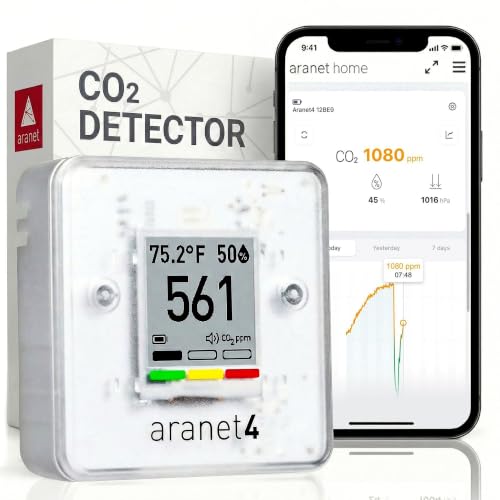
- Measures CO2, temperature, humidity, and pressure in real time.
- NDIR sensor plus e-ink display supports up to 4 years of battery life.
- App stores up to 90 days of historical data with graphs.
Best For: CO2-focused monitoring with very long battery life
Premium Whole-Home Air Health Monitor
Airthings View Plus Radon & IAQ

- Tracks radon, PM2.5, CO2, VOCs, humidity, temp, and pressure
- Battery powered with cable-free placement
- App-based live data, alerts, and trend history
Best For: Homeowners who want continuous radon and IAQ monitoring with app insights
Portable Multi-Parameter Air Tester
16-in-1 Indoor Air Quality Monitor

- Reads PM1.0, PM2.5, PM10, CO2, TVOC, HCHO, temp, and humidity
- HD color screen with color-coded readings
- Portable with Type-C charging
Best For: People who want quick portable air checks across several rooms or spaces
Data-Logging Science Monitor

- Tracks PM2.5, PM10, HCHO, VOCs, temp, humidity, and AQI
- Exports up to 3 months of data to Excel
- Includes a 12-hour trend histogram
Best For: Users who want portable readings plus exportable data for analysis
Home Lab Pick
16-in-1 Air Quality Monitor Indoor 7" High-Precision Real-Time CO2 Monitor

- Tracks CO2, PM, HCHO, TVOC, temp, humidity, AQI
- Large 7-inch LED display with 3 brightness settings
- External high-precision sensors with AQI alert buzzers
Best For: users who want broad real-time indoor tracking on a large screen
Cordless Desk Monitor
16-in-1 Air Quality Monitor Indoor High-Precision CO2 Monitor & HD Screen
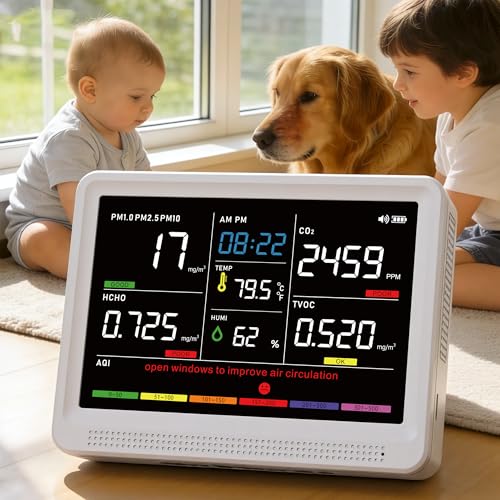
- 2500mAh battery for up to 10 hours cordless use
- Measures CO2, PM, HCHO, TVOC, temp, humidity, AQI
- 5.5-inch LED screen with 7 AQI alert buzzers
Best For: portable indoor monitoring with cordless operation and a clear display
Multi-Parameter Room Monitor – Sainlogic 16-in-1 Indoor Air Quality Monitor
If you want air quality monitors for home science that show a broad snapshot of indoor conditions without needing an app, the Sainlogic is built for exactly that. It tracks core comfort and contamination metrics in one large-display unit, making it easy to watch changes in living rooms, bedrooms, nurseries, or even a car interior.
Best For: Families, allergy-conscious households, and anyone who wants a large, easy-to-read monitor with broad coverage.
Pros:
- Tracks 9 essential indicators, including CO2, PM1.0, PM2.5, PM10, HCHO, TVOC, temperature, humidity, and AQI.
- 7 user-defined alert thresholds plus tri-color LED status and icons for fast visual checks.
- Large 7.2-inch display with 3 brightness levels, designed for easy viewing across the room.
- Works without WiFi or app installation and includes USB-C rechargeable wireless operation.
Cons:
- Battery life is listed at up to 8 hours, so it is not a long-term cordless solution.
- Best suited for room-by-room monitoring rather than remote data review.
For practical home use, this model stands out for combining a wide sensor set with simple day-to-day operation. It is a strong pick if you want clear on-device readings and alerts more than software features.
App-Enabled Analyzer – BREATHE Airmonitor Plus Gen 2
For buyers comparing air quality monitors for home science, the BREATHE Airmonitor Plus Gen 2 is the most data-focused option here. It combines real-time sensing with app history, export tools, and portable operation, so it works well when you want to study how cooking, cleaning, or ventilation changes indoor air.
Best For: Data-driven users who want app history, exportable readings, and detailed indoor air tracking.
Pros:
- Measures 8 indoor air quality factors, including CO2, PM1, PM2.5, PM10, TVOC, HCHO, temperature, and humidity.
- Offers 90-day app history and data export for deeper trend analysis.
- Uses NDIR CO2 measurement plus laser particle sensing and dedicated TVOC/formaldehyde detection.
- Rechargeable design provides up to 6 hours of portable use and supports USB-C power for continuous monitoring.
Cons:
- Portable battery life is limited compared with always-on plugged-in monitors.
- Requires 2.4 GHz Wi-Fi and app setup to use the smart features.
This model is strongest when you want more than a quick reading and actually plan to review patterns over time. Its combination of sensors, alerts, and historical data makes it especially useful for careful indoor air testing.
Smart Home Integration Pick – Amazon Smart Air Quality Monitor
If your home setup already runs on Alexa, this air quality monitor keeps indoor tracking simple. It measures the main comfort and warning factors, then ties them into app notifications and routines, making it a practical choice for everyday home science monitoring without a complicated setup.
Best For: Alexa households that want easy alerts and automation with minimal setup.
Pros:
- Tracks 5 key factors: PM2.5, VOCs, carbon monoxide, humidity, and temperature.
- Provides a color-coded LED plus an easy-to-understand air quality score in the Alexa app.
- Sends phone notifications and Echo announcements when air quality drops.
- Can trigger Alexa routines to control compatible purifiers, dehumidifiers, and fans.
Cons:
- Offers fewer sensor types than more advanced multi-parameter monitors.
- Best experience depends on using Alexa-compatible devices and routines.
For households already invested in the Alexa ecosystem, this monitor is appealing because it turns air readings into simple actions. It is less about deep analysis and more about making indoor air easier to manage day to day.
Long-Life CO2 Specialist – Aranet4 Wireless Indoor Monitor
When you want air quality monitors for home science focused on ventilation and CO2 tracking, the Aranet4 is a standout. It measures the essentials for understanding air freshness and does so with a battery-friendly e-ink design that is easy to keep running for long periods.
Best For: Users who want a simple, highly portable CO2 monitor with long battery life.
Pros:
- Measures CO2, temperature, relative humidity, and atmospheric pressure in real time.
- Uses NDIR sensor technology for precise and reliable CO2 readings.
- Power-efficient e-ink display delivers up to 4 years of battery life.
- Includes color coding, a prominent CO2 reading, optional buzzer, and a free app with 90 days of history.
Cons:
- Does not measure particles, VOCs, or formaldehyde.
- Less broad in scope than full indoor air quality monitors.
The Aranet4 is the most specialized option in this group, and that focus is its strength. If your main goal is watching CO2 and ventilation quality over time, it offers excellent efficiency and straightforward use.
Premium Whole-Home Air Health Monitor – Airthings View Plus Radon & IAQ
If you want air quality monitors for home science that cover more than basic dust readings, the Airthings View Plus is built for broad indoor tracking. It continuously measures radon, PM2.5, CO2, VOCs, humidity, temperature, and air pressure, then syncs data to the Airthings app for trend analysis and alerts.
Best For: Homeowners who want always-on radon and indoor air tracking with app-based trend data.
Pros:
- Measures radon plus PM2.5, CO2, VOCs, humidity, temperature, and pressure in one device
- Battery-powered design makes placement easy without cables
- App support includes live readings, trends, notifications, and pollen forecast data
- Five-year warranty option adds long-term ownership value
Cons:
- Requires the Airthings app and an account to function
- The monitor and app both need internet access for cloud features
- Not the simplest option if you want a no-app, standalone display only
For buyers focused on a broad, science-friendly view of indoor air, this model stands out for its always-on sensing and radon coverage. It is best when you want continuous data you can review over time rather than a quick one-time check.
Portable Multi-Parameter Air Tester – 16-in-1 Indoor Air Quality Monitor
Among air quality monitors for home science, this 16-in-1 tester is aimed at users who want a compact, multi-parameter snapshot of indoor conditions. It reads PM1.0, PM2.5, PM10, CO2, TVOC, HCHO, temperature, and humidity on a color screen, making it practical for bedrooms, offices, cars, and other small spaces.
Best For: Buyers who want a portable, easy-to-read monitor for quick multi-room air checks.
Pros:
- Tracks a wide set of parameters including PM1.0, PM2.5, PM10, CO2, TVOC, and HCHO
- HD color display shows readings clearly with color-coded air levels
- Simple one-button operation with optional audio prompt control
- Portable design and Type-C charging make it easy to move between spaces
Cons:
- Runtime is limited to about 4-5 hours per charge
- Does not offer app-based logs or export tools in the supplied notes
- Best suited to spot checks and short sessions rather than always-on monitoring
This is a good fit if you want fast, straightforward readings without a complex setup. Its strength is convenience: a broad sensor set, a readable screen, and flexible placement for everyday testing.
Data-Logging Science Monitor – Temtop 7-in-1 AQI Tester
If you need air quality monitors for home science that emphasize measurement history, the Temtop LKC-1000S+ is built around trend detection and data export. It tracks PM2.5, PM10, HCHO, VOCs, humidity, temperature, and AQI, then lets you export up to three months of data to Excel for analysis.
Best For: Users who want a portable monitor with exportable data for deeper analysis and reporting.
Pros:
- Tracks seven parameters including PM2.5, PM10, HCHO, VOCs, humidity, temperature, and AQI
- USB data export to Excel supports long-term tracking and reporting
- Built-in 12-hour trend histogram helps identify pollution sources and ventilation results
- Can run on battery for spot checks or stay plugged in for continuous monitoring
Cons:
- Does not detect gas or CO leaks, so it is not a replacement for a dedicated alarm
- For most accurate results, it needs warm-up time after temperature changes
- Best used with careful handling around sprays and strong cleaning agents
This model is especially useful when you care about trends instead of just instant numbers. It combines a strong feature set with exportable records, which makes it a smart pick for renovation checks, health tracking, or home experiments.
Home Lab Pick – 16-in-1 Air Quality Monitor Indoor 7" High-Precision Real-Time CO2 Monitor
If you want air quality monitors for home science that pack a lot of data into one screen, this 16-in-1 unit is built for close indoor tracking. It shows CO2, PM2.5, PM1.0, PM10, HCHO, TVOC, temperature, humidity, AQI, and time, making it useful for hands-on monitoring of daily room conditions.
Best For: Home science users who want a large display and broad real-time pollutant tracking in one device.
Pros:
- Tracks 9 key parameters plus 7 AQI alert buzzers.
- 7-inch display makes readings easy to see at a glance.
- External high-precision sensors are designed for direct air sampling.
- Three brightness settings help it work in different lighting conditions.
Cons:
- Accuracy depends on keeping sensors clean and away from perfumes or strong odors.
- It uses buzzer alerts, which may be more than some buyers want.
This is a strong fit if your priority is broad measurement coverage and a display that makes routine checking simple. It leans more toward detailed indoor monitoring than minimal, basic use.
Portable Study Tool – Air Quality Monitor Indoor, 10-in-1 Portable Smart Air Quality Tester
For air quality monitors for home science that you can move from room to room, this compact 10-in-1 tester covers the core indoor metrics most people watch. It reports CO2, HCHO, TVOC, PM2.5, PM1.0, PM10, temperature, humidity, AQI, and time, with a color screen that makes changes easy to spot.
Best For: Portable indoor checking across rooms, cars, and other everyday spaces.
Pros:
- Measures a wide set of common indoor air indicators in real time.
- Color display changes when air quality crosses safety thresholds.
- Bluetooth time calibration adds a convenient setup step.
- Compact format suits bedrooms, kitchens, cars, offices, and more.
Cons:
- Screen size is not as large as some desk-style monitors.
- Advanced functions like calibration may take a little learning.
This model makes sense if you want a portable monitor that is easy to bring into different environments. It balances broad measurement coverage with simple, glanceable visual feedback.
Cordless Desk Monitor – 16-in-1 Air Quality Monitor Indoor High-Precision CO2 Monitor & HD Screen
If your version of air quality monitors for home science needs to move around without a cord, this 16-in-1 monitor adds battery-powered flexibility. It provides real-time readings for CO2, PM2.5, PM1.0, PM10, HCHO, TVOC, temperature, humidity, AQI, and time, with a 5.5-inch display and 7 AQI alert buzzers.
Best For: Buyers who want a portable indoor monitor with cordless use and a clear display.
Pros:
- 2500mAh battery supports up to 10 hours of cordless operation.
- Tracks the same broad set of indoor air metrics as the larger model.
- 5.5-inch LED screen provides a clear overview of readings.
- Supports quick °F/°C switching and brightness adjustment.
Cons:
- Display is smaller than the 7-inch version.
- Battery life may still require regular charging for longer sessions.
This is the better pick if you want the flexibility to move the monitor around the house or use it away from a power outlet. It keeps the detailed measurement set while adding cordless convenience.
How We Picked the Best Air Quality Monitors for Home Science
We prioritized monitors that are useful for home science setups: clear sensor coverage, dependable readings, readable displays, and features that make it easier to observe changes in real indoor conditions. We also favored models that measure multiple pollutants or environmental factors instead of relying on a single metric.
Because this category is used for both curiosity and decision-making, we looked for devices with practical alerts, long-term trend tracking, and straightforward interfaces. For many buyers, Air Quality Monitors for Home Science should help answer simple questions such as whether ventilation is working, whether cooking is raising particles, or whether humidity is drifting out of range.
Quick Comparison
For the fastest shortlist, think in terms of use case. CO2-focused models are best for ventilation checks and occupancy monitoring. Multi-parameter monitors are better if you want a broader picture that includes PM, VOCs, temperature, and humidity. Smart app-connected units are useful if you want notifications and remote history, while portable handheld-style units are better for moving from room to room.
Key Buying Factors for Air Quality Monitors for Home Science
Sensor Coverage
More sensors are not always better, but the right sensors matter. CO2 is useful for ventilation and occupancy, PM2.5 and PM10 help track combustion and dust, VOCs can flag off-gassing or cleaners, and temperature and humidity provide context that helps explain the readings.
Accuracy and Stability
Look for monitors with a reputation for stable readings and clear calibration guidance. For home science, consistency over time is often more valuable than flashy peak numbers. A monitor that reacts smoothly and predictably is easier to trust.
Display and Logging
A large, readable screen makes a monitor easier to use at a glance. App support and history logs are especially helpful if you want to compare rooms, test after changes, or track trends across days and weeks.
Alerts and Smart Features
Notifications can be valuable if you want to know when air quality drops without watching the device constantly. Just make sure the alerts are tied to metrics you actually care about, not only basic app convenience.
Who Should Buy Which Air Quality Monitors for Home Science?
If your main goal is ventilation tracking, choose a CO2-focused monitor. If you want broader indoor air analysis, go with a multi-parameter model that includes particles, VOCs, humidity, and temperature. If you want remote monitoring and alerts, pick a smart app-connected unit. If you want a portable tool for testing different rooms or short-term checks, a compact handheld monitor is the better fit.
For most buyers, the best Air Quality Monitors for Home Science are the ones that match the type of testing you will actually do. Start with your biggest concern—CO2, particles, or general indoor conditions—and choose the device that measures that category well.