Choosing among arbitrary waveform signal generators means balancing bandwidth, sample rate, channel count, waveform depth, modulation features, and everyday usability. The right model should match both your signal requirements and the way you work.
This roundup covers 10 options ranging from compact handheld instruments to higher-bandwidth dual-channel generators, helping you narrow the field by performance, flexibility, and value.
Best 10 Arbitrary Waveform Signal Generators Picks for 2026
Versatile Bench Performer
Siglent SDG2042X 40 MHz Generator
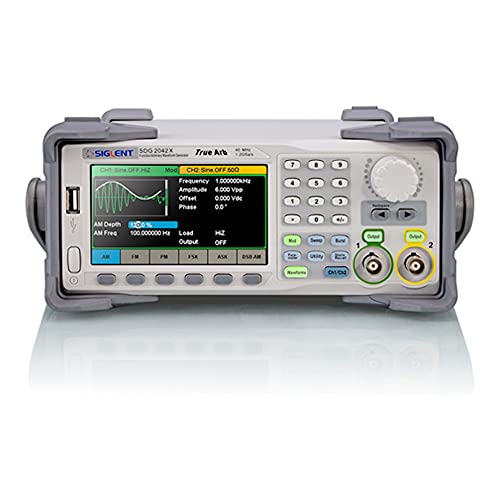
- Dual-channel, 40 MHz sine-wave output
- 16-bit resolution with touch-screen control
- Modulation, sweep, burst, USB, and LAN
Best For: General-purpose lab testing and waveform development
Precision Lab Choice
Rigol DG822 Pro 25 MHz Generator

- Dual independent channels
- 16-bit resolution with 200 MSa/s sampling
- Broad modulation, sweep, burst, and harmonic functions
Best For: Labs, classrooms, and general-purpose signal simulation
High-Bandwidth Specialist
Siglent SDG6022X 200 MHz Generator
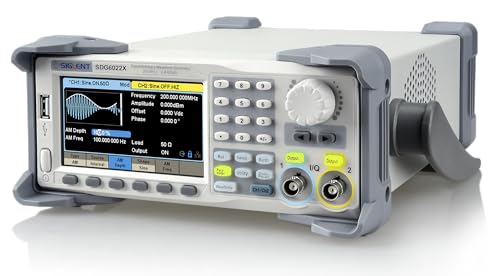
- 200 MHz bandwidth across two channels
- 2.4 GSa/s maximum sampling rate
- 16-bit resolution with 20 Mpts waveform length
Best For: Professional high-frequency testing and waveform work
Compact Value Pick

- 70 MHz dual-channel output
- 300 MSa/s sampling with 14-bit resolution
- USB, SCPI, LabVIEW, and custom waveform support
Best For: Students, hobbyists, repair work, and small labs
High-Bandwidth Pick
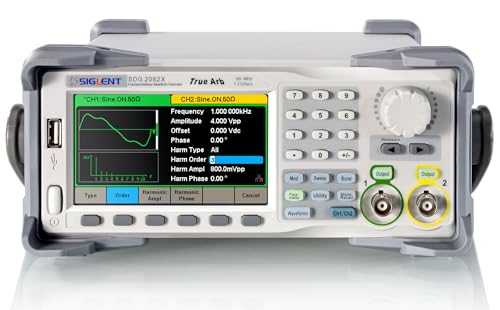
- Dual-channel, 80 MHz output
- 1.2 GSa/s sampling and 16-bit resolution
- TrueArb waveforms up to 8 Mpoints
Best For: Professional waveform development and detailed bench testing
Versatile Bench Value

- Dual-channel output up to 25 MHz
- 200 MSa/s sampling with 14-bit resolution
- 160 built-in waveforms and broad modulation support
Best For: Education, repair, embedded design, and general lab testing
Portable Choice

- Handheld dual-channel design with 60 MHz output
- 200 MS/s sampling and 4Kpts memory
- AM, FM, PM, FSK, USB, and scan functions
Best For: Mobile troubleshooting and compact electronics work
Versatile Lab Workhorse

- Dual independent output channels
- 30 MHz bandwidth with 16-bit resolution
- AM/FM and other modulation modes
Best For: Lab testing, education, and circuit development
Compact Dual-Channel Value
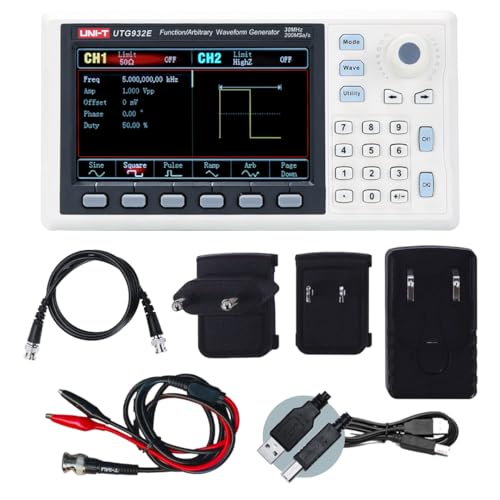
- Dual 30 MHz output channels
- 200 MSa/s sampling with waveform memory
- USB, SCPI, and phase-locking support
Best For: Portable multi-channel testing and waveform control
Simple Single-Channel Specialist

- 10 MHz single-channel output
- 46 built-in arbitrary waveforms
- Low-jitter pulse and USB support
Best For: Basic bench testing and pulse-focused applications
Versatile Bench Performer – Siglent SDG2042X 40 MHz Generator
Siglent Technologies SDG2042X Arbitrary Waveform Function-Generators, 40 MHz, Grey
Check Price On AmazonThe Siglent SDG2042X is a practical choice among arbitrary waveform signal generators when you need two channels, a touch-screen interface, and flexible modulation features. Its 40 MHz sine-wave output, 16-bit vertical resolution, and TrueArb technology suit general bench testing and waveform development.
Best For: Engineers, technicians, and labs needing dual-channel signal generation with USB or LAN connectivity.
Pros:
- Dual-channel output with 40 MHz sine-wave capability
- 16-bit vertical resolution and touch-screen display
- Supports modulation, sweep, burst, TrueArb, and Easy Pulse functions
- Built-in frequency counter plus USB and LAN interfaces
Cons:
- Optional GPIB connectivity requires an adapter
- Its feature set may be more than needed for basic signal generation
The SDG2042X balances useful bench features with straightforward connectivity, making it a strong all-purpose option for waveform simulation, testing, and development.
Precision Lab Choice – Rigol DG822 Pro 25 MHz Generator
The Rigol DG822 Pro is a flexible option for arbitrary waveform signal generators in labs, classrooms, and development benches. It combines two independent channels with 16-bit resolution, a 25 MHz output frequency, and support for common analog, digital, and arbitrary waveforms.
Best For: Education, embedded development, circuit testing, and general-purpose laboratory signal simulation.
Pros:
- Two independent output channels for simultaneous signal control
- Supports sine, square, pulse, ramp, noise, DC, and arbitrary waveforms
- Includes AM, FM, PM, ASK, FSK, PSK, PWM, sweep, and burst functions
- 16-bit resolution and 200 MSa/s sampling support smooth signal generation
Cons:
- 25 MHz bandwidth is lower than some higher-frequency alternatives
- Its advanced modulation features may be unnecessary for simple bench tasks
With broad waveform and modulation support, the DG822 Pro is a well-rounded generator for repeatable testing, demonstrations, and day-to-day engineering work.
High-Bandwidth Specialist – Siglent SDG6022X 200 MHz Generator
SIGLENT SDG6022X Function/Arbitrary Waveform Generator Signal Generator Bandwidth 200 MHz
Check Price On AmazonThe Siglent SDG6022X stands out among arbitrary waveform signal generators for applications requiring higher bandwidth. Its dual-channel design, 200 MHz bandwidth, 2.4 GSa/s maximum sampling rate, and 16-bit vertical resolution support demanding waveform generation and analysis work.
Best For: Professional engineering benches and commercial test environments that need high-frequency, high-sample-rate signal generation.
Pros:
- Dual channels with 200 MHz bandwidth
- 2.4 GSa/s maximum sampling rate
- 16-bit vertical resolution for detailed signal generation
- 20 Mpts waveform length and EasyPulse circuitry for reduced jitter
Cons:
- Higher-end specifications may exceed the needs of basic testing
- The supplied notes do not specify interface or modulation features
The SDG6022X is the strongest fit here when bandwidth and sampling performance take priority, particularly for more demanding professional signal-generation tasks.
Compact Value Pick – 70 MHz Dual-Channel Generator
This compact dual-channel unit is a useful entry in the arbitrary waveform signal generators category for bench work, repair, prototyping, and electronics learning. It offers 70 MHz operation, 300 MSa/s sampling, 14-bit resolution, built-in waveforms, and computer control through USB.
Best For: Students, hobbyists, engineers, and small labs seeking a space-saving generator with automation support.
Pros:
- Two independent channels with output up to 70 MHz
- 300 MSa/s sampling rate and 14-bit resolution
- Five basic waveforms plus 150 built-in waveforms and custom-signal loading
- AM, FM, PM, FSK, sweep, burst, SCPI, and LabVIEW support
Cons:
- 14-bit resolution is lower than the 16-bit alternatives listed
- Its 3.6-inch LCD may feel small for complex waveform setup
For users who value compactness and broad functionality, this generator provides a practical combination of dual-channel output, waveform variety, and PC-based control.
High-Bandwidth Pick – Siglent SDG2082X
Siglent SDG2082X - Function/Arbitrary Waveform Generator (2 Channels/80MHz/1.2 GSa/s)
Check Price On AmazonFor demanding arbitrary waveform signal generators applications, the Siglent SDG2082X combines dual-channel output with an 80 MHz bandwidth and up to 1.2 GSa/s sampling. Its 16-bit vertical resolution and TrueArb technology make it well suited to detailed waveform creation and professional bench testing.
Best For: Professional users who need high sampling speed, fine vertical resolution, and long user-defined waveforms.
Pros:
- Dual channels with 80 MHz bandwidth
- Fast 1.2 GSa/s maximum sampling rate
- 16-bit vertical resolution
- Supports custom waveforms from 8 points to 8 Mpoints
Cons:
- Professional capabilities may be more than basic users need
- Heavier and less portable than handheld alternatives at 8.8 pounds
The SDG2082X is the strongest choice here for complex, high-fidelity waveform work. Its broad bandwidth, high sampling rate, and flexible TrueArb controls favor advanced lab and engineering applications.
Versatile Bench Value – Rigol DG1022Z
The Rigol DG1022Z is a practical dual-channel option for arbitrary waveform signal generators buyers who want broad functionality without moving into higher-bandwidth equipment. It offers 25 MHz output, 200 MSa/s sampling, 14-bit resolution, built-in waveforms, and extensive modulation features.
Best For: Education, general electronics testing, repair, embedded design, and automated bench setups.
Pros:
- Dual-channel output with a 25 MHz frequency range
- 200 MSa/s sampling and 14-bit vertical resolution
- Includes 160 built-in waveforms and arbitrary output
- Supports AM, FM, PM, FSK, ASK, PWM, sweep, burst, and harmonic functions
Cons:
- 25 MHz maximum frequency is lower than some competing models
- Its extensive functions may require more setup for simple tests
With USB Host, USB Device, and LAN connectivity, the DG1022Z fits both classroom benches and PC-controlled test environments. It is a well-rounded pick when modulation and waveform variety matter more than maximum bandwidth.
Portable Choice – UNI-T UTG962E
For portable arbitrary waveform signal generators use, the UNI-T UTG962E packs two channels and a 60 MHz maximum output into a compact handheld design. It also provides 200 MS/s sampling, 4Kpts memory depth, USB connectivity, and several modulation modes.
Best For: Electronics enthusiasts and technicians who need a lightweight generator for mobile or space-limited testing.
Pros:
- Compact 14.1-ounce handheld design
- Dual channels with up to 60 MHz output
- Supports AM, FM, PM, and FSK modulation
- Stores up to 24 non-volatile digital arbitrary waveforms
Cons:
- 4Kpts memory depth is smaller than the Siglent model’s maximum
- Handheld format may provide fewer bench-oriented conveniences
The UTG962E is the most convenient option for field work, quick troubleshooting, and compact benches. Its scan functions and 1 μHz resolution add flexibility, while the included adapter, USB-to-DC cord, and BNC cables help it get started quickly.
Versatile Lab Workhorse – Rigol DG1032Z
The Rigol DG1032Z is a strong choice for users seeking arbitrary waveform signal generators with dual-channel flexibility and broad modulation support. Its 30 MHz bandwidth, 16-bit vertical resolution, and 200 MSa/s sample rate suit circuit development, signal simulation, and lab testing.
Best For: Engineers, electronics developers, educators, and students who need two independent outputs and advanced modulation functions.
Pros:
- Two independently controlled channels can generate different waveforms simultaneously.
- Supports sine, square, pulse, ramp, noise, and arbitrary waveforms up to 30 MHz.
- Includes AM, FM, PM, ASK, FSK, PSK, PWM, sweep, and burst functions.
- 16-bit resolution and 200 MSa/s sampling support precise waveform output.
Cons:
- Its 7.04-pound size may be less convenient for portable setups.
- The feature set may be more than needed for basic single-channel signal tasks.
Choose the DG1032Z when independent dual-channel operation and detailed waveform control matter more than compactness. It is well suited to varied bench and automated-test applications.
Compact Dual-Channel Value – UNI-T UTG932E
The UNI-T UTG932E combines arbitrary waveform signal generators with a compact design, dual-channel output, and USB control. With 30 MHz output, 200 MSa/s sampling, waveform memory, and user-defined waveform support, it provides a practical source for multi-point testing.
Best For: Users who want a lightweight dual-channel generator with phase locking, computer connectivity, and included accessories.
Pros:
- Two independently controllable channels support separate or differential signals.
- Offers sine, square, ramp, pulse, noise, DC, and user-defined arbitrary waveforms.
- Includes AM, FM, PM, FSK, PSK, PWM, and sweep functions.
- USB connectivity, SCPI compatibility, waveform software, cables, and a power cord are included.
Cons:
- The supplied listing identifies the unit as the 30 MHz, two-channel version.
- Its 14-bit vertical resolution is lower than some higher-resolution alternatives.
The UTG932E is a convenient option when portability and connectivity are priorities. Its dual outputs and phase-locking capability make it especially useful for coordinated stimulus and development work.
Simple Single-Channel Specialist – Siglent SDG810
The Siglent SDG810 is a straightforward choice among arbitrary waveform signal generators for single-channel bench work. Its 10 MHz bandwidth, 125 MSa/s sampling rate, built-in arbitrary waveforms, and broad modulation functions cover common signal-generation tasks.
Best For: Bench users who need a single-channel generator with built-in waveform choices, pulse capability, and USB storage.
Pros:
- Provides 125 MSa/s sampling and 14-bit vertical resolution.
- Includes five standard waveform types and 46 built-in arbitrary waveforms, including DC.
- Supports AM, DSB-AM, FM, PM, FSK, ASK, PWM, sweep, and burst functions.
- Easy Pulse technology supports low-jitter pulses with quick rising and falling edges.
Cons:
- Only one output channel is provided.
- Its 10 MHz bandwidth is narrower than the other listed generators.
The SDG810 makes sense for focused, single-source applications where built-in waveform variety and pulse performance are more important than dual-channel operation or higher bandwidth. USB host and device interfaces also support storage and updates.
How We Picked These Arbitrary Waveform Signal Generators
We focused on specifications that have the greatest practical effect on signal-generation work: maximum frequency, sample rate, vertical resolution, channel configuration, modulation support, connectivity, and form factor. The selection includes established bench instruments alongside compact options for portable troubleshooting and field service.
Rather than treating the highest bandwidth as automatically best, we considered how each generator fits common uses such as circuit development, education, communications testing, audio and control-system work, and general laboratory verification. A useful waveform generator should also be straightforward to configure, display settings clearly, and integrate with an oscilloscope or automated test setup.
Quick Comparison
- For higher-frequency bench testing: Consider the 200 MHz Siglent model or the 80 MHz SDG2082X when bandwidth and fast waveform updates are priorities.
- For general two-channel work: The 25–70 MHz options provide useful flexibility for synchronized signals, modulation, and everyday prototyping.
- For portable testing: UNI-T handheld models are better suited to field service, classrooms, and workspaces where bench equipment is inconvenient.
- For basic signal generation: A 10–30 MHz unit can be sufficient for low-frequency electronics, educational labs, and routine troubleshooting.
Key Buying Factors for Arbitrary Waveform Signal Generators
Bandwidth and Sample Rate
Choose bandwidth above the highest fundamental frequency you need to generate, especially when producing fast edges or harmonics. A higher sample rate generally supports cleaner reproduction of complex waveforms, but the result also depends on memory depth and output filtering.
Channels and Synchronization
Two channels are valuable for differential signals, reference-and-test setups, frequency response checks, and synchronized timing experiments. Verify whether the channels support the phase, frequency, amplitude, and trigger relationships your application requires.
Resolution, Memory, and Waveform Control
Higher vertical resolution can provide finer amplitude steps and less quantization error. Deeper arbitrary-waveform memory is useful for long sequences, while intuitive editing, onboard waveform libraries, and computer connectivity can save substantial setup time.
Modulation, Outputs, and Connectivity
Check for the modulation types you need, such as AM, FM, PM, sweep, burst, or frequency shift keying. Also confirm output amplitude limits, impedance settings, trigger inputs, USB or LAN control, and compatibility with your existing automation software.
Who Should Buy Which Arbitrary Waveform Signal Generators?
Engineers and advanced laboratories should prioritize bandwidth, sample rate, memory, synchronized channels, and remote-control capability. Designers and repair technicians will often get the best balance from a dependable dual-channel model with broad modulation support. Students, educators, and hobbyists can save money with a lower-bandwidth generator if their projects involve audio, sensors, microcontrollers, or basic analog circuits. Field technicians should favor a compact handheld unit with clear controls, USB connectivity, and the modulation functions they regularly use.
Before buying, compare the generator’s maximum output, connector type, power requirements, software support, and warranty with your test setup. Paying for specifications you will never use is unnecessary, but insufficient bandwidth or memory can limit a generator quickly as projects become more demanding.