Building a homeschool chemistry setup is easier when you choose tools that match your student’s age, experiment goals, and safety needs. The right kit helps lessons feel hands-on without overbuying unnecessary gear.
Below, we focus on practical chemistry lab equipment for homeschool use, from basic glassware and plastic measuring tools to starter stands and accessory sets that support real experiments.
Best 10 Chemistry Lab Equipment for Homeschool Picks for 2026
Precision Glass Measuring Set
Borosilicate Cylinder & Beaker Bundle

- 4 cylinder sizes, 3 beaker sizes, and 2 droppers
- 3.3 borosilicate glass with acid/alkali resistance
- Clear scales and tapered pouring edges
Best For: Homeschool science lessons needing durable glass measuring tools
Starter Chemistry Tools

- 17 tools including tongs, clamps, forceps, and spatulas
- Stainless steel build for durable handling
- Good for powders, small items, and hot glassware
Best For: Homeschoolers needing a basic chemistry handling kit
Classic Beaker Set

- Six beaker sizes from 10ml to 1000ml
- 3.3 borosilicate glass resists heat and corrosion
- Flat bottoms and double-metric graduations
Best For: Homeschool labs needing durable beakers in multiple sizes
All-in-One Plastic Lab Kit
Tubes, Cylinders, Beakers, Flask
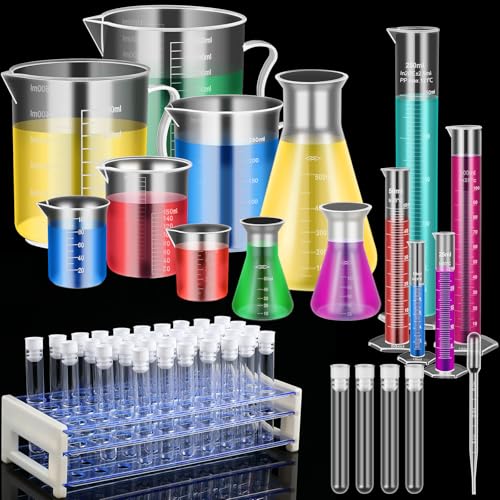
- 40 pieces including tubes, rack, cylinders, beakers, flasks, and pipettes
- Plastic build helps reduce breakage risk
- Clear markings and stable bases for easier student use
Best For: Homeschool families wanting a large, low-breakage starter set
Glass Measurement Set
Borosilicate Labware for Homeschool Experiments

- 18-piece glassware assortment
- 3.3 borosilicate resists heat changes
- Clear scales for measuring and mixing
Best For: Homeschool chemistry lessons needing durable, measurable glassware
Lab Stand Kit
Complete Chemistry Support for Home Labs

- Ring stand, clamps, rack, and tools included
- Chemical-resistant powder-coated base
- Sturdy alloy steel and stainless steel build
Best For: Home labs that need support gear for demonstrations and titration
Plastic Measurement Set

- 10-piece beaker and cylinder set
- Food-grade plastic is reusable and resistant
- Raised scales and stable bases aid measuring
Best For: Families needing easy-to-handle measuring tools for beginner science
Complete Glassware Kit

- 20-piece assortment with beakers, cylinders, droppers, and rods
- Borosilicate glass is acid and alkali resistant
- Clear scales and multiple sizes support varied experiments
Best For: Homeschool families wanting a broad glassware starter set
Starter Beaker Set

- Five beaker sizes from 10ml to 250ml
- Class A 3.3 borosilicate glass for durability
- Flat bottom, spout, and clear scales for easy use
Best For: Homeschoolers needing a basic, durable beaker set
Kid-Friendly Plastic Lab Set
Shatterproof Cylinders and Beakers

- Food-grade plastic is shatterproof and non-toxic
- Includes cylinders, beakers, pipettes, and a brush
- Hexagonal base and clear scales support stable measuring
Best For: Families with younger kids who want a safe starter kit
Precision Glass Measuring Set – Borosilicate Cylinder & Beaker Bundle
If you want chemistry lab equipment for homeschool that feels close to real labware, this glass measuring set gives you graduated cylinders, beakers, and droppers in practical sizes for everyday experiments. The 3.3 borosilicate glass construction is built for heat, acids, alkalis, and repeated use, while the clear scales and tapered pouring edges make basic measuring and transfer work easier.
Best For: Homeschool science lessons that need durable glass measuring tools for accurate liquid handling.
Pros:
- Includes 4 graduated cylinders, 3 beakers, and 2 glass droppers in multiple useful sizes.
- Made from 3.3 borosilicate glass for durability, stability, and resistance to acids and alkalis.
- Clear graduations and stable bases support easier reading and measuring.
- Tapered pouring gates help reduce spills when transferring liquids.
Cons:
- Glass construction may be less forgiving than plastic for younger students.
- Smaller set size may not cover larger-volume classroom-style experiments.
This is a solid pick if your homeschool setup prioritizes lab-style accuracy and durable glass over kid-proof convenience. It covers the core measuring tasks well and should serve as a dependable starter or upgrade set for guided experiments.
Starter Chemistry Tools – Stainless Steel Handling Set
For chemistry lab equipment for homeschool, this stainless steel tool set is a practical way to add the small handling tools that experiments often require. It covers tongs, clamps, forceps, spatulas, scoops, and spoons, giving students the basics for moving, holding, and measuring small amounts of material during supervised lab work.
Best For: Homeschoolers who need a starter set of stainless steel handling tools for chemistry activities.
Pros:
- 17-in-1 assortment includes crucible tongs, a test tube clamp, forceps, spatulas, scoops, and spoons.
- Stainless steel construction is designed for durability and safe handling.
- Useful for precision tasks like picking up small items, mixing, and retrieving powders.
- Covers several basic lab-handling needs in one starter kit.
Cons:
- Does not include glassware or measuring containers.
- Best suited to handling tasks rather than full experiment setups.
This set works well as a support kit rather than a complete lab solution. If your homeschool chemistry plan already has beakers, cylinders, or test tubes, these tools fill an important gap for safe, controlled manipulation of materials.
Classic Beaker Set – Six Sizes Borosilicate Glass
When you are comparing chemistry lab equipment for homeschool, a reliable beaker set is one of the most useful foundations you can buy. This six-size borosilicate set gives you a wide capacity range from 10ml to 1000ml, with flat-bottom beakers that sit securely on a bench or hot plate and scales that are easy to read.
Best For: Homeschool labs that need durable beakers in multiple sizes for everyday experiments.
Pros:
- Six useful beaker sizes from 10ml through 1000ml.
- 3.3 borosilicate glass offers heat, corrosion, acid, alkali, and thermal shock resistance.
- Flat bottoms make the beakers easy to place on a lab bench or hot plate.
- Double-metric graduations help with routine measuring.
Cons:
- Beakers are only one part of a full homeschool chemistry setup.
- Glassware requires more care than plastic alternatives.
This set is a strong choice if you want a straightforward, durable beaker lineup for home experiments. It is especially appealing for families that value reusable lab glassware and want size flexibility without buying a scattered mix of individual pieces.
All-in-One Plastic Lab Kit – Tubes, Cylinders, Beakers, Flask
If you want chemistry lab equipment for homeschool in one larger starter bundle, this plastic set covers a lot of the basics at once. It includes test tubes with a rack, graduated cylinders, multiple beakers, Erlenmeyer flasks, and pipettes, making it a convenient choice for practice measurements, mixing, and simple demonstrations.
Best For: Homeschool families wanting a large, low-breakage lab set with many experiment pieces.
Pros:
- Broad 40-piece assortment includes test tubes, rack, cylinders, beakers, flasks, and pipettes.
- Plastic construction lowers the risk of breakage compared with glass.
- Clear scales and hexagonal base design support easier reading and stability.
- Multiple size options make it flexible for different activities and volumes.
Cons:
- Plastic is not the same as laboratory glassware for more advanced work.
- Some pieces are smaller, so it is better suited to student experiments than heavy-duty lab use.
This kit is the most all-encompassing of the group and is especially practical for home use where durability and variety matter. It is a good fit if you want one purchase to cover several common homeschool experiment needs without worrying as much about broken glass.
Glass Measurement Set – Borosilicate Labware for Homeschool Experiments
If you want chemistry lab equipment for homeschool that feels closer to a real lab setup, this 18-piece borosilicate glass set is a practical place to start. It gives students a mix of beakers, flasks, cylinders, droppers, stir rods, and brushes for measuring, mixing, and basic experiment cleanup.
Best For: Homeschool chemistry lessons that need durable glassware with clear markings and a full starter assortment.
Pros:
- 3.3 borosilicate glass is designed to resist rapid temperature changes up to 180°C.
- Clear scale markings support more precise measuring and liquid handling.
- Includes 18 pieces: beakers, flasks, cylinders, droppers, stir rods, and cleaning brushes.
- Suitable for controlled heating on lab plates or hot water baths.
Cons:
- Not intended for open flame use.
- Glass construction requires careful handling in a homeschool setting.
This set is a strong fit if you want a more complete glassware kit for structured science work. It balances versatility with the durability and measurement clarity that matter in teaching chemistry at home.
Lab Stand Kit – Complete Chemistry Support for Home Labs
For homeschool science work that needs holding, clamping, and support gear, this EISCO lab starter kit fills an important gap in chemistry lab equipment for homeschool. It combines a ring stand, clamps, tripod burner stand, iron gauze, rack, tongs, and more into one durable setup for classroom-style experiments.
Best For: Home science spaces that need a sturdy support kit for demonstrations, titration, and general lab setup.
Pros:
- Includes a broad starter set with rod, base, stand, clamp, rack, tongs, spoon/spatula, and brush.
- Powder-coated, chemically resistant base helps with durability and bench protection.
- Test tube/lab instrument rack holds up to 17 objects in multiple hole sizes.
- Built with alloy steel and stainless steel for sturdy classroom or home lab use.
Cons:
- More specialized than basic glassware, so it may be overkill for casual experiments.
- Some homeschool users may need matching accessories depending on their lesson plans.
This kit makes sense when your lessons go beyond simple measuring and pouring. It gives a homeschool chemistry setup more structure and stability for hands-on demonstrations and basic lab procedures.
Plastic Measurement Set – Safer Starter Gear for Kids
If you need chemistry lab equipment for homeschool that is easier to handle around younger students, this plastic beaker and graduated cylinder set is a practical option. It includes multiple sizes for both cylinders and beakers, giving learners plenty of room to practice measuring liquids without relying on glass.
Best For: Families wanting reusable, low-risk measuring tools for beginner chemistry and general science work.
Pros:
- Includes 10 pieces total with five graduated cylinders and five beakers in multiple sizes.
- Food-grade plastic is acid resistant, alkali resistant, odorless, and reusable.
- Double-sided raised scales are designed to stay clear and accurate over time.
- Hexagonal cylinder bases improve stability during use.
Cons:
- Plastic is less premium than glass for advanced chemistry work.
- More suited to basic measuring than heated lab procedures.
This set is a smart pick for homeschool science when safety and convenience matter most. It offers a wide size range and easy handling, making it well suited to early chemistry practice and everyday liquid measurement.
Complete Glassware Kit – 20-Piece Borosilicate Lab Set
If you want chemistry lab equipment for homeschool that covers the basics in one purchase, this 20-piece glassware set gives you a wide spread of sizes for measuring, pouring, stirring, and transferring liquids. The included beakers, graduated cylinders, measuring cups, droppers, and stirring rods make it easier to run simple science projects without piecing together separate items.
Best For: Homeschool families looking for a broad starter kit with multiple glassware types and sizes.
Pros:
- Includes 20 total pieces: beakers, measuring cups, graduated cylinders, droppers, and stirring rods
- Made from borosilicate glass for acid and alkali resistance and long-term use
- Clear scales help with reading measurements more easily
- Multiple sizes support a range of experiments and liquid volumes
Cons:
- Glass construction is less forgiving than plastic if dropped
- No storage case is mentioned in the supplied details
This is a practical option if you want a more complete homeschool setup and prefer glass over plastic. The assortment is especially useful for families doing a variety of experiments rather than just occasional measuring tasks.
Starter Beaker Set – 5-Sized Borosilicate Beakers
This beaker set is a straightforward choice for chemistry lab equipment for homeschool when you mainly need reliable containers for measuring, mixing, and heating small liquid amounts. With five beaker sizes from 10ml to 250ml, it fits basic classroom-style experiments and everyday science demonstrations.
Best For: Homeschoolers who want a simple, durable beaker-only set for basic chemistry work.
Pros:
- Five sizes cover 10ml, 25ml, 50ml, 100ml, and 250ml
- Class A 3.3 borosilicate glass is built for thermal stability and durability
- Flat bottom helps the beakers sit securely on flat surfaces
- Pouring spout and clear scales make them easier to use and read
Cons:
- Only beakers are included, so you’ll need other tools separately
- Graduation tolerance is listed at 5%, so it is not a precision lab solution
For homeschool use, this set works well when you want dependable beakers without extra accessories you may not need. It keeps the setup simple while still giving you multiple capacities for common science activities.
Kid-Friendly Plastic Lab Set – Shatterproof Cylinders and Beakers
If safety and easy cleanup matter most, this plastic set is a practical pick for chemistry lab equipment for homeschool. It combines graduated cylinders, beakers, pipettes, and a test tube brush, giving kids a lightweight, shatterproof way to practice measuring and liquid transfer.
Best For: Families with younger students who want a lightweight, shatterproof starter lab kit.
Pros:
- Food-grade plastic construction is shatterproof and non-toxic
- Includes 4 cylinder sizes, 5 beaker sizes, and 5 pipettes for varied use
- Clear scale lines support basic liquid measurement
- Hexagonal base adds stability during use
Cons:
- Plastic may not suit users who prefer traditional glass labware
- The set is geared toward DIY and kids’ science rather than advanced lab work
This set is a strong fit for home science with younger learners because it is lightweight and less fragile than glass. It gives you the core pieces for simple experiments while staying easy to handle and clean.
How We Picked These Chemistry Lab Equipment for Homeschool
We prioritized sets that offer useful size ranges, clear measurement markings, and a mix of essential tools for common homeschool experiments. We also looked for materials that fit different teaching environments, including durable plastic options for younger learners and borosilicate glass for more advanced work.
Safety, versatility, and value mattered most. A strong homeschool setup should support measuring, pouring, transferring, heating-safe tasks when appropriate, and general lab organization without forcing you to piece together every item separately.
Quick Comparison
If you want the simplest setup, look for a starter kit with beakers, graduated cylinders, and pipettes. If your student is moving into more serious experiments, a borosilicate glassware set is the better long-term choice. For younger children or group activities, plastic Chemistry Lab Equipment for Homeschool is often the safer and more forgiving option.
Key Buying Factors for Chemistry Lab Equipment for Homeschool
Material Type
Glassware is best for clarity, chemical resistance, and more accurate work. Borosilicate glass is especially useful because it handles heat and repeated use better than basic glass. Plastic sets are lighter, less breakable, and easier to manage for beginners.
Core Pieces
Most homeschool labs should start with graduated cylinders, beakers, pipettes or droppers, and at least a few test tubes. As lessons progress, add stirring rods, clamps, tongs, a rack, or a ring stand set if you plan to do more structured demonstrations.
Capacity Range
Choose multiple sizes instead of one large container. Smaller volumes help with precise measurement, while larger beakers and cylinders are useful for mixing, dilution, and visible demonstrations. A good range keeps experiments flexible.
Safety and Age Fit
For elementary and middle school students, plastic or simplified glass sets are often the most practical choice. Older students may benefit from more complete glassware kits and metal tools, especially if they are following high school-level lab procedures.
Who Should Buy Which Chemistry Lab Equipment for Homeschool?
Choose a basic plastic set if you are teaching younger students, running casual science activities, or want an affordable first step into Chemistry Lab Equipment for Homeschool. Pick a mid-range glass and accessory set if you want better measurement accuracy and more realistic lab practice. Go with a fuller starter kit if you need support gear like clamps, stands, and racks for repeated experiments.
In short, the best choice depends on how often you’ll use the equipment, how precise your work needs to be, and how much durability matters in your homeschool science room.