If you want a telescope that makes stargazing easier from the very first night, computerized mounts and guided-sky tools can remove a lot of the guesswork. That matters most for beginners who want to spend less time searching and more time observing.
In this roundup of the best computerized telescopes for beginners, we focus on models that balance ease of use, portability, and views of the Moon, planets, and brighter deep-sky targets.
Best 10 Computerized Telescopes for Beginners Picks for 2026
Premium Computerized SCT

- 6-inch Schmidt-Cassegrain optics
- GoTo mount with 40,000+ objects
- SkyAlign for fast setup
Best For: Beginners ready for a more capable computerized scope
Smartphone-Guided Starter
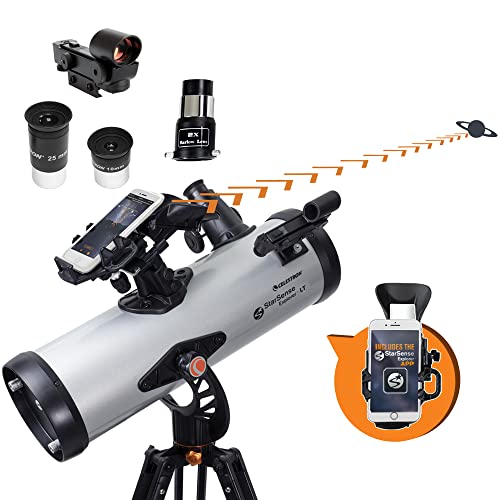
- Phone-guided sky navigation
- 114mm reflector with solid views
- Curated target list by location
Best For: Beginners who want app-guided finding without full automation
Compact Computerized SCT

- 5-inch Schmidt-Cassegrain optics
- Automated GoTo with SkyAlign
- Built-in wedge for astroimaging
Best For: Beginners who want portability and imaging potential
Computerized Deep-Sky Starter

- GoTo system with 4,000+ objects
- 130mm reflector for brighter views
- Compact and easy to transport
Best For: Beginners who want a portable GoTo scope with deep-sky reach
Portable Planet Picker

- Automated GoTo with 40,000+ objects
- SkyAlign simplifies setup
- Compact 4-inch Maksutov optics
Best For: New observers who want a compact, automated scope for Moon and planets
Smartphone-Guided Sky Tour

- App-guided sky navigation via smartphone
- 130mm reflector for Moon and deep-sky views
- Manual mount with slow-motion controls
Best For: Beginners who prefer smartphone guidance over a traditional computerized hand controller
Portable SkyAlign Starter

- 40,000+ object database with computerized tracking
- SkyAlign setup is designed to get you observing fast
- Compact refractor package for travel and backyard use
Best For: Beginners and families who want an easy portable computerized telescope
Simple Sky Tour Choice

- GoTo mount can locate 4,000 celestial objects
- Sky Tour suggests what to view right now
- Includes tripod, eyepieces, and red dot finder
Best For: New users who want a guided computerized reflector with included basics
High-Contrast Planet Picker

- 127mm Maksutov-Cassegrain optics for sharp, high-contrast views
- SkyAlign and GoTo database make setup and finding objects easy
- Portable design suits backyard observing and camping
Best For: Beginners focused on crisp Moon and planet views with a portable GoTo scope
Premium Computerized SCT – Celestron NexStar 6SE GoTo
If you want computerized telescopes for beginners that can grow with you, the Celestron NexStar 6SE is a strong step-up pick. Its fully automated GoTo mount, SkyAlign setup, and 40,000+ object database make it easier to spend time observing and less time searching. The 6-inch Schmidt-Cassegrain optical tube also keeps the system relatively compact for the amount of light it gathers.
Best For: Beginners who want a more advanced, portable computerized telescope with room to grow.
Pros:
- Fully computerized GoTo mount slews to and tracks objects automatically.
- SkyAlign helps you get set up quickly using any three bright stars or planets.
- 6-inch aperture is well suited for lunar detail, Jupiter, and deep-sky viewing.
- Compact Schmidt-Cassegrain design is easier to handle than many larger scopes.
Cons:
- Higher-tech setup may be more than a first-ever telescope buyer needs.
- Batteries or external power source are required and not included.
- Manual focus means the viewing experience is not fully automated end to end.
This is a smart choice if you want beginner-friendly automation without giving up serious optical capability. It is best for observers who expect to use the telescope often and appreciate a system that can expand with accessories later.
Smartphone-Guided Starter – Celestron StarSense LT 114AZ
For shoppers comparing computerized telescopes for beginners, the StarSense Explorer LT 114AZ is a different kind of easy-entry option. Instead of a motorized GoTo mount, it uses your smartphone and StarSense sky-recognition tech to guide you with on-screen arrows, making object location more approachable for first-time users. The 114mm reflector also offers a solid step into Moon, planet, and brighter deep-sky viewing.
Best For: First-time observers who want guided navigation through a smartphone rather than a fully motorized mount.
Pros:
- StarSense app uses sky recognition to help pinpoint the telescope’s position.
- App suggests tonight’s best targets based on your time and location.
- 114mm reflector provides good views of the Moon, planets, and bright deep-sky objects.
- Manual altazimuth mount keeps the setup straightforward and portable.
Cons:
- It is guided by a smartphone, not a fully computerized GoTo mount.
- Manual tracking means you still move the scope yourself.
- Best target selection and guidance depend on using the app and compatible phone.
This model is a practical pick if you want help finding objects without committing to a full automated telescope. It bridges the gap between a basic manual scope and a more advanced computerized system.
Compact Computerized SCT – Celestron NexStar 5SE GoTo
The NexStar 5SE is a compact choice for buyers looking at computerized telescopes for beginners, especially if you want automatic object finding without a bulky setup. Its GoTo mount, SkyAlign system, and 40,000+ object database make it easy to start observing quickly, while the 5-inch Schmidt-Cassegrain design keeps the tube portable. It also includes a built-in wedge for users who want to try entry-level astroimaging.
Best For: Beginners who want a portable computerized telescope with an upgrade path into astrophotography.
Pros:
- Fully automated GoTo mount locates and tracks objects for you.
- SkyAlign makes alignment simple using any three bright stars or planets.
- 5-inch aperture balances portability with strong lunar and planetary views.
- Built-in wedge adds astroimaging flexibility for entry-level imaging work.
Cons:
- Smaller aperture than the 6SE, so it gathers less light.
- Batteries or external power are required and not included.
- Still uses manual focus, so image adjustment is not fully automatic.
This is a well-rounded starter telescope if portability matters and you want computerized features that can grow with your interest in the hobby. It offers a strong mix of convenience, size, and future flexibility.
All-in-One Smart Scope – FASHIONARI 4K Auto-Focus Telescope
This smart telescope takes a different approach to computerized telescopes for beginners by combining auto-focus, a 4K astrophotography camera, and built-in dual screens. With an 80mm aperture, 300mm focal length, and one-touch photo and video modes, it is aimed at users who want a highly automated viewing and capture experience. It can also store content on external storage up to 512GB, so it is built with sharing in mind.
Best For: Beginners who want a digital telescope focused on easy viewing, imaging, and sharing.
Pros:
- Auto-focus and dual-screen design simplify the viewing process.
- 4K camera and one-touch photo/video modes make capture easy.
- Built-in battery offers up to 6 hours of use on a full charge.
- Supports up to 512GB external storage for saving images and clips.
Cons:
- Optics are aimed more at digital capture than traditional telescope observing.
- Tripod-mounted design is less like a classic GoTo telescope setup.
- Best suited to moon, spotting, and general use rather than a pure astronomy workflow.
If you want a beginner-friendly smart scope with built-in imaging features, this model is easy to understand and simple to use. It is a practical pick for users who care as much about recording what they see as they do about viewing it.
Computerized Deep-Sky Starter – Celestron NexStar 130SLT
If you want computerized telescopes for beginners that can show more than the Moon, the Celestron NexStar 130SLT is a strong place to start. Its 130mm Newtonian reflector, SkyAlign setup, and database of more than 4,000 objects make it easier to find nebulae, galaxies, and star clusters without a lot of manual searching.
Best For: Beginners who want a portable GoTo scope with solid deep-sky potential.
Pros:
- Computerized GoTo system locates and tracks objects from a database of more than 4,000 targets.
- 130mm aperture and parabolic primary mirror are aimed at bright views of the Moon, planets, and deep-sky objects.
- Compact, portable design works well for camping trips and dark-sky outings.
- Includes free Starry Night software for sky simulation.
Cons:
- Requires manual focusing and a 12V or battery power setup; batteries are not included.
- Reflector design and computerized setup may still take some learning for first-time users.
The NexStar 130SLT offers a practical mix of automation and aperture, so beginners can spend less time hunting and more time observing. It is a good fit if you want an entry-level computerized telescope with real room to grow.
Portable Planet Picker – Celestron NexStar 4SE
For beginners comparing computerized telescopes for beginners, the Celestron NexStar 4SE stands out for its simple GoTo operation and compact Maksutov-Cassegrain optics. The 40,000+ object database, SkyAlign feature, and small footprint make it a convenient way to get fast, automated views of the Moon and planets.
Best For: New observers who want a compact, automated scope for lunar and planetary viewing.
Pros:
- Fully automated GoTo mount with NexStar+ hand control and a 40,000+ object database.
- SkyAlign helps you start observing in minutes by centering any three bright stars or planets.
- 4-inch Maksutov-Cassegrain optics are tuned for sharp, high-contrast Moon and planet views.
- Built-in wedge supports entry-level astroimaging and improved tracking for imaging.
Cons:
- Smaller aperture than 130mm-class reflectors, so deep-sky performance is more limited.
- Batteries and power adapter are not included.
The NexStar 4SE is a smart pick if your priority is ease of use, portability, and crisp views of bright targets. It gives beginners a computerized system that is approachable now and upgrade-friendly later.
Smartphone-Guided Sky Tour – Celestron StarSense DX 130AZ
If you want computerized telescopes for beginners without a full GoTo mount, the Celestron StarSense Explorer DX 130AZ offers a very approachable middle ground. You dock your phone, follow the app’s arrows, and use the 130mm Newtonian reflector to view planets, nebulae, galaxies, and star clusters from the backyard or darker skies.
Best For: Beginners who prefer smartphone guidance over a traditional computerized hand controller.
Pros:
- StarSense Explorer app uses smartphone sky recognition to help point the telescope.
- Curated target list changes with your time and location for easier observing.
- 130mm reflector with coated mirrors provides strong views of the Moon, planets, and deep-sky favorites.
- Dual-axis slow-motion controls make manual tracking smoother once you reach your target.
Cons:
- It is still a manual altazimuth mount, so tracking is not fully automated.
- Requires a compatible smartphone for the app-guided experience.
This model is ideal if you want modern navigation help but do not need a motorized GoTo mount. It keeps the learning curve friendly while still delivering a capable 5-inch reflector package.
Portable SkyAlign Starter – Celestron NexStar 102SLT
If you want computerized telescopes for beginners that are easy to move and quick to set up, the Celestron NexStar 102SLT is a practical pick. Its SkyAlign system helps you get observing in minutes, while the 102mm refractor design is built to show bright detail on the Moon and planets.
Best For: Beginners, families, and casual observers who want a compact GoTo refractor for backyard sessions or trips to darker skies.
Pros:
- Database of more than 40,000 stars, galaxies, nebulae, and other objects
- SkyAlign helps align the telescope quickly with three bright objects
- Compact and portable for camping trips or easy transport
- Includes 20mm and 9mm eyepieces plus a StarPointer red dot finderscope
Cons:
- Manual focus, so fine adjustment is still hands-on
- Requires 8xAA batteries for the mount, which are not included
- Refractor design is more compact than larger apertures, but still limited by its 102mm size
The NexStar 102SLT is a strong beginner-friendly balance of portability and automation. It gives first-time users computerized object finding without feeling oversized or complicated, which makes it a sensible starter GoTo scope.
Simple Sky Tour Choice – Celestron 114LCM
The Celestron 114LCM is aimed at computerized telescopes for beginners who want the mount to do the locating work. Its GoTo system can find thousands of objects, and the Sky Tour button is useful when you simply want a guided list of what is available tonight.
Best For: First-time telescope users, families, and kids who want a straightforward computerized reflector with guided object selection.
Pros:
- Computerized GoTo mount can automatically locate 4,000 celestial objects
- Sky Tour feature suggests the best objects currently visible
- Includes full-height tripod, 25mm and 9mm eyepieces, and StarPointer red dot finderscope
- Free Starry Night software download adds planning and sky simulation
Cons:
- Manual focus means the user still handles final sharpness adjustments
- Battery powered, so you will need to manage power for observing sessions
- Reflector design may feel less compact than some portable alternatives
For beginners who want a simple guided introduction to GoTo astronomy, the 114LCM keeps the learning curve manageable. The Sky Tour feature and included accessories make it easy to start exploring without needing a lot of prior experience.
High-Contrast Planet Picker – Celestron NexStar 127SLT
If your version of computerized telescopes for beginners leans toward sharper Moon and planet views, the NexStar 127SLT is the most focused option here. Its Maksutov-Cassegrain optical design and 127mm aperture are built for high-contrast detail, while SkyAlign keeps setup quick.
Best For: Beginners who want a portable computerized telescope with stronger high-contrast views of the Moon, Saturn, Jupiter, and other bright targets.
Pros:
- 40,000+ object database with computerized tracking
- 127mm Maksutov-Cassegrain optics are designed for sharp, high-contrast views
- SkyAlign can get the telescope ready in minutes
- Compact and lightweight enough for backyard use or camping
Cons:
- Heavier than the smaller 102SLT at 18.1 pounds
- Manual focus means you still make the final adjustments yourself
- Battery powered, so it is not a plug-in-and-forget setup
The 127SLT stands out if you want a beginner-friendly computerized scope that prioritizes planetary detail over sheer portability. It is still easy to transport, but the larger aperture and Maksutov design make it the more specialized choice for crisp views.
How We Picked These Computerized Telescopes for Beginners
We prioritized models that are beginner-friendly in setup and operation, with a strong emphasis on reliable GoTo or guided navigation, manageable size, and optics that suit first-time users. We also looked for options that reduce frustration, whether through SkyAlign-style alignment, smartphone guidance, or simple alt-az mounts.
Quick Comparison: Which Type Fits Your First Telescope?
Among Computerized Telescopes for Beginners, the biggest differences are usually optical design and how the telescope helps you find targets. Schmidt-Cassegrain and Maksutov-Cassegrain models are often more compact and strong for lunar and planetary viewing. Newtonian reflectors can offer more aperture for the price, which is appealing if you want brighter deep-sky views. Smartphone-guided models may be the easiest entry point if you prefer app-assisted navigation over fully automated pointing.
Key Buying Factors for Computerized Telescopes for Beginners
Ease of Alignment
Look for systems that make setup simple. Features like SkyAlign, one-star alignment, or app-based target finding can save time and reduce the learning curve.
Aperture and Optical Design
A larger aperture gathers more light, which helps with faint objects. That said, beginners should also consider portability and stability. A smaller, well-mounted telescope is often more enjoyable than a larger one that is hard to use.
Mount Stability and Control
A computerized telescope is only as useful as its mount. Smooth tracking, solid tripod construction, and intuitive hand controls or app interfaces all improve the observing experience.
Portability and Storage
If you plan to observe from a backyard, balcony, or travel site, compact models are easier to carry and set up. This is a major advantage for many first-time buyers.
What You Want to Observe
For Moon and planets, higher-contrast designs and stable tracking are especially helpful. For deep-sky observing, aperture matters more, so choose a model that gives you enough light-gathering power without becoming too bulky.
Who Should Buy Which Computerized Telescopes for Beginners?
If you want the simplest path into astronomy, choose a guided or fully computerized model with straightforward alignment. If you value portability and mostly want crisp views of the Moon and planets, a compact Maksutov or Schmidt-Cassegrain is a strong fit. If your priority is value and brighter deep-sky objects, a Newtonian reflector may give you more aperture for the money.
Overall, the best Computerized Telescopes for Beginners are the ones that match your observing goals, your setup space, and how much effort you want to put into learning the sky. A telescope you actually use often is the one that delivers the best results.