Electrical engineering kits for students are one of the fastest ways to turn abstract concepts into hands-on understanding. The best kits help learners build circuits, test components, and see how electricity behaves in real time.
Below, we focus on kits that balance educational value, project variety, and ease of use for different ages and experience levels.
Best 10 Electrical Engineering Kits for Students Picks for 2026
Beginner-Friendly Circuit Builder

- Over 300 guided projects for repeated practice
- Snap-together parts; no tools or soldering
- Color-coded pieces make circuits easy to follow
Best For: younger beginners and first-time circuit builders
High School Physics Lab Kit
EUDAX Electricity & Magnetism Kit
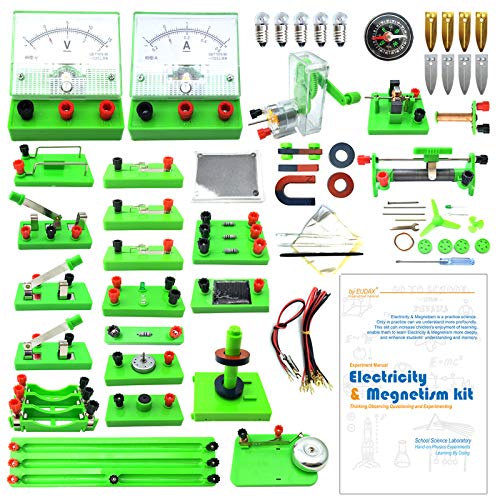
- Hands-on experiments in electricity and magnetism
- Includes series/parallel circuits, Ohm's law, and generators
- Full-color manual plus storage bag for class use
Best For: high school lab work and physics practice
Arduino-Based Learning Kit

- 200+ components and a Mega 2560 board
- 35+ guided lessons in the PDF tutorial
- Combines electronics, coding, and problem solving
Best For: students learning Arduino and programming together
Curriculum-Ready Electronics Set

- Over 750 projects for extended practice
- Includes solar cell, analog meter, and electromagnet
- Study guide and training program support learning
Best For: learners who want a larger Snap Circuits curriculum set
Budget-friendly Arduino starter
UNO R3 Project Super Starter Kit

- More than 22 PDF lessons
- Large mix of beginner components
- UNO-compatible board and power supply
Best For: Beginners who want an affordable, guided Arduino kit
Tool-free circuit starter
Snap Circuits Jr. SC-100 Electronics Kit

- 100+ projects for learning circuitry
- No soldering or tools needed
- Color-coded snap parts and manual
Best For: Younger students who want a safe, hands-on circuit starter
Guided Arduino learning kit

- Interactive curriculum with step-by-step tutorials
- Hands-on projects blend circuits and coding
- Includes sensors, motors, LEDs, and breadboard
Best For: Students and educators wanting a structured Arduino learning path
Starter Circuit Lab
STEM Electric Circuit Kit for Kids

- 8 guided circuit experiments
- Teaches series, parallel, and fruit battery basics
- Good for home or classroom STEM use
Best For: Younger beginners learning electricity fundamentals
Project-Heavy Pick
National Geographic Circuit Kit with 120 Projects

- 120+ electrical projects and activities
- Snap wires and video instructions included
- Wide variety from lights to sound and motion
Best For: Students who want lots of guided circuit projects
Advanced Experiment Station
Playz Circuit Board with 328+ Experiments

- 328+ hands-on circuit experiments
- Includes AM/FM radio, fan, lights, and sound builds
- 64-page manual supports guided learning
Best For: Students ready for a bigger, more advanced circuit board
Beginner-Friendly Circuit Builder – Snap Circuits Classic SC-300
If you’re comparing electrical engineering kits for students, this Snap Circuits set is a practical place to start. It uses snap-together parts, a full-color manual, and more than 300 projects to make basic circuits feel approachable without soldering or tools.
Best For: Younger students and beginners who want a safe, hands-on introduction to electronics with lots of guided projects.
Pros:
- Over 300 projects provide plenty of variety and repeat practice.
- No tools or soldering required, which keeps setup simple.
- Color-coded, numbered parts help students follow directions confidently.
- Includes classic projects like AM radios, burglar alarms, and doorbells.
Cons:
- Designed for ages 8+, so it is less suited to older students seeking advanced circuitry.
- Requires batteries, which are not included in the notes.
This kit stands out for accessibility and volume of hands-on builds. It is a strong choice when you want an introduction to electrical engineering that feels more like play than lab work.
High School Physics Lab Kit – EUDAX Electricity & Magnetism Kit
For students who need a more classroom-style option among electrical engineering kits for students, this EUDAX set focuses on electricity and magnetism experiments. The full-color manual and included parts support hands-on learning across common physics topics like circuits, electromagnets, and generators.
Best For: High school students working through basic electricity and magnetism experiments in a structured lab setting.
Pros:
- Covers both electricity and magnetism with a wide mix of experiments.
- Includes series and parallel circuits, fruit battery, Ohm’s law, and more.
- Comes with a full-color manual and storage bag for organized use.
- Built for grades 9-11 with hands-on exploration in mind.
Cons:
- Batteries are not included and 3 AA batteries are needed.
- It is more academic than toy-like, so it may feel less playful for younger students.
This is a solid pick if the goal is classroom relevance and concept reinforcement. It offers enough experiment variety to support study in basic physics and introductory electrical engineering.
Arduino-Based Learning Kit – ELEGOO Mega 2560 Starter Kit
If you want electrical engineering kits for students that bridge circuits and programming, this ELEGOO starter kit is a strong fit. It includes a Mega 2560 board, more than 200 components, and a tutorial with over 35 guided lessons for building and coding projects.
Best For: Students ready to move beyond simple circuit demos into Arduino-based electronics and programming.
Pros:
- Over 200 components give students plenty of parts to explore.
- Includes a Mega 2560 controller board and USB cable.
- PDF tutorial with more than 35 lessons provides guided learning.
- Compatible with Arduino IDE and covers electronics, coding, and problem solving.
Cons:
- More complex than basic snap-together kits, so beginners may need more time.
- Some projects are better suited to youth with an interest in programming.
This kit is useful when you want a more serious learning path that combines hardware and code. It offers a broad component set and structured lessons that support steady skill-building.
Curriculum-Ready Electronics Set – Snap Circuits Extreme SC-750R
Among electrical engineering kits for students, this Snap Circuits Extreme set is aimed at learners who want more depth and a study component. It builds on the familiar snap-together format with over 750 projects, extra specialty parts, and a student training program with study guide.
Best For: Students who already like Snap Circuits and want a larger project library with curriculum support.
Pros:
- Over 750 projects offer the broadest variety in this group.
- Includes added components like a solar cell, analog meter, and electromagnet.
- Student training program and study guide make it more classroom-ready.
- Still uses a no-solder, snap-together design for easy building.
Cons:
- Best suited to students already comfortable with the Snap Circuits format.
- Requires batteries, and the notes indicate a rechargeable battery project as part of the set.
This is the most expansive option here for repeated hands-on learning. It works well when you want a kit that can stretch beyond basics while still remaining approachable.
Budget-friendly Arduino starter – UNO R3 Project Super Starter Kit
If you’re comparing electrical engineering kits for students, this ELEGOO starter set is a strong entry point for hands-on circuit building. It pairs an UNO R3-compatible board with more than 22 PDF-tutorial lessons and a wide mix of components, so beginners can move from simple LEDs to sensors, motors, and relay projects without piecing together extra parts.
Best For: Beginners who want an economical Arduino-based kit with a large parts assortment and a guided lesson path.
Pros:
- Includes a PDF tutorial with more than 22 lessons for structured learning.
- Comes with a broad component list, including LCD1602, sensors, motors, LEDs, resistors, and a breadboard.
- Upgraded kit includes a power supply module and 9V battery with DC connector.
- Compatible with Arduino UNO R3, UNO R4, MEGA 2560 R3, and NANO boards.
Cons:
- Best suited to beginners, so advanced users may outgrow it quickly.
- Warning notes limit the power supply to 9V or lower.
This is a practical starter option if you want one box that covers the basics of electronics, sensors, and simple automation. It stands out for value and lesson support rather than premium depth, which makes it a sensible first kit for students.
Tool-free circuit starter – Snap Circuits Jr. SC-100 Electronics Kit
For electrical engineering kits for students, Snap Circuits Jr. SC-100 is one of the easiest ways to start learning circuitry. The color-coded snap pieces and project manual make it simple to build and test projects right away, without soldering or tools, which is ideal for younger learners or anyone who wants a low-friction introduction.
Best For: Kids and younger students who need a safe, tool-free introduction to circuits and STEM basics.
Pros:
- Offers 100+ projects for a wide range of learning and play.
- No soldering or tools required; pieces snap onto the grid.
- Includes a full-color project manual and color-coded parts.
- Designed for ages 8+ and recognized by multiple educational awards.
Cons:
- Uses plastic snap modules rather than a microcontroller platform.
- Batteries are required and not included in the notes provided.
This kit is less about programming and more about building confidence with core circuit concepts. If you want a straightforward classroom or home starter that keeps setup simple, it delivers a lot of learning value with very little frustration.
Guided Arduino learning kit – Arduino Student Kit AKX00025
The Arduino Student Kit is a strong pick for electrical engineering kits for students who want a more complete learning path. It combines hands-on projects, sensors, components, and an interactive curriculum, so learners can move through guided builds like traffic lights, lamp control, and motion alarms while also practicing programming in the Arduino IDE.
Best For: Students, teachers, and beginners who want a guided Arduino curriculum with real-world project practice.
Pros:
- Includes an interactive curriculum with step-by-step tutorials.
- Covers hands-on projects such as a traffic light system, light-sensitive lamp, and motion-activated alarm.
- Supplies a broad range of components for experimentation, including sensors, motors, LEDs, resistors, capacitors, and a breadboard.
- Supports both written instructions and video tutorials for self-paced or classroom use.
Cons:
- More focused on guided learning than open-ended advanced builds.
- Uses a 9-volt battery description, so power planning may still be needed.
Overall, this kit is the most curriculum-driven option in the group and is especially well matched to classroom learning or structured self-study. If you want students to understand both circuits and coding together, it offers a solid balance of instruction and experimentation.
Starter Circuit Lab – STEM Electric Circuit Kit for Kids
If you’re comparing electrical engineering kits for students, this STEM electric circuit kit is a simple hands-on way to teach core electricity concepts. It includes 8 circuit experiments across 7 packs, with projects like series and parallel circuits, saltwater power generation, and fruit battery builds. The included circuit book helps guide learning, making it a practical pick for home science time or classroom demos.
Best For: Younger students who need an easy-to-follow introduction to circuits, conductivity, and energy.
Pros:
- Includes 8 experiments covering core electricity ideas like series and parallel circuits
- Guided circuit book supports step-by-step learning
- Focuses on STEM, science, and critical thinking
- Works well for home use, school projects, and science fairs
Cons:
- AA batteries are required but not included
- Less expansive than larger circuit sets with dozens of projects
- Best suited to introductory learning rather than advanced experimentation
Overall, this kit is a straightforward entry point for students who want a basic, guided circuit experience without a steep learning curve. It emphasizes simple builds and practical electricity concepts over sheer project volume.
Project-Heavy Pick – National Geographic Circuit Kit with 120 Projects
For shoppers seeking electrical engineering kits for students with lots of replay value, this National Geographic set stands out with 120+ projects and activities. It covers a wide range of electrical experiments, from keyboard mode and light shows to a flying copter and voice amplification. The snap-together wires and video instructions keep it approachable for kids who are ready to build more often and try many variations.
Best For: Students who want a larger circuit kit with lots of project variety and guided experimentation.
Pros:
- More than 120 projects and activities for extended hands-on learning
- Includes kid-friendly illustrated instructions plus QR-code video help
- No tools needed; wires snap securely to components
- Covers a broad range of electrical possibilities in one kit
Cons:
- Requires batteries, which are not the focus of the included components
- Large project count may feel overwhelming for very new learners
- Primarily aimed at ages 8 and up, so it is not for preschool use
This is the best choice in the group if you want a circuit kit that can keep students busy for a long time. Its main advantage is breadth: many activities, clear instructions, and easy assembly.
Advanced Experiment Station – Playz Circuit Board with 328+ Experiments
If you want electrical engineering kits for students that go beyond a few basic demos, this Playz circuit board offers a much bigger experiment range. It advertises 328+ experiments and lets kids explore lights, sounds, magnetism, touch controls, and even AM/FM radio builds. The 64-page illustrated manual adds structure, while the mix of simple and more challenging experiments gives the kit room to grow with the child.
Best For: Students who want a larger, more advanced circuit board experience with many experiment options.
Pros:
- Very large experiment count with 328+ hands-on activities
- Covers lights, sounds, magnetism, touch controls, and radios
- Includes a 64-page illustrated instruction manual
- Experiments range from simple to challenging for longer-term use
Cons:
- Younger children may need adult or parental supervision
- Larger size and 4-pound weight make it less compact than smaller kits
- May be more than a beginner needs if they only want a few starter projects
Among these options, this is the most expansive kit for students who want a true at-home electronics lab feel. The big experiment count and broader feature set make it a strong fit for sustained STEM exploration.
How We Picked the Best Electrical Engineering Kits for Students
We prioritized kits that make learning practical, not just entertaining. Our shortlist emphasizes clear instructions, strong educational alignment, age-appropriate complexity, and enough project variety to support repeated use. We also looked for kits that can work well for home learners, classrooms, and STEM clubs.
Quick Comparison
Some of the included options are best for younger beginners who need simple snap-together circuits, while others are better for teens ready to work with microcontrollers, sensors, and coding. If you want a low-friction introduction, choose a circuit-snap style kit. If your student is ready for deeper electronics and programming concepts, an Arduino-based kit is usually the better fit.
Key Buying Factors for Electrical Engineering Kits for Students
Age and Skill Level
Match the kit to the learner’s current ability. Younger students often benefit from visual, color-coded builds, while high school students may be ready for breadboards, coding, and more advanced troubleshooting.
Project Count and Reusability
A higher project count can be helpful, but only if the projects remain varied and educational. Look for kits that let students rebuild and experiment, not just follow one-time demonstrations.
Instruction Quality
For Electrical Engineering Kits for Students, strong instructions matter as much as the parts. Manuals, tutorials, and guided curricula can reduce frustration and improve learning outcomes.
Component Breadth
Kits with switches, LEDs, resistors, sensors, motors, and microcontroller support give students a broader foundation. More component variety usually means more opportunities to explore core electrical principles.
Learning Path
Consider whether you want a pure circuit-building experience or a path that grows into programming and engineering design. Some kits are ideal for basic electricity concepts, while others bridge into coding and prototyping.
Who Should Buy Which Electrical Engineering Kits for Students?
Choose a simpler snap-circuit kit if you are buying for younger learners, first-time experimenters, or families who want quick setup and easy wins. Choose a physics or school-lab style kit if the goal is classroom demonstrations and concept reinforcement. Choose an Arduino or microcontroller-based option if the student is ready to learn more advanced electronics, inputs and outputs, and beginner coding.
If you are shopping for a broad classroom or homeschool solution, look for a kit with durable parts, structured lessons, and enough depth to support multiple learning sessions. That combination makes Electrical Engineering Kits for Students far more useful than a one-off novelty set.