Choosing the right handheld 3D scanner can save hours of setup and cleanup, especially if you want reliable results for 3D printing, reverse engineering, or digital archiving.
Below, we focus on scanners that balance accuracy, tracking stability, portability, and value so you can match the right tool to your workflow.
Best 10 Handheld 3d Scanners Picks for 2026
Blue-Laser Versatility for Detail Work

- 0.02mm accuracy with blue laser and NIR modes
- Scans objects from tiny parts to large components
- 24-bit color capture with anti-shake tracking
Best For: Users needing detailed scans across a wide object size range
All-Weather Precision and Speed
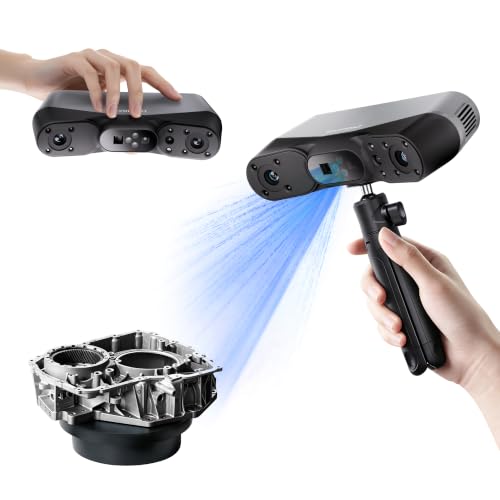
- Up to 0.03 mm single-frame accuracy
- 105 fps scanning with multiple modes
- AI segmentation and outdoor-capable design
Best For: Precision users who scan indoors, outdoors, and on difficult surfaces
Wide-Range Scan Coverage

- Scans tiny parts up to car-sized objects
- Works on black and metal surfaces without spray
- Wireless support for iOS, Android, Windows, and macOS
Best For: Users who need a single scanner for very small through very large objects
Lightweight Outdoor Scanning

- Only 190g with WiFi 6 wireless scanning
- Up to 0.05mm accuracy in structured light and laser modes
- Captures dark and reflective surfaces without spray
Best For: Portable scanning on the go, including outdoor and mixed-surface work
Wireless Precision Scanner
Creality Otter Lite for Flexible 3D Capture
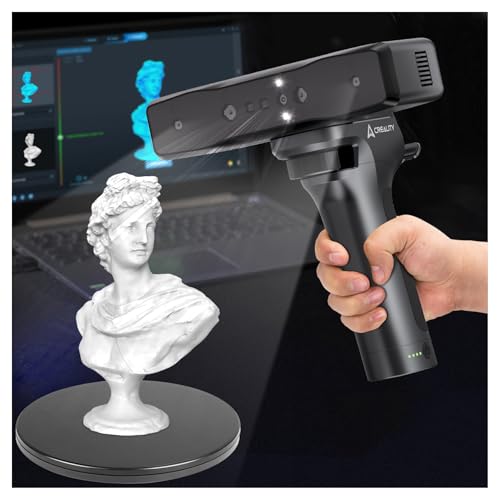
- 0.05mm accuracy with infrared structured light
- Wi‑Fi and smartphone control for cable-free scanning
- Scans tiny parts up to large objects in varied lighting
Best For: Engineers, designers, and hobbyists needing flexible wireless scanning
High-Detail Mid-Range Scanner
3DMakerpro Moose for Detailed Models

- Up to 0.03mm accuracy with blue LED light source
- 24-bit color scanning for realistic texture capture
- Best for 15mm to 1500mm indoor objects
Best For: Medium-format scanning with strong detail and color capture
Wireless Full-Color Scanner
Creality Ferret Pro for Fast Mobile Use

- 0.1mm accuracy with 30FPS scanning
- WiFi 6 bridge for faster wireless transfer
- Anti-shake tracking for smoother beginner-friendly scans
Best For: Beginners and mobile users wanting fast wireless scanning
AI-Driven Beginner-Friendly Pick
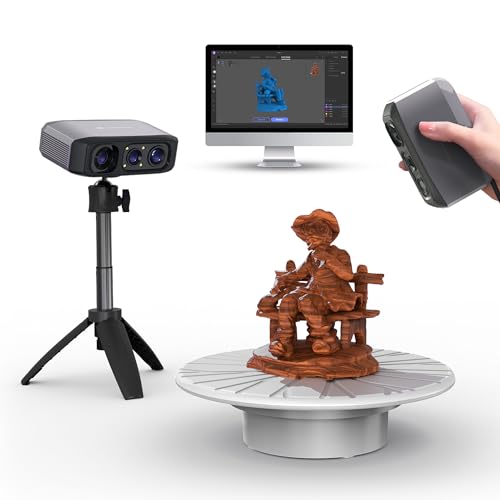
- AI visual tracking with automatic model repair
- Anti-shake module plus re-scanning support
- Marker-free workflow with free lifetime OTA software
Best For: Beginners who want simpler handheld scanning
Fast Color Scanner for Mixed Materials

- 0.1mm accuracy with 30FPS scanning
- 2MP color camera for vivid textures
- Scans black and metal objects without spray
Best For: Fast color scans on medium to large objects
Portable Dual-Mode Scanner

- Dual-mode scanning for wide and fine-detail capture
- ASIC chip enables faster processing and smoother scans
- Built-in RGB camera and portable power options
Best For: Portable scanning with flexible capture modes
Blue-Laser Versatility for Detail Work – Creality CR-Scan Raptor
If you’re shopping for handheld 3D scanners that can handle both fine detail and larger objects, the Creality CR-Scan Raptor is built around flexibility. Its blue laser and NIR modes, anti-shake tracking, and 24-bit color capture make it a strong fit for users who want sharp geometry without a complicated setup.
Best For: Reverse engineering, miniatures, industrial parts, and full-color scans with a wide size range.
Pros:
- Up to 0.02mm accuracy with 7 parallel blue laser lines for fine detail
- Supports very small to very large objects, from 5×5×5mm to 2000×2000×2000mm
- 60fps blue laser scanning and marker-free capture for faster workflows
- 24-bit full-color scanning with LED lighting for more realistic models
Cons:
- Recommended PC and Mac specs are fairly demanding for best performance
- NIR scanning is slower than blue laser mode
- Best results depend on using the CrealityScan software workflow
Overall, the Raptor is a capable pick if you want one scanner that can move between precision work and larger-format capture. It leans more toward serious hobbyists and professionals who will benefit from its speed, stability, and color output.
All-Weather Precision and Speed – Revopoint POP 4 Premium
Among handheld 3D scanners, the Revopoint POP 4 Premium stands out for combining high accuracy, fast capture, and strong outdoor performance. It is designed for users who want flexible scanning modes, background cleanup tools, and reliable results on challenging surfaces and in bright environments.
Best For: Precision scanning, reverse engineering, outdoor capture, and users who want advanced software features.
Pros:
- Single-frame accuracy up to 0.03 mm for detailed modeling
- Fast scanning up to 105 fps with multi-line laser mode
- AI object segmentation helps isolate the target and reduce cleanup work
- Works with dark and reflective objects, plus bright outdoor conditions
Cons:
- Some features, like AI segmentation, are Windows only
- Professional workflow tools may feel more complex for casual users
- To get the most from outdoor scanning, accessories and mode selection matter
This is a strong choice if you need a scanner that can handle demanding jobs without sacrificing speed. The POP 4 Premium is especially appealing for users who value versatility across indoor, outdoor, and reflective-surface scanning.
Wide-Range Scan Coverage – Creality CR-Scan Otter
The Creality CR-Scan Otter is a practical option if you want handheld 3D scanners that can move from small objects to very large ones without a lot of setup hassle. Its dual lenses, One-Shot 3D imaging, and full-color capture make it a versatile pick for creators who need dependable results on different object types.
Best For: Scanning everything from small parts to cars, including dark or metal surfaces.
Pros:
- Captures objects from 10×10×10mm up to 2000×2000×2000mm
- Dual lenses and multiple cameras help balance detail and range
- Handles black and metal objects without scanning spray
- Supports wireless use with iOS and Android accessories, plus Windows and macOS
Cons:
- Android wireless use requires accessories rather than direct connection
- Performance requirements are fairly high on all supported platforms
- Top-end color and outdoor performance depend on the lighting conditions
For buyers who want one scanner to cover a broad range of object sizes, the Otter is easy to recommend. It offers useful practical features for real-world scanning, especially when you need to deal with mixed materials and larger subjects.
Lightweight Outdoor Scanning – Revopoint INSPIRE 2
If portability matters, the Revopoint INSPIRE 2 is one of the more travel-friendly handheld 3D scanners in this group. It pairs a lightweight 190g body with wireless scanning, outdoor-capable operation, and dual scanning modes aimed at users who want a compact tool for detailed models.
Best For: Portable scanning, outdoor use, and compact workflows for 3D printing or archiving.
Pros:
- Lightweight 190g design makes it easy to carry and use on location
- Wireless WiFi 6 scanning with PC-to-mobile interactive streaming
- Handles reflective and dark surfaces without scanning spray
- Offers up to 0.05mm accuracy with structured light and laser modes
Cons:
- Outdoor scanning is rated for up to 20,000 lux, so very bright sun can be limiting
- Some advanced workflow features depend on the Revo Metro/Revo Design software stack
- Best system compatibility requires relatively capable devices
The INSPIRE 2 is a smart fit if you want a compact scanner that still offers practical flexibility. It focuses on convenience, portability, and good everyday scan quality rather than raw industrial heft.
Wireless Precision Scanner – Creality Otter Lite for Flexible 3D Capture
If you want handheld 3D scanners that balance precision with mobility, the Creality Otter Lite is built for exactly that use case. It combines 0.05mm accuracy with wireless operation, so you can scan small parts, larger objects, and even work outdoors without being tied to a cable.
Best For: Engineers, designers, and hobbyists who want a wireless handheld scanner for a wide range of object sizes.
Pros:
- 0.05mm accuracy with infrared structured light for detailed scans
- Handles objects from 20mm³ to 2000mm³, from tiny parts to large components
- Wi-Fi plus mobile control through the Creality Scan app
- Works in low light or bright outdoor conditions up to 30,000 lux
Cons:
- Requires Windows or macOS, so it is not a standalone scanner
- Best results still depend on using the supported software and system specs
The Otter Lite stands out for users who need flexibility without giving up accuracy. Its wireless design, anti-shake performance, and broad size compatibility make it a strong all-around choice for practical scanning workflows.
High-Detail Mid-Range Scanner – 3DMakerpro Moose for Detailed Models
Among handheld 3D scanners, the 3DMakerpro Moose is aimed at users who want strong detail on medium-sized objects. Its blue LED structured light system, 0.03mm claimed accuracy, and 24-bit color support make it a solid option for model capture where surface detail matters.
Best For: Users scanning medium-format objects who want high detail and full-color capture.
Pros:
- Up to 0.03mm accuracy and 0.07mm resolution
- Captures objects from 15mm to 1500mm
- 24-bit color scanning adds realistic tone and texture
- JMStudio offers visual tracking, error correction, and auto-alignment
Cons:
- Best used indoors for optimal results
- Has a learning curve and needs a relatively powerful PC
The Moose is a good fit if you are willing to spend time learning the workflow in exchange for finer detail. Its software support and size range make it especially useful for printing and creative capture projects.
Wireless Full-Color Scanner – Creality Ferret Pro for Fast Mobile Use
If you are comparing handheld 3D scanners for speed and mobility, the Creality CR-Scan Ferret Pro is built around wireless convenience and fast capture. It offers 0.1mm accuracy, 30FPS scanning, and WiFi 6 transmission, making it a practical pick for users who want smoother scanning on supported mobile devices and PCs.
Best For: Beginners and mobile users who want a wireless handheld scanner with fast, stable scanning.
Pros:
- 0.1mm accuracy and 30FPS scanning for quick model capture
- WiFi 6 bridge enables faster wireless transfer than WiFi 5
- Anti-shake tracking helps maintain stable scans
- Supports OBJ, STL, and PLY exports for common workflows
Cons:
- Performs best when avoiding highly reflective, transparent, or very dark surfaces
- Requires compatible device and software versions across platforms
The Ferret Pro is a well-rounded choice if you want wireless scanning with broad device support. Its outdoor-friendly design and anti-shake features make it especially appealing for users who value convenience and speed.
AI-Driven Beginner-Friendly Pick – 3DMakerpro Moose Lite Premium
Among handheld 3D scanners, the 3DMakerpro Moose Lite Premium is built for users who want an easier path to clean scans. Its AI visual tracking, anti-shake module, and marker-free workflow are designed to reduce common beginner frustrations while keeping the scanning process efficient.
Best For: Beginners and hobbyists who want a marker-free handheld scanner with built-in scan recovery and software support.
Pros:
- AI visual tracking helps detect vulnerabilities and supports automatic 3D model repair.
- Optical anti-shake module makes the scanner more forgiving of shaky hands.
- Re-scanning function lets you continue after an interruption.
- Marker-free scanning and lifetime free OTA software updates simplify the workflow.
Cons:
- 10FPS scanning speed is not the fastest option here.
- Package weight is relatively heavy at 3.65 pounds.
If you want a handheld scanner that emphasizes ease of use over raw speed, this model stands out for practical everyday scanning. The included software and recovery features make it appealing for people learning 3D scanning for printing.
Fast Color Scanner for Mixed Materials – Creality CR-Ferret SE
If you want handheld 3D scanners that can move quickly and capture color, the Creality CR-Ferret SE is a strong practical option. It combines 0.1mm accuracy, 30FPS scanning, and a built-in 2MP color camera, while also being tuned to handle black and metal objects without spray.
Best For: Users who need a fast, color-capable scanner for medium to large objects and tricky surfaces.
Pros:
- Up to 0.1mm accuracy and 30FPS scanning speed.
- Anti-shake one-shot 3D imaging helps improve tracking for beginners.
- Built-in 2MP color camera captures vivid full-color textures.
- Can scan black or metal objects without white powder or spray.
Cons:
- Geared more toward medium to large objects than very small parts.
- Connection and workflow details may matter if you want maximum portability.
This model is a good fit if you want a faster handheld scanner that still keeps setup fairly approachable. Its color capture and surface flexibility make it especially useful for users working with varied object types.
Portable Dual-Mode Scanner – Creality CR-Scan Ferret
The Creality CR-Scan Ferret is aimed at buyers who want a flexible handheld 3D scanner with both wide-range and high-accuracy modes. It offers up to 0.1mm precision, uses an ASIC chip for faster processing, and includes a built-in RGB camera for full-color models.
Best For: Users who want a portable handheld scanner with dual-mode capture and broad device compatibility.
Pros:
- Dual-mode scanning covers both large objects and fine detail work.
- Up to 0.1mm precision and 0.16mm resolution in high-accuracy mode.
- ASIC chipset supports faster processing and smoother scanning.
- Built-in color camera preserves realistic textures.
Cons:
- Android mobile scanning support is available, but mobile compatibility is not uniform across all versions.
- System requirements are fairly specific across Windows, macOS, Android, and iOS.
This scanner is a sensible choice if you want one device that can handle both broad coverage and more detailed captures. The portability and power-bank support add convenience for scanning away from a desktop setup.
How We Picked These Handheld 3d Scanners
We focused on practical buying signals that matter in real scanning sessions: stated accuracy, frame rate, tracking stability, supported device types, color capture, scan range, and how well each model fits common use cases like hobby printing, inspection, and content creation. We also favored models with features that reduce frustration, such as anti-shake tools, wireless workflows, and broader compatibility.
Quick Comparison
The best Handheld 3d Scanners for precision work tend to prioritize tighter accuracy and stronger tracking, while value-focused models often trade a bit of fine detail for easier setup and wider everyday usability. If you need small-object detail, look for higher stated precision and a stable close-range capture window. For larger objects, prioritize scan range, real-time tracking, and ergonomics over raw headline accuracy.
Key Buying Factors for Handheld 3d Scanners
Accuracy and Resolution
Accuracy matters most when you need printable geometry, fit checks, or dimensional references. For decorative scans or basic modeling, moderate precision may be enough. For mechanical parts, aim for tighter specs and dependable alignment.
Tracking and Stabilization
Good tracking helps the scanner stay locked onto surfaces without repeated resets. Anti-shake features, multi-line capture, and strong software tracking can make a big difference on reflective, textured, or uneven objects.
Object Size and Working Distance
Some Handheld 3d Scanners are better for small-to-medium subjects, while others are built for larger items or mixed-size scanning. Check the usable range so you do not end up fighting the scanner on objects that are too small, too large, or too close for comfortable operation.
Color Capture and Workflow
If you need textured models for visualization or digital presentation, full-color capture is worth considering. Also factor in whether the scanner works smoothly with your preferred setup, including Windows, Mac, Android, or wireless operation.
Who Should Buy Which Handheld 3d Scanners?
If you want the most precise results for demanding 3D printing tasks, choose a scanner positioned toward the accuracy-first end of the lineup. If you are new to scanning or want a simpler everyday option, pick a model that emphasizes ease of use, stable tracking, and broad compatibility. For larger objects or faster field use, wireless and higher-speed Handheld 3d Scanners are usually the better fit. If you need color-rich scans for presentation or reference, prioritize full-color support over marginal gains in precision.
In short, the best choice depends on whether you value fine detail, portability, scan size, or convenience most. Matching those priorities to the scanner’s strengths will matter more than chasing a single spec.