Photo editing is easier when your canvas, tools, folders, and reference images are visible at the same time. Laptop screen extenders add portable workspace without requiring a full desktop setup.
These 10 options span compact dual-screen designs and larger triple-monitor configurations, with features such as Full HD IPS panels, USB-C or HDMI connectivity, detachable screens, and travel-friendly construction.
Best 10 Laptop Screen Extenders for Photo Editing Picks for 2026
Best Balanced Pick
KEFEYA 14-inch FHD Laptop Screen Extender

- 14-inch 1080p IPS display
- Adjustable image controls
- Multiple connection options
Best For: Mobile photo editors needing a compact second screen
Best Large Single Screen
Anyking 15.6-inch FHD Extender

- Large 15.6-inch IPS display
- 330-nit brightness and 100% gamut listed
- Adjustable stand with VESA support
Best For: Editors wanting a spacious, flexible second screen
Best Lightweight Triple-Screen Setup
Synnov 15.6-inch Triple Monitor Extender

- Portable triple-screen workstation
- 15.6-inch IPS display with 100% gamut listed
- Thin aluminum build with carry bag
Best For: Mobile creators managing edits, references, and communication
Best for Vertical Workspace

- 16:10 1920×1200 IPS displays
- 350-nit brightness and 100% gamut listed
- Large triple-screen workspace
Best For: Creators needing vertical room for panels and references
Best for Flexible Photo Workflows
15.6-inch FHD Detachable Extender

- 15.6-inch matte FHD IPS display
- Detachable with vertical mounting support
- Fits 13- to 17.3-inch laptops
Best For: Photo editors needing a large, flexible secondary display
Best for a Desktop-Style Setup
15.6-inch Triple-Screen FHD Monitor

- 100% sRGB coverage with HDR support
- Freestanding aluminum-alloy design
- Expands compatible laptops to three screens
Best For: Desk-based editing and extensive multitasking
Best for Travel Editing
14.2-inch Ultra-Portable FHD Extender

- Weighs 1.87 pounds and is 0.27 inches thin
- 300-nit matte FHD IPS display
- Supports portrait, extend, and mirror modes
Best For: Photographers who edit while traveling
Flexible Color-Accurate Pick
Aefieoy 15.6-Inch Dual Extender

- 15.6-inch FHD IPS panel with claimed 100% sRGB coverage
- Detachable, rotating design supports portrait and landscape use
- Thin 2.8-pound build for travel
Best For: Portable photo editing with flexible screen positioning
Triple-Screen Workspace Pick
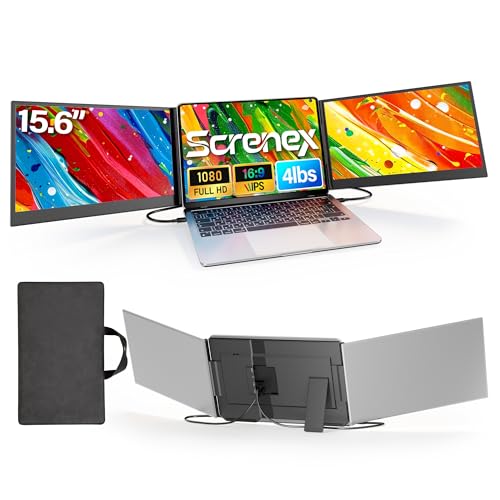
- Adds two 15.6-inch FHD IPS screens for a triple display
- Free-standing design avoids laptop hinge and screen pressure
- Includes cables, power adapter, and carry case
Best For: Editors who need extensive multitasking workspace
Compact Eye-Care Pick

- 14-inch FHD IPS display with 300-nit brightness
- Matte anti-glare finish and independent brightness control
- Adjustable padded stand fits 13- to 17.3-inch laptops
Best For: Traveling editors who prefer a compact, low-glare setup
Best Balanced Pick – KEFEYA 14-inch FHD Laptop Screen Extender
For shoppers comparing laptop screen extenders for photo editing, the KEFEYA offers a practical 14-inch FHD IPS display with adjustable image settings. Its 1920×1080 resolution, 300-nit brightness, and 72% NTSC color gamut provide a useful secondary workspace for palettes, reference images, file management, or editing controls.
Best For: Photographers and creators who want a compact, versatile second screen for editing on the go.
Pros:
- FHD IPS panel with adjustable brightness, contrast, and backlight settings.
- Supports landscape, portrait, mirror, and extended display modes.
- Includes USB-C, USB-C-to-USB-A, and HDMI cables for flexible connectivity.
- Compatible with Windows, Mac, Chrome, Linux, Android, and selected consoles.
Cons:
- The 72% NTSC gamut is more modest than the wider-gamut options in this roundup.
- HDMI connections require an additional USB-A-to-USB-C cable for power.
The KEFEYA is a sensible travel choice when portability and broad compatibility matter more than maximum color coverage. Its independent display controls are helpful for matching a secondary workspace to your editing setup.
Best Large Single Screen – Anyking 15.6-inch FHD Extender
The Anyking is a strong option for laptop screen extenders for photo editing when you want more physical workspace without adding a full desktop monitor. Its 15.6-inch 1920×1080 IPS display, 330-nit brightness, and listed 100% color gamut give editing panels and image previews more room.
Best For: Creators who prefer a larger attached display and flexible positioning for home, office, or travel use.
Pros:
- Large 15.6-inch FHD IPS screen with 330-nit brightness.
- Offers extend, mirror, landscape, portrait, and rotated modes.
- Adjustable slide-rail stand supports height changes and 90-degree rotation.
- Supports 75×75mm VESA mounting and one-cable USB-C operation on compatible laptops.
Cons:
- FHD resolution provides less vertical space than the 16:10 1200p model.
- One-cable operation depends on a full-featured USB-C port.
With its larger panel, flexible stand, and broad positioning options, the Anyking works well as an editing companion for users who want a spacious, adaptable screen. Confirm your laptop’s port support before buying.
Best Lightweight Triple-Screen Setup – Synnov 15.6-inch Triple Monitor Extender
For photo editors who need multiple windows around their main canvas, the Synnov creates a portable triple-screen workstation. Its 15.6-inch FHD IPS display has a listed 100% color gamut, 178-degree viewing angle, adjustable brightness, and a 180-degree adjustable angle.
Best For: Traveling creators who want extra room for editing tools, references, and communication windows.
Pros:
- Creates an extended triple-screen workspace for multitasking.
- 15.6-inch 1080p IPS screen with a listed 100% color gamut.
- Thin aluminum-alloy construction and included leather carry bag support portability.
- Supports extend, mirror, and portrait modes without driver installation.
Cons:
- Requires at least one full-featured USB-C port, with two USB-C connections or USB-C plus HDMI used for setup.
- The notes specifically identify compatibility limitations with M1, M2, and M3 MacBook models.
- Its glossy finish may be less convenient around reflections than a matte screen.
The Synnov is appealing when a full three-screen workflow is more valuable than a minimal setup. Its connection requirements deserve careful checking, especially for MacBook owners, but the listed gamut and large IPS panel suit a multitasking editing workflow.
Best for Vertical Workspace – 16-inch 1200p Triple Extender
This 16-inch model stands out among laptop screen extenders for photo editing by using a 16:10 1920×1200 IPS format. The extra vertical space can show more layers, tool controls, file lists, or web content, while the 350-nit brightness and listed 100% color gamut support a detailed secondary editing workspace.
Best For: Content creators who value vertical space and a spacious triple-screen arrangement.
Pros:
- Dual 16-inch IPS displays provide a large triple-screen workstation.
- 1920×1200 resolution and 16:10 aspect ratio show more vertical content than standard 1080p screens.
- 350-nit brightness and a listed 100% color gamut support bright, detailed visuals.
- Ultra-slim aluminum construction and a driver-free two-cable setup improve portability and convenience.
Cons:
- Requires two full-featured USB-C ports on the laptop.
- At 4.6 pounds, it is heavier than a compact single-screen extender.
- The glossy finish may produce more reflections in bright environments.
If your editing workflow benefits from more vertical room and multiple surrounding panels, this is the most expansive option here. Its two-port requirement and larger weight make it better suited to compatible creator laptops than ultra-light travel setups.
Best for Flexible Photo Workflows – 15.6-inch FHD Detachable Extender
For photographers who want more room for editing panels, reference images, and file browsers, this 15.6-inch FHD IPS model is a versatile option among laptop screen extenders for photo editing. Its matte display, 300-nit brightness, and detachable design provide a practical setup for home, office, or travel use.
Best For: Photo editors who want a large secondary display with horizontal and vertical mounting flexibility.
Pros:
- 15.6-inch 1920×1080 IPS display with a matte finish and 300-nit brightness.
- Detachable screen supports vertical mounting for portrait-oriented content and tools.
- Fits 13- to 17.3-inch laptops and includes USB-C, USB-A, and HDMI connection options.
- Folds slim and weighs 1.5 pounds for easier transport.
Cons:
- Single-cable operation requires a full-function USB-C port; other setups use HDMI and USB-A.
- At 1080p, it may offer less workspace detail than a higher-resolution editing monitor.
Its combination of screen size, matte viewing surface, portrait support, and broad laptop fit makes it a strong all-around choice for mobile photo workflows.
Best for a Desktop-Style Setup – 15.6-inch Triple-Screen FHD Monitor
This Rizpak model suits photographers who want a more spacious, stationary workstation. As one of the laptop screen extenders for photo editing, it adds a 15.6-inch FHD IPS panel with 100% sRGB color coverage and HDR support, while its freestanding design avoids attaching extra weight directly to the laptop screen.
Best For: Desk-based photo editing, multitasking, and users who want a triple-screen workspace.
Pros:
- 15.6-inch 1080p IPS display lists 100% sRGB color coverage and HDR support.
- Triple-screen setup provides space for editing tools, images, and reference material.
- Freestanding aluminum-alloy design avoids pressure from a clip-on mount.
- Supports USB-C and HDMI on compatible systems.
Cons:
- Weighs 4 pounds, making it less travel-friendly than lighter extenders.
- Optimal brightness and stable performance may require an external 5V/3A-or-higher power supply.
- Compatibility requires a full-function USB-C video output on many laptops; some MacBooks may need an adapter.
The color specification and freestanding construction make this a compelling choice for a permanent or semi-permanent editing desk, provided your laptop and power setup are compatible.
Best for Travel Editing – 14.2-inch Ultra-Portable FHD Extender
When portability matters, this 14.2-inch dual monitor keeps the setup lighter without giving up a full HD IPS image. It is a practical pick among laptop screen extenders for photo editing, with 300-nit brightness, a matte finish, adjustable viewing angles, and support for extend, mirror, and portrait modes.
Best For: Traveling photographers, remote workers, and editors using 14- to 17.3-inch laptops.
Pros:
- Lightweight 1.87-pound, 0.27-inch-thin design is suited to travel.
- 1080p IPS display provides 300-nit brightness and a matte finish.
- Supports extend, mirror, and portrait modes with a 0-226-degree adjustable angle.
- Includes cables for USB-C or HDMI plus USB-A connections.
Cons:
- The 14.2-inch screen provides less physical workspace than the 15.6-inch alternatives.
- Full-function USB-C is needed for the simplest direct connection.
- 1080p resolution may limit fine-detail workspace for demanding photo projects.
This is the most travel-oriented option of the three, balancing a usable IPS display and flexible positioning with a notably light, slim build.
Flexible Color-Accurate Pick – Aefieoy 15.6-Inch Dual Extender
For shoppers comparing laptop screen extenders for photo editing, the Aefieoy combines a 15.6-inch 1080p IPS panel with claimed 100% sRGB coverage. Its detachable screen and rotating stand also make it adaptable for portrait layouts, presentations, or a more traditional dual-screen workspace.
Best For: Photo editors who want a larger portable display with wide color coverage and flexible positioning.
Pros:
- 15.6-inch FHD IPS display with claimed 100% sRGB coverage, 300-nit brightness, and 1000:1 contrast
- Detachable screen and 360-degree rotating rear stand support landscape, portrait, and single-screen use
- Thin 0.27-inch design and 2.8-pound weight are suited to travel
- Works with Windows, Mac, Android, Linux, and Chrome OS; HDMI connectivity is also supported
Cons:
- Some laptops may need an external 5V/2A power adapter if the display flickers or shows no signal
- Users must confirm that USB-C ports are full-featured or use HDMI and separate power connections
The claimed full sRGB coverage makes this one of the more editing-oriented options in the group, while its detachable design adds versatility. Check your ports and power setup before buying, especially for mobile editing workflows.
Triple-Screen Workspace Pick – P7 15.6-Inch Triple Extender
This P7 model is designed for editors who want more workspace around a laptop. It adds two 15.6-inch FHD IPS panels for a triple-screen setup, making it easier to keep photo tools, previews, and reference material visible at the same time.
Best For: Photo editors who prioritize maximum workspace and regularly multitask across several windows.
Pros:
- Two 15.6-inch 1080p IPS panels provide an expansive triple-screen arrangement
- 178-degree viewing angles and claimed accurate color reproduction suit shared viewing and creative work
- Free-standing design avoids hanging from or clamping onto the laptop screen
- Includes cables, power adapter, quick guide, instructions, and a carry case
Cons:
- The complete setup weighs 3.9 pounds, making it heavier than the dual-screen alternatives
- Two full-function USB-C ports are needed for the simplest two-cable connection
- M1-M3 MacBooks and other systems without suitable ports may require an H5-T cable, HDMI, USB-A power, and driver installation
For photo editing, the additional panels can reduce window switching and provide room for palettes and references. However, its larger footprint, weight, and more involved compatibility requirements make it better suited to stationary travel or desk use than minimalist mobile setups.
Compact Eye-Care Pick – CIDETTY 14-Inch Dual Extender
The CIDETTY is a compact option for laptop screen extenders for photo editing, pairing a 14-inch 1080p IPS display with a matte anti-glare finish. Its independent brightness control and portable dual-screen format are useful for editing on the go without adding the bulk of a triple-monitor setup.
Best For: Mobile photo editors who want a compact second screen with adjustable brightness and reduced glare.
Pros:
- FHD IPS display offers 300-nit brightness, 60Hz refresh, and 178-degree viewing angles
- Matte anti-glare coating and independent brightness controls support extended work sessions
- Adjustable telescopic stand with protective padding fits 13- to 17.3-inch laptops
- Supports expand, mirror, and second-screen modes across Windows, Mac, Chrome, Android, Linux, DeX, and Switch
Cons:
- Some laptops require two cables, including HDMI for video and USB for power
- Laptops lacking the required full-featured USB-C or HDMI ports may need a special cable
- At 14 inches, the added workspace is smaller than the 15.6-inch alternatives
This is a practical balance for photographers who travel frequently and value glare control over maximum screen size. Confirm your laptop’s ports before purchase, particularly with older Surface models and similar devices.
How We Picked the Best Laptop Screen Extenders for Photo Editing
We focused on the specifications that matter most in a visual workflow: panel resolution, IPS viewing quality, screen size, connection options, laptop compatibility, portability, and mounting flexibility. We also considered whether each extender supports a practical dual- or triple-screen setup and whether its design is suitable for travel or frequent repositioning.
Because these accessories depend on the host laptop, advertised features should be checked against your computer’s ports, operating system, graphics capability, and screen-size range before purchase.
Quick Comparison
| Feature | What to look for | Why it matters |
|---|---|---|
| Display | 1080p or higher, preferably IPS | Sharper images and more consistent viewing angles |
| Configuration | Dual or triple screen | More workspace for editing tools and references |
| Connectivity | USB-C and/or HDMI | Improves compatibility across laptop models |
| Portability | Thin, lightweight, detachable designs | Makes mobile editing more practical |
| Flexibility | Vertical mounting or multiple modes | Supports portraits, timelines, and different desk layouts |
Key Buying Factors for Laptop Screen Extenders for Photo Editing
Resolution and Panel Quality
Full HD 1080p is the common baseline in this category and is generally suitable for palettes, browser windows, file management, and reference material. An IPS panel is valuable because it typically provides wider viewing angles and more consistent color and brightness when the display is viewed off-center. For critical color grading, however, verify color-gamut and calibration information rather than assuming every IPS panel is color-accurate.
Ports, Power, and Compatibility
USB-C can simplify setup, but not every USB-C port supports video output. Some laptops require HDMI for the image signal and USB for power, while certain configurations may need drivers or adapters. Check the extender’s supported screen sizes, your laptop’s operating system, available ports, and whether your graphics hardware can drive the additional displays.
Size, Weight, and Mounting
Larger 15.6- or 16-inch extenders offer more usable workspace but add bulk. Compact 14-inch models are easier to carry. Detachable screens, vertical support, and multiple viewing modes can be especially useful for portrait-oriented images, retouching panels, or cramped workspaces.
Who Should Buy Which Laptop Screen Extenders for Photo Editing?
Choose a Compact Dual-Screen Model If Portability Comes First
Traveling photographers, students, and editors working from cafés or client locations may prefer a lightweight 14-inch extender that adds workspace without significantly increasing the size of the laptop bag.
Choose a 15.6-Inch Dual-Screen Model for Balanced Everyday Editing
This is the practical middle ground for users who want a larger secondary canvas for tools, folders, email, or references while retaining a relatively manageable setup.
Choose a Triple-Screen Model for Maximum Workspace
Triple-monitor extenders suit photographers who routinely keep the image canvas, editing controls, and reference material open simultaneously. Confirm desk space, laptop performance, and power requirements before choosing the largest configuration.