Learning to tell time gets easier when kids can see, touch, and practice with the right clock. The best learning clocks for kids turn a tricky concept into a hands-on skill.
Whether you want a classroom demonstration clock, a magnetic teaching aid, or a simple home practice model, this roundup focuses on clear designs, durability, and age-friendly features.
Best 10 Learning Clocks for Kids Picks for 2026
Classroom Time Kit
Hands-On Time-Telling Practice
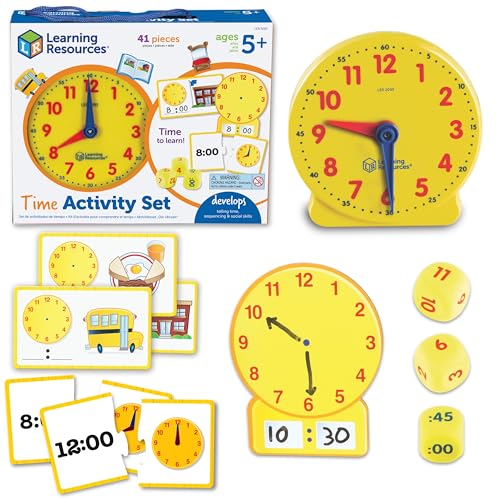
- Includes teaching clock, cards, puzzles, dice, and guide
- Supports hours, half-hours, and early analog clock skills
- Good for classroom lessons and independent practice
Best For: Classrooms and home practice for ages 5+
Wooden Match Clock

- Reversible time cards support matching practice
- Digital display changes to match analog time
- Screen-free wooden design for ages 4 to 7
Best For: Young learners matching analog and digital time
Magnetic Happy Face Clock

- Moveable hands and annotated phrases support early lessons
- Magnetic back and hanging slot make display easy
- Strong board build designed for portability
Best For: Toddlers and early learners starting time language
Mini Gear Clock
Compact Classroom Time Trainer

- Hidden gears keep time accurate as hands move
- Color-coded hands support hour and minute learning
- Small tabletop design with removable stand
Best For: Desk or tabletop time practice for ages 5+
Classroom Time Trainer
Learning Resources Big Time Student Clock

- Hidden gear moves the hour hand as you adjust minutes
- Minute hand shifts in 1-minute increments
- Includes stand and activity guide
Best For: Analog time lessons for ages 5+
Time Play Board Set
Coogam Wooden Clock Teaching Toy

- Teaches analog and digital time together
- Includes flashcards and a 2-4 player game
- Reusable dry-erase cards add extra practice
Best For: Game-based time learning for ages 3+
Demo Clock Double Duty
Learning Resources Write & Wipe Clock

- Large 12-inch face for classroom visibility
- Write-and-wipe surface for digital practice
- Movable hands support analog demonstrations
Best For: Reusable classroom time demonstrations
Classroom Pack
hand2mind Mini Geared Clock Set

- 24-pack for group or classroom practice
- Color-coded movable hands support learning
- Geared design keeps time relationships aligned
Best For: Teachers and homeschool groups needing multiple practice clocks
Writable Demo
ANCOMEDO Magnetic Teaching Clock

- Large 12 x 11 inch demo clock for visibility
- Dry erase surface supports practice and review
- Magnetic and hanging options for flexible use
Best For: Parents and teachers who want an interactive teaching aid
Silent Decor

- Fully labeled face helps kids read time confidently
- Silent movement avoids ticking noise
- Includes a teaching-time activity e-book
Best For: Quiet bedrooms, classrooms, and homeschool spaces
Classroom Time Kit – Hands-On Time-Telling Practice
If you’re comparing learning clocks for kids, this time activity set is built for guided practice and independent use. It combines a realistic teaching clock with activity cards, puzzles, dice, and a write-and-wipe clock so children can practice hours, half-hours, and other early time concepts in multiple ways.
Best For: Classroom lessons, small-group activities, and home practice for children ages 5+.
Pros:
- Includes a full activity set, not just a single clock, for varied practice.
- Uses a realistic analog clock with moving hour and minute hands.
- Supports teacher-led instruction, learning centers, and independent work.
- No batteries required and designed for manual use.
Cons:
- More suited to structured learning than casual play.
- Some components may be better for classroom tables than portability.
This is a strong pick when you want an all-in-one teaching tool that reinforces time-telling through repetition and hands-on activities. It’s especially useful for kids who learn best by doing rather than by only looking at a clock face.
Wooden Match Clock – Reversible Card Time Learning
Melissa & Doug Turn & Tell Wooden Clock - Educational Toy with 12+ Reversible Time Cards
Check Price On AmazonFor families shopping learning clocks for kids, this wooden clock leans into simple matching practice. The reversible time cards and hideaway digital display make it easy to connect analog time with the matching digital reading while keeping the activity screen-free.
Best For: Ages 4 to 7 who are learning to match analog and digital time.
Pros:
- Time cards slot into the top for matching activities.
- Hideaway digital clock automatically changes to match the analog time.
- Hands move independently for teaching and practice.
- Wooden build is suited to hands-on, screen-free play.
Cons:
- Single-piece format offers less variety than multi-activity sets.
- Best for early learners rather than older kids needing advanced practice.
This model is a practical choice if you want a straightforward teaching clock with built-in time matching. It works well as a focused learning aid for younger children developing early time-telling and fine motor skills.
Magnetic Happy Face Clock – Portable Early Learning Aid
If you want learning clocks for kids that are easy to display, this magnetic clock is designed for simple early instruction. It uses moveable hands, annotated phrases like “quarter to,” and a colorful face to help young children engage with time concepts in a visual way.
Best For: Toddlers and young children learning basic time language at home or in class.
Pros:
- Colorful, engaging design encourages participation.
- Annotated with helpful time phrases such as “quarter to.”
- Magnetic strips on the back add display flexibility.
- Strong board construction is made not to bend or crease easily.
Cons:
- Does not include the broader activity components of some teaching sets.
- Best suited to early numeracy and time introduction rather than advanced practice.
This clock is a good fit if you need something portable and easy to display in a bedroom, playroom, homeschool area, or classroom. Its simple, visual approach makes it a friendly starting point for young children who are just beginning to tell time.
Mini Gear Clock – Compact Classroom Time Trainer
This compact option stands out among learning clocks for kids because it keeps the focus on early time skills in a small tabletop format. Hidden gears keep the time correct as children spin the hands, and the color-coded design helps match the hands to the hour and minute markings.
Best For: Kids ages 5+ who need a small tabletop clock for time practice.
Pros:
- Hidden gears keep the time accurate while hands are turned.
- Color-coded hands help learners connect markings and movement.
- Includes a removable plastic stand for tabletop use.
- Compact 4-inch size is easy to fit on a desk or table.
Cons:
- Smaller size may be less visible for group instruction.
- Limited to a single clock rather than a full activity kit.
This is a smart pick for focused practice when space is limited or when you want a simple manipulative instead of a larger teaching set. It gives children a hands-on way to explore time without extra pieces or setup.
Classroom Time Trainer – Learning Resources Big Time Student Clock
If you want learning clocks for kids that make analog time feel concrete, this teaching clock is built for direct instruction. The hidden gear mechanism automatically advances the hour hand when the minute hand is moved, so students can see how the two hands relate while practicing 1-minute increments on an easy-to-read 12-hour face.
Best For: Hands-on time-telling lessons for kids ages 5+ who are ready to learn analog clock basics.
Pros:
- Hidden gear mechanism links the hands for realistic time-teaching practice
- Minute hand moves in 1-minute increments for precise demonstrations
- Includes a removable stand and activity guide for guided lessons
- Large 12-hour display is easy to read in classroom or home use
Cons:
- Requires a battery to operate
- Designed around analog time only, not digital practice
This is a straightforward teaching tool for parents and teachers who want a visual, reusable way to introduce time. It focuses on the core mechanics of telling time rather than extra game features, which makes it especially useful for structured learning.
Time Play Board Set – Coogam Wooden Clock Teaching Toy
Among learning clocks for kids, this wooden set stands out because it combines an analog clock, digital practice, flashcards, and a board game. The hands rotate with a gentle push, and the included reusable dry-erase cards add extra practice for hours, half-hours, and quarter-hours.
Best For: Kids ages 3+ who learn best through games, flashcards, and hands-on practice.
Pros:
- Combines analog and digital time learning in one set
- Includes 4 double-sided flashcards plus a 2-4 player board game
- Reusable dry-erase cards support repeated practice at different levels
- Wooden construction with no batteries required
Cons:
- Manual setup is needed for game and card activities
- Smaller than a large classroom demonstration clock
This is a flexible pick if you want a more interactive approach than a basic teaching clock. It works well for home school, classrooms, or travel when you want time-telling practice to feel like a game instead of a worksheet.
Demo Clock Double Duty – Learning Resources Write & Wipe Clock
If you need learning clocks for kids that can handle group instruction, this write-and-wipe demo clock gives you both analog and digital practice in one tool. The large 12-inch face is easy for students to see, and the dry-erase surface makes it simple to reset lessons during class, circle time, or homeschooling.
Best For: Classroom demonstrations and reusable time-telling practice for young learners.
Pros:
- Large 12-inch face is designed for group visibility
- Movable hands support analog time demonstrations
- Write-on surface lets kids practice digital time repeatedly
- Durable plastic construction suits classroom use
Cons:
- Battery-powered design may be unnecessary for simple lessons
- Made for demonstration, so it is less game-like than some toy clocks
This model is a strong fit when the goal is clear, reusable instruction rather than play-based learning. It keeps the focus on showing analog and digital concepts side by side, which is helpful for first-grade skills and early math lessons.
Classroom Pack – hand2mind Mini Geared Clock Set
If you need learning clocks for kids that work well in small groups, this 24-pack of mini geared clocks is built for repeated practice. The large hour numbers, minute dots, and color-coded hands make it easier for beginners to connect hours and minutes while building basic telling-time skills.
Best For: Classrooms, homeschool co-ops, and teachers who want a full set for individual or group time-telling practice.
Pros:
- Set of 24 gives you enough clocks for classroom or small-group use.
- Color-coded movable hands help kids see the hour-minute relationship.
- Large red hour numbers and edge dots make minutes easier to read.
- Geared mechanism keeps hour and minute movement aligned like a real analog clock.
Cons:
- No batteries or electronic features, so it is strictly a manual teaching tool.
- Small mini-clock size may be less ideal for whole-class wall demonstration.
This set is a practical pick if you want hands-on practice materials for 1st grade math and early time-telling lessons. It is best suited to repeated student use rather than a single display clock.
Writable Demo – ANCOMEDO Magnetic Teaching Clock
For learning clocks for kids that double as a teaching board, this large magnetic dry erase model makes time lessons more interactive. The colorful numerals, movable hands, and writable surface let parents and teachers demonstrate a time and then have children practice writing it back.
Best For: Home-school rooms, classrooms, and parents who want a large, easy-to-demonstrate teaching clock.
Pros:
- Large 12 x 11 inch size is easy to see in a lesson setting.
- Writable dry erase face lets kids practice and review times directly.
- Magnetic backing and included stickers add flexible display options.
- Suitable for teaching both 12-hour and 24-hour time.
Cons:
- Made of paper/cardboard materials, so it may not feel as durable as plastic or wood.
- Manual setup is required for hanging or magnetic mounting.
This is a strong choice if your goal is active instruction rather than just decoration. It gives adults a simple way to show time visually and then test a child’s understanding right away.
Silent Decor – Oyster&Pop Kids Wall Clock
This wall-mounted option is a good fit if you want learning clocks for kids that also function as room decor. Every minute is numbered, the hands are labeled and color-coded, and the silent sweep movement helps keep bedrooms, classrooms, and study areas quiet.
Best For: Bedrooms, classrooms, and homeschool spaces where a quiet, attractive learning clock is important.
Pros:
- Fully labeled, color-coded face helps kids read a real clock with less guessing.
- Silent, no-ticking movement is ideal for naps, bedtime, or study time.
- Works as both a learning tool and a decorative wall clock.
- Includes a teaching-time activity e-book for added practice.
Cons:
- Requires 1 AA battery, which is not included in the listing details.
- Wall-mount design is less portable than tabletop teaching clocks.
This clock is a smart pick if you want a long-term everyday clock that quietly reinforces time reading. Its combination of clear labeling and child-friendly styling makes it especially useful for consistent practice.
How We Picked the Best Learning Clocks for Kids
We focused on teaching clocks that make time-reading easier for young learners. Key factors included visibility, hand movement, number labeling, durability, and whether the clock supports both guided lessons and independent practice. We also favored models that fit different settings, from preschool learning centers to elementary classrooms and home use.
Quick Comparison
In general, larger demonstration clocks are best for whole-group instruction, while compact tabletop models work better for one-on-one practice. Reversible cards, dry-erase surfaces, geared hands, and color-coded numbers can all help children connect analog time with digital concepts faster. If you want a simple visual aid, choose a clear analog clock; if you want more interactive learning, look for sets with activity cards or writable surfaces.
Key Buying Factors for Learning Clocks for Kids
Readability
Look for bold numbers, strong contrast, and clearly marked minute increments. For beginners, color-coded hour and minute hands can reduce confusion.
Hands and Movement
A good teaching clock should have hands that move smoothly and stay in place. Geared mechanisms can help kids see the relationship between hours and minutes more accurately.
Size and Use Case
Large wall or demo clocks are better for classrooms, while mini clocks are easier for desks, centers, and travel. Think about whether the child will learn best through group instruction or hands-on individual play.
Extra Learning Features
Some Learning Clocks for Kids include time cards, dry-erase boards, or digital-to-analog matching activities. These extras can reinforce skills without making the clock feel overly complicated.
Age Appropriateness
Choose simpler designs for preschoolers and more detailed models for early elementary students. Kids who are just starting may need a clock that emphasizes hour and half-hour reading first.
Who Should Buy Which Learning Clocks for Kids?
Parents teaching time at home may prefer a compact, easy-to-use model with visual supports. Teachers and homeschoolers often benefit from larger demonstration clocks or classroom sets that let multiple children practice at once. If your child is hands-on and learns by doing, choose a model with movable hands, activity cards, or writable features. If you mainly need a clear reference clock, go with a labeled analog design that keeps the lesson simple and focused.
For most families and classrooms, the best choice is the one that matches the child’s current skill level and learning style. The right teaching clock can make time-telling less intimidating and much more engaging.