Managing cards from cameras, drones, audio recorders, and other devices is easier with a reader that can access multiple formats at once. The best models combine broad compatibility with dependable transfer speeds and convenient USB connectivity.
We selected 10 options for different workflows, from everyday SD and microSD transfers to professional setups involving CFexpress, CFast, XQD, or several cards simultaneously.
Best 10 Memory Card Reader with Multiple Simultaneous Slots Picks for 2026
Versatile 4-Card Pick
BENFEI 4-in-1 USB-C/USB 3.0 Reader

- Reads SD, microSD, MS, and CF simultaneously
- USB-C and USB-A connectivity
- Up to 160MB/s UHS-I transfer rate
Best For: Mixed-format card users
Durable 10Gbps Option
BENFEI USB 3.2 All-in-One Reader
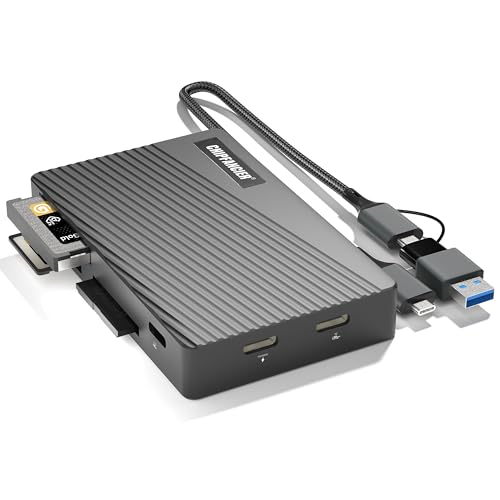
- Simultaneous SD, microSD, MS, and CF access
- USB-C and USB-A support
- Braided nylon and aluminum housing
Best For: Frequent multi-device transfers
Maximum Slot Capacity

- Four SD and four microSD/TF slots
- Simultaneous read and write
- USB-A and USB-C connectors
Best For: Multi-camera productions and large card batches
Compact Established Choice
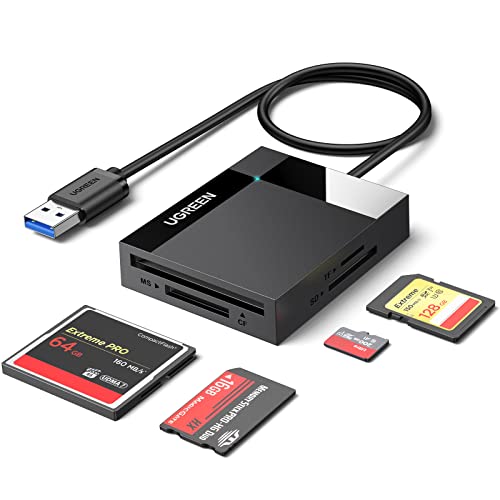
- Four-card simultaneous reading and writing
- Supports SD, microSD, CF, and MS
- Compact design with 1.7-foot cable
Best For: Portable USB-A computer setups
Professional 8-Slot Choice
CFexpress Type B & A Multi-Card Reader

- Eight formats with simultaneous multi-card reading
- USB 3.2 Gen 2 supports up to 10Gbps
- Aluminum body with USB-A/USB-C cable
Best For: High-volume photo and video workflows
Compact Everyday Pick
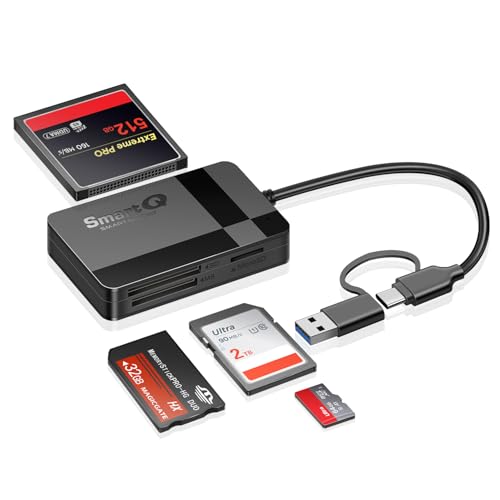
- Simultaneously reads SD, Micro SD, CF, and MS
- USB 3.0 transfer rates up to 5Gbps
- Lightweight, plug-and-play design
Best For: Portable everyday file transfers
Versatile 7-Slot Value
Rocketek USB-C Multi-Card Reader

- Seven slots cover five major card families
- Reads and writes up to five cards at once
- USB-C and USB-A connectors included
Best For: Mixed-format card management on a budget
Best for Four SD Cards

- Reads up to four SD or microSD cards at once
- USB-C and USB-A connectivity
- Includes two microSD adapters and activity LEDs
Best For: Photographers managing several SD cards
Best Format Coverage

- Reads and writes seven cards simultaneously
- Supports SD, CF, MS, MMC, XD, and microSD formats
- USB 3.0 supports speeds up to 5Gbps
Best For: Mixed-format camera card workflows
Best for CFast Workflows

- Five independent slots read and write simultaneously
- Supports CFast, CF, SD, TF, and XD cards
- USB-C and USB-A with USB 3.0 connectivity
Best For: Photographers using CFast and mixed card formats
Versatile 4-Card Pick – BENFEI 4-in-1 USB-C/USB 3.0 Reader
If you need a memory card reader with multiple simultaneous slots for mixed media, the BENFEI 4-in-1 supports SD, microSD, Memory Stick, and CompactFlash cards. Its integrated USB-C and USB-A design suits newer laptops and devices with traditional USB ports.
Best For: Users who need to read and write four different card formats at the same time.
Pros:
- Reads four card types simultaneously.
- USB-C and USB 3.0 connectivity improves device flexibility.
- Supports UHS-I transfer rates up to 160MB/s, depending on the card and port.
- Includes an 18-month warranty.
Cons:
- Not compatible with standard Memory Stick, Memory Stick Micro (M2), or CF Type I cards.
- Older operating systems may not support exFAT-formatted SDXC cards.
The BENFEI is a practical all-purpose option when your workflow includes several legacy and current card formats. Its dual connector design is especially useful for moving between USB-C laptops and USB-A computers.
Durable 10Gbps Option – BENFEI USB 3.2 All-in-One Reader
For shoppers seeking a memory card reader with multiple simultaneous slots and a sturdier build, this USB 3.2 model supports SD, microSD, Memory Stick, and CompactFlash cards. Its USB-C and USB-A compatibility makes it suitable for computers, cameras, smartphones, and tablets.
Best For: Users who prioritize broad compatibility and a durable reader for frequent transfers.
Pros:
- Supports simultaneous access to four card formats.
- Works with USB-C and USB-A devices.
- Braided nylon and aluminum construction are designed for durability.
- Compatible with Windows, macOS, Linux, Chrome OS, and Android.
Cons:
- Listed UHS-I transfer speeds reach up to 104MB/s, despite the USB 3.2 interface.
- The product information contains mixed warranty references, so confirm coverage before purchase.
This reader stands out for its reinforced exterior and wide operating-system support. It is a sensible choice for transfer-heavy setups where a compact, flexible, and durable multi-card reader matters more than maximum card-specific speeds.
Maximum Slot Capacity – 8-in-1 SD and TF Card Reader
This 8-in-1 unit is a strong fit if your priority is a memory card reader with multiple simultaneous slots. It provides four SD slots and four microSD/TF slots, letting photographers and content creators transfer between several cards without repeatedly swapping them.
Best For: Multi-camera shoots, events, and creators managing several SD or microSD cards.
Pros:
- Offers eight total slots: four SD and four microSD/TF.
- Supports simultaneous reading and writing between cards.
- USB-A and USB-C connectors support a wide range of devices.
- Aluminum housing helps with heat dissipation during extended transfers.
Cons:
- Supports SD and microSD families but does not list CF or Memory Stick slots.
- Transfer performance depends on the cards and device, with up to 104MB/s stated for compatible UHS-I cards.
- Cards are not included.
Choose this reader when slot count is more important than supporting many card families. Its eight dedicated SD/TF slots can simplify backups and file organization for workflows involving multiple cameras or cards.
Compact Established Choice – UGREEN 4-Slot USB 3.0 Reader
The UGREEN USB 3.0 reader is a compact memory card reader with multiple simultaneous slots for SD, microSD, CompactFlash, and Memory Stick media. It supports reading and writing four cards at once and includes a 1.7-foot cable for convenient laptop or desktop use.
Best For: On-the-go users who want broad card-format support in a compact USB-A reader.
Pros:
- Reads and writes four different memory cards simultaneously.
- Supports SD, microSD, CF, MS, and related formats including SDXC and UHS-I.
- USB 3.0 offers transmission rates up to 5Gbps.
- Compact size and attached cable make it easy to carry.
Cons:
- Uses a USB connection rather than offering a built-in USB-C connector.
- Its listed operating-system compatibility does not include Android.
- Cards with capacities up to 2TB are supported, but actual performance depends on the card and host device.
The UGREEN is a straightforward choice for computers with USB-A ports. It combines four simultaneous slots, broad media compatibility, and a portable footprint without adding unnecessary features.
Professional 8-Slot Choice – CFexpress Type B & A Multi-Card Reader
For demanding workflows, this memory card reader with multiple simultaneous slots supports eight formats, including CFexpress Type B and Type A, XQD, SD, TF, MS, XD, and CF. USB 3.2 Gen 2 connectivity offers up to 10Gbps, while the aluminum housing and included USB-A/USB-C-to-C cable suit studio or field use.
Best For: Professional photographers, filmmakers, and creators working with several premium card formats.
Pros:
- Supports simultaneous reading across eight card formats.
- Up to 10Gbps transfer rate for compatible cards and hardware.
- Works with Windows, Mac OS, Linux, iPadOS, iOS, and Android without extra software.
- Compact aluminum design includes a versatile 2-in-1 cable.
Cons:
- Actual transfer speeds depend on the card and host hardware.
- XQD support is limited to USB-protocol XQD cards.
This is the most capable option here for mixed-format, high-volume transfers. Its eight-slot design and faster interface are particularly useful when offloading RAW photos or 8K footage, provided your cards and computer can take advantage of the rated speed.
Compact Everyday Pick – SmartQ C368 Pro 4-in-1 Reader
This memory card reader with multiple simultaneous slots is a compact choice for SD, Micro SD, CF, and MS cards. Its USB 3.0 interface supports fast transfers, and the plug-and-play design works with compatible computers and USB-C mobile devices without requiring additional drivers.
Best For: Travelers, photographers, and users managing common SD, microSD, CF, and Memory Stick formats.
Pros:
- Reads SD, Micro SD, CF, and MS cards simultaneously.
- USB 3.0 supports data rates up to 5Gbps and works with USB 2.0.
- Compact 1.45-ounce design is easy to carry.
- Plug-and-play compatibility across Windows, macOS, Linux, and supported USB-C devices.
Cons:
- Offers four slots rather than the broader format coverage of larger readers.
- Listed compatibility and device support should be checked for your specific USB-C phone or tablet.
The C368 Pro balances simultaneous access and portability. It is a sensible everyday reader when you need the four listed card families but do not need CFexpress or the higher 10Gbps interface of a professional model.
Versatile 7-Slot Value – Rocketek USB-C Multi-Card Reader
For broad format coverage at a moderate transfer rate, this memory card reader with multiple simultaneous slots includes CF, SD, microSD/TF, XD, and MS connections. It can read and write five cards at once, uses both USB-C and USB-A, and supports up to 5Gbps through USB 3.0.
Best For: Users who need wide legacy and modern card compatibility across USB-A and USB-C computers, tablets, and phones.
Pros:
- Seven-slot layout covers CF, SD, microSD/TF, XD, and MS formats.
- Reads and writes up to five cards simultaneously.
- Dual USB-C and USB-A connectivity improves device flexibility.
- Supports Windows, Mac OS, Linux, Chrome OS, and Android without extra drivers.
Cons:
- Its 5Gbps rating is below the 10Gbps option in this roundup.
- Supplied notes do not list iOS or iPadOS compatibility.
The Rocketek is a strong middle-ground option for mixed card collections. Its ability to handle five cards simultaneously and its dual-connector design make it practical for photographers managing several sources, while its USB 3.0 speed keeps the price-conscious workflow moving.
Best for Four SD Cards – 4-Port Simultaneous SD Reader
If you need a memory card reader with multiple simultaneous slots for SD-based workflows, this four-slot UTECHMIX model lets you read up to four SD cards at once. It supports combinations of full-size SD and microSD cards, and includes both USB-C and USB-A connectivity for computers, phones, and tablets.
Best For: Photographers, videographers, and content creators offloading cards from multi-camera shoots.
Pros:
- Reads up to four SD cards simultaneously, including two SD and two microSD cards.
- Supports USB 3.0 with UHS-I and UHS-II cards for transferring large files.
- Includes USB-C and USB-A connections, two microSD adapters, and independent activity LEDs.
- Works with Windows, macOS, Linux, and OTG-enabled mobile devices.
Cons:
- Designed for SD and microSD media rather than broader card formats.
- Actual transfer speeds vary by the memory card and connected device.
- SD cards are not included.
This is a focused choice for users who primarily work with SD-family cards and want to avoid swapping cards during a shoot. Its four independent indicators also make it easier to monitor card detection and transfers.
Best Format Coverage – 7-in-1 Multi-Card Reader
For broad format support, this Togconn model is a memory card reader with multiple simultaneous slots that can read and write up to seven cards at once. Its USB 3.0 interface supports transfers up to 5Gbps, while the included USB-A and USB-C cables help connect it to a range of computers and tablets.
Best For: Users who handle mixed camera card formats, including SD, microSD, CompactFlash, Memory Stick, MMC, and XD.
Pros:
- Reads and writes seven cards simultaneously.
- Supports a wide range of formats, including SD, microSD, CF I/II, MS, MMC, and XD.
- USB 3.0 supports data transfer speeds up to 5Gbps and is backward compatible with USB 2.0 and 1.1.
- Includes USB-A-to-Micro-USB 3.0 and USB-C-to-Micro-USB 3.0 cables.
Cons:
- The supplied cables use a Micro-USB 3.0 connection on the reader.
- Transfer performance depends on the cards and host device.
- Its broader format support may be unnecessary for users who only use SD cards.
Choose this reader when compatibility is more important than a streamlined design. The seven simultaneous slots and wide card support can simplify workflows involving cameras or devices that use different media standards.
Best for CFast Workflows – 5-in-1 CFast Card Reader
This clickfish adapter is a memory card reader with multiple simultaneous slots built around professional and legacy camera formats. Its five independent slots support simultaneous reading and writing for CFast, CompactFlash, SD, TF, and XD cards, with USB-C and USB-A 3.0 connectivity for modern computers and mobile devices.
Best For: Photographers and videographers who need CFast support alongside CF, SD, microSD, or XD cards.
Pros:
- Reads and writes five different cards simultaneously.
- Supports CFast 2.0, CF-I, SD, microSD/TF, and XD formats.
- Offers USB-C and USB-A connectivity with claimed USB 3.0 speeds up to 5Gbps.
- Aluminum construction is designed for durability and heat dissipation.
Cons:
- Its CFast-focused feature set may be excessive for SD-only users.
- Actual transfer speeds can vary with the card and connected device.
- The supplied notes do not specify included memory cards.
The main reason to choose this reader is CFast compatibility combined with simultaneous access to four other card types. It is a practical fit for users whose camera kit spans newer and older storage formats.
How We Picked the Best Memory Card Reader with Multiple Simultaneous Slots
We focused on readers that support multiple memory-card formats and can read more than one card at the same time. We also considered interface speed, connector flexibility, slot layout, operating-system compatibility, build quality, and how well each design fits common photography, video, and file-management workflows.
Because advertised performance depends on the card, computer, cable, and file sizes, transfer-rate claims are best treated as maximum interface speeds rather than guaranteed real-world results. Simultaneous access is especially useful when consolidating footage or comparing files across cards, but some readers may share bandwidth between slots.
Quick Comparison
- Best for general use: A 4-in-1 reader with SD, microSD, CF, and MS support covers many cameras and everyday devices.
- Best for high-speed transfers: Look for USB 3.2 Gen 2 or 10Gbps support, provided your computer and cards support it.
- Best for many cards: Seven- and eight-slot designs are useful for photographers and teams handling several media formats.
- Best for professional media: CFexpress, CFast, and XQD support matters for newer cameras and high-bitrate video workflows.
- Best for mixed computers: Dual USB-C and USB-A connectors reduce the need for adapters when switching between devices.
Key Buying Factors for a Memory Card Reader with Multiple Simultaneous Slots
Card Compatibility
Start with the formats you actually use. SDXC and microSD are common, while CompactFlash, Memory Stick, XD, CFast, CFexpress, and XQD support is more specialized. Check the exact card standard and capacity support rather than relying only on a slot count.
Simultaneous Reading and Writing
Some readers advertise several slots but restrict transfers to one card at a time. If you need a Memory Card Reader with Multiple Simultaneous Slots, verify that the product specifically supports concurrent reading, writing, or both. This feature can save time when backing up several cards, but throughput may be divided among active slots.
Connection Speed and Compatibility
USB 3.0 is sufficient for many SD cards, while USB 3.2 10Gbps offers more headroom for faster media. A fast reader cannot overcome a slower card or host port. USB-C is convenient for newer laptops and phones; USB-A remains useful with older computers.
Design and Reliability
Choose a sturdy enclosure, clearly labeled slots, a cable or connector that fits your setup, and adequate spacing for cards. For travel, compactness matters. For desk-based workflows, a longer cable and stable housing may be more valuable.
Who Should Buy Which Memory Card Reader with Multiple Simultaneous Slots?
Casual users and laptop owners should choose a compact 4-in-1 USB-C/USB-A reader for routine camera, phone, and drone transfers. Photographers handling several cards will benefit from four- or seven-slot models with confirmed simultaneous access. Videographers and professionals should prioritize 10Gbps interfaces and specialized CFexpress, CFast, or XQD compatibility when required by their cameras. Mixed-device households and teams should favor broad format support, dual connectors, and compatibility with Windows, macOS, Linux, or Android as needed.