Robotics kits can turn STEM concepts into something students can build, test, and improve. For high school learners, the best options offer enough challenge to stay engaging while still teaching real-world skills.
This roundup focuses on kits that support coding, engineering, and problem-solving, with choices suited to beginners, tinkerers, and students ready for more advanced projects.
Best 10 Robotics Kits for High School Students Picks for 2026
Entry-Level App-Controlled Robot
ELEGOO UNO R3 Smart Robot Car Kit V4

- 24 modules for obstacle avoidance, line tracing, and IR control
- App control on Android and iOS plus IR remote option
- HD assembly instructions and included code files support learning
Best For: High school beginners who want a guided robotics and coding starter kit
Hydraulic Engineering Build

- Water-powered hydraulic system; no batteries needed
- 6 axes with up to 270-degree rotation
- Detailed build focused on mechanics and problem solving
Best For: Students who want a hands-on hydraulic robotics project
Fast-Build Coding Robot
Makeblock mBot STEM Coding Toys Robotics Kit

- Build time is about 15 minutes
- Works with Scratch, Arduino, and mBlock software
- Line-follow and obstacle-avoidance functions add practice
Best For: High school students who want a quick, beginner-friendly coding robot
Tracked FPV Coding Tank
ELEGOO Conqueror Robot Tank Kit
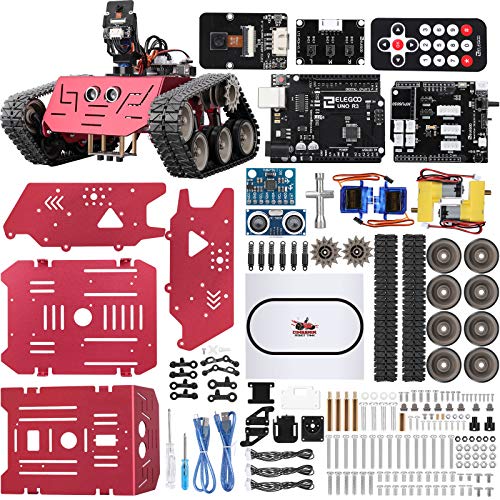
- Five modes include FPV driving, line tracking, and auto-follow
- Camera and Wi-Fi module stream live view to a phone
- Block coding and Arduino IDE support a learning progression
Best For: Teens ready for a more advanced robotics project with camera control
Mechanical Arm STEM Build
Robot Arm Kit for Hands-On Learning

- Wooden mechanical arm with motors and wiring
- No soldering required for beginner-friendly assembly
- Teaches circuits, movement, and problem-solving
Best For: Teens starting with a hands-on robotics and engineering project
Obstacle-Avoiding Smart Car
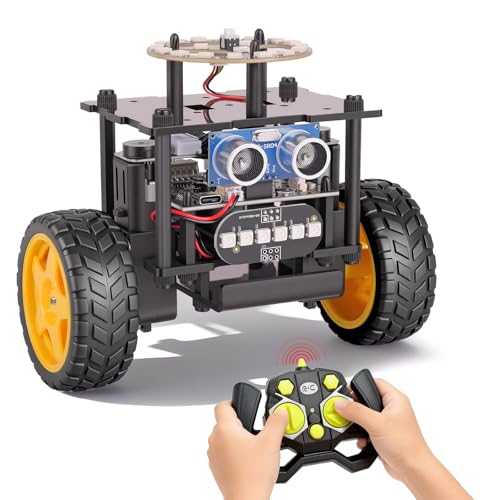
- Obstacle avoidance with ultrasonic radar
- Auto-go and remote-control play modes
- Rechargeable car battery with step-by-step tutorial
Best For: Teens who want an easy robot car with active play features
10-in-1 Electronics Lab
Butterfly EduFields Robotics Kit

- Includes 10 STEM projects and 100+ components
- Step-by-step illustrated instructions
- Covers robotics, mechanics, and electronics basics
Best For: Beginners who want multiple short robotics projects
Beginner-Friendly Coding Car
ACEBOTT Smart Robot Car Kit for Teens

- Scratch, Arduino, and Python support
- 16 guided tutorials for step-by-step learning
- App and IR remote control included
Best For: Teens who want a flexible starter robot car with room to grow
Walking Spider Robot

- 8 lessons guide programming and electronics
- 6 movement modes with 9 preset actions
- App control and easy-screw assembly
Best For: Teens who want a lesson-based robot with unique walking and crawling motion
Camera Robot Car
ACEBOTT Smart Robot Car Kit with 3MP Camera

- 3MP camera streams live video to a smartphone
- Scratch and Arduino support with 16 tutorials
- Mecanum wheels and modular add-ons
Best For: Students who want a robot car with live video and upgrade potential
Entry-Level App-Controlled Robot – ELEGOO UNO R3 Smart Robot Car Kit V4
If you’re comparing robotics kits for high school students, this ELEGOO robot car is a practical way to build core skills in programming, electronics assembling, and robotics. It combines multiple sensor modules with app or IR remote control, so students can move from assembly to testing and code-driven experiments.
Best For: High school beginners who want a hands-on intro to coding, sensors, and robot assembly.
Pros:
- Includes 24 module parts for obstacle avoidance, line tracing, and infrared control.
- Supports control by Android or iOS phone/tablet, plus IR remote use.
- Modified XH2.54 ports are designed to make assembly easier and reduce errors.
- HD instructions and code files are included for guided building and programming.
Cons:
- Requires basic electronic knowledge to get the most from the kit.
- The notes recommend supervision or guidance if the user has no experience.
This is a good starter platform for students who want a structured first robotics project rather than a purely toy-like build. It offers enough features to keep a high school learner engaged while still staying approachable.
Hydraulic Engineering Build – Teach Tech Hydrobot Arm Kit
For shoppers browsing robotics kits for high school students, this hydraulic arm stands out as a non-electric engineering build that teaches motion, mechanics, and control. It uses water-powered hydraulics instead of batteries, giving students a different kind of hands-on robotics experience focused on mechanical problem solving.
Best For: Students who want a mechanical robotics project with hydraulics and multi-axis movement.
Pros:
- Powered by water, so no batteries are required.
- Features 6 axes and can rotate up to 270 degrees.
- The gripper can open and close, and it can be replaced with suction components.
- Step-by-step instructions are designed to build problem solving and analytical thinking.
Cons:
- It is described as an in-depth build, not a pre-assembled toy.
- Expect multiple hours of assembly time.
This kit is a strong fit if you want students to learn robotics through mechanics rather than coding first. It’s better suited to a focused build project than a quick weekend toy.
Fast-Build Coding Robot – Makeblock mBot STEM Coding Toys Robotics Kit
Among robotics kits for high school students, the Makeblock mBot is a compact entry point into coding, robotics, and electronics. It is designed to be built quickly, then used with Scratch, Arduino, and Makeblock software for step-by-step programming and experimentation.
Best For: Students who want a quick-build robot with a clear path from block coding to Arduino.
Pros:
- Builds in about 15 minutes according to the notes.
- Supports Scratch and Arduino learning in a step-by-step format.
- Includes coding cards, lessons, and free Makeblock apps plus mBlock software.
- Offers line-follow and obstacle-avoidance functions for practical testing.
Cons:
- Remote controller battery is not included.
- The robot kit also needs 4 AA batteries, which are not included.
This is a smart pick for students who want to start coding fast and keep expanding with add-on parts later. It balances easy assembly with enough software depth to stay useful beyond the first project.
Tracked FPV Coding Tank – ELEGOO Conqueror Robot Tank Kit
If you want robotics kits for high school students that feel more advanced, this ELEGOO tank adds camera driving, sensor navigation, and coding progression in one project. Students can assemble the tracked chassis, then move from block-based control to Arduino IDE work using the included platform and open resources.
Best For: Teens who want a more advanced robotics build with FPV driving and coding progression.
Pros:
- Offers five interactive modes, including FPV driving, obstacle avoidance, line tracking, and auto-follow.
- Includes an OV2640 camera and ESP32-WROVER Wi-Fi module for live phone viewing.
- Supports block-based programming in the app and text-based projects in Arduino IDE.
- Metal chassis, included tools, and no-solder build make it a substantial hands-on project.
Cons:
- Adults should guide ages 8+ during the build.
- It is a larger, heavier kit than simpler entry-level robot projects.
This kit is a strong choice when you want more depth than a basic starter robot. The camera, tracked drive, and coding options make it especially engaging for students ready to explore multiple robotics concepts in one build.
Mechanical Arm STEM Build – Robot Arm Kit for Hands-On Learning
If you want robotics kits for high school students that focus on core build-and-learn skills, this robot arm kit is a practical starting point. It combines a wooden mechanical build with motors, a PCB microcontroller board, and wiring, so students can see how circuits control movement while assembling a working arm.
Best For: Teens who want a challenging, no-solder introduction to electronics, mechanics, and problem-solving.
Pros:
- Teaches basic circuits and mechanical movement through a hands-on robotic arm build.
- No soldering required, which makes it more approachable for beginners.
- Wooden pieces and step-by-step assembly create a more satisfying engineering project.
- Useful for STEM learning, logical thinking, and problem-solving practice.
Cons:
- Requires 6 AA batteries, which are not included.
- Primarily an introductory build, so advanced students may outgrow it quickly.
- Assembly can still be demanding for first-time builders.
This is a solid pick if you want a tactile, educational kit that blends creativity with real engineering basics. It is especially appealing for students who like wood builds and want a first robotics project with visible motion and circuitry.
Obstacle-Avoiding Smart Car – Remote Control Robotics Kit
Among robotics kits for high school students, this smart robot car stands out for mixing assembly with active play. Students build a 2WD car with obstacle avoidance, then use either auto-go or remote-control mode to explore how sensors and self-balancing behavior work in a real robot toy.
Best For: Teens who want a beginner-friendly robot car with multiple play modes and obstacle avoidance.
Pros:
- Includes DIY assembly that builds electronics and robotics familiarity.
- Ultrasonic radar supports real-time obstacle avoidance.
- Offers both auto-go and remote-control modes for more variety.
- Rechargeable battery is included for the car, and the tutorial uses illustrations plus video.
Cons:
- Remote control needs 2 AA batteries, though they are included.
- Beginners may benefit from parent help during assembly.
- Playtime is limited to the rechargeable battery’s 1-4 hour range.
This kit is a good fit if you want something interactive rather than purely instructional. The mix of obstacle sensing, self-balancing, and dual control modes makes it feel like a more complete robotics experience for newer builders.
10-in-1 Electronics Lab – Butterfly EduFields Robotics Kit
If you are comparing robotics kits for high school students but want something broader than a single build, this 10-in-1 set is a strong option. It includes more than 100 components and uses step-by-step instructions to guide learners through multiple STEM projects focused on electronics, robotics, and mechanics.
Best For: Students who want variety, quick builds, and an introductory electronics-and-robotics experience.
Pros:
- 10-in-1 format offers multiple science and robotics activities in one kit.
- More than 100 components provide plenty of hands-on building pieces.
- Clear illustrated instructions help simplify the build process.
- Supports learning around robotics, engineering, electronics, and mechanics.
Cons:
- It is designed as an introductory kit, not an advanced robotics platform.
- Builds are relatively quick, so experienced students may want more depth.
- Best suited to younger teens and beginners rather than older hobbyists.
This is the most versatile of the three for families or classrooms that want multiple short projects instead of one large build. It works well as a starter kit for students who are still exploring what part of robotics they enjoy most.
Beginner-Friendly Coding Car – ACEBOTT Smart Robot Car Kit for Teens
If you’re comparing robotics kits for high school students, this ACEBOTT robot car is a practical pick for learners who want to move from block coding into more advanced programming. It blends assembly, coding, and real-time control with support for Scratch, Arduino, and Python, so students can start simple and keep growing their skills.
Best For: Teens who want a flexible starter kit that supports Scratch, Arduino, and Python plus mobile coding.
Pros:
- Supports three programming paths: Scratch, Arduino, and Python.
- Includes 16 story-based tutorials plus illustrated step-by-step build guidance.
- Works with computers, tablets, and mobile devices for coding on the go.
- App and IR remote control help students see code-to-movement results quickly.
Cons:
- Batteries are not included.
- Best suited to learners who are comfortable with a hands-on build process.
Overall, this kit is a solid fit for classrooms or home learning when you want a beginner-friendly robot that can still scale with a student’s skills. Its mix of mobile coding, multiple languages, and guided assembly makes it a versatile educational option.
Walking Spider Robot – ACEBOTT ESP8266 Spider Kit
Among robotics kits for high school students, this walking spider stands out for learners who want a more unusual build with visible motion and structured lessons. It uses an ESP8266 motherboard, guided tutorials, and app control to introduce programming and electronics through a hands-on robot that crawls and walks.
Best For: Students who want a more advanced-looking robot build with motion variety and lesson-based learning.
Pros:
- Includes 8 comprehensive lessons plus a paper manual for guided learning.
- Offers 6 movement modes and 9 preset actions for varied play.
- Uses uniform screws and a pre-burned program for easier assembly and setup.
- App control adds interactive movement and remote operation.
Cons:
- Flat top battery is required but not included.
- Its spider build may be less appealing for students who want a traditional robot car.
This is a strong choice if the goal is to teach programming, hardware basics, and problem-solving through a robot with standout movement. It feels more like a science project than a simple toy, which can make it appealing for teen learners and school settings.
Camera Robot Car – ACEBOTT Smart Robot Car Kit with 3MP Camera
If you’re shopping robotics kits for high school students who like hands-on building and real-time feedback, this ACEBOTT car adds a useful twist: a built-in 3MP camera that streams video to a smartphone. It pairs that feature with Scratch and Arduino support, making it a practical pick for students who want coding, driving, and visual exploration in one project.
Best For: Students who want a robot car with live video, app control, and room for future add-ons.
Pros:
- Built-in 3MP camera streams real-time video to a smartphone.
- Supports Arduino and Scratch with 16 story-based tutorials.
- Mecanum wheels enable omnidirectional movement, including sideways drift and rotation.
- Modular expansion options include a robotic arm, tank track, and solar panel sold separately.
Cons:
- Expansion accessories are sold separately.
- Batteries are not included in the kit.
This kit is especially compelling for learners who want more than basic driving and coding. The camera and modular design make it a good long-term STEM option for students who may want to keep building on the same platform.
How We Picked These Robotics Kits for High School Students
We looked for kits that balance educational value, build quality, expandability, and ease of setup. For high school students, the best robotics kits should do more than move around—they should introduce sensors, programming logic, mechanical design, and troubleshooting in a way that feels rewarding.
We also prioritized kits with clear documentation, multiple control options, and enough depth to grow with a student’s skill level.
Quick Comparison
Before buying, compare kits by project type, coding platform, and build complexity. Some are best for first-time builders who want guided learning, while others are better for students who already know basic programming and want more advanced control or customization.
In general, simpler robot cars are great for learning fundamentals, while robotic arms, tanks, and multi-project electronics kits offer broader hands-on engineering practice.
Key Buying Factors for Robotics Kits for High School Students
Coding and Control
Look for support for beginner-friendly platforms like Scratch, as well as more advanced environments such as Arduino-based coding. That flexibility helps students start simple and progress over time.
Build Complexity
The right difficulty level depends on the student. A kit that is too easy can get boring, while one that is too advanced may feel frustrating without guidance. High school students usually do best with kits that include real assembly and debugging challenges.
Sensors and Features
Obstacle avoidance, line tracking, camera modules, app control, and remote control all add replay value. These features also teach how robotics systems interact with their environment.
Expandability and Learning Value
Choose kits with room to experiment. Extra ports, modular parts, and compatibility with common platforms can make a kit useful long after the first build is finished.
Who Should Buy Which Robotics Kits for High School Students?
Beginners who want a guided entry into STEM should lean toward simple coding robot car kits. Students who enjoy hands-on engineering may prefer robotic arms or hydraulic builds. If the goal is to learn programming, sensors, and problem-solving together, Robotics Kits for High School Students with Arduino or app-based control are the strongest all-around choice.
For classrooms, clubs, or independent learners, the best pick is usually the kit that matches the student’s current skill level while still leaving room to grow.