Deep-sky observing rewards patience, dark skies, and the right combination of aperture, optics, and usability. The best telescope for galaxies, nebulae, and star clusters should gather enough light without becoming so complex that it stays in the closet.
We selected 10 telescopes for deep sky viewing across several budgets and designs, including traditional Dobsonians, computerized Schmidt-Cassegrains, refractors, reflectors, and compact tabletop models.
Best 10 Telescopes for Deep Sky Viewing Picks for 2026
Top Computerized Pick

- 8-inch Schmidt-Cassegrain optics
- 40,000-plus-object GoTo database
- SkyAlign simplifies setup
Best For: Guided deep-sky and planetary observing
Maximum Light-Gathering Pick

- Large 400mm aperture
- SynScan GoTo with 42,000-plus objects
- Collapsible Dobsonian tube
Best For: Deep-sky observers prioritizing aperture
Astrophotography-Friendly Refractor

- 102mm f/7 ED refractor
- Dual-speed focuser and field rotator
- S-FPL51 ED glass reduces color fringing
Best For: Manual visual observing and deep-sky astrophotography
Best Integrated Power Pick

- 8-inch Schmidt-Cassegrain optics
- WiFi SkyPortal app control
- Built-in 10-hour LiFePO4 battery
Best For: Convenient app-controlled deep-sky observing
Best Beginner Equatorial Reflector
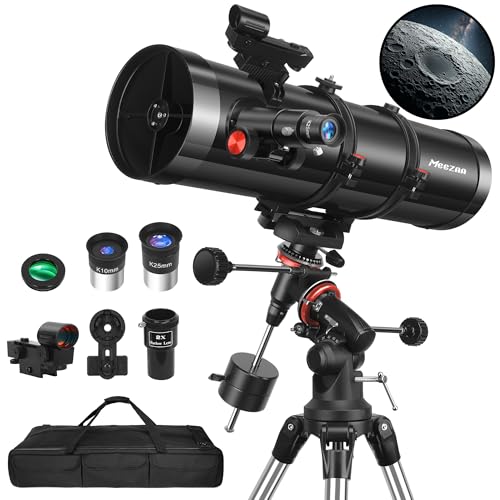
- 150mm aperture for bright deep-space views
- 26x–130x magnification with included optics
- Equatorial mount, phone adapter, and carry bag
Best For: Adults and families learning hands-on astronomy
Best Smartphone-Guided Dobsonian
Celestron StarSense Explorer 8
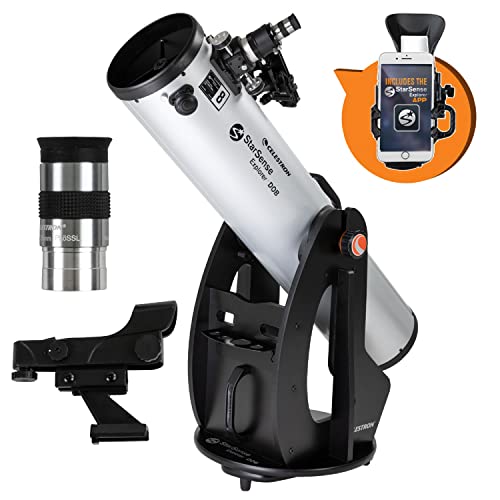
- 8-inch reflector for deep-sky and planetary views
- StarSense app helps locate targets with a phone
- Stable manual Dobsonian base and 2-year warranty
Best For: Beginners wanting guided navigation and large-aperture views
Best High-Contrast Maksutov

- 180mm aperture with 2700mm focal length
- 94% reflectivity coatings and fully baffled tube
- Includes 2-inch eyepiece, diagonal, and 9x50 finder
Best For: Observers prioritizing contrast-rich views and optical refinement
Best Guided Experience
Celestron StarSense Explorer 150mm Tabletop Dobsonian

- 150mm reflector for bright deep-sky views
- Smartphone-guided object finding
- Stable manual tabletop Dobsonian base
Best For: Beginners who want guided deep-sky exploration without an electronically powered mount
Best Aperture Value
Sky-Watcher Classic 200 Dobsonian

- 8-inch aperture for strong light gathering
- 94% reflective, fully multi-coated mirrors
- Includes two eyepieces and a 9x50 finder
Best For: Visual observers who prioritize aperture and can accommodate a full-size telescope
Best Equatorial Starter

- 130mm Newtonian reflector for beginner observing
- Equatorial mount with slow-motion controls
- Includes two eyepieces and StarPointer finder
Best For: Beginners who prefer a tripod-mounted telescope with manual equatorial controls
Top Computerized Pick – Celestron NexStar 8SE
For shoppers seeking telescopes for deep sky viewing with guided object finding, the Celestron NexStar 8SE combines an 8-inch Schmidt-Cassegrain optical tube with a computerized GoTo mount. Its 40,000-plus-object database, SkyAlign setup, and compact form make it a practical step up from a manual telescope.
Best For: Adults who want automated deep-sky and planetary observing in a relatively portable setup.
Pros:
- 8-inch optics gather light for galaxies, globular clusters, lunar details, and planets.
- GoTo system automatically locates and tracks selected objects.
- SkyAlign can align the mount using three bright stars or planets.
- Includes a 25mm eyepiece, red-dot finderscope, tripod, and accessory tray.
Cons:
- Power sources such as AA batteries, an AC adapter, or a PowerTank are not included.
- Manual focusing and a single-fork alt-azimuth mount may limit specialized imaging setups.
The NexStar 8SE is a strong all-around choice when ease of navigation matters as much as aperture. It offers substantial light-gathering capability without the bulk of a much larger Dobsonian.
Maximum Light-Gathering Pick – Sky-Watcher Flextube 16-inch
Among telescopes for deep sky viewing, the Sky-Watcher Flextube 16-inch Dobsonian stands out for its large 400mm aperture. The collapsible tube combines traditional Dobsonian value with SynScan GoTo operation, automatic tracking, and a 42,000-plus-object database.
Best For: Experienced observers with room to transport and store a large computerized Dobsonian.
Pros:
- 16-inch aperture offers substantial light-gathering potential for deep-sky targets.
- SynScan GoTo system provides automatic object locating and tracking.
- Collapsible design helps reduce the tube’s storage length.
- Includes 10mm and 25mm Plössl eyepieces and a 9×50 finderscope.
Cons:
- At about 69.2 pounds, it is considerably less portable than smaller telescopes.
- The 70-inch optical tube and large base require substantial storage space.
- Manual focus and an alt-azimuth mount may not suit advanced long-exposure imaging.
This model prioritizes aperture above all else. Its GoTo features make a very large telescope easier to use, but its size and weight are important practical considerations before purchase.
Astrophotography-Friendly Refractor – SVBONY SV503 102mm ED
The SVBONY SV503 is a 102mm f/7 ED refractor for shoppers comparing telescopes for deep sky viewing with imaging in mind. Fully multi-coated optics, S-FPL51 ED glass, a dual-speed focuser, and a 360-degree field rotator support precise visual observation and astrophotography.
Best For: Adults and teens wanting a manual optical tube for deep-sky imaging, planetary viewing, and visual astronomy.
Pros:
- S-FPL51 ED glass helps reduce chromatic aberration and color fringing.
- Dual-speed 1:10 focuser supports fine focus adjustments.
- 360-degree field rotator helps align a camera without rotating the tube.
- 90mm focus travel accommodates accessories such as filter wheels and field flatteners.
Cons:
- The optical tube does not include a finderscope.
- It is a manual-focus OTA rather than a computerized GoTo telescope.
- Mount and observing accessories beyond the listed adapters, rings, and dovetail plate may be needed.
This refractor is best viewed as a flexible optical platform rather than a complete automated observing system. Its focusing and rotation features make it particularly appealing to users building an imaging setup.
Best Integrated Power Pick – Celestron NexStar Evolution 8
The Celestron NexStar Evolution 8 is a convenient option for telescopes for deep sky viewing, pairing an 8-inch Schmidt-Cassegrain tube with WiFi control through the Celestron SkyPortal app. Its automated locating and tracking, built-in battery, and carry handles make it well suited to organized observing sessions.
Best For: Observers who want app-based GoTo control, smooth tracking, and self-contained field power.
Pros:
- 8-inch StarBright XLT optics support bright deep-sky and planetary views.
- SkyPortal WiFi app can select, locate, and track objects automatically.
- Built-in 10-hour LiFePO4 battery reduces the need for an external power supply.
- Manual clutches, integrated handles, accessory trays, and a USB charging port improve field convenience.
Cons:
- Its approximately 17.46kg weight is substantial for a portable telescope.
- The alt-azimuth mount and manual focus are less specialized for long-exposure imaging.
- A smartphone is useful for taking advantage of the WiFi control features.
The Evolution 8 emphasizes convenience without sacrificing the light-gathering benefits of an 8-inch optical tube. It is a compelling choice for users who prefer app control and integrated power over a more basic computerized setup.
Best Beginner Equatorial Reflector – MEEZAA 150EQ Telescope
For beginners comparing telescopes for deep sky viewing, the MEEZAA 150EQ combines a 150mm aperture with a 650mm focal length to gather ample light for bright views of deep-space objects, planets, and the Moon. Its equatorial mount, phone adapter, and included accessories make it a flexible starter setup.
Best For: Adults and families who want a beginner-friendly reflector with manual tracking and a generous accessory package.
Pros:
- 150mm aperture provides strong light-gathering capability for deep-space observation.
- 26x to 130x magnification range comes from two eyepieces and a 2x Barlow lens.
- Equatorial mount includes precision dials and slow-motion controls for manual tracking.
- Includes a phone adapter, moon filter, finderscope, tripod, and carry bag.
Cons:
- Manual focusing and tracking require hands-on operation.
- The included equatorial mount may involve a learning curve for first-time users.
The MEEZAA 150EQ is a well-equipped entry point for buyers who want deep-sky capability without giving up portability or smartphone compatibility. Its manual equatorial design is most appealing to beginners willing to learn basic telescope operation.
Best Smartphone-Guided Dobsonian – Celestron StarSense Explorer 8
The Celestron StarSense Explorer 8-inch Dobsonian is a strong choice among telescopes for deep sky viewing, pairing a large 203mm Newtonian reflector with smartphone-guided navigation. Its app helps locate nebulae, galaxies, and star clusters, while the manual Dobsonian base keeps setup straightforward.
Best For: Beginners and families who want large-aperture deep-sky views with guided target finding.
Pros:
- 8-inch aperture and XLT coatings support sharp, vivid views of deep-sky targets.
- StarSense technology uses smartphone sky recognition to help locate objects.
- App provides a curated list of targets based on time and location.
- Stable Dobsonian base offers simple setup and smooth manual tracking.
Cons:
- At 43.4 pounds, the complete telescope is less convenient to move than smaller models.
- Manual operation requires users to follow and adjust the telescope themselves.
With its substantial aperture and phone-assisted navigation, the StarSense Explorer 8 is especially practical for newcomers who want to explore faint targets without learning the sky entirely from scratch. Plan for a dedicated storage and viewing location because of its size and weight.
Best High-Contrast Maksutov – Sky-Watcher Skymax 180mm
For experienced observers seeking telescopes for deep sky viewing, the Sky-Watcher Skymax 180mm Maksutov-Cassegrain emphasizes contrast, light transmission, and controlled optics. Its 180mm aperture, 2700mm focal length, baffled tube, and matched optical components are designed for detailed viewing with darker-looking backgrounds.
Best For: Observers who prioritize contrast-rich views and a compact compound optical tube for astronomy or camera compatibility.
Pros:
- 180mm aperture offers substantial light-gathering capacity.
- 94% reflectivity mirror coatings support efficient light transmission.
- Fully baffled tube helps reduce stray light during observations.
- Includes a 28mm 2-inch eyepiece, 2-inch star diagonal, and 9×50 finderscope.
Cons:
- The 2700mm focal length provides a narrower, highly magnified viewing approach than shorter-focus reflectors.
- This listing includes the optical tube and accessories but does not specify a complete tripod or mount package.
The Skymax 180mm is a specialized option for buyers who value matched optics and contrast over an all-in-one beginner package. Confirm mount compatibility before purchasing, using its Vixen-style dovetail as the connection standard.
Best Guided Experience – Celestron StarSense Explorer 150mm Tabletop Dobsonian
For beginners seeking telescopes for deep sky viewing, the Celestron StarSense Explorer combines a generous 150mm reflector with smartphone-guided object finding. Its tabletop Dobsonian base keeps setup simple while the app helps you locate nebulae, galaxies, and star clusters.
Best For: Beginners who want guided deep-sky exploration without an electronically powered mount.
Pros:
- 150mm reflector provides bright views of targets such as the Orion Nebula and Andromeda Galaxy.
- StarSense technology uses smartphone sky recognition to help locate objects.
- Includes 25mm and 10mm Kellner eyepieces and a stable tabletop Dobsonian base.
- Manual operation requires no external power source.
Cons:
- Tabletop design requires a suitable stable surface.
- Manual tracking may require occasional repositioning as objects move across the sky.
This is a practical choice when ease of navigation matters as much as aperture. It offers a straightforward route into deep-sky observing, especially from darker locations where its 150mm mirror can show more detail.
Best Aperture Value – Sky-Watcher Classic 200 Dobsonian
The Sky-Watcher Classic 200 is a strong contender among telescopes for deep sky viewing when light-gathering power is the priority. Its 8-inch parabolic mirror, 94% reflective coatings, and traditional Dobsonian design are built for bright, direct visual observing.
Best For: Beginners and visual observers who want maximum aperture and a simple manual setup.
Pros:
- 8-inch (203mm) aperture offers substantial light-gathering ability for deep-sky targets.
- Fully multi-coated borosilicate mirrors are rated at 94% reflectivity.
- Includes 25mm and 10mm wide-angle eyepieces plus a 9×50 finder scope.
- Teflon bearings and tension-control handles support smooth, accurate movement.
Cons:
- At 45 pounds assembled, it is less portable than smaller tabletop models.
- The solid-tube design requires more storage space and transport planning.
- Manual Dobsonian operation does not provide automatic tracking.
Choose this model if your observing space and storage setup can accommodate a full-size solid-tube Dobsonian. Its larger mirror makes it the aperture-focused option in this group for visual deep-sky work.
Best Equatorial Starter – Celestron AstroMaster 130EQ
The Celestron AstroMaster 130EQ is a beginner-friendly option for telescopes for deep sky viewing, pairing 130mm Newtonian optics with an equatorial mount and manual slow-motion controls. Its adjustable tripod and relatively light 17-pound weight make it convenient for backyard observing.
Best For: Beginners who want a tripod-mounted telescope with coordinated manual controls for centering targets.
Pros:
- 130mm Newtonian reflector provides useful light-gathering capacity for Moon and deep-sky targets.
- German equatorial mount includes slow-motion controls for right ascension and declination.
- Quick setup requires only a few key parts and no tools.
- Includes 20mm and 10mm eyepieces, a StarPointer finder, and astronomy software.
Cons:
- Its 130mm aperture gathers less light than the 150mm and 200mm models in this roundup.
- The equatorial mount has a learning curve compared with a simple tabletop Dobsonian.
- Manual operation does not include powered tracking.
This AstroMaster is a sensible starting point if you prefer a conventional tripod and equatorial layout. It balances manageable size with useful aperture, though observers focused primarily on faint deep-sky views may prefer a larger mirror.
How We Picked the Best Telescopes for Deep Sky Viewing
We focused on the features that matter most beyond the Solar System: usable aperture, optical design, mount stability, tracking or object-location assistance, portability, and setup demands. Larger apertures generally reveal fainter objects, but a telescope that is difficult to transport, align, or store may see less use than a simpler model.
We also considered the needs of different observers. Beginners may value an intuitive app or uncomplicated Dobsonian mount, while experienced users may prefer motorized tracking, Wi-Fi control, or a larger light bucket for serious visual observing.
Quick Comparison
- Best all-around computerized option: Celestron NexStar 8SE or NexStar Evolution 8.
- Best for maximum visual light gathering: Sky-Watcher Flextube 16-inch Dobsonian.
- Best traditional beginner design: Sky-Watcher Classic 200 Dobsonian.
- Best guided setup for new observers: Celestron StarSense Explorer Dobsonian models.
- Best compact refractor-style option: SVBONY SV503 102mm ED telescope.
- Best compact high-magnification instrument: Sky-Watcher Skymax 180mm Maksutov-Cassegrain.
Key Buying Factors for Telescopes for Deep Sky Viewing
Aperture and Light Gathering
Aperture is the diameter of the telescope’s primary lens or mirror. More aperture collects more light and can improve views of faint galaxies, nebulae, and globular clusters. An 8-inch telescope is a versatile starting point, while 12- to 16-inch Dobsonians provide a substantial increase in brightness and resolution. Remember that larger instruments are heavier and require more storage space.
Optical Design
Dobsonian reflectors offer excellent aperture per dollar and are often the simplest choice for visual deep-sky work. Schmidt-Cassegrain and Maksutov-Cassegrain designs are compact and well suited to computerized mounts, though they can have narrower fields of view and longer cooldown times. Refractors provide crisp, low-maintenance views but typically cost more per inch of aperture.
Mount, Tracking, and Finding Tools
A stable mount is essential at high magnification. Manual Dobsonians are straightforward and fast to set up, while GoTo mounts can locate and track targets automatically after alignment. Smartphone-assisted systems help identify objects without requiring a fully motorized mount. Tracking is especially useful for sharing views or making detailed observations.
Portability and Observing Conditions
Dark skies often improve deep-sky views more than a small increase in aperture. Choose a model you can realistically move to a darker site. Collapsible and tabletop designs save space, whereas large solid-tube or truss Dobsonians may need a vehicle and multiple people.
Who Should Buy Which Telescopes for Deep Sky Viewing?
First-time observers should consider a simple 6- or 8-inch Dobsonian or a StarSense Explorer model for an easier learning curve. Observers who want automation should look at the NexStar 8SE or Evolution 8, especially if locating faint targets is a priority. Experienced visual astronomers seeking the brightest views should choose the largest Dobsonian they can transport and store comfortably. Apartment dwellers or frequent travelers may prefer a compact Maksutov, refractor, or tabletop reflector. Finally, anyone choosing among Telescopes for Deep Sky Viewing should budget for practical accessories such as a red flashlight, star atlas, observing chair, and additional eyepieces—but should prioritize aperture and mount quality first.