Choosing among precision balances for laboratories means matching readability, capacity, repeatability, and workflow features to the materials you weigh. A balance designed for milligram measurements may not suit larger samples, while high-capacity models can trade fine resolution for versatility.
This roundup compares 10 laboratory-focused digital balances with capacities from 220g to 5,000g and readability from 0.0001g to 0.01g. Use the guide below to narrow the options by accuracy, connectivity, calibration, and intended application.
Best 10 Precision Balances for Laboratories Picks for 2026
Best All-Purpose Precision Balance
500g x 0.001g Digital Lab Scale

- 0.001g readability with 500g capacity
- Includes calibration weight and windshield
- 19 units plus RS232 connectivity
Best For: General laboratory, QC, jewelry, and food weighing
Best for Micro-Measurements
Bonvoisin 220g x 0.0001g Analytical Balance
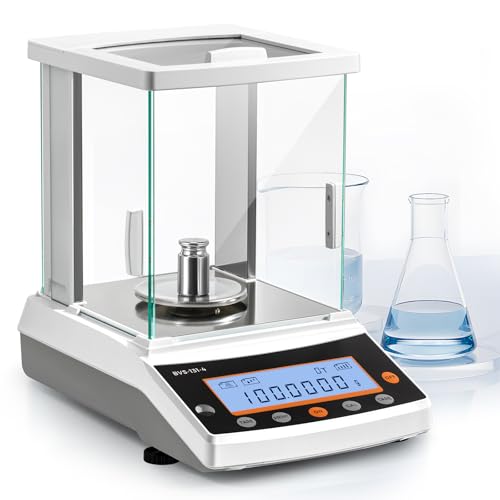
- 0.1mg readability for fine measurements
- Percentage weighing and counting functions
- RS232 output with memory function
Best For: Laboratories, pharmacies, and jewelry stores
Best High-Capacity Option
U.S. Solid 5000g x 0.01g Lab Balance

- 5kg capacity with 0.01g readability
- 19 units and lockable measurement settings
- RS232, counting, check-weighing, and tare
Best For: Higher-volume laboratory, production, and QC weighing
Best Draftshielded Analytical Balance
Hanchen 220g x 0.0001g Analytical Balance

- 0.1mg readability with a glass draftshield
- Temperature compensation and fast results
- USB and RS232 connectivity with PC software
Best For: Sensitive laboratory, pharmacy, chemical, and jewelry measurements
Flexible Unit Control
Bonvoisin 500g x 0.001g Analytical Balance

- 0.001g readability and 500g capacity
- Integrated windshield and RS-232 interface
- 17 units plus approximately 36-hour battery operation
Best For: General lab, gemstone, and jewelry weighing
Milligram-Level Stability
U.S. Solid 320g x 0.0001g Balance
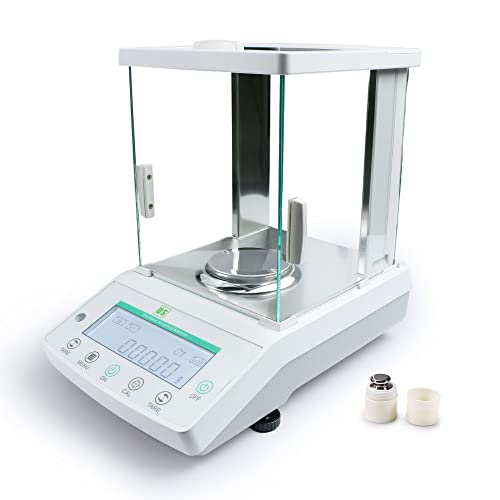
- 0.0001g readability with 320g capacity
- Electromagnetic force compensation sensor
- Underhook weighing, RS-232, and calibration weight
Best For: Research, compounding, jewelry analysis, and density testing
Portable Everyday Precision
Bonvoisin 500g x 0.001g Lab Scale

- 500g capacity with 0.001g readability
- Counting, percentage, and tare functions
- Draft shield, leveling feet, and 13 units
Best For: Routine lab, pharmacy, jewelry, and formulation work
Ultra-Fine Precision
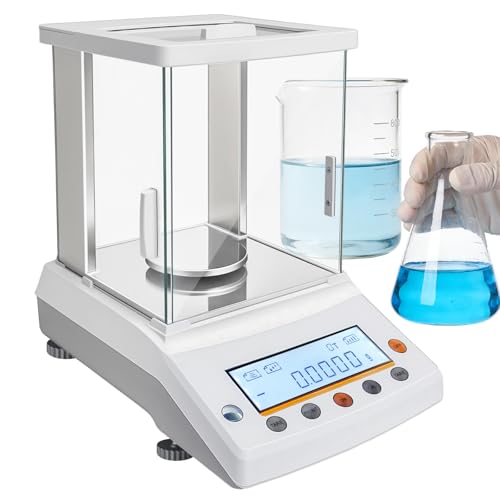
- 0.0001 g readability and 220 g capacity
- Glass shield and fast stabilization
- Touchscreen with counting and percentage modes
Best For: Fine-resolution laboratory, pharmacy, and jewelry weighing
Best Heavy-Duty Pick
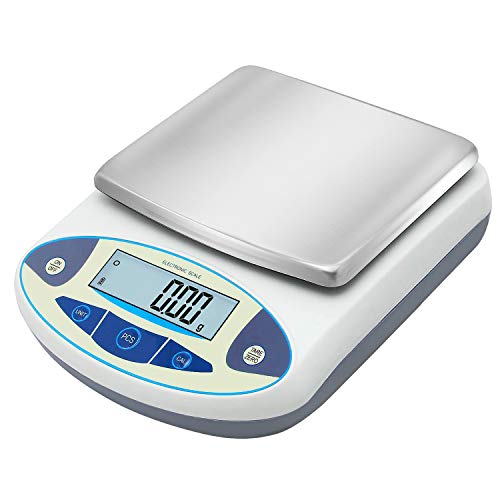
- 5,000 g capacity with 0.01 g accuracy
- Large stainless-steel weighing pan
- 13 unit conversions and external calibration
Best For: Higher-capacity lab, school, business, and jewelry weighing
Versatile Bench Scale
- 3,000 g capacity with 0.01 g accuracy
- Calibration weights included for this range
- Backlit LCD, counting, and 13 unit conversions
Best For: Routine medium-capacity laboratory and educational weighing
Best All-Purpose Precision Balance – 500g x 0.001g Digital Lab Scale
For laboratories seeking practical precision balances for laboratories, this countertop model combines 0.001g readability with a 500g capacity. Its stainless-steel construction, included calibration weight, windshield, and plug-in power make it suited to routine scientific, quality-control, jewelry, food, and industrial weighing.
Best For: General laboratory and QC work requiring fine 0.001g readings, multiple units, and a straightforward plug-in balance.
Pros:
- 0.001g readability with a 500g maximum capacity.
- Includes a 500g calibration weight and stainless-steel weighing pan.
- Supports 19 units, including grams, carats, ounces, and pounds.
- Windshield, backlit LCD, tare, and RS232 interface support everyday workflows.
Cons:
- It is less sensitive than the 0.0001g analytical models in this roundup.
- Plug-in operation may be less convenient where AC power is unavailable.
This is a versatile choice when 0.001g precision is sufficient and you want useful accessories, broad unit support, and durable bench-ready construction without moving to a lower-capacity analytical balance.
Best for Micro-Measurements – Bonvoisin 220g x 0.0001g Analytical Balance
Among precision balances for laboratories, the Bonvoisin stands out for 0.0001g—or 0.1mg—readability in a compact format. Percentage weighing, counting, memory, and RS232 output add practical functions for laboratory, pharmacy, and jewelry applications.
Best For: Users who need highly readable 0.1mg measurements, percentage calculations, counting, and computer or printer data output.
Pros:
- 0.0001g readability with a 220g capacity and stated ±0.0004g tolerance.
- Percentage weighing helps with experimental ratios without extra calculations.
- Counting function supports light ingredients and jewelry accessories.
- RS232, four switchable units, and memory function improve repeat workflows.
Cons:
- The 220g capacity is lower than the 500g and 5000g alternatives.
- Counting is recommended for unit weights over 50mg.
This model is a strong fit when fine readability and workflow features matter more than maximum capacity, particularly for small-batch laboratory, pharmacy, and jewelry measurements.
Best High-Capacity Option – U.S. Solid 5000g x 0.01g Lab Balance
U.S. Solid Digital Precision Balance 5000g x 0.01g, Lab Scale, RS232 Interface, 19 Measurement Units
Check Price On AmazonIf your work requires more capacity than typical analytical balances, this U.S. Solid model weighs up to 5000g in 0.01g steps. It pairs a stainless-steel platform with 19 measurement units, RS232 output, counting, check-weighing, tare, and calibration functions for laboratory, production, and QC tasks.
Best For: Labs and production environments that need a 5kg maximum capacity, repeatable 0.01g readings, and flexible data or weighing modes.
Pros:
- High 5000g capacity with 0.01g readability and stated ±0.02g repeatability.
- Offers 19 measurement units, including grams, kilograms, carats, and percentage.
- RS232 output supports PC and printer data tracking.
- Includes check-weighing, counting, tare, manual calibration, and overload protection.
Cons:
- Its 0.01g readability is coarser than the 0.001g and 0.0001g options.
- The flat platform design does not provide the enclosed draftshield described for the analytical models.
Choose this balance when capacity and process versatility are priorities. It is especially practical for larger samples, production checks, paper testing, jewelry work, and other applications where 5kg range matters.
Best Draftshielded Analytical Balance – Hanchen 220g x 0.0001g Analytical Balance
The Hanchen is designed for sensitive work where airflow, vibration, and temperature changes can affect readings. Its three-sided glass draftshield, electromagnetic load cell, temperature-compensation technology, and 0.1mg readability make it a focused option among precision balances for laboratories.
Best For: Laboratory, pharmacy, chemical, and jewelry users who want a compact draftshielded balance with USB and RS232 connectivity.
Pros:
- 0.0001g readability with a 220g maximum capacity.
- Three-sided glass draftshield and stable base help limit airflow and minor disturbances.
- Temperature compensation supports repeatable readings, with results available in about five seconds.
- USB and RS232 connectivity, PC software, and eight unit conversions support data handling.
Cons:
- The 220g capacity limits larger-sample work.
- It offers fewer unit conversions than the 19-unit models.
- The supplied details do not identify an included calibration weight.
For highly sensitive bench measurements, the Hanchen emphasizes environmental protection and data connectivity in a compact footprint. It is a sensible pick when draftshielding and 0.1mg readability are more important than maximum capacity.
Flexible Unit Control – Bonvoisin 500g x 0.001g Analytical Balance
For laboratories seeking precision balances for laboratories with flexible unit handling, this Bonvoisin model combines 0.001g readability with a 500g maximum capacity. Its integrated windshield helps limit environmental effects, while battery operation supports use during power interruptions.
Best For: General laboratory weighing, gemstones, and jewelry applications where multiple selectable units and portable backup power are useful.
Pros:
- Offers 0.001g readability with a 500g maximum weighing capacity.
- Integrated windshield reduces the effect of surrounding conditions on results.
- Supports 17 selectable units, with unused units able to be turned off.
- Built-in lithium battery can provide about 36 hours of operation when fully charged.
Cons:
- Its stated accuracy is ±0.004g, so readability and accuracy are not identical.
- The 10mg minimum weighing value may not suit extremely small samples.
- The included RS-232 interface may require compatible computer or printer equipment.
This is a practical choice when capacity, unit customization, and extended battery backup matter more than ultra-fine 0.0001g readability.
Milligram-Level Stability – U.S. Solid 320g x 0.0001g Balance
Among precision balances for laboratories, this U.S. Solid model stands out for its 0.0001g readability and electromagnetic force compensation sensor. It also adds a draft shield, RS-232 connectivity, underhook weighing, and an included 200g calibration weight for more demanding analytical work.
Best For: Scientific research, compounding, jewelry analysis, and density or specific-gravity testing that benefits from milligram-level resolution.
Pros:
- Provides 0.1mg readability across a 320g maximum capacity.
- Electromagnetic force compensation is designed to reduce drift.
- Underhook weighing supports density determination and specific-gravity testing.
- Includes a 200g external calibration weight and RS-232 data interface.
Cons:
- Requires a 30-minute warm-up for thermal equilibrium.
- The 320g capacity is lower than some 500g alternatives.
- Its higher-resolution operation may demand more careful environmental control.
Choose this balance when fine resolution and repeatable analytical workflows are priorities, particularly if underhook weighing and computer-based data logging are part of the process.
Portable Everyday Precision – Bonvoisin 500g x 0.001g Lab Scale
This Bonvoisin balance is a versatile option for buyers comparing precision balances for laboratories that also need counting and percentage functions. It provides 0.001g readability, a 500g capacity, adjustable leveling, a draft shield, and dual power options for routine lab, pharmacy, jewelry, and formulation tasks.
Best For: Routine laboratory, pharmacy, jewelry, and small-part weighing where counting, percentage calculations, and a relatively portable design are valuable.
Pros:
- Combines 500g capacity with 0.001g readability.
- Includes a windshield, adjustable feet, and built-in spirit level for stable setup.
- Offers tare, counting, and percentage-weighing modes.
- Supports 13 switchable units and linear or nonlinear calibration.
Cons:
- Backup battery is not included and is intended for emergency use only.
- Battery operation lasts approximately 30 minutes with a fresh battery.
- Recommended warm-up and calibration add setup time before use.
This model suits users who want broad functionality in a compact balance, especially when routine calculations and flexible measurement modes are as important as basic laboratory precision.
Ultra-Fine Precision – 0.1mg Analytical Balance
For laboratories seeking precision balances for laboratories with fine readability, this analytical balance combines a 220 g capacity with 0.0001 g resolution. Its electromagnetic sensor, glass shield, stabilization under five seconds, and thermal-expansion technology are designed for consistent measurements in sensitive workflows.
Best For: Laboratory, pharmacy, jewelry, education, and research applications requiring 0.1 mg precision.
Pros:
- Provides 0.0001 g readability with a 220 g maximum capacity.
- Glass shield helps reduce the effects of airflow and small disturbances.
- Includes counting and percentage-weighing functions, plus a touchscreen LCD.
- Includes a 200 g calibration weight.
Cons:
- The 220 g capacity is lower than the Bonvoisin alternatives.
- Its fine-resolution design is intended for careful bench-top use rather than bulk weighing.
This is the strongest fit when measurement resolution is the priority. The compact design and included shield support routine analytical work, while the lower capacity limits it to smaller samples.
Best Heavy-Duty Pick – Bonvoisin 5000g Lab Scale
This Bonvoisin model is a practical option among precision balances for laboratories when capacity matters more than ultra-fine readability. It weighs up to 5,000 g at 0.01 g accuracy and adds a stainless-steel pan, external calibration, overload alerts, and 13 unit conversions.
Best For: Laboratories, schools, businesses, and jewelers handling larger samples, powders, screws, or multiple items.
Pros:
- Offers a 5,000 g maximum capacity with 0.01 g accuracy.
- Large 180 x 140 mm stainless-steel weighing pan supports varied materials.
- Includes tare, memory, counting, fault-display, and unit-conversion functions.
- Adjustable feet, a level bubble, and external calibration support setup.
Cons:
- Calibration weights are not included with the 5,000 g version.
- Its 0.01 g accuracy is less fine than a 0.1 mg analytical balance.
Choose this version for a broad weighing range and a larger working surface. It is especially useful where capacity and flexible unit conversion are more important than sub-milligram resolution.
Versatile Bench Scale – Bonvoisin 3000g Balance
For general-purpose precision balances for laboratories, this Bonvoisin balance offers 3,000 g capacity with 0.01 g accuracy. Its stainless-steel pan, adjustable feet, level bubble, backlit LCD, and multiple weighing functions make it suited to routine bench work.
Best For: Laboratories, universities, schools, jewelers, and businesses needing a versatile medium-capacity scale.
Pros:
- Balances loads up to 3,000 g with 0.01 g accuracy.
- Includes calibration weights for the 200–3000 g range.
- Supports tare, memory, counting, fault visualization, and 13 unit conversions.
- Large stainless-steel pan and backlit LCD improve everyday usability.
Cons:
- It does not provide the 0.0001 g readability of the first product.
- The 3,000 g capacity is lower than the 5,000 g Bonvoisin model.
This is a balanced middle option for routine weighing. It retains the useful functions and construction of the larger model while offering a lower capacity that may better match typical classroom, jewelry, and laboratory workloads.
How We Picked These Precision Balances for Laboratories
We selected models across the most useful laboratory weighing ranges: 220g balances with 0.0001g readability, 320g and 500g models with 0.001g or 0.0001g resolution, and higher-capacity 3,000g to 5,000g scales with 0.01g readability. We also considered practical features such as draft shields, RS232 connectivity, percentage weighing, measurement-unit selection, calibration support, and suitability for research, pharmacy, compounding, jewelry, and general laboratory work.
Displayed readability is not the same as guaranteed accuracy. For regulated or highly repeatable work, verify the manufacturer’s specifications for repeatability, linearity, allowable environmental conditions, and calibration procedures before purchase.
Quick Comparison
| Best For | Typical Capacity | Readability | Useful Features |
|---|---|---|---|
| Fine analytical measurements | 220g–320g | 0.0001g | Draft shield, calibration, RS232 |
| General precision laboratory work | 500g | 0.001g | Multiple units, percentage weighing |
| Larger samples and batching | 3,000g–5,000g | 0.01g | Higher capacity, RS232, broad unit support |
Key Buying Factors for Precision Balances for Laboratories
Readability and Capacity
Readability indicates the smallest displayed increment, while capacity is the maximum load. Choose a balance that comfortably handles your heaviest container and sample without sacrificing the resolution your procedure requires. A 0.0001g balance is appropriate for very small analytical quantities, but a 0.01g model may be more practical for larger samples or preparation batches.
Repeatability and Calibration
Look for clear calibration instructions and confirm whether external calibration weights are required. A stable, repeatable result is more important than a small displayed increment. Allow the balance to warm up, level it properly, and recalibrate after relocation or major temperature changes.
Draft Protection and Environment
Air movement, vibration, static, temperature variation, and humidity can affect fine measurements. For 0.0001g work, a windshield is especially valuable. Place the balance on a rigid, vibration-resistant bench away from doors, vents, sunlight, and heavy equipment.
Connectivity and Workflow
RS232 can simplify data transfer to a computer, printer, or laboratory information system, but confirm cable, software, and protocol compatibility. Percentage weighing and multiple measurement units are useful when comparing formulations, checking samples, or switching between laboratory and production tasks.
Who Should Buy Which Precision Balances for Laboratories?
Choose a 220g or 320g, 0.0001g model for analytical chemistry, pharmaceutical compounding, jewelry analysis, and other applications requiring very fine displayed resolution. Choose a 500g, 0.001g model for general-purpose research, educational laboratories, formulation work, and samples that need more capacity. Choose a 3,000g or 5,000g, 0.01g model for larger containers, batching, material preparation, and routine weighing where capacity matters more than sub-milligram readability.
Before ordering, confirm the balance’s actual performance specifications, pan size, power requirements, calibration method, enclosure, warranty, and return policy. For compliance-sensitive work, select a model supported by the documentation and verification process required by your laboratory.