The best stereo microscopes make it easier to inspect, repair, assemble, and study three-dimensional objects without the narrow view of a traditional compound microscope. This roundup compares 10 options ranging from compact binocular models to high-magnification trinocular systems and digital microscopes.
Use the buying guide below to match magnification, lighting, viewing comfort, camera connectivity, and working distance to your projects before choosing a microscope.
Best 10 Stereo Microscopes Picks for 2026
Best Cordless Option
AmScope SE306R-P-LED Stereo Microscope

- 20x and 40x stereo magnification
- Cordless LED top and bottom lighting
- Metal pillar stand with widefield optics
Best For: Portable everyday inspection and educational viewing
Best Digital Workbench Pick
Andonstar AD246S-M 3-Lens Microscope

- Three lenses for repair, specimens, and slides
- 2160P recording with HDMI output
- Adjustable boom arm and included accessories
Best For: Electronics repair and screen-based demonstrations
Best Magnification Range
AmScope SE305R-PZ Binocular Microscope

- 10x, 20x, 30x, and 60x settings
- Binocular optical viewing
- Built-in top and bottom illumination
Best For: Detailed inspection with flexible optical magnification
Best Starter Kit
Aomekie 20x-50x Portable Stereo Microscope

- Includes slides, insects, and mineral specimens
- 20x and 50x binocular viewing
- Portable battery-powered LED illumination
Best For: Beginner home, classroom, and hobby use
Best Heavy-Duty Upgrade
Trinocular Stereo Zoom Microscope

- 3.5X–90X magnification range
- Adjustable boom arm with 18-pound base
- Trinocular camera-ready design
Best For: Industrial inspection, jewelry, assembly, and teaching
Best for Beginners
AmScope SE100-LED Portable Microscope

- Simple 20X binocular viewing
- Battery-powered upper LED illumination
- Portable design for home or classroom use
Best For: Students, hobbyists, and larger specimens
Best Professional Value
SWIFT Trinocular Stereo Zoom Microscope
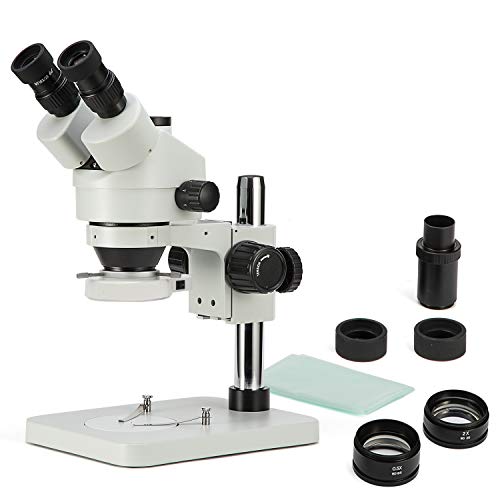
- 3.5X–90X expanded magnification
- 100 mm working distance
- Cool 56-bulb LED ring light
Best For: Gemology, electronics, research, and engraving
Compact Zoom Pick
ZTEEERS 6X-45X Stereo Microscope

- 6X-45X continuous zoom
- 56-bulb LED ring light
- Stable aluminum-alloy stand
Best For: Routine inspection and hobby work
Advanced Imaging Pick
ZTEEERS 3.5X-90X Trinocular Microscope

- 3.5X-90X magnification
- Camera-ready trinocular port
- Heavy-duty boom stand
Best For: Detailed inspection and documentation
Camera-Ready Value
ZTEEERS 6X-45X Trinocular Microscope

- 6X-45X zoom range
- Includes 0.5X CTV adapter
- 56-bulb LED ring light
Best For: Camera-assisted general inspection
Best Cordless Option – AmScope SE306R-P-LED Stereo Microscope
If you want portable stereo microscopes for general inspection, the AmScope SE306R-P-LED offers straightforward 20x and 40x viewing in a binocular design. Its battery-powered LED system supports both top and bottom illumination, while the metal pillar stand provides a stable platform.
Best For: Portable inspection of specimens, small parts, crafts, and educational projects.
Pros:
- Cordless, battery-powered operation for flexible placement
- 20x and 40x stereo magnification settings
- Top and bottom LED lighting for incident and transmitted illumination
- Widefield optical glass lenses and a sturdy metal-framework stand
Cons:
- Maximum magnification is limited to 40x
- Battery operation requires keeping replacement batteries available
The SE306R-P-LED is a practical choice when portability matters more than a broad magnification range. Its two-light setup adds useful flexibility for everyday stereo viewing.
Best Digital Workbench Pick – Andonstar AD246S-M 3-Lens Microscope
Among digital stereo microscopes, the Andonstar AD246S-M stands out for its three interchangeable lenses, 2160P video recording, and HDMI output. Its adjustable boom arm and included accessories make it especially suited to electronics repair, demonstrations, and varied specimen viewing.
Best For: Soldering, circuit-board repair, digital demonstrations, and multi-purpose observation.
Pros:
- Three lenses cover soldering, general objects, and biological slides
- 2160P recording with HDMI output to a larger display
- Adjustable metal boom arm supports a larger work envelope
- Includes measurement software support, remote control, Micro SD card, and slides
Cons:
- Requires lens changes for different viewing tasks
- Its digital design depends on a screen for the viewing experience
- The feature-rich setup may be more than needed for simple inspection
The AD246S-M is the most versatile option here for users who need documentation, screen sharing, or electronics work. Its advertised magnification varies by lens and display, so selecting the right lens is important.
Best Magnification Range – AmScope SE305R-PZ Binocular Microscope
The AmScope SE305R-PZ is a strong choice for users who want optical stereo microscopes with more magnification flexibility. Its WF10x and WF20x eyepieces combine with the objective to provide 10x, 20x, 30x, and 60x settings, supported by both top and bottom illumination.
Best For: Detailed inspection tasks requiring multiple optical magnification levels.
Pros:
- Four stereo magnification settings from 10x to 60x
- Forward binocular head with widefield optical glass lenses
- Built-in incident and transmitted lighting
- Metal-framework pillar stand for stable positioning
Cons:
- Corded operation is less portable than battery-powered alternatives
- Halogen lighting may be less convenient than LED lighting
- Its 120-volt power requirement may limit placement
Choose the SE305R-PZ when a 60x ceiling and conventional optical viewing are more important than cordless convenience. It offers a useful range for progressively closer inspection without relying on digital zoom.
Best Starter Kit – Aomekie 20x-50x Portable Stereo Microscope
For beginners comparing stereo microscopes for home or classroom use, the Aomekie combines 20x and 50x magnification with a substantial specimen starter kit. Binocular viewing, adjustable working distance, and battery-powered LED illumination make it approachable for inspecting rocks, insects, slides, stamps, and small objects.
Best For: Children, beginners, classrooms, and hobbyists exploring prepared specimens and minerals.
Pros:
- Includes insect specimens, 10 slides, and 12 mineral specimens
- 20x and 50x magnification using WF10x and WF25x eyepieces
- Battery-powered LED lighting supports portable use
- Adjustable working range and interpupillary distance accommodate different users
Cons:
- Two AA batteries are required and are not included
- Maximum magnification is limited to 50x
- Designed as an elementary microscope rather than a specialized professional system
The Aomekie is a convenient entry point because the included specimens let users begin exploring immediately. Its portable, binocular format is particularly appealing for shared family or classroom activities.
Best Heavy-Duty Upgrade – Trinocular Stereo Zoom Microscope
For demanding stereo microscopes applications, this trinocular model combines 3.5X–90X magnification, 3D viewing, and a fully adjustable boom arm. Its large steel base and included ring light make it suited to detailed inspection where stability, working space, and image documentation matter.
Best For: Industrial inspection, jewelry identification, assembly work, dissection, and teaching or research setups.
Pros:
- Trinocular design supports simultaneous viewing and camera connection.
- Wide 3.5X–90X magnification range with included 0.5X and 2X auxiliary lenses.
- 18-pound base and adjustable boom arm provide stable, flexible positioning.
- Includes 56-LED ring light and 10X eyepieces for plug-and-play use.
Cons:
- The heavy-duty construction is less portable than a compact classroom microscope.
- Its many adjustment and accessory options may be more than casual users need.
This is the most workstation-oriented option in the group. Choose it when a broad magnification range, camera support, and vibration-resistant positioning are more important than portability.
Best for Beginners – AmScope SE100-LED Portable Microscope
This portable AmScope is a straightforward choice among stereo microscopes for home and classroom use. Its 20X binocular setup, battery-powered LED illumination, and reversible stage make it practical for examining larger specimens without a complicated setup.
Best For: Students, hobbyists, classroom demonstrations, and inspecting rocks, stamps, jewelry, and biological specimens.
Pros:
- Compact, portable design weighs approximately 600 g.
- Binocular 10X widefield eyepieces offer simple two-eye viewing.
- Battery-powered upper LED light illuminates specimens from above.
- Reversible black-and-white stage improves contrast with different samples.
Cons:
- Maximum magnification is 20X, limiting very fine-detail work.
- It has a fixed 2X objective and lacks the trinocular camera port found on the other models.
With its low magnification, long focal length, and simple controls, this is the accessible pick for learning and routine specimen handling. It is less appropriate for professional documentation or high-magnification inspection.
Best Professional Value – SWIFT Trinocular Stereo Zoom Microscope
This SWIFT model is one of the more versatile stereo microscopes for users who need zoom control and image capture. The 3.5X–90X expanded range, 100 mm working distance, trinocular port, and cool 56-bulb ring light support detailed work across electronics, gemology, engraving, and laboratory applications.
Best For: Researchers, gemologists, engravers, collectors, electronics professionals, and low-heat biological lab work.
Pros:
- Expanded 3.5X–90X magnification range with 0.5X and 2X objectives.
- 100 mm working distance accommodates hands-on work with objects.
- Trinocular port supports camera attachment and specimen documentation.
- 56-bulb LED ring light provides bright, shadow-free illumination with low heat.
Cons:
- Corded operation reduces portability.
- Its professional feature set may be excessive for basic classroom viewing.
- The supplied specifications list a 230-volt power requirement, so users should verify compatibility.
This is a strong middle ground between a basic portable unit and a heavier boom-arm workstation. It stands out when comfortable angled viewing, cool illumination, and camera-ready observation are priorities.
Compact Zoom Pick – ZTEEERS 6X-45X Stereo Microscope
For shoppers comparing stereo microscopes for general inspection, this ZTEEERS model combines continuous 6X-45X zoom magnification with a binocular viewing setup and integrated LED lighting. Its aluminum-alloy frame and pillar stand are designed to provide a stable work surface.
Best For: Routine hands-on inspection, hobby work, and users who want a broad zoom range with built-in illumination.
Pros:
- 6X-45X continuous zoom range with WF10X eyepieces
- 56-bulb LED ring light provides bright, uniform illumination
- Aluminum-alloy construction and stable pillar stand
Cons:
- No warranty is listed in the supplied specifications
- Camera connectivity is not specifically included in the product notes
This is a practical stereo microscope for users who prioritize straightforward binocular viewing, a wide magnification range, and an integrated ring light in a relatively compact setup.
Advanced Imaging Pick – ZTEEERS 3.5X-90X Trinocular Microscope
Among stereo microscopes, this ZTEEERS trinocular model stands out for its expanded 3.5X-90X magnification range, camera-ready viewing port, and flexible boom stand. Included auxiliary lenses extend the zoom range, while the weighted steel base supports larger inspection setups.
Best For: Detailed inspection, camera-assisted documentation, and users who need long working flexibility and a wide magnification range.
Pros:
- 3.5X-90X range using the 0.7X-4.5X zoom objective and auxiliary lenses
- Trinocular head includes two adapter configurations for electronic eyepieces or cameras
- Heavy-duty 18-pound steel base and single-arm boom stand
- Dimmable 56S LED ring light with shadow-free illumination
Cons:
- Larger and heavier than the other listed models
- Its advanced stand and accessories may be more setup than casual users need
With its camera-oriented trinocular design, high maximum magnification, and boom-arm flexibility, this is the strongest choice in the group for users building a more capable inspection or documentation station.
Camera-Ready Value – ZTEEERS 6X-45X Trinocular Microscope
This ZTEEERS model is a useful option for shoppers seeking stereo microscopes with camera attachment capability without moving to the larger boom-stand design. It offers 6X-45X zoom, WF10X eyepieces, a 0.5X CTV adapter, and a 56-bulb LED ring light.
Best For: Users who want binocular observation plus basic camera connectivity for documentation or a wider camera field of view.
Pros:
- Trinocular head supports binocular viewing and camera attachment
- 6X-45X zoom range with WF10X eyepieces
- Included 0.5X CTV adapter provides a larger field of view
- 56-bulb LED ring light delivers bright, uniform illumination
Cons:
- Maximum magnification is lower than the 3.5X-90X model in this roundup
- The supplied notes do not specify a camera or electronic eyepiece
This microscope balances a camera-ready trinocular head with a conventional pillar stand, making it a sensible middle ground for users who want documentation features without the bulk of a boom-arm system.
How We Picked These Stereo Microscopes
We selected models across several common use cases, including electronics repair, jewelry and craft work, education, specimen viewing, hobby projects, and professional inspection. The lineup includes binocular and trinocular designs, portable units, zoom microscopes, LED-lit systems, and a digital HDMI microscope. We focused on useful magnification ranges, illumination, viewing configuration, working flexibility, and the features that affect everyday usability.
Because specifications and included accessories can vary by seller or configuration, confirm the current listing before purchase. Pay particular attention to included eyepieces, auxiliary lenses, stands, cameras, and power requirements.
Quick Comparison
- Best for portability: Compact AmScope models and other lightweight binocular microscopes are convenient for classrooms, field use, and occasional inspection.
- Best for routine bench work: Binocular zoom models with LED ring lights provide comfortable viewing and adjustable magnification for repairs and assembly.
- Best for documentation: Trinocular microscopes allow simultaneous viewing and camera use, while the Andonstar digital model is designed around HDMI display and image capture.
- Best for broad magnification: Trinocular zoom systems covering approximately 3.5X to 90X offer flexibility when paired with auxiliary lenses.
Key Buying Factors for Stereo Microscopes
Magnification and Zoom Range
Choose magnification based on the size and detail of your work. Around 10X to 20X is often suitable for general inspection, soldering, insects, and crafts. Higher ranges can reveal smaller components, but maximum magnification is only useful when optics, lighting, stability, and working distance remain adequate. Zoom systems are more versatile than fixed-power models because they let you adjust detail without changing eyepieces.
Binocular or Trinocular Viewing
Binocular microscopes are usually the simplest and most affordable choice for comfortable two-eye viewing. Trinocular models add a dedicated camera port, making them better for teaching, recording, photography, or sharing live images. If you do not plan to use a camera, the added port may not justify the extra cost.
Lighting and Working Distance
Adjustable LED illumination helps reduce shadows and improves visibility on reflective or uneven objects. Ring lights provide even coverage around the objective, while built-in top and bottom lighting can be useful for specimens and translucent materials. A generous working distance is especially important for tools, circuit boards, and hands-on repair.
Stand, Ergonomics, and Accessories
Look for a stable stand, smooth focus, comfortable eyepieces, and enough clearance for your projects. An auxiliary lens can change both magnification and working distance, so verify how it affects the configuration you plan to use. Portable models are convenient, but heavier bases and longer support arms generally improve stability on a permanent workbench.
Who Should Buy Which Stereo Microscopes?
Choose a compact binocular microscope if you need a straightforward, portable instrument for inspection, education, insects, or occasional repairs. Choose a binocular zoom model with a ring light for electronics, jewelry, crafts, and other bench work where adjustable magnification and clear illumination matter most.
Choose a trinocular zoom microscope if you regularly document work, teach, stream, or inspect alongside a camera. Models with auxiliary lenses are suited to buyers who need a wider range of magnification and working distances. Choose a digital HDMI microscope if a monitor-based workflow is more important than traditional eyepiece viewing. Finally, compare the stand, included optics, lighting controls, and camera compatibility—not just the advertised maximum magnification—before ordering.