The best telescopes for children make astronomy approachable without overwhelming young beginners with complicated setup or fragile components. This roundup compares portable refractors, kid-focused kits, and larger-aperture beginner models for viewing the Moon, bright planets, and easy-to-find celestial targets.
When choosing, consider more than advertised magnification. Aperture, mount stability, included accessories, portability, and the child’s age all affect whether a telescope feels exciting or frustrating to use.
Best 10 Telescopes for Children Picks for 2026
Best Travel Telescope
Gskyer 70mm Beginner Telescope

- 70mm coated optics for Moon and star viewing
- Two eyepieces plus 3x Barlow lens
- Tripod, carry bag, phone adapter, and remote included
Best For: Older children and beginners who want portable, smartphone-friendly astronomy
Best First Telescope
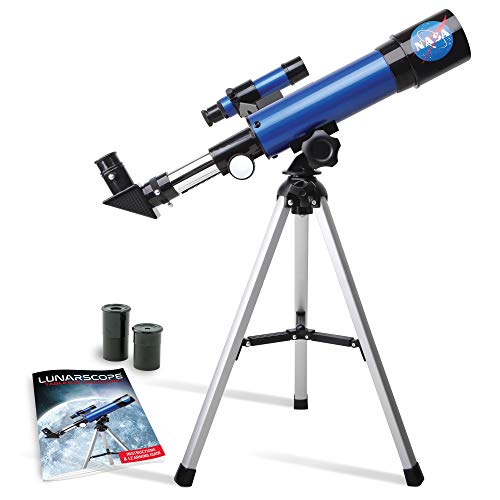
- Designed for children ages 8 and up
- Includes finder scope and two eyepieces
- Tabletop tripod supports steady Moon viewing
Best For: Young beginners primarily interested in exploring the Moon
Best Family Upgrade
MEEZAA 80mm Refractor Telescope
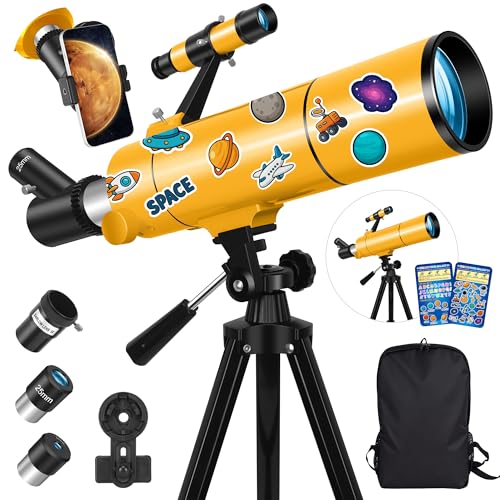
- Large 80mm aperture with multi-coated optics
- 20x–150x range from two eyepieces and Barlow lens
- Backpack, tripod, phone adapter, and finder scope included
Best For: Families wanting a versatile scope for astronomy, travel, and nature viewing
Best Learning Kit
Wow in the World Kids’ Telescope

- Beginner-friendly 25x and 50x eyepieces
- Tripod adjusts up to 48 inches
- Includes star wheel, guide, and audio content
Best For: Young children who benefit from guided, hands-on astronomy learning
Best Family Stargazing Pick
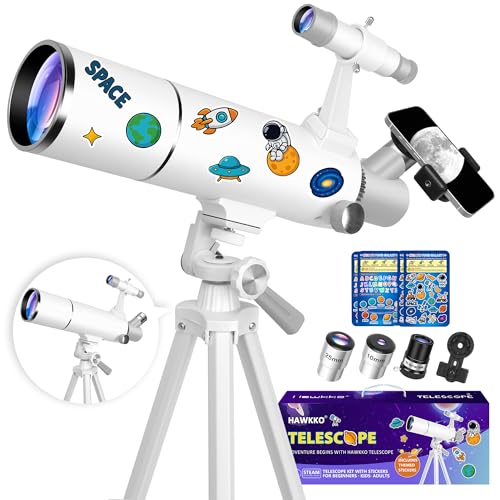
- Bright 80mm multi-coated objective lens
- 20x–150x magnification range
- Includes phone adapter and space stickers
Best For: Families wanting astronomy and daytime viewing in one beginner kit
Best Travel-Friendly Kit

- 70mm coated optics for bright views
- Includes three eyepieces and 3x Barlow
- Wireless remote and phone adapter included
Best For: Portable family viewing with convenient phone and finder accessories
Best Simple Starter

- Designed for children ages 8–12
- 20x–100x beginner magnification range
- Includes tripod, finder scope, and lunar filter
Best For: Young beginners starting hands-on astronomy and STEM exploration
Best Overall
EACONN 80mm Portable Telescope

- 80mm aperture with coated optics
- 30x-66x eyepiece magnification
- Backpack and phone adapter included
Best For: Families seeking a portable beginner telescope for children and adults
Best STEM Toy

- Designed for ages 6-12
- Includes two eyepieces and a Barlow lens
- Encourages hands-on, screen-free learning
Best For: Young beginners who want an educational astronomy activity
Best for Moon and Planet Viewing

- 70mm fully multi-coated optics
- 15x-150x range with Barlow lens
- Phone adapter and star chart included
Best For: Families sharing moon, planet, and daytime observations
Best Travel Telescope – Gskyer 70mm Beginner Telescope
For families seeking telescopes for children that can also support adult beginners, the Gskyer 70mm refractor offers a capable, portable setup. Its coated optics, adjustable tripod, finder scope, phone adapter, and wireless remote make it practical for backyard viewing, travel, and simple celestial photography.
Best For: Older children and beginners who want a portable telescope with smartphone features.
Pros:
- 70mm aperture and 400mm focal length provide a versatile starting point for viewing the Moon and stars.
- Two eyepieces and a 3x Barlow lens offer multiple magnification options.
- Includes an adjustable tripod, carry bag, smartphone adapter, and wireless camera remote.
Cons:
- Manual focusing and an altazimuth mount require hands-on adjustment.
- At 5.7 pounds, it is less lightweight than simpler tabletop models.
This is a strong choice when portability and phone-friendly extras matter as much as basic astronomy. The broader accessory package also gives children more ways to stay engaged as their interest develops.
Best First Telescope – NASA Lunar Telescope for Kids
Among telescopes for children, the NASA Lunar Telescope is a straightforward option focused on moon viewing. It includes a finder scope, two eyepieces, and a tabletop tripod, helping children and parents assemble and use the scope together without an overly complex setup.
Best For: Children ages 8 and up who are especially interested in the Moon and beginner astronomy.
Pros:
- Designed around accessible lunar observation and beginner use.
- Includes low- and high-power eyepieces plus a finder scope for locating and examining the Moon.
- Tabletop tripod and smooth mounting system support steady scanning.
Cons:
- The 25mm objective lens is more limited than the larger-aperture scopes in this roundup.
- The tabletop design may be less flexible for taller users or long-distance outdoor viewing.
Its focused design makes this a sensible introduction for a young space enthusiast rather than a general-purpose family telescope. The NASA branding and educational learning guide add extra appeal for a first astronomy gift.
Best Family Upgrade – MEEZAA 80mm Refractor Telescope
For families comparing telescopes for children with room to grow, the MEEZAA 80mm refractor provides a larger aperture and a broad accessory package. Its 20x–150x magnification range, adjustable tripod, phone adapter, and waterproof backpack support astronomy, daytime nature viewing, and travel.
Best For: Children ages 8–12 and families wanting one portable telescope for shared use.
Pros:
- 80mm aperture and fully multi-coated optics are designed for brighter, sharper images.
- Two eyepieces and a 3x Barlow lens provide a 20x–150x magnification range.
- Includes a finder scope, 45-degree zenith mirror, phone adapter, adjustable tripod, and waterproof backpack.
Cons:
- The larger feature set may require more setup and supervision than a basic children’s scope.
- Manual focus and an altazimuth mount still require user adjustment.
This is the most complete option for families who expect a child’s interest to continue beyond occasional Moon viewing. Its portability and daytime viewing capability make it useful for camping, nature observation, and family projects.
Best Learning Kit – Wow in the World Kids’ Telescope
The Wow in the World Kids’ Telescope combines a simple refractor with guided learning, making it one of the more approachable telescopes for children starting astronomy. Two eyepieces provide 25x and 50x magnification, while the star wheel, illustrated guide, and companion audio content turn observing into a hands-on activity.
Best For: Young children and families who value structured, educational astronomy activities.
Pros:
- Simple 25x and 50x magnification levels are easy for beginners to understand.
- Adjustable tripod extends to 48 inches and includes an altitude adjustment handle.
- Star wheel, illustrated guide, and exclusive audio content add educational support.
Cons:
- Its 25x–50x range is narrower than the higher-magnification options in this roundup.
- The kit does not list a finder scope or phone adapter among its included features.
This model is less about maximizing specifications and more about making the first observing sessions engaging. The guided materials can help children learn what to look for while building confidence with the telescope.
Best Family Stargazing Pick – Hawkko 80mm Telescope
For families comparing telescopes for children, the Hawkko 80mm model offers a bright, flexible setup for viewing the Moon, daytime landscapes, birds, and wildlife. Its adjustable tripod and included phone adapter make it practical for shared backyard or travel use.
Best For: Families wanting a larger-aperture beginner telescope for both astronomy and daytime viewing.
Pros:
- 80mm fully multi-coated lens gathers more light than 70mm models.
- 20x to 150x viewing range with two eyepieces and a 3x Barlow lens.
- Includes smartphone adapter, finderscope, adjustable tripod, and space-themed stickers.
- Designed for quick setup and use by children and adults.
Cons:
- Manual focusing and an altazimuth mount require hands-on adjustment.
- The included accessories may make the kit less compact than simpler starter telescopes.
The Hawkko is a strong choice when clear, brighter views and family-friendly extras matter more than having the smallest travel package.
Best Travel-Friendly Kit – Koolpte 70mm Travel Telescope
The Koolpte 70mm travel refractor is a versatile option among telescopes for children, pairing coated optics with a phone adapter, adjustable tripod, finder scope, and wireless remote. It is suited to Moon watching, landscapes, and portable outdoor sessions.
Best For: Beginners who want a portable telescope with convenient locating and phone-capture accessories.
Pros:
- 70mm aperture and anti-reflection-coated lenses are designed for bright, high-contrast images.
- Three eyepieces and a 3x Barlow lens provide a stated 20x–200x range.
- Adjustable aluminum tripod supports portable use.
- Wireless remote and cross-hair finder scope add convenience for locating and capturing views.
Cons:
- Manual focusing still requires user adjustment.
- The many accessories may require more setup for young beginners.
Choose the Koolpte when portability and included electronics are priorities, especially for families planning outdoor viewing or smartphone photos.
Best Simple Starter – Sobrzy 50mm Kids Telescope
The Sobrzy 50mm telescope keeps the introduction to astronomy straightforward, making it a practical entry among telescopes for children ages 8–12. It includes a tripod, finder scope, two eyepieces, an erecting eyepiece, and a lunar filter for beginner Moon and bright-planet viewing.
Best For: Children ages 8–12 who need a lightweight, easy-to-use STEM starter telescope.
Pros:
- Simple 20x–100x magnification range is suited to introductory observations.
- Complete starter kit includes tripod, finder scope, two eyepieces, and lunar filter.
- Lightweight design supports backyard, camping, and family astronomy use.
- Designed around hands-on STEM learning for children ages 8–12.
Cons:
- Its 50mm aperture gathers less light than the larger 70mm and 80mm options.
- It offers fewer included viewing accessories than the Koolpte kit.
The Sobrzy is a sensible first telescope for a child who benefits from a compact, focused kit rather than a more advanced accessory bundle.
Best Overall – EACONN 80mm Portable Telescope
For families comparing telescopes for children, the EACONN 80mm refractor offers a useful balance of brighter views, portability, and beginner-friendly controls. Its larger aperture, adjustable tripod, finder scope, and phone adapter make it suitable for moon viewing and daytime outdoor observations.
Best For: Families wanting a versatile beginner telescope for children ages 8-12 and adults.
Pros:
- True 80mm aperture and fully coated optics are designed to provide brighter, clearer images.
- Includes two eyepieces offering approximately 30x-66x magnification and a 5×24 finder scope.
- Adjustable tripod, carrying backpack, detailed instructions, and smartphone adapter support portable use.
Cons:
- Manual focusing and rough adjustment may require adult guidance for younger children.
- The included magnification range is more modest than some kits claiming very high power.
This is a strong all-around choice when portability and optical brightness matter more than a toy-focused design. The backpack also makes it practical for camping, travel, and backyard astronomy.
Best STEM Toy – Luzsco 50mm Kids Telescope
The Luzsco 50mm model is one of the more approachable telescopes for children because it emphasizes hands-on setup and screen-free exploration. Designed for ages 6-12, it includes the basic accessories children can assemble and experiment with alongside a parent.
Best For: Young children who need a simple, activity-focused introduction to astronomy.
Pros:
- Designed as an educational STEM toy for children ages 6-12.
- Includes a tripod, finder scope, 6mm and 20mm eyepieces, Barlow lens, and moon filter.
- Hands-on assembly can encourage patience, problem-solving, and independent play.
Cons:
- The 50mm objective lens is smaller than the apertures on the other options here.
- Its fixed mount may offer less positioning flexibility than an adjustable altazimuth mount.
- Manual setup and focusing may still require supervision for younger users.
This kit is best viewed as an introductory learning activity rather than a highly advanced observing instrument. It makes a practical gift for children who enjoy assembling things and exploring science away from screens.
Best for Moon and Planet Viewing – ToyerBee 70mm Refractor
For shoppers seeking telescopes for children that can also serve adults, the ToyerBee 70mm refractor combines a relatively large aperture with a broad advertised 15x-150x range. Its phone adapter, wireless remote, star chart, and lightweight design add useful features for family observing and travel.
Best For: Families interested in moon, Jupiter, star, and daytime viewing with smartphone capture.
Pros:
- 70mm aperture and fully multi-coated optics are designed to maximize light transmission.
- Includes 20mm and 6mm eyepieces plus a 3X Barlow lens for different viewing levels.
- Phone adapter, wireless camera remote, finder scope, tripod, and star chart support family use.
Cons:
- Manual focus and a high advertised magnification range may require careful setup for clear views.
- At 3.5 pounds, it is less lightweight than the smallest children’s kit.
- The supplied notes do not specify an age range or mount type.
This option has the feature set for families that want to move beyond a basic toy telescope. The aperture and included accessories make it appealing for shared moon and planet sessions, while the travel-focused design supports camping and road trips.
How We Picked the Best Telescopes for Children
We focused on beginner-friendly refracting telescopes and astronomy kits suited to children, families, and first-time users. The selection includes models with apertures from 50mm to 80mm, focal lengths ranging from compact travel designs to longer 600mm instruments, and features such as adjustable tripods, finder scopes, phone adapters, carrying cases, star wheels, and educational audio content.
We also considered setup simplicity, portability, stated age guidance, mount design, and the practical usefulness of included accessories. Because very high magnification claims can be misleading, aperture and stability received more weight than the largest number printed on the box.
Quick Comparison
| Best For | What to Look For |
|---|---|
| Young children and first use | Simple controls, sturdy tripod, and educational extras |
| Moon viewing | At least 50mm aperture and a stable mount |
| Family beginners | 70mm to 80mm aperture with interchangeable eyepieces |
| Travel and camping | Compact refractor, carry bag, and quick setup |
| Phone photography | Compatible phone adapter and a steady tripod |
Key Buying Factors for Telescopes for Children
Aperture and Realistic Magnification
Aperture is the diameter of the telescope’s front lens and determines how much light it gathers. A 70mm or 80mm model generally offers a more satisfying beginner experience than a very small instrument, especially for lunar details and brighter planets. Advertised magnification is only useful when the optics and mount can support it; extremely high claims often produce dim, shaky images.
Mount Stability and Ease of Use
Children need a telescope that stays pointed at the target when the focus or direction is adjusted. Look for a tripod with a broad stance and simple controls. A finder scope can make locating the Moon and bright objects easier, while complicated equatorial mounts may be better reserved for older children with adult guidance.
Age, Supervision, and Accessories
Check the manufacturer’s age recommendation, but treat it as a starting point. Younger users benefit from a simple kit, star guide, or audio companion. Older children may appreciate interchangeable eyepieces, a phone adapter, or a longer focal length. Adult supervision is essential, and no telescope should ever be pointed at the Sun without a properly fitted, certified solar filter.
Portability and Storage
A telescope that is easy to carry outside is more likely to be used. Travel cases, lightweight tubes, and quick assembly help families move between a backyard, balcony, campsite, or dark-sky location. Keep optics capped and store the telescope in a dry, protected place.
Who Should Buy Which Telescopes for Children?
Choose an educational kit with a simple tripod and activity materials for a younger child who is discovering astronomy for the first time. A 70mm travel refractor is a strong all-purpose choice for families who want portability and straightforward lunar viewing. Select an 80mm model when clearer, brighter views and room to grow matter more than minimum size.
Older children and family beginners may prefer a longer 500mm or 600mm refractor with a finder scope and multiple eyepieces. If photographing the Moon is part of the plan, prioritize a stable mount and a genuinely compatible phone adapter rather than magnification alone. Whichever model you choose, realistic expectations, patient focusing, and observing from a darker location will have as much impact as the telescope itself.