The right microscope can turn homeschool biology from a textbook lesson into hands-on discovery. These compound microscopes for homeschool span affordable starter kits, flexible student instruments, and more advanced models for serious lab work.
We evaluated the selected options for magnification, optical quality, lighting, stage design, included accessories, and ease of use so you can choose a setup that fits your learner, curriculum, and budget.
Best 10 Compound Microscopes for Homeschool Picks for 2026
Best Complete Starter Kit
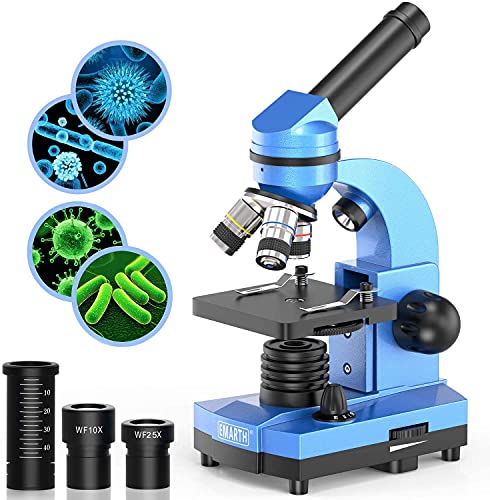
- 40X–1000X magnification
- Dual LED lighting for varied specimens
- 52-piece educational kit
Best For: Homeschool beginners and ages 8–12
Best Durable Cordless Option

- All-metal construction
- Five settings from 40X to 1000X
- AC or three-AA battery operation
Best For: Long-term elementary through high school use
Best High-Magnification Kit

- Six settings up to 2000X
- Dual adjustable LED lighting
- Slides, tools, and phone adapter included
Best For: Older homeschool learners and guided lab work
Research-Ready Choice
SWIFT SW350B Binocular Compound Microscope

- 40X–2500X magnification range
- Binocular head with mechanical stage
- Adjustable LED and Abbe condenser
Best For: Advanced homeschool science and serious hobby use
Beginner-Friendly Value
HUTACT 40X-2000X Compound Microscope

- Achromatic lenses with LED lighting
- Five-piece prepared slide set included
- Lightweight metal body with storage bag
Best For: First-time homeschool microscopy and family science exploration
Comfort-Focused Binocular Pick
Herwicm Dual-LED Compound Microscope

- Wide-angle binocular viewing
- Top and bottom LED illumination
- Coaxial focus and mechanical stage
Best For: Comfortable homeschool observation and beginner biology work
High-Power All-in-One Pick
PalliPartners Compound Microscope

- 100X–2000X magnification range
- 28 included prepared and blank slides
- Dual LED lighting with phone adapter
Best For: Homeschool biology lessons and student science projects
Sturdy Student Starter
BEBANG 2000X Compound Microscope
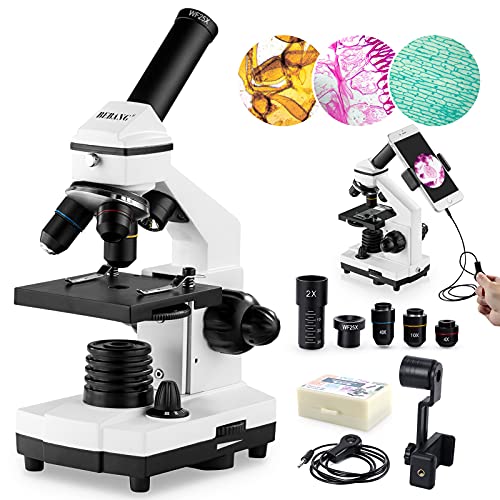
- Six magnification settings up to 2000X
- Metal frame with coarse and fine focus
- Includes slides, carrying bag, and phone adapter
Best For: Beginner biology lessons and one-on-one homeschool instruction
Flexible Dual-Eyepiece Option
Woehrsh Home School Microscope

- WF10X and WF25X eyepieces included
- Dual illumination with six-hole diaphragm
- Swivel head and two power-supply options
Best For: Flexible homeschool labs and portable student observation
Best Complete Starter Kit – Emarth 40X-1000X Microscope
For families comparing compound microscopes for homeschool, the Emarth 40X-1000X model combines a sturdy metal frame, dual LED illumination, and a 52-piece accessory kit. Its broad magnification range and included slides make it a practical starting point for guided biology activities and independent experiments.
Best For: Homeschool students ages 8–12, beginner biology lessons, and hands-on STEM activities.
Pros:
- 40X–1000X magnification with achromatic objective lenses.
- Top and bottom LED illumination supports opaque and translucent specimens.
- 52-piece kit includes prepared slides, blank slides, and experiment tools.
- Metal construction, smooth focusing, and six color filters support beginner use.
Cons:
- Batteries are not included.
- The extensive kit may include more accessories than very young learners need initially.
This is a well-rounded choice when you want a true compound microscope and supplies for immediate homeschool experimentation. The dual-light design adds flexibility, while the metal frame is useful for regular educational use.
Best Durable Cordless Option – AmScope M150C 40X-1000X
The AmScope M150C is a straightforward option for shoppers seeking compound microscopes for homeschool with a durable all-metal body and optical glass lenses. It offers five useful magnification settings and can run from an outlet or three AA batteries, making it suitable for lessons at different workspaces.
Best For: Elementary through high school students who need a durable microscope for ongoing science study.
Pros:
- Five magnification settings from 40X to 1000X.
- All-metal framework is sturdy for regular educational use.
- Optical glass elements and an achromatic objective support clear viewing.
- LED illumination works with the included adapter or three AA batteries.
Cons:
- It includes the microscope but not the larger accessory assortment found in kit-style models.
- The monocular design provides one viewing path rather than binocular viewing.
The M150C emphasizes dependable construction and flexible power rather than a large collection of supplies. It is a sensible fit for families that already have slides and tools or plan to build a homeschool lab gradually.
Best High-Magnification Kit – PALOBIL 100X-2000X Microscope
Families looking for compound microscopes for homeschool with a higher stated maximum magnification may prefer this PALOBIL model. It provides six magnification settings up to 2000X, adjustable top and bottom LED lighting, and a beginner accessory set with prepared and blank slides.
Best For: Older children, adults, and homeschool learners who want flexible lighting and higher-magnification exploration.
Pros:
- Six settings spanning 100X to 2000X.
- Top incident and bottom transmitted lighting handle opaque and translucent specimens.
- Includes prepared slides, blank slides, droppers, tweezers, and a phone adapter.
- Metal frame and adjustable five-color aperture disk support stable, contrast-enhanced viewing.
Cons:
- Batteries are not included, although an AC adapter is included.
- The many settings and accessories may require more instruction for younger beginners.
- The listed warranty is one year.
This model offers the broadest magnification range in the group and useful specimen-lighting flexibility. Its included phone adapter also suits families who want to document observations, while the feature-rich setup may be better for supervised learning.
Best Portable STEM Kit – AmScope M30 120X-1200X
The AmScope M30 is a convenient pick among compound microscopes for homeschool when portability and a complete beginner kit matter. Its six magnification settings, LED lighting, rotating color filter wheel, and hard ABS carrying case support hands-on lessons at home or in different study areas.
Best For: Young learners who benefit from an organized, portable introduction to microscopy.
Pros:
- Six magnification settings from 120X to 1200X.
- 52-piece STEM kit includes sample slides and related accessories.
- Hard ABS case makes storage and transport easier.
- Metal body, LED illumination, and rotating color filter wheel support practical viewing.
Cons:
- The starting magnification is 120X, so it does not offer lower-power viewing.
- The one-year manufacturer warranty is shorter than the warranty listed for the AmScope M150C.
The M30 focuses on ease of entry and organization. The carrying case and included materials make it especially useful for homeschool families that want a ready-to-use science kit without assembling accessories separately.
Research-Ready Choice – SWIFT SW350B Binocular Compound Microscope
For homeschoolers who want a compound microscope that can support advanced slide work, the SWIFT SW350B combines binocular viewing, a mechanical stage, adjustable LED illumination, and magnification options from 40X to 2500X. Its sturdy design and broad feature set make it suitable for progressing beyond introductory observations.
Best For: Homeschool families, high school students, university-level learners, and serious hobbyists who want a versatile lab-style microscope.
Pros:
- Binocular Siedentopf head rotates for shared viewing and has an ergonomic 30-degree tilt.
- Six magnification levels from 40X to 2500X using achromatic objectives and interchangeable 10X and 25X eyepieces.
- Mechanical stage, slide holder, adjustable Abbe condenser, and brightness-controlled LED illumination support precise slide observation.
- Integrated carrying handle makes the 10.7-pound microscope easier to transport.
Cons:
- Its research-oriented features and 10.7-pound weight may be more than younger beginners need.
- It uses an AC adapter, so it is best suited to a dedicated indoor workspace.
The SW350B is a strong long-term option among compound microscopes for homeschool, particularly when students need comfortable binocular viewing and controlled slide positioning. It is a substantial investment in size and capability, but its feature set can accommodate increasingly demanding biology work.
Beginner-Friendly Value – HUTACT 40X-2000X Compound Microscope
For families seeking approachable compound microscopes for homeschool, this HUTACT model offers a straightforward setup with achromatic lenses, LED lighting, and a slide set for immediate exploration. Its metal construction and included storage bag make it a practical starter for children, adults, and beginners.
Best For: Beginning homeschool students, families exploring microscopy together, and science learners who want included slides and storage.
Pros:
- Supports standard magnification combinations from 40X to 1000X, with a stated maximum of 2000X using the included 2X magnifying lens.
- Includes H10X and H25X eyepieces, 4X, 10X, and 40X objectives, and achromatic glass lenses.
- Comes with a five-piece prepared glass slide set, storage bag, and user manual.
- Lightweight metal construction weighs about 0.76 kg and includes LED illumination.
Cons:
- The supplied notes do not describe a mechanical stage or binocular viewing head.
- The 2000X maximum relies on an additional 2X magnifying lens rather than the primary objective combinations alone.
This model is a convenient entry point for homeschool microscopy because the prepared slides let students begin quickly. It is best viewed as a beginner-focused educational microscope rather than a fully equipped laboratory instrument.
Comfort-Focused Binocular Pick – Herwicm Dual-LED Compound Microscope
This Herwicm microscope is a useful choice for homeschool learners who expect longer observation sessions and want binocular viewing. It combines wide-angle eyepieces, dual LED lighting, coaxial coarse and fine focus, and a two-layer mechanical stage for hands-on slide exploration.
Best For: Children, students, adult beginners, and hobbyists who value comfortable binocular observation and flexible lighting.
Pros:
- Ultra-wide-angle binocular eyepieces are designed to provide a broad, clear field of view.
- Dual top and bottom LED lighting supports different observation needs and includes an automatic fill-light design.
- Coaxial coarse and fine focusing controls allow quicker adjustment and more precise focusing.
- Large two-layer mechanical stage includes a spiral moving scale for positioning specimens.
Cons:
- The supplied specifications are inconsistent: the title and bullets state 40X–2500X, while the details list a 40X maximum.
- It is corded electric and may require a dedicated tabletop workspace.
With its binocular design and dual illumination, this model emphasizes viewing comfort and flexibility. Verify the actual magnification configuration before purchase, especially if high-power observation is central to your homeschool curriculum.
High-Power All-in-One Pick – PalliPartners Compound Microscope
For families comparing compound microscopes for homeschool, the PalliPartners model offers broad magnification, dual LED illumination, and a generous slide kit. Its 100X–2000X range and included phone adapter support both guided lessons and independent science projects.
Best For: Homeschool students ages 8–18, biology projects, and families wanting a ready-to-use microscope kit.
Pros:
- Provides six magnification settings from 100X to 2000X using 4X, 10X, and 40X objectives, WF25X eyepiece, and 2X lens.
- Includes 10 prepared slides, 18 blank slides, a phone adapter, Bluetooth shutter, and power adapter.
- Top and bottom LED lighting accommodates opaque objects and translucent specimens.
- Coaxial coarse and fine focus controls support more precise adjustments.
Cons:
- The extensive 2000X range may be more than younger beginners need.
- The included phone adapter is useful for basic documentation but does not replace dedicated imaging equipment.
With its combination of accessories, lighting flexibility, and student-oriented design, this is a practical choice for a homeschool lab that wants room to progress beyond introductory observations.
Sturdy Student Starter – BEBANG 2000X Compound Microscope
This BEBANG microscope is a solid option for compound microscopes for homeschool when a metal frame, adjustable focus, and basic observation accessories matter. It combines six magnification settings with dual illumination for lessons covering cells, plant material, and other specimens.
Best For: Beginners, one-on-one instruction, and homeschool families seeking a metal-framed educational microscope.
Pros:
- Offers six settings from 100X to 2000X with WF25X and 2X options plus 4X, 10X, and 40X objectives.
- Metal construction provides a sturdier platform than lightweight plastic designs.
- Coarse and fine focusing knobs help users refine image clarity.
- Includes a phone adapter, wire shutter, 15-slide set, 10 operating accessories, and carrying bag.
Cons:
- The kit includes fewer slides than some larger all-in-one packages.
- Its 120-volt specification may require attention when used outside compatible electrical systems.
The BEBANG’s straightforward controls and metal frame make it well suited to structured homeschool instruction, especially when portability and a complete starter accessory set are priorities.
Flexible Dual-Eyepiece Option – Woehrsh Home School Microscope
For compound microscopes for homeschool with flexible viewing and travel-friendly features, the Woehrsh model pairs WF10X and WF25X eyepieces with compound objectives. Its swivel head, dual power options, and included lab supplies support varied home-learning setups.
Best For: Families wanting multiple eyepiece choices, adjustable illumination, and a portable student lab kit.
Pros:
- Offers 40X, 100X, 250X, 400X, and 2000X settings with 4X, 10X, and 40X objectives.
- Includes both WF10X and WF25X eyepieces for varied magnification choices.
- Top and bottom lighting, brightness adjustment, and a six-hole diaphragm support different specimen types.
- Features a 360-degree swivel head, coarse and fine coaxial focus, and two power-supply options.
Cons:
- The 3.5-pound weight is heavier than some compact beginner microscopes.
- The broad feature set may require extra setup time for younger users.
This model stands out for homeschoolers who value viewing flexibility and a fuller lab package, particularly if the microscope may be moved between indoor lessons and other observation settings.
How We Picked the Best Compound Microscopes for Homeschool
We focused on the features that matter most in a home learning environment: usable magnification, clear optics, stable construction, straightforward controls, and practical accessories. A high number on the magnification label is not enough by itself, so we considered whether each microscope also provides suitable eyepieces, focusing control, illumination, and a stage that can hold slides securely.
We also considered the likely age range and learning path. Beginner kits can make it easier for children to start examining prepared specimens, while metal-bodied models, binocular viewing, and mechanical stages are better suited to extended biology coursework or students who may continue into advanced science.
Quick Comparison
| Best For | Look For | Why It Matters |
|---|---|---|
| Young beginners | Simple controls and included supplies | Reduces setup time and encourages independent use |
| General homeschool biology | Compound optics, adjustable LED lighting, and a mechanical stage | Supports a wider range of prepared and wet specimens |
| Older students | Binocular viewing, sturdy construction, and multiple eyepieces | Improves comfort and provides room to develop skills |
| Advanced lab work | High-quality glass optics and precise focusing | Helps maintain clarity at higher useful magnifications |
Key Buying Factors for Compound Microscopes for Homeschool
Useful Magnification
Most students can complete a large portion of introductory biology with 40X to 400X magnification. Models advertising 1000X, 2000X, or 2500X may be useful for specific specimens, but maximum magnification is only valuable when the optics and illumination can support a sharp image.
Optics and Viewing Comfort
Glass objectives and eyepieces generally provide a better viewing experience than basic plastic optics. Monocular microscopes are often less expensive and simple to operate. Binocular models can be more comfortable during longer study sessions, particularly for older students and adults.
Lighting and Stage Control
Adjustable LED lighting is practical for homeschool use because it provides consistent illumination and usually runs cool. A mechanical stage is worth prioritizing when students need to scan across a slide smoothly instead of moving it by hand.
Included Accessories
Slides, stains, specimen tools, and carrying cases add value to beginner kits, but inspect the contents carefully. Accessories are helpful for getting started; they should not outweigh the microscope’s optical quality and stability.
Who Should Buy Which Compound Microscopes for Homeschool?
Choose a beginner kit if a child is exploring microscopy for the first time and needs an all-in-one introduction. A straightforward student microscope is a better fit for regular homeschool biology, especially when it includes adjustable lighting and dependable focusing. Older students, pre-med learners, and families sharing one instrument should consider a sturdier model with better optics, a mechanical stage, or binocular viewing. If your homeschool program includes advanced biology or laboratory-style work, prioritize construction quality and optical performance over bundled accessories or impressive maximum-magnification claims.