The best portable multitrack recorders let you capture ideas, rehearsals, interviews, and full productions without carrying a computer-based studio. The right model depends on how many inputs and tracks you need, whether you want built-in microphones, and how much hands-on control you prefer.
We selected 10 options ranging from compact handheld recorders to full digital Portastudios, podcast-focused mixers, and flexible mobile production systems. Use the guide below to narrow the choices by workflow, connectivity, recording quality, and portability.
Best 10 Portable Multitrack Recorders Picks for 2026
Best All-Around Choice

- Four-track recording with built-in X/Y microphones
- Two XLR/TRS inputs plus 1/8-inch mic input
- USB interface, effects, and high-resolution WAV support
Best For: Flexible music, video, and podcast recording
Best Portastudio Workflow

- Eight-track recording with two-channel simultaneous input
- Built-in stereo condenser microphones and instrument connections
- Onboard editing, mastering effects, tuner, and metronome
Best For: Hands-on songwriting and self-contained music production
Best for Modern Mobile Production

- Eight tracks with touchscreen editing and mixing
- Built-in drum loops, FM synths, and MIDI support
- USB-C interface, phantom power, and Hi-Z guitar input
Best For: Computer-free songwriting and mobile arrangement
Best for Large Multitrack Sessions

- Up to 24 tracks for complex recording projects
- Eight XLR inputs for multiple microphones or sources
- Color screen with effects and mastering features
Best For: Bands and project studios needing many inputs
Best Mixer-Recorder for Group Sessions

- Records up to 12 tracks at 24-bit/96kHz
- Four headphone outputs with three monitor mixes
- Simultaneous SD-card and computer recording
Best For: Bands, podcasters, and small live setups
Best for Camera-Mounted Production
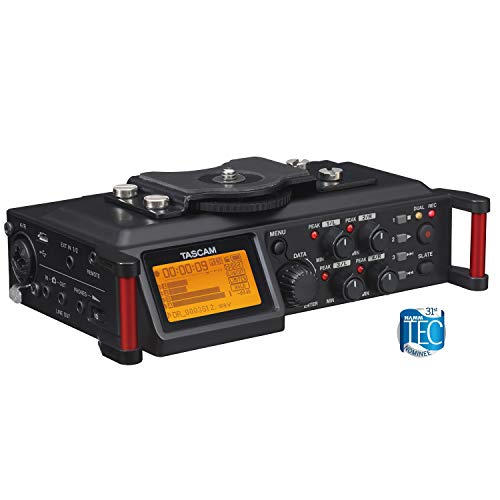
- Four balanced XLR inputs with phantom power
- Mounts above or below a camera
- Dual Recording mode adds a lower-level safety copy
Best For: Videographers, filmmakers, and documentary crews
Best Handheld Option for Flexible Recording

- Four-track recording with stereo mics and two XLR/TRS inputs
- 32-bit float recording for clip-free capture
- USB-C connectivity plus SD-card backup recording
Best For: Mobile musicians, podcasters, filmmakers, and field creators
Compact Track Builder
Tascam DP-004 Digital 4-Track Recorder

- Four-track WAV recording to SD Card media
- Two 1/4-inch mic/line inputs
- Switchable guitar input and USB 2 connection
Best For: Solo musicians and songwriters
Portable Podcast Hub
Zoom PodTrak P4 Podcast Recorder

- Four XLR inputs with phantom power
- Four headphone outputs with individual volume
- Mix-minus for phone and remote interviews
Best For: Podcast teams and interview recordings
Clip-Free Layering Tool

- 32-bit float recording for clip-free capture
- Four-track layering and bounce workflow
- Built-in rhythms plus USB audio-interface mode
Best For: Mobile songwriting and layered music demos
Best All-Around Choice – Zoom H4n Pro 4-Track
The Zoom H4n Pro is a versatile option for shoppers comparing portable multitrack recorders. Its built-in X/Y microphones, four-track recording, two XLR/TRS combo inputs, and battery-powered design suit music, video, and podcast recording away from the studio.
Best For: Musicians, content creators, and podcasters who need flexible recording and USB interface functionality.
Pros:
- Records up to four tracks and supports WAV recording up to 24-bit/96 kHz.
- Includes built-in stereo microphones, two XLR/TRS inputs, and a 1/8-inch mic input.
- Offers onboard effects, tripod or mic-stand mounting, and 2-in/2-out USB interface operation.
Cons:
- Battery life is listed at up to 5.5 hours, or up to 8 hours in Stamina mode.
- Its built-in recording capacity and features may be more than needed for simple voice memos.
The H4n Pro stands out as a portable, adaptable recorder with useful connectivity and built-in processing. It is a strong fit when you want one device for field capture, multitrack work, and computer-based recording.
Best Portastudio Workflow – TASCAM DP-03SD 8-Track
The TASCAM DP-03SD brings a dedicated Portastudio workflow to portable multitrack recorders. It provides eight-track recording, two-channel simultaneous input, built-in stereo condenser microphones, and onboard editing and mastering tools.
Best For: Songwriters and musicians who prefer a self-contained recorder with a familiar multitrack-studio approach.
Pros:
- Provides eight tracks with two-channel simultaneous input.
- Supports condenser microphones through its XLR terminal and guitar or keyboard connections through TRS inputs.
- Includes mastering effects, editing functions, a tuner, and a metronome.
Cons:
- At 5.3 pounds, it is substantially heavier than the other portable options listed.
- Its specifications list a 50-hour battery life but require two AAA batteries.
- Recording is provided in WAV format rather than a broader selection of listed formats.
The DP-03SD is less of a pocket recorder and more of a portable desktop Portastudio. Choose it when hands-on track creation, onboard mastering, and dedicated controls matter more than minimum size.
Best for Modern Mobile Production – Zoom R12 8-Track
The Zoom R12 combines eight-track recording with a touchscreen interface, making it one of the more computer-like portable multitrack recorders in this roundup. It adds onboard editing, effects, drum loops, FM synths, MIDI support, and USB-C connectivity.
Best For: Musicians who want to arrange, edit, and build song ideas without carrying a computer.
Pros:
- Records up to eight tracks and provides DAW-style editing on a full-color touchscreen.
- Includes 150 drum loops, 18 FM synth instruments, and MIDI support.
- Offers 48V phantom power on both inputs, Hi-Z on input 1, and USB-C interface and DAW-control functions.
Cons:
- Battery operation is listed at up to five hours using four AA batteries.
- It has two XLR/TRS combo inputs, which may limit simultaneous source connections.
The R12 is especially appealing for portable songwriting and arrangement. Its touchscreen, rhythm tools, and USB-C features make it a practical bridge between standalone recording and computer-based production.
Best for Large Multitrack Sessions – TASCAM DP-24SD 24-Track
The TASCAM DP-24SD is the high-capacity choice among these portable multitrack recorders. Its 24-track design, eight XLR inputs, onboard effects and mastering, and color screen are aimed at larger recording setups and more involved projects.
Best For: Bands and project studios that need many tracks and multiple microphone inputs in a dedicated recorder.
Pros:
- Provides up to 24 tracks for more expansive recording projects.
- Includes eight XLR inputs for connecting multiple microphones or sources.
- Offers onboard effects, mastering features, and a color screen.
Cons:
- At 13.7 pounds, it is considerably less convenient for casual handheld portability.
- Its listed dimensions are substantially larger than those of compact field recorders.
- The supplied details provide limited information about battery operation and recording controls.
The DP-24SD is best viewed as a portable studio rather than an everyday carry recorder. Its track count and eight XLR inputs make it the logical choice when a project demands substantially more simultaneous sources.
Best Mixer-Recorder for Group Sessions – Zoom LiveTrak L-8
For musicians and podcasters who need a portable multitrack recorder with mixing control, the Zoom LiveTrak L-8 combines eight-channel operation with recording up to 12 tracks simultaneously at 24-bit/96kHz. Its battery-powered design and SD-card recording make it practical for gigs, rehearsals, and mobile sessions.
Best For: Bands, podcasters, and small live or studio setups that need multiple headphone mixes.
Pros:
- Records up to 12 tracks simultaneously at 24-bit/96kHz.
- Six preamps offer up to +54dB of gain and a -121dBu noise floor.
- Four headphone outputs and three independent monitor mixes support performers.
- Can record to an SD card and computer at the same time.
Cons:
- Its mixer-style format is less compact than a handheld recorder.
- Four AA batteries are not listed as the power source; the supplied notes specify battery-powered operation without battery details.
The L-8 is the most capable choice here for multi-person recording and monitoring. Choose it when hands-on mixing and several performer mixes matter more than the smallest possible footprint.
Best for Camera-Mounted Production – TASCAM DR-70D
The TASCAM DR-70D is a portable multitrack recorder designed around filmmaking and production sound. Four balanced XLR inputs with phantom power, built-in microphones, and a camera-mountable body make it a practical option for DSLR shooters, documentarians, and video crews.
Best For: Videographers and filmmakers who need multiple microphone inputs while recording to removable media.
Pros:
- Four balanced XLR mic inputs include phantom power and individual gain controls.
- Can mount above or below a camera.
- Built-in microphones provide an additional on-set recording option.
- Dual Recording mode creates a lower-level safety copy to help prevent distorted takes.
Cons:
- Its four-track capacity is more limited than the LiveTrak L-8.
- It uses four AA batteries and records to SD, SDHC, or SDXC media rather than offering the L-8’s stated simultaneous computer recording.
- The supplied warranty is 90 days labor and one year parts.
The DR-70D prioritizes production-friendly mounting, XLR connectivity, and recording safeguards. It is a strong fit for camera-based work, but less suited to performers who need several independent headphone mixes.
Best Handheld Option for Flexible Recording – Zoom H4 Essential
The Zoom H4 Essential is a compact portable multitrack recorder for musicians, podcasters, filmmakers, and field creators. It combines built-in stereo microphones with two XLR/TRS inputs, 32-bit float recording, and USB-C connectivity for recording or streaming to a phone, tablet, or computer.
Best For: Creators who want a lightweight handheld recorder for music, dialogue, video audio, and live performances.
Pros:
- Supports four-track recording with built-in stereo microphones and two XLR/TRS inputs.
- 32-bit float recording helps capture loud and quiet sources without worrying about distorted takes.
- Records to an SD card while connecting to devices over USB-C.
- Spoken menu guidance can make navigation easier for visually impaired users.
Cons:
- It has fewer external inputs than the TASCAM DR-70D and fewer channels than the LiveTrak L-8.
- Two AA batteries are required, according to the supplied details.
- The product is a handheld recorder rather than a full mixer with multiple custom monitor mixes.
The H4 Essential is the easiest pick when portability and flexible source capture are the priorities. Its 32-bit float workflow and USB-C support add convenience for creators moving between field recording, streaming, and production.
Compact Track Builder – Tascam DP-004 Digital 4-Track Recorder
The Tascam DP-004 is a straightforward option for musicians seeking portable multitrack recorders. It records WAV files to SD Card media and provides two 1/4-inch mic/line inputs, plus a switchable guitar input for basic mobile songwriting and overdubbing.
Best For: Solo musicians and songwriters who want a compact four-track recorder with dedicated instrument connectivity.
Pros:
- Records up to four tracks and saves WAV files to SD Card media.
- Two 1/4-inch mic/line inputs support flexible source connections.
- Switchable guitar input is useful for direct instrument recording.
- USB 2 connectivity supports transfers to a home computer.
Cons:
- Requires four AA batteries.
- Its 1.5-pound weight is less pocketable than smaller handheld recorders.
- It has a 3.5-millimeter headphone jack rather than multiple headphone outputs.
The DP-004 focuses on essential four-track recording rather than podcast-specific features or advanced interface functions. Choose it if simple track layering, guitar input, and SD-based WAV recording are your priorities.
Portable Podcast Hub – Zoom PodTrak P4 Podcast Recorder
The Zoom PodTrak P4 is one of the more specialized portable multitrack recorders for spoken-word production. It combines four XLR microphone inputs with phantom power, four individually controlled headphone outputs, programmable sound pads, and connections for phone or USB-based remote interviews.
Best For: Podcast teams, interviewers, and small panel recordings that need several microphones and separate headphone monitoring.
Pros:
- Four microphone inputs include phantom power for compatible microphones.
- Four headphone outputs have individual volume control.
- Automatic mix-minus supports call-in phone and remote interviews.
- Supports multitrack recording for inputs and sound pads.
Cons:
- Battery life is listed at up to 3.5 hours on two AA batteries.
- Its feature set is more podcast-focused than general music production.
- The compact 2-inch screen may feel limited for detailed editing.
The P4 is a practical choice when multiple hosts or guests need microphones and headphone feeds in a portable setup. Its sound pads, mix-minus functions, and phone connectivity make it especially suitable for interviews and remote conversations.
Clip-Free Layering Tool – Zoom R4 Multi-Track Recorder
The Zoom R4 is a flexible pick among portable multitrack recorders for musicians who want to build arrangements away from a computer. It captures up to four tracks, supports bouncing to a dedicated bounce track, and uses 32-bit float recording to reduce concern about clipping while tracking.
Best For: Musicians and songwriters who want mobile layering, built-in rhythms, effects, and flexible computer or smartphone connectivity.
Pros:
- Records, layers, and bounces up to four tracks with undo support.
- 32-bit float recording is designed for clip-free capture without manual gain adjustments.
- Two XLR/TRS combo inputs accommodate microphones, instruments, and keyboards.
- Includes more than 80 built-in rhythm patterns and works as a 2-in/2-out USB audio interface.
Cons:
- Four AA batteries are required for battery operation.
- Only two physical combo inputs are provided for simultaneous sources.
- The four-track workflow may be limiting for larger arrangements.
The R4 stands out for hands-on composition: record a part, bounce it, and continue adding layers while using rhythms for timing. Its USB-C power and audio-interface modes also make it useful beyond standalone recording.
How We Picked the Best Portable Multitrack Recorders
We compared these Portable Multitrack Recorders by looking at track count, input types, microphone quality, battery operation, portability, monitoring options, onboard effects, storage, and ease of use. We also considered different recording styles, including solo songwriting, band rehearsal, location audio, podcasting, and video production.
A compact handheld unit may be the better choice for quick stereo or overdubbed recordings, while a Portastudio-style recorder makes more sense for hands-on mixing and larger sessions. Podcast mixers were judged more heavily on microphone connectivity, headphone monitoring, remote-call support, and live workflow.
Quick Comparison
| Best For | Look For | Best-Style Option |
|---|---|---|
| Songwriting and overdubs | Built-in microphones, effects, and simple track controls | Compact multitrack recorder |
| Full band recording | Multiple XLR inputs and higher track capacity | Digital Portastudio |
| Podcasting | Several headphone outputs, mic inputs, and remote-call support | Podcast recorder or mixer |
| Filmmaking and location sound | Quiet preamps, limiters, camera connectivity, and reliable battery power | Camera-oriented handheld recorder |
| Live sessions and streaming | Mixing controls, overdub flexibility, effects, and USB connectivity | Portable mixer/recorder |
Key Buying Factors for Portable Multitrack Recorders
Track Count and Inputs
Track count describes how much you can record and mix, but input count determines how many sources you can capture at once. Two combo inputs are sufficient for a singer-songwriter or stereo instrument. Bands, interview panels, and drum setups usually need more XLR inputs.
Microphones and Preamps
Built-in stereo microphones are convenient for rehearsals, ambience, and field recording. For vocals, instruments, and professional dialogue, prioritize clean preamps, phantom power, and compatible XLR inputs. A limiter and high-pass filter are especially useful for unpredictable location audio.
Workflow and Editing
Some recorders emphasize immediate, tactile control, while others offer touchscreen editing, effects, drum patterns, or computer integration. Choose a streamlined interface for capturing ideas quickly, or a larger Portastudio layout if you want to mix without relying on a laptop.
Power, Storage, and Portability
Battery operation matters for outdoor recording and rehearsals, but check expected battery life and whether the device uses standard replaceable cells. Also verify supported SD-card capacity, file formats, USB functions, and the size of the included or required accessories.
Who Should Buy Which Portable Multitrack Recorders?
Songwriters and solo musicians: Choose a compact recorder with built-in microphones, overdubbing, effects, and simple track controls. Bands and home studios: A higher-track Portastudio with several XLR inputs provides more room for simultaneous recording and detailed mixing.
Podcasters: Prioritize multiple headphone outputs, dedicated mic inputs, sound pads, phone or USB connectivity, and easy gain control. Videographers: Look for camera-friendly outputs, limiter and filter controls, quiet preamps, and dependable battery power. Live performers and streamers: A battery-capable mixer/recorder with hands-on faders and USB connectivity can combine recording, monitoring, and live mixing in one setup.