The best digital electronics microscopes make tiny solder joints, circuit traces, components, and surface details easier to inspect on a bright, comfortable screen.
We compared 10 popular models across image quality, magnification, working space, lighting, mounts, recording features, and practical bench usability.
Best 10 Digital Electronics Microscopes Picks for 2026
Versatile Electronics Workbench
Andonstar AD249S-M 3-Lens 2160P Microscope

- Three lenses for soldering, coins, and slides
- 2160P recording with HDMI output
- Adjustable boom arm and included 32GB card
Best For: Multi-purpose electronics repair and close-up inspection
Collector-Friendly Inspection Pick
TOMLOV DM9B 7-Inch Digital Microscope

- Black metal base helps limit glare
- 7-inch screen with adjustable metal stand
- 12MP photos, 1080P video, and flexible lighting
Best For: Coin collecting with occasional PCB and hobby inspection
Complete Soldering Station
Andonstar AD249S-M Plus 3-Lens Microscope

- Expanded soldering area with component storage
- Helping hands, tool holder, and anti-static mat included
- 2160P video, HDMI output, and three lenses
Best For: Dedicated electronics repair and soldering benches
Hands-Free Focus Upgrade
TOMLOV TM4K-AF Flex 4K Microscope

- TOF-assisted autofocus with two preset focus points
- 4K video and 52MP image capture
- 360-degree flex arm with 8-inch screen
Best For: Soldering and PCB inspection with easier focus control
Hands-Free Soldering Pick
5" LCD Digital Soldering Microscope

- C-clamp and flexible arm support two-handed PCB work
- 5-inch IPS display works without a computer
- Manual focus; Micro SD card required for saving
Best For: PCB repair and soldering checks
Advanced 3D Inspection Pick
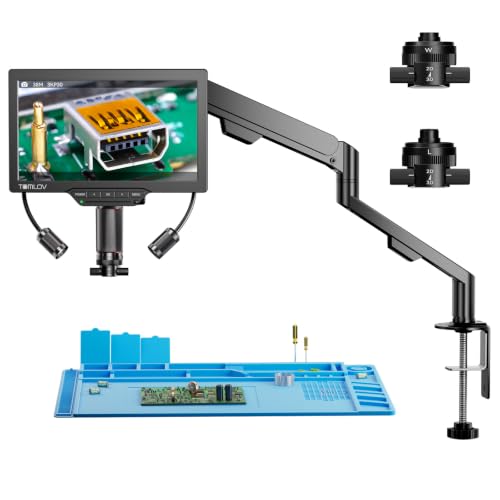
- 3D side-viewing with 360-degree rotation
- Magnetic long-distance and wide-angle lenses
- 3K 7-inch display with HDMI and USB output
Best For: PCB repair requiring angled component views
Versatile Large-Screen Pick
Dcorn 7" 1200X Digital Microscope

- 7-inch display with 1080FHD video and 12MP photos
- Metal stand and adjustable screen support stable viewing
- Eight LEDs plus two adjustable side lights
Best For: Electronics, coins, and general hobby inspection
Versatile Workbench Pick

- 10.1-inch IPS display with 12MP photos
- Adjustable stand and 1cm–26cm working distance
- Three lighting modes plus slide kit
Best For: Multi-purpose electronics repair and coin inspection
High-Resolution Screen Choice

- 20MP photos and 1080p video recording
- 5X–1500X zoom with PC/monitor connection
- 10 adjustable lights and tall 12.6-inch stand
Best For: Detailed inspection, recording, and soldering work
Multi-Lens Pro Pick

- Three interchangeable lenses for varied tasks
- 2160p recording with HDMI output
- Adjustable boom arm and Windows measurement software
Best For: Multi-purpose repair, demonstrations, and advanced hobby use
Versatile Electronics Workbench – Andonstar AD249S-M 3-Lens 2160P Microscope
For shoppers comparing digital electronics microscopes, the Andonstar AD249S-M stands out as a flexible three-lens system for soldering, circuit-board repair, coin viewing, and biological slides. Its 10.1-inch display, 2160P recording, HDMI output, adjustable boom arm, and included accessories make it a practical all-purpose setup.
Best For: Electronics repairers, hobbyists, educators, and users who want one microscope for both soldering and general close-up inspection.
Pros:
- Three interchangeable lenses cover soldering, general viewing, and biological slides.
- 2160P video, HDMI output, photo/video capture, and included 32GB microSD card.
- Adjustable metal boom arm and eight LED brightness levels support detailed bench work.
- Windows measurement software can measure objects and capture images or video.
Cons:
- Changing lenses requires removing and reinstalling screws.
- The broad feature set may be more than needed for users focused only on coin viewing.
The AD249S-M is a strong choice when versatility matters. Its multi-lens design and sturdy adjustable stand make it especially useful for a mixed electronics, repair, and observation workspace.
Collector-Friendly Inspection Pick – TOMLOV DM9B 7-Inch Digital Microscope
Among digital electronics microscopes, the TOMLOV DM9B is geared toward coin inspection while remaining useful for PCB work, jewelry, and other small objects. Its black metal base, 7-inch screen, adjustable stand, and multiple lights provide a stable, comfortable viewing platform for detailed inspection.
Best For: Coin collectors and hobbyists who also need occasional electronics, jewelry, or small-component inspection.
Pros:
- Black metal base helps reduce glare and reflections around the viewing area.
- Built-in 7-inch screen provides a comfortable direct viewing experience.
- 12MP camera, 1080P video, and included 16GB card support documentation.
- Eight LEDs and two flexible gooseneck lights allow adjustable illumination.
Cons:
- Its coin-focused design may be less versatile than a multi-lens microscope.
- The supplied video capability is 1080P rather than 4K or 2160P.
The DM9B makes sense for buyers who prioritize coin details but want a capable secondary tool for small electronics and hands-on projects. Its stable metal stand and flexible lighting are practical strengths for routine inspection.
Complete Soldering Station – Andonstar AD249S-M Plus 3-Lens Microscope
The Andonstar AD249S-M Plus is one of the more complete digital electronics microscopes for a dedicated soldering bench. It combines three lenses, 2160P video, HDMI support, a metal stand, an expanded work area, tool storage, helping hands, and an anti-static mat.
Best For: Electronics repairers who want a microscope and organized soldering workstation in one package.
Pros:
- Lens options support soldering, coins, general objects, and biological slides.
- Extension base increases the soldering area by 230% and adds component storage.
- Includes a tool holder, rotatable soldering helping hands, and anti-static mat.
- 2160P capture, HDMI output, 32GB storage, measurement software, and a two-year warranty.
Cons:
- The larger workstation setup may require more bench space than a basic microscope.
- Lens changes still require removing and installing screws.
The AD249S-M Plus is the better fit for users building a serious repair station rather than seeking a compact viewer. Its added workspace and soldering accessories give it a clear advantage for repeated electronics work.
Hands-Free Focus Upgrade – TOMLOV TM4K-AF Flex 4K Microscope
For buyers seeking digital electronics microscopes with simpler focusing, the TOMLOV TM4K-AF Flex uses autofocus with a TOF sensor and preset focus points. Its 4K video, 52MP images, 8-inch screen, and 360-degree articulating arm make it well suited to soldering, PCB inspection, and uneven subjects.
Best For: Users who want autofocus convenience and a flexible viewing position for precision electronics work.
Pros:
- TOF-assisted autofocus is designed to keep images clear, including with moving subjects.
- P1 and P2 focus presets support quick switching between two observation points.
- 4K video, 52MP images, and an 8-inch 1280 × 800 screen provide detailed viewing.
- 360-degree flex arm allows adjustable positioning for soldering and PCB inspection.
Cons:
- It has a 12-month warranty, shorter than the two-year warranty listed for the Andonstar Plus.
- The supplied notes identify a single microscope configuration rather than interchangeable lenses.
The TM4K-AF Flex is a compelling choice when rapid focus adjustment and a movable arm matter more than a multi-lens kit. It offers a modern, streamlined approach to close-up electronics work.
Hands-Free Soldering Pick – 5" LCD Digital Soldering Microscope
For hands-on electronics work, this digital electronics microscope combines a 5-inch IPS display with a C-clamp and flexible arm. It is designed for inspecting solder joints and other small PCB details without requiring a computer.
Best For: PCB repair, soldering checks, and compact workspaces where keeping both hands free matters.
Pros:
- C-clamp and flexible arm help position the scope while leaving both hands available.
- 5-inch IPS screen is intended to reduce eye and neck strain during longer sessions.
- Connects to Windows or Mac using the built-in Camera or Photo Booth apps, without third-party software.
Cons:
- It is not autofocus; focus and magnification require changing the lens distance and turning the focus wheel.
- A Micro SD card, not included, is required for saving 1080P videos and larger photo batches.
- The compact viewing design is better for micro-details than full-screen views of large objects.
This is a practical choice if your priority is soldering access and a computer-free display. Factor in the manual focusing process and the additional Micro SD card when comparing digital electronics microscopes.
Advanced 3D Inspection Pick – TOMLOV TM3K-3D 7" Microscope
The TOMLOV TM3K-3D stands out among digital electronics microscopes with side-viewing and 360-degree 3D rotation. Its dual magnetic lenses, 3K display, and flexible arm give electronics repair users multiple ways to inspect components and solder joints.
Best For: Detailed PCB repair, micro-soldering, watchmaking, and users who need angled or rotating views.
Pros:
- 3D side-viewing and 360-degree rotation support inspection from multiple angles.
- Magnetic L and W lenses switch without tools; the L lens provides working distance for soldering.
- 7-inch IPS screen offers 3K resolution, with HDMI and USB display options for larger-screen viewing or computer analysis.
- Adjustable LED gooseneck spotlight helps direct illumination and reduce shadows.
Cons:
- The feature-rich design may be more than needed for basic magnified viewing.
- Its supplied notes identify multiple accessories and display options, so setup may involve more components than a simple LCD scope.
Choose this model when viewing angle and workspace flexibility are as important as magnification. The dual-lens system also broadens its usefulness for coins, jewelry, and other objects beyond circuit boards.
Versatile Large-Screen Pick – Dcorn 7" 1200X Digital Microscope
The Dcorn 7-inch digital microscope is a versatile option for electronics inspection, combining a metal stand, 1080FHD video, 12MP photos, and adjustable lighting. It suits shoppers comparing digital electronics microscopes for both soldering and general object inspection.
Best For: Electronics repair, coin viewing, hobby inspection, and users who want a stable stand with a larger built-in screen.
Pros:
- 7-inch display supports up to 1080FHD video and 12MP photos.
- Metal base is designed to reduce shaking, while the screen offers adjustable height and viewing angle.
- Eight built-in LED lights plus two adjustable side lights provide flexible illumination.
- Works with Windows 10 and Mac through default Camera or Photo Booth applications.
Cons:
- Memory card is not included; saving photos and videos requires a TF card up to 64GB.
- Advertised magnification varies with lens-to-object distance and the screen used.
- The wired remote and metal stand may be less convenient if you need a highly portable setup.
This model is a strong all-purpose pick when a large screen, stable base, and flexible lighting matter more than specialized 3D viewing. Its PC compatibility also makes it suitable for sharing or examining images on a larger display.
Versatile Workbench Pick – Andonstar AD210
The Andonstar AD210 is a flexible choice among digital electronics microscopes, combining a large 10.1-inch IPS display with an adjustable metal stand and multiple lighting options. Its generous working distance makes it practical for soldering, coin inspection, and basic slide viewing.
Best For: Electronics repair, coin collecting, and hobbyists who want one microscope for several tasks.
Pros:
- 10.1-inch IPS screen with 178-degree viewing angle, 1080p video, and 12MP photos.
- Adjustable 1cm-to-26cm working distance and a stand reaching up to 12.6 inches.
- Top, side, and bottom LED illumination supports soldering, coins, and biological slides.
- Includes a 32GB memory card, remote control, slide kit, and bottom light stage.
Cons:
- Its broad feature set may be more than needed for a single-purpose electronics workstation.
- The supplied notes do not specify HDMI output or measurement software.
The AD210 stands out for buyers who value workspace flexibility and included accessories. It is a practical all-purpose option, especially when both soldering and non-electronics observations matter.
High-Resolution Screen Choice – TOMLOV DM9 Max
The TOMLOV DM9 Max is one of the more feature-rich digital electronics microscopes for users who want a large built-in display and detailed image capture. Its 5X-to-1500X zoom range, PC/monitor connection, and tall stand suit both inspection and repair work.
Best For: Coin collectors, soldering projects, and users who want high-resolution recording with a comfortable viewing screen.
Pros:
- 10.1-inch IPS display with a 178-degree viewing angle.
- Supports 20MP photos, 1080p video, and recording to the included 16GB microSD card.
- Connects to a computer or monitor for a larger view.
- Eight lens-mounted LEDs and two dimmable gooseneck lights provide adjustable illumination.
Cons:
- It has less storage included than models supplied with a 32GB card.
- The many zoom and recording features may be unnecessary for simple soldering checks.
Choose the DM9 Max if display comfort, documentation, and flexible lighting are priorities. The larger base and 12.6-inch stand also give it useful room for coins and circuit-board work.
Multi-Lens Pro Pick – Andonstar AD246S-M
The Andonstar AD246S-M is a versatile option among digital electronics microscopes, using three interchangeable lenses for soldering, general inspection, and biological slides. Its 2160p recording, HDMI output, and adjustable boom-arm stand make it well suited to larger work areas and demonstrations.
Best For: Experienced hobbyists, electronics repair, education, and users who need different lenses for different subjects.
Pros:
- Three lenses cover circuit-board repair, coins and objects, and biological slides.
- Records in 2160p and supports HDMI output to a larger display.
- Adjustable metal boom arm provides a broad work envelope and suits soldering conditions.
- Windows measurement software supports measuring objects and capturing photos or videos.
Cons:
- Changing lenses adds setup steps compared with fixed-lens microscopes.
- The maximum magnification depends on the lens and display connection rather than being available in every setup.
- The supplied notes specify Windows compatibility for the measurement software.
The AD246S-M is the strongest fit for buyers who want one system that can shift from electronics repair to coins or slides. Its lens range and HDMI capability offer more expansion than a basic screen-only microscope.
How We Picked the Best Digital Electronics Microscopes
We focused on features that matter during real inspection and repair work rather than relying on headline magnification alone. The comparison considers screen size and resolution, camera clarity, focusing performance, working distance, lighting control, stand stability, lens flexibility, and connectivity. We also looked for designs suited to soldering, PCB repair, coin inspection, and general hobby electronics.
Models with adjustable arms, multiple lenses, or more generous working space can be easier to use with tools under the lens. Autofocus and 4K capture may improve convenience and documentation, while HDMI output can provide a larger external display with less delay than some wireless solutions.
Quick Comparison
The 10 microscopes in this roundup cover several useful categories. Large 10.1-inch models are suited to shared benches and extended viewing. Seven- and eight-inch units provide a smaller footprint while retaining a comfortable image. Compact 5-inch designs can work well where space and budget are limited.
- For maximum flexibility: Consider a three-lens system or a dual-lens 3D design.
- For soldering: Prioritize working distance, stand clearance, stable mounting, and controllable illumination.
- For documentation: Look for high-resolution photo and video capture, storage support, and HDMI connectivity.
- For coins and collectibles: A high-resolution sensor, even lighting, and a clear on-screen magnified image are especially useful.
Key Buying Factors for Digital Electronics Microscopes
Image Quality and Display
Resolution affects how clearly you can distinguish fine traces, bridges, scratches, and surface texture. A larger IPS or LCD screen can reduce eye strain, but camera quality and lighting are just as important as the advertised pixel count.
Working Distance and Focus
For electronics work, leave enough room to position tweezers, probes, and a soldering iron beneath the lens. Manual focus can be precise, while autofocus is convenient when the subject height changes. Check whether the stand and lens combination provides usable clearance at your preferred magnification.
Stand, Lighting, and Connectivity
A rigid metal stand helps prevent image shake. Adjustable LED lighting is valuable for reflective components and coins, while side or fill lighting can reveal texture better than a single ring light. HDMI, USB, remote controls, and onboard recording each add convenience depending on your workflow.
Who Should Buy Which Digital Electronics Microscopes?
Choose a multi-lens Andonstar model if you want lens flexibility, a large display, and a versatile bench setup. Choose a TOMLOV autofocus or 3D model if convenience, wider viewing options, or a more natural inspection perspective matters most. Choose a compact 5-inch or 7-inch microscope for occasional repairs, small workspaces, or a lower-cost entry point.
Before buying, measure your bench space and confirm the included stand, power requirements, storage options, and output ports. For frequent soldering, prioritize mechanical stability and working distance over the highest printed magnification figure.