Choosing accurate monitors is only half the challenge: your room can exaggerate bass, create reflections, and make balanced mixes sound wrong elsewhere.
These 10 picks combine nearfield monitors, DSP-equipped speakers, and calibration systems to help you hear more dependable detail at your desk or in a treated studio.
Best 10 Studio Monitors with Room Correction Picks for 2026
Compact ARC Precision

- ARC X room correction and monitor emulation
- 36 Hz–32 kHz response with time alignment
- Flexible tabletop or mic-stand mounting
Best For: Compact home studios and desktop mixing
DSP Monitoring Standard

- Onboard DSP with active 245W amplification
- 5.25-inch woofer and 1-inch tweeter
- XLR, RCA, and 1/4-inch TRS inputs
Best For: Professional nearfield studio monitoring
System-Wide Calibration

- Measurement microphone and correction software included
- Stand-alone processor for compatible monitor setups
- Corrects frequency balance and stereo imaging
Best For: Upgrading existing studio monitors
Room-Tunable 7-Inch Pair

- Manual low- and high-frequency adjustment
- Front-firing port supports flexible placement
- 73W powered, bi-amped Class A/B design
Best For: Larger nearfield monitoring with simple room tuning
Premium Room-Corrected Monitor
IK Multimedia iLoud Precision 6 MKII
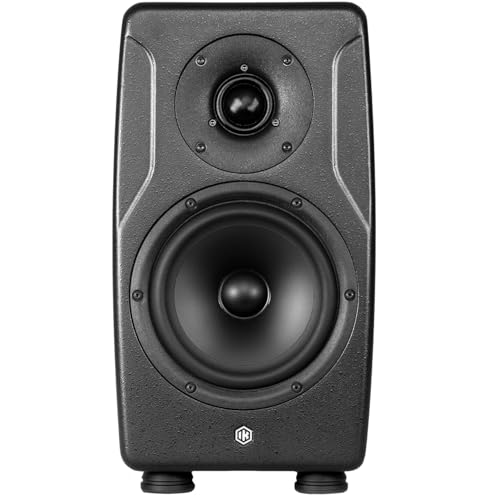
- Built-in ARC room calibration
- Linear-phase, time-coherent monitoring
- ARC X emulation for 20+ systems
Best For: Professional mixing, mastering, and immersive studio setups
Flexible Desktop Pair
M-AUDIO BX5BT 5-inch Studio Monitors
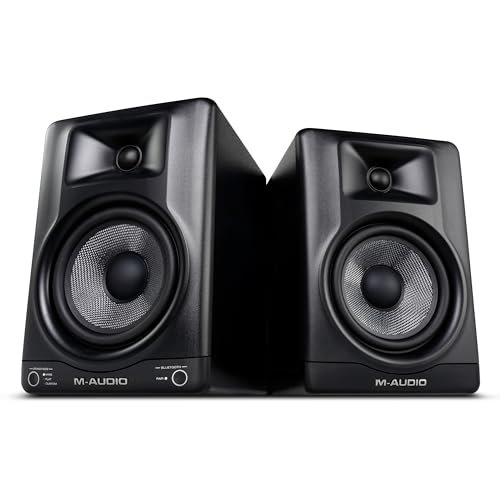
- DSP modes and five-band app EQ
- Bluetooth 5.0 plus TRS inputs
- Compact pair with 240W output
Best For: Desktop music production and content creation
Software Calibration System
IK Multimedia ARC X Room Correction
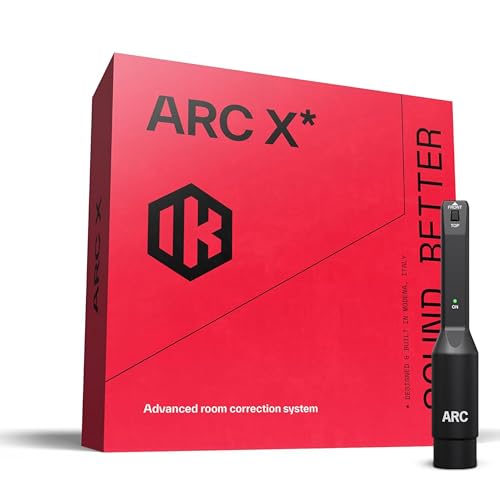
- VRM acoustic measurement and correction
- Works with IK and third-party monitors
- 20+ virtual monitoring references
Best For: Existing monitor setups in home and project studios
Balanced Reference Pick

- Two-monitor bundle with 8-inch woofers
- 38Hz–30kHz stated frequency response
- 120W bi-amped power per monitor
Best For: Home studios and traditional recording setups
Wide-Dispersion Premium Pick
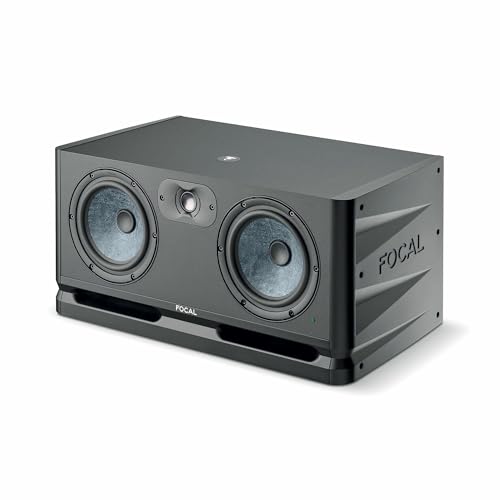
- Wide dispersion for consistent room coverage
- Slatefiber cone targets neutral, low-distortion sound
- XLR, TRS, and RCA inputs support three sources
Best For: Advanced studios needing broad coverage and flexible inputs
High-Power Large-Room Pick

- 8-inch woofer for substantial monitoring output
- 115W powered two-way Class D design
- Pair suited to production, recording, and editing
Best For: Professional and home studios needing powerful 8-inch monitors
Compact ARC Precision – iLoud MTM MKII
The IK Multimedia iLoud MTM MKII is a compact pair of studio monitors with room correction capabilities, making them a practical choice for accurate monitoring in smaller workspaces. Their ARC X technology, time alignment, and wide 36 Hz–32 kHz frequency range support detailed mixing, production, and critical listening.
Best For: Home studios, desktop mixing, podcasting, video editing, and creators who need flexible placement.
Pros:
- ARC X room correction helps optimize response for different rooms and speaker placements.
- Time alignment supports precise imaging and reduced phase distortion.
- Compact design includes tabletop stands and mic-stand mounting options.
- ARC X monitor emulation provides additional reference perspectives.
Cons:
- The supplied notes indicate the ARC microphone may be sold separately for the monitor’s room-calibration function.
- The 3.5-inch monitor design may be less suitable when maximum low-end output is the priority.
Choose the iLoud MTM MKII if space, placement flexibility, and built-in ARC-based correction matter more than using a larger cabinet. It is especially well suited to nearfield desktop monitoring and detailed editing work.
DSP Monitoring Standard – Neumann KH 120 II
The Neumann KH 120 II is a powered studio monitor with onboard DSP and a 5.25-inch woofer, aimed at producers who want controlled nearfield monitoring with digital signal processing. Its 245W active design and multiple wired inputs make it suitable for serious music-production setups.
Best For: Studio monitoring and music production where DSP-equipped, professional nearfield speakers are desired.
Pros:
- Onboard DSP supports digitally managed monitor performance.
- Active 245W design pairs amplification with the 5.25-inch woofer and 1-inch tweeter.
- Offers XLR, RCA, and 1/4-inch TRS connectivity.
- Compact nearfield format fits many desktop or control-room environments.
Cons:
- This listing is for one monitor, so a stereo setup requires two units.
- The supplied notes do not specify an included measurement microphone or dedicated calibration software.
- There is no wireless connectivity.
The KH 120 II is a strong option for buyers prioritizing Neumann’s DSP-equipped monitoring format and flexible wired connections. Verify the full room-correction workflow and accessories needed for your particular setup before buying.
System-Wide Calibration – IK Multimedia ARC Studio
The IK Multimedia ARC Studio is a room-correction system rather than a monitor pair, combining a measurement microphone, calibration software, and a stand-alone correction processor. It is a useful route for turning existing compatible studio monitors into a more balanced monitoring system without replacing the speakers.
Best For: Home and professional studios that already own monitors and want measurement-based acoustic correction.
Pros:
- Includes a high-precision measurement microphone, software, and dedicated correction processor.
- Designed to correct frequency imbalances and improve stereo imaging.
- Works with studio monitors and audio interfaces in a range of studio setups.
- Includes monitor-emulation features for checking mixes against alternate references.
Cons:
- It does not include studio monitors, so it is not a complete monitoring solution by itself.
- It adds another processor and calibration step to the signal chain.
- Compatibility and cabling should be confirmed for the specific interface and monitor setup.
For buyers searching for studio monitors with room correction but already satisfied with their speakers, ARC Studio can be the more flexible upgrade. It focuses on correcting the room and signal path rather than changing the monitor hardware.
Room-Tunable 7-Inch Pair – KRK Classic 7
The KRK Classic 7 is a pair of powered two-way studio monitors with manual low- and high-frequency controls for adapting the response to room acoustics. While it does not provide automated room correction, its front-firing ports and adjustable controls offer practical flexibility for placement and basic room matching.
Best For: Producers who want larger 7-inch monitors with straightforward manual response adjustment.
Pros:
- Dedicated low- and high-frequency controls help tailor the response to the room.
- Front-firing ports allow more flexible placement near walls than rear-ported designs.
- 73W self-powered monitors use matched amplification with the drivers.
- Bi-amped Class A/B amplifiers provide headroom and low distortion.
Cons:
- Room adjustment is manual rather than measurement-based or automated.
- The 7-inch cabinets may require more desk or stand space than compact monitors.
- They do not include a dedicated calibration microphone or correction software.
The Classic 7 is best viewed as a practical alternative to fully automated studio monitors with room correction. Choose it when cabinet size, front-port placement, and simple onboard tuning are more important than software-guided calibration.
Premium Room-Corrected Monitor – IK Multimedia iLoud Precision 6 MKII
The IK Multimedia iLoud Precision 6 MKII is a strong choice for anyone seeking studio monitors with room correction built in. Its ARC System calibration, linear-phase design, and 6.5-inch woofer are aimed at accurate mixing, mastering, and immersive audio work.
Best For: Professional studios, stereo mixing, mastering, and Atmos or surround setups.
Pros:
- Integrated ARC calibration analyzes the room and adjusts the monitor for a more neutral response.
- True linear-phase and time-coherent design supports detailed, balanced monitoring.
- ARC X adds target curves, voicing controls, and emulation of more than 20 monitor and consumer systems.
- 150W Class-D amplification, mounting options, and low-frequency management suit advanced studio installations.
Cons:
- Its professional feature set may be more than needed for casual desktop listening.
- Room-correction and virtual-monitoring features require setup with the measurement mic and ARC X software.
- Sold as a single monitor rather than a pair.
Choose this model when translation accuracy and integrated calibration matter more than simplicity. The combination of ARC correction, extended low-end response, and virtual monitoring makes it particularly versatile for serious production environments.
Flexible Desktop Pair – M-AUDIO BX5BT 5-inch Studio Monitors
The M-AUDIO BX5BT offers a compact, accessible route to studio monitors with room correction features. Its DSP modes, five-band EQ, custom presets, and app control let creators adapt the sound to a desktop workspace or personal listening preference.
Best For: Home producers, video editors, podcasters, streamers, and desktop setups that need Bluetooth.
Pros:
- DSP crossover and FLAT, HYPE, and CUSTOM modes support different monitoring preferences.
- Studio Control App provides five-band EQ adjustment and saved custom presets.
- Includes a 5-inch Kevlar woofer, 1-inch silk-dome tweeter, and 240W of bi-amplified power.
- Bluetooth 5.0 offers wireless playback with a stated range of up to 100 feet, alongside TRS inputs.
Cons:
- Its DSP tuning is less specialized than dedicated acoustic measurement systems.
- Five-inch drivers provide a more compact solution than larger professional monitors.
- Bluetooth and HYPE modes may be less appropriate when strictly neutral monitoring is required.
The BX5BT is best viewed as a flexible desktop pair rather than a full acoustic-calibration platform. It makes practical sense for creators who want adjustable DSP, app-based EQ, and convenient Bluetooth in a compact setup.
Software Calibration System – IK Multimedia ARC X Room Correction
IK Multimedia ARC X is a useful alternative for buyers who already have monitors and want studio monitors with room correction through a calibration system. It combines a supplied measurement mic, VRM acoustic analysis, monitor calibration, and virtual monitoring in a flexible software-based workflow.
Best For: Home and project studios using IK or third-party monitors that need measurable room correction and monitor emulation.
Pros:
- VRM measurement analyzes room response and applies phase-coherent correction.
- Supports real-time on-speaker calibration or DAW-based correction through the ARC X plug-in.
- Emulates more than 20 studio monitors, consumer speakers, and mobile devices.
- Includes guided one-, three-, seven-, or 21-point scans plus nine target curves and adjustable correction ranges.
Cons:
- It is a calibration system rather than a complete pair of physical studio monitors.
- Requires measurement and software setup before the correction profiles can be used.
- Its benefits depend on compatible monitoring hardware and a suitable studio workflow.
ARC X is the most adaptable option here for upgrading an existing monitoring chain. Its measurement mic, customizable target curves, and virtual reference systems can help improve consistency without replacing the speakers already in the room.
Balanced Reference Pick – Yamaha HS8
The Yamaha HS8 is a practical choice for anyone seeking studio monitors with room correction potential. Its 8-inch woofer, 1-inch tweeter, and separate LF/HF amplification provide a capable foundation for accurate studio recording, while the wired XLR connection suits traditional setups.
Best For: Home studios and recording setups that need a powerful, conventional monitor pair.
Pros:
- Pair includes two powered monitors.
- 38Hz–30kHz stated frequency response.
- 120W bi-amped power per monitor, with 75W LF and 45W HF amplification.
- 8-inch woofer and 1-inch dome tweeter support full-range monitoring.
Cons:
- Large and heavy pair at a listed 56 pounds.
- XLR cables are not included.
- No dedicated room-correction feature is listed, so correction may require separate software or hardware.
The HS8 is a straightforward, high-output monitoring solution. If your room needs correction, pair it with an appropriate calibration system rather than expecting built-in correction from the monitor itself.
Wide-Dispersion Premium Pick – Focal Alpha-Twin-EVO
The Focal Alpha-Twin-EVO is designed for listeners who want studio monitors with room correction flexibility and consistent coverage across a workspace. Its wide dispersion, Slatefiber cone, and 2.5-way active design are aimed at maintaining a neutral presentation from multiple listening positions.
Best For: Professional or advanced studio users who value wide listening coverage and multiple wired inputs.
Pros:
- Wide dispersion helps maintain a consistent sound throughout the room.
- Slatefiber cone is designed for neutrality and low distortion.
- Connects up to three audio sources through XLR, TRS, and RCA inputs.
- 130W maximum output supports dynamic monitoring.
Cons:
- Sold as one monitor rather than a pair.
- Its 6.5-inch woofer may provide less low-end reach than larger monitors.
- No built-in room-correction system is listed.
The Alpha-Twin-EVO stands out for room-wide consistency and connection flexibility. For a stereo setup, plan to purchase a second monitor, then add separate calibration software or hardware if room correction is required.
High-Power Large-Room Pick – Focal Alpha 80 Evo
The Focal Alpha 80 Evo is a strong candidate for studio monitors with room correction when you want substantial output from an 8-inch two-way design. Its 115W powered configuration, Class D bi-amplification, and 1-inch tweeter suit professional production, recording, and editing environments.
Best For: Professional and home studios that need a powerful 8-inch monitor for production or editing.
Pros:
- 8-inch woofer provides a larger monitoring platform.
- 115W powered two-way design with Class D bi-amplification.
- Listed uses include professional audio production, recording, and editing.
- Sold as a pair according to the supplied product details.
Cons:
- Large 8-inch monitors may be more demanding in a small room.
- Only TRS connectivity is specifically listed in the details.
- No integrated room-correction feature is listed.
The Alpha 80 Evo offers the output and driver size suited to demanding monitoring work. Because its supplied specifications do not identify built-in correction, use external calibration to address room-related frequency problems.
How We Picked the Best Studio Monitors with Room Correction
We focused on products that either include built-in DSP room correction or work as part of a practical calibration workflow. The selection spans compact desktop monitors, larger nearfield speakers, standalone correction systems, and budget-friendly options that can benefit from external measurement and calibration.
We considered correction capability, measurement-microphone support, frequency response, amplifier power, driver size, connection options, placement flexibility, and suitability for music production, mixing, editing, and general critical listening. Because room correction cannot fix every acoustic problem, we also weighed whether each product makes sense alongside basic treatment and careful monitor positioning.
Quick Comparison
| Best For | Recommended Type | What to Prioritize |
|---|---|---|
| Small desks and untreated rooms | Compact DSP monitor or calibration system | Low-frequency control, boundary settings, and easy setup |
| Professional nearfield mixing | DSP-equipped 5- to 8-inch monitor | Neutral response, headroom, and dependable stereo imaging |
| Flexible speaker upgrades | Standalone room-correction hardware or software | Broad compatibility and a reliable measurement microphone |
| Budget-conscious production | Conventional powered monitor pair | Placement, acoustic treatment, and future calibration options |
Key Buying Factors for Studio Monitors with Room Correction
Built-In DSP Versus Standalone Calibration
Built-in correction is convenient because the monitor can apply its profile directly, often with fewer software dependencies. Standalone systems are more flexible and may work with multiple speakers, headphones, or future upgrades. Check whether the correction solution requires a computer, compatible software, or a specific microphone.
Room Size and Listening Distance
Five- and six-inch monitors are often easier to place in compact rooms, while larger eight-inch models can provide more bass extension and output. Bigger is not automatically better: excessive low-frequency energy can make an untreated room harder to manage. Choose a speaker that suits your listening distance and available space.
Placement and Acoustic Treatment
Room correction works best after you position the speakers symmetrically, form an equilateral listening triangle, and reduce major reflections. It can smooth frequency imbalances, but it cannot fully repair strong flutter echo, severe nulls, rattling surfaces, or poor speaker placement.
Connections, Controls, and Emulation Features
Confirm the required inputs, balanced connectivity, desktop controls, standby behavior, and mounting options. Speaker-emulation modes can be useful for checking translation, but a neutral, trustworthy primary response should remain the priority for mixing.
Who Should Buy Which Studio Monitors with Room Correction?
Choose a compact DSP monitor such as the iLoud MTM MKII if you work at a small desk or need correction without adding much hardware. A higher-end DSP model such as the Neumann KH 120 II or iLoud Precision 6 MKII is better suited to demanding mixing where imaging, headroom, and tonal consistency matter.
Choose a standalone ARC system if you already own monitors you like and want a flexible correction path. Traditional options such as the KRK Classic 7, M-Audio BX5BT, Yamaha HS8, or Focal Alpha models can still be strong choices when paired with appropriate placement, treatment, and calibration. The right pick is the one that fits your room, listening distance, workflow, and upgrade plans—not simply the model with the largest woofer.