Choosing the right 3D scanner can make the difference between a frustrating workflow and clean, usable scans ready for printing or CAD work.
Below, we break down the best options for creators, hobbyists, and professionals based on accuracy, speed, tracking, portability, and overall value.
Best 10 3d Scanners Picks for 2026
Industrial Precision Choice
Revopoint MetroY Ultra 3D Scanner

- 0.01 mm single-frame precision
- Five scanning modes for varied parts
- Wi-Fi 6 and 5500 mAh battery grip
Best For: Reverse engineering and inspection of detailed parts
Color Scanning Pick
Creality Otter Lite Basic 3D Scanner

- 0.05 mm accuracy at up to 30 fps
- 24-bit color texture with RGB camera
- Scans dark and metallic surfaces without spray
Best For: Full-color scanning for mixed-size objects
AI Workflow Upgrade
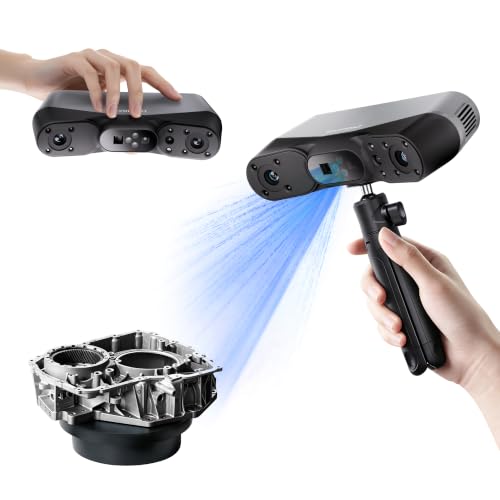
- 0.03 mm accuracy for fine-detail capture
- AI segmentation helps clean up scans
- Five modes cover small parts to large scenes
Best For: Detailed scanning with AI-assisted cleanup
High-Detail Hybrid Pick
Creality CR-Scan Raptor 3D Scanner

- Up to 0.02 mm accuracy
- Blue laser and NIR scanning modes
- Handles 5 mm to 2000 mm objects
Best For: Precise scanning across a very wide object range
Premium Accuracy Pick
High-Accuracy 3D Scanner for Mixed-Surface Work

- 0.03 mm single-frame accuracy
- Five scan modes for varied objects
- AI segmentation and photorealistic output
Best For: Detailed scanning for 3D printing and reverse engineering
Wireless Precision Pick
Wireless Blue-Laser 3D Scanner

- Up to 0.02 mm lab accuracy
- 60 FPS scanning with Scan Bridge
- Full-color capture with marker alignment
Best For: Fast, detailed scanning with wireless convenience
Portable Workflow Pick
Lightweight Outdoor 3D Scanner

- Only 190 g for easy portability
- Dual scan modes with WiFi 6.0
- Up to 0.05 mm accuracy and color capture
Best For: Portable scanning for mixed surfaces and outdoor use
Beginner-Friendly Precision
3DMakerpro Moose Lite Premium Handheld Scanner
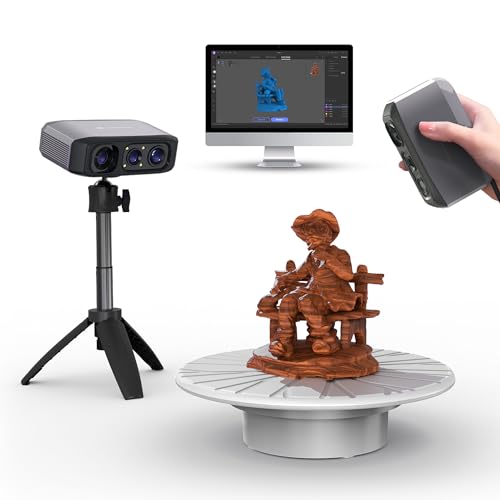
- 0.05 mm precision for detailed scans
- AI tracking and anti-shake help beginners
- Marker-free workflow with free OTA software
Best For: Beginners who want a simple handheld scanner for 3D printing
All-in-One Metrology Scanner
Revopoint MIRACO Plus 3D Scanner

- Photogrammetric kit supports measurement accuracy
- 0.04 mm single-point cloud accuracy
- Built-in screen, storage, and wireless transfer
Best For: Portable users who need accurate scanning and photogrammetry
Wireless Speed Pick
Creality CR-Scan Ferret Pro 3D Scanner

- 0.1 mm accuracy with 30 FPS scanning
- WiFi 6 bridge for faster wireless transfer
- Anti-shake tracking improves handheld stability
Best For: Mobile scanning with wireless convenience and broad device support
Industrial Precision Choice – Revopoint MetroY Ultra 3D Scanner
If you need 3d scanners for tight-tolerance parts, the Revopoint MetroY Ultra is built for accurate capture of small to medium objects with multiple laser and structured-light modes. It focuses on industrial workflows like reverse engineering, inspection, and 3D printing, while also offering wireless operation and outdoor scanning support.
Best For: Reverse engineering, inspection, and high-detail scanning of industrial parts
Pros:
- Up to 0.01 mm single-frame precision and 0.015 + 0.04 mm x L(m) volumetric accuracy
- Five scanning modes, including 34 laser cross-lines, parallel lines, single-line, structured light, and turntable scanning
- Scans dark, shiny, and metallic parts without spray, and works outdoors up to 100,000 lux
- Wi-Fi 6 and a 5500 mAh battery grip support flexible field use
Cons:
- Requires relatively powerful Windows or Mac hardware for best performance
- Best suited to small and medium objects rather than very large items
Overall, this is a strong pick if you want a feature-rich 3d scanner that emphasizes accuracy, speed, and industrial versatility. It is especially compelling for users who need reliable results on difficult surfaces and in real-world working conditions.
Color Scanning Pick – Creality Otter Lite Basic 3D Scanner
The Creality Otter Lite Basic is a practical choice among 3d scanners if you want a handheld model that balances accuracy, speed, and full-color capture. Its quad-camera design helps it handle everything from small objects to larger items, and the no-spray workflow is useful for dark or metallic surfaces.
Best For: Full-color scanning of objects ranging from small parts to large props
Pros:
- Up to 0.05 mm accuracy with 30 fps scanning
- Quad-camera system covers objects from 0.8 inches to 78 inches
- No spray needed for black and metallic surfaces
- Captures 24-bit color texture with RGB camera and fill lights
Cons:
- Outdoor scanning is rated to 30,000 lux, lower than some industrial-focused scanners
- Optional Scan Bridge handle is sold separately
For buyers who want a flexible handheld 3d scanner with realistic color output, this model covers a wide range of uses without much setup friction. It is a strong general-purpose option for printing, prototyping, and visual presentation work.
AI Workflow Upgrade – Revopoint POP 4 3D Scanner
If you want 3d scanners that combine precision with smarter post-processing, the Revopoint POP 4 is designed for detailed modeling and efficient workflow management. It supports multiple scan modes, high frame rates, and AI segmentation to help keep scans clean and easier to process.
Best For: Users who want high-detail scanning with AI-assisted cleanup and photorealistic results
Pros:
- Up to 0.03 mm single-frame accuracy and 0.03 mm + 0.05 mm x L(m) volumetric accuracy
- Five scanning modes for small parts, dark objects, reflective surfaces, and larger scenes
- AI object segmentation helps isolate the subject and reduce background noise
- Wi-Fi 6 and a 5500 mAh battery grip support wireless outdoor scanning
Cons:
- AI object segmentation is Windows only
- Best results may require stronger GPU-accelerated hardware for top scan speed
The POP 4 stands out for buyers who want more than basic capture from a 3d scanner. Between its AI tools, multi-mode flexibility, and support for photorealistic outputs, it fits well into creative and technical workflows alike.
High-Detail Hybrid Pick – Creality CR-Scan Raptor 3D Scanner
The Creality CR-Scan Raptor is a capable option if you want 3d scanners that combine blue laser precision with infrared flexibility. It is built for users who need a wide size range, fast capture, and accurate results on everything from small components to large objects.
Best For: Precision scanning across very small and very large objects
Pros:
- Up to 0.02 mm accuracy with 7 parallel blue laser lines
- 2-in-1 blue light and NIR scanning expands use cases
- Scans objects from 5 mm to 2000 mm, covering a broad size range
- Blue light mode reaches up to 60 fps for fast capture
Cons:
- Requires a high-performance PC, especially for Windows systems
- Class 1 blue light still requires avoiding direct eye exposure
This is a strong fit for buyers who want a serious 3d scanner with precision first, flexibility second. Its hybrid scanning setup makes it useful for both fine-detail work and broader capture scenarios.
Premium Accuracy Pick – High-Accuracy 3D Scanner for Mixed-Surface Work
If you want one of the more capable 3d scanners for detailed modeling, the Revopoint POP 4 is built around precision, speed, and flexibility. It combines multi-mode scanning with strong accuracy claims, fast frame rates, and AI-assisted cleanup, making it a practical pick for 3D printing, reverse engineering, and larger workflow-heavy projects.
Best For: Users who need high-accuracy scanning across small parts, reflective surfaces, and larger objects.
Pros:
- Single-frame accuracy up to 0.03 mm and volumetric accuracy of 0.03 mm + 0.05 mm x L(m)
- Five scanning modes, including structured light, multi-line laser, and deep-hole single-line capture
- Handles small objects from 10x10x10 mm up to large items as big as 2x2x2 m
- AI object segmentation and photorealistic splat output help streamline post-processing
Cons:
- Outdoor filter and battery grip are sold separately
- AI object segmentation is Windows only
- Some advanced workflows may be more than casual users need
Overall, the POP 4 is the most feature-packed option here if you need a scanner that can move between indoor and outdoor work, detailed small parts, and broad object sizes without giving up precision.
Wireless Precision Pick – Wireless Blue-Laser 3D Scanner
The Creality Raptor Pro stands out among 3d scanners if you want high precision plus wireless convenience. It pairs Scan Bridge wireless scanning with blue laser lines, fast frame rates, and full-color capture, which makes it a strong fit for users who want detailed scans with less cable clutter.
Best For: Buyers who want a fast, high-precision scanner with wireless flexibility.
Pros:
- Up to 0.02 mm accuracy in laboratory conditions
- Scans at up to 60 FPS and 660,000 points per second
- Wireless scanning support via Scan Bridge adds convenience
- Marker-based alignment and full-color scanning improve workflow and realism
Cons:
- Large package and 12.17 lb weight make it less portable than lightweight handheld options
- Maximum accuracy depends on laboratory conditions
- May be more scanner than casual hobbyists need
For users focused on speed, detail, and wireless operation, the Raptor Pro is a capable choice that balances precision with a more flexible scanning setup.
Portable Workflow Pick – Lightweight Outdoor 3D Scanner
If portability matters in your search for 3d scanners, the Revopoint INSPIRE 2 is designed to stay light while still covering a lot of use cases. With WiFi 6.0, dual scanning modules, outdoor support, and full-color texture capture, it suits users who want a versatile scanner for 3D printing, heritage work, and product design.
Best For: Users who want a lightweight scanner for portable scanning and mixed-material objects.
Pros:
- Only 190 g, making it easy to carry and set up
- Infrared structured light plus multi-line laser modes for different surfaces and environments
- Up to 0.05 mm accuracy and 0.03 mm precision for detailed models
- WiFi 6.0, mobile streaming, and built-in RGB color capture improve flexibility
Cons:
- Outdoor scanning is rated up to 20,000 lux, so it is best for shaded or semi-bright conditions
- Revo Design is sold separately and is Windows only
- Advanced workflow features may require more setup than simpler scanners
As a lightweight, feature-rich option, the INSPIRE 2 is well suited to users who need portability without giving up useful scanning modes or color capture.
Beginner-Friendly Precision – 3DMakerpro Moose Lite Premium Handheld Scanner
If you’re comparing 3d scanners for 3D printing and want something that feels approachable right away, the 3DMakerpro Moose Lite Premium is built around ease of use. Its AI visual tracking, anti-shake module, and marker-free workflow are aimed at making scanning smoother for beginners while still targeting fine detail with 0.05 mm precision.
Best For: Beginners and hobbyists who want marker-free handheld scanning with simple recovery features.
Pros:
- AI visual tracking helps detect issues and supports automated model repair.
- Anti-shake module and re-scanning make interrupted sessions easier to recover.
- Marker-free scanning reduces setup time and keeps the workflow simple.
- JMStudio includes lifetime free OTA software upgrades.
Cons:
- At 3.65 pounds, it is not the lightest option in this group.
- 10 FPS scanning is slower than some faster handheld competitors.
Overall, this is a practical pick if you want a user-friendly handheld scanner that prioritizes stability and convenience over raw speed. It makes the most sense for straightforward scanning tasks where setup simplicity matters.
All-in-One Metrology Scanner – Revopoint MIRACO Plus 3D ScannerThe Revopoint MIRACO Plus stands out among 3d scanners if you need an all-in-one system that can handle both small details and larger objects. Its photogrammetric metrology kit, 0.04 mm single-point cloud accuracy, and dual scan modes make it a versatile choice for users who care about measurement workflow as much as scanning.
Best For: Users who need portable, high-accuracy scanning with photogrammetric measurement support.
Pros:
- Photogrammetric kit supports precise length accuracy for large-object measurement.
- Quad depth camera system and near/far modes cover tiny parts and larger surfaces.
- 48MP RGB camera and flash LEDs improve color capture and model realism.
- Built-in processor, 32GB RAM, and 256GB storage support an all-in-one workflow.
Cons:
- Revo Design scan-to-CAD software is sold separately.
- The software note indicates compatibility limits for the photogrammetric workflow.
- Two-hour battery life may be restrictive for longer field sessions.
This is the most workflow-heavy option here, aimed at users who want scanning, capture, and processing in one portable device. It is especially compelling when measurement accuracy and format flexibility matter.
Wireless Speed Pick – Creality CR-Scan Ferret Pro 3D Scanner
If you want 3d scanners with strong mobility and quick setup, the Creality CR-Scan Ferret Pro is built for wireless handheld scanning. It combines 0.1 mm accuracy, 30 FPS capture, WiFi 6 transmission, and anti-shake tracking to make scanning smoother across a range of compatible devices.
Best For: Mobile users who want fast wireless scanning for printing and reverse engineering.
Pros:
- WiFi 6 bridge offers faster wireless transmission than WiFi 5.
- 30 FPS scanning and 0.1 mm accuracy support detailed captures.
- Anti-shake tracking and one-shot imaging help maintain stable scans.
- Works with iOS, Android, Windows, and compatible Mac systems.
Cons:
- Reflective, transparent, and very dark surfaces are not ideal.
- Requires fairly specific device and OS compatibility for each platform.
- Performance depends on having the right app and hardware support.
For buyers who value portability and wireless convenience, this is a strong everyday handheld scanner. It is especially appealing if you want fast model capture without being tied to a cable-heavy workflow.
How We Picked These 3d Scanners
We focused on the features that matter most in real-world use: accuracy, tracking stability, scan speed, object-size range, color capture, portability, and software support. For buyers comparing 3d Scanners, the best choice is usually the one that matches your workflow, not the one with the highest headline specs.
We also looked for models that cover different use cases, from compact handheld scanners for tabletop objects to higher-precision systems for detailed parts and larger items.
Quick Comparison
As a general rule, choose a high-precision laser scanner if detail is your priority, a portable all-in-one model if convenience matters most, and a budget-friendly handheld scanner if you are learning or scanning simpler objects. Wireless or AI-assisted models can save time, but they are most useful when their software is polished and easy to use.
Key Buying Factors for 3d Scanners
Accuracy and Resolution
Higher accuracy helps when you need tight-fitting prints, reverse engineering, or mechanical parts. If you mainly scan figurines, props, or larger objects for visualization, you may not need the most expensive option.
Tracking and Stability
Good tracking reduces drift, gaps, and rescans. Features like anti-shake tracking, structured-light guidance, and multi-camera systems are especially helpful for handheld scanning.
Scan Speed and Workflow
Faster scan speeds can reduce motion artifacts and make large projects easier, but speed should not come at the expense of stability. Look for a balance of fps, ease of use, and reliable software tools.
Color, Lighting, and Surface Handling
If you need realistic textures for presentation or archival work, 24-bit or full-color scanning is worth prioritizing. Very shiny, black, or transparent surfaces may still need preparation, depending on the scanner and lighting.
Portability and Power
Some 3d Scanners are better for desktop setups, while others are designed for field use, outdoor scans, or all-in-one workflows. Battery life, wireless support, and phone compatibility can matter as much as raw performance.
Who Should Buy Which 3d Scanners?
Beginners should look for simpler, more forgiving scanners with solid software and stable tracking. Makers and 3D printing users often benefit from balanced midrange models that offer enough accuracy without a steep learning curve. Professionals and advanced users should prioritize precision, better object-size flexibility, and features that fit reverse engineering or inspection tasks.
If you want the most practical advice, start by matching the scanner to your typical object size, the level of detail you need, and how much time you want to spend cleaning up scans afterward.