Finding a capable astronomy camera does not require a four-figure budget. The best astronomy cameras under $300 can make it easier to capture the Moon, planets, and bright deep-sky targets while offering useful features such as USB connectivity, wireless viewing, or built-in screens.
This roundup compares 10 affordable telescope cameras across resolution, sensor design, connection options, compatibility, and ease of use. Whether you want a simple electronic eyepiece or more control for planetary imaging, these options cover several common observing setups.
Best 10 Astronomy Cameras Under 300 Picks for 2026
High-Resolution Pick
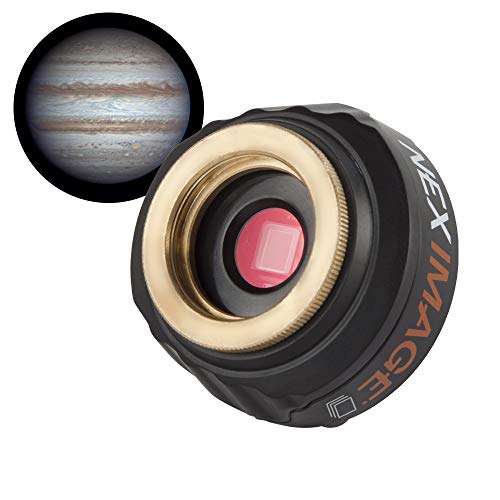
- 10.7 MP color planetary sensor
- Includes capture and stacking software
- 1.25-inch barrel with IR-cut window
Best For: Beginners pursuing detailed Moon and planetary images
Best Plug-and-Play Option

- 1080p video at up to 30fps
- UVC support for Windows, macOS, and Linux
- Removable UV/IR-cut filter
Best For: Simple computer-based lunar and planetary viewing
Budget Learning Pick

- Driver-free USB viewing on Windows
- Up to 30fps live video
- Standard 1.25-inch telescope interface
Best For: Casual lunar viewing and educational demonstrations
Versatile Beginner Choice
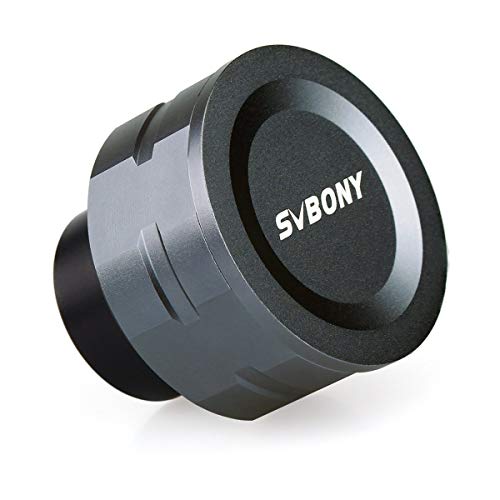
- IMX307 color sensor at 1080p/30fps
- Plug-and-play USB telescope camera
- Supports several desktop capture workflows
Best For: Beginners learning live planetary imaging
Best 4K Lunar Camera

- 8MP sensor with up to 4K video
- UVC viewing plus optional ASCOM support
- Removable IR-cut filter and 1.25-inch fit
Best For: Beginner lunar and planetary imaging
Best for EAA

- IMX662 color sensor with low readout noise
- ROI, BIN, and buffered image transfer
- 1.25-inch interface with CS-C adapter
Best For: Planetary imaging and electronically assisted astronomy
Best Wireless Telescope Camera

- 8MP sensor with 4K video and up to 64MP images
- Rotatable 2.8-inch IPS viewing screen
- WiFi app control, battery, and microSD support
Best For: Portable and shared telescope viewing
Best Value WiFi Eyepiece
Telonixium 1080P Telescope Camera

- Built-in 1.5-inch IPS display
- 1080P video and 2MP photos
- 28mm–50mm mounting compatibility
Best For: Beginner astronomy and wildlife viewing
Best Compact Phone Viewing

- Real-time 1080P phone viewing
- Fits 1.25-inch telescopes
- App-based focus and exposure controls
Best For: Quick smartphone-controlled stargazing
Best High-Resolution Features

- 4K video with 8MP CMOS sensor
- 2.8-inch rotatable IPS screen
- 23mm–60mm universal mounting range
Best For: Higher-resolution astronomy and outdoor recording
High-Resolution Pick – Celestron NexImage 10
If you want one of the more capable astronomy cameras under 300 for detailed Moon and planetary imaging, the Celestron NexImage 10 is a strong beginner-oriented option. Its 10.7 MP color sensor, 1.25-inch barrel, and included stacking software are designed for capturing and refining planetary video.
Best For: Beginners who want high-resolution lunar and planetary imaging with included capture and stacking tools.
Pros:
- 10.7 MP color sensor with noise-reduction technology
- Includes camera control and frame-stacking software
- Standard 1.25-inch barrel fits many telescope focusers
- Includes an integrated IR-cut window and 2-year US warranty
Cons:
- Designed primarily for Moon and planetary targets rather than deep-sky imaging
- Requires a computer for viewing and capture
The NexImage 10 stands out for its resolution and software package. It is a practical choice if you want to move beyond basic live viewing and experiment with stacking sharper planetary frames.
Best Plug-and-Play Option – FIBONAX Nova200
The FIBONAX Nova200 is a straightforward choice among astronomy cameras under 300, especially if you prioritize easy computer viewing. It delivers 1080p video at up to 30 frames per second, connects through USB, and includes a removable UV/IR-cut filter for added flexibility.
Best For: Beginners, classrooms, and astronomy clubs that want simple live lunar and planetary viewing on a computer.
Pros:
- UVC plug-and-play compatibility with Windows, macOS, and Linux
- 1080p 30fps video for lunar and planetary imaging
- Removable UV/IR-cut filter supports different observing setups
- Lightweight CNC aluminum body with standard 1.25-inch fit
Cons:
- Manual focus requires adjustment through the telescope
- Optional ASCOM support is specifically listed for compatible Windows workflows
Nova200 focuses on convenience rather than advanced specifications. Its removable filter, broad operating-system compatibility, and screen-based viewing make it especially approachable for shared observing and STEM activities.
Budget Learning Pick – Plastic Astronomy Camera
This compact plastic astronomy camera is a basic entry point for shoppers comparing astronomy cameras under 300. It connects directly to a Windows PC or laptop, provides live telescope viewing, and is aimed at bright targets such as the Moon and planets rather than deep-space objects.
Best For: Casual beginners, educational demonstrations, and lightweight lunar or planetary recording.
Pros:
- Driver-free USB connection for Windows XP through 10
- Supports live viewing and video capture at up to 30fps
- Standard 1.25-inch interface accepts compatible filters
- Lightweight plastic construction is easy to handle
Cons:
- Not intended for deep-space nebula imaging
- Compatibility information is centered on older Windows versions
- Plastic housing may be less durable than an aluminum camera body
This model keeps the setup simple and portable. It makes the most sense when your goals are basic computer viewing, educational use, and documenting bright solar-system targets without needing advanced deep-sky capability.
Versatile Beginner Choice – SVBONY SV105
The SVBONY SV105 is a practical option for beginners comparing astronomy cameras under 300. Its 1/2.8-inch IMX307 color sensor records 1920×1080 video at up to 30fps, while USB connectivity and support for several capture applications make it useful for live lunar, planetary, and terrestrial viewing.
Best For: Beginners who want an affordable electronic eyepiece with broad computer and software compatibility.
Pros:
- IMX307 color sensor with 1920×1080 capture at up to 30fps
- Plug-and-play design with no required driver for basic use
- 1.25-inch format and M28.5×0.6 thread support compatible filters
- Works with listed Windows, Linux, and macOS workflows
Cons:
- Manual focus requires telescope-side adjustment
- Best suited to bright lunar and planetary targets rather than deep-sky imaging
- Android compatibility is listed for USB Camera, but not Apple phones or tablets
The SV105 balances beginner-friendly operation with useful software flexibility. It is a good fit if you want live computer viewing and basic video capture while keeping the option to use astronomy-focused applications later.
Best 4K Lunar Camera – FIBONAX NOVA8M
For astronomy cameras under 300, the FIBONAX NOVA8M is a practical option for beginners who want detailed lunar and planetary video without a complicated setup. Its 8MP sensor supports up to 4K video, while standard UVC viewing works with compatible Windows, macOS, and Linux software.
Best For: Beginners capturing the Moon and bright planets with a computer-connected telescope.
Pros:
- 8MP sensor supports up to 4K video and high-frame-rate 1080p capture.
- UVC plug-and-play viewing, with optional ASCOM support for compatible Windows applications.
- Standard 1.25-inch barrel, M28.5×0.6 filter thread, and removable IR-cut filter.
- Lightweight CNC aluminum body weighs approximately 110g.
Cons:
- Requires manual focusing through the telescope.
- Designed primarily for lunar and planetary imaging rather than long-exposure deep-sky photography.
- Focus compatibility depends on sufficient focuser travel; the 1.25-inch fit alone does not guarantee focus.
The NOVA8M emphasizes resolution and straightforward computer viewing. It is a sensible pick for shared observing and bright-object imaging, provided your telescope can reach focus and you do not need a dedicated deep-sky camera.
Best for EAA – SVBONY SV305C
Among astronomy cameras under 300, the SVBONY SV305C stands out as a feature-rich color entry-level camera for planetary, lunar, and electronically assisted astronomy. Its IMX662 sensor, ROI controls, binning, and built-in image buffer give users more control over capture performance.
Best For: Entry-level planetary imaging, lunar photography, and EAA users who want adjustable capture settings.
Pros:
- Color IMX662 sensor with low readout noise, no glow, and improved red-band sensitivity.
- Planetary high-speed and sky-space long-exposure modes can be set in SharpCap.
- ROI and BIN functions can help increase capture rate or sensitivity.
- 1.25-inch astronomical interface with included CS-C adapter for compatible C- or CS-mount lenses.
Cons:
- Effective still resolution is approximately 2.27MP, despite the listed 4K video specification.
- Manual focus is required.
- The UV/IR-cut filter is built in and is not removable, while the protective glass is removable.
The SV305C offers useful controls for learning planetary capture and EAA workflows. It is less focused on headline resolution than some alternatives, but its sensor behavior, ROI, binning, and buffering make it a flexible entry-level choice.
Best Wireless Telescope Camera – Telonixium 4K WiFi Camera
For astronomy cameras under 300 that prioritize convenience, the Telonixium 4K Wireless Telescope Camera combines on-device viewing, WiFi access, and app controls. Its 8MP sensor records 4K video, while the universal locking groove fits eyepieces from 23mm to 60mm.
Best For: Beginners who want wireless viewing, built-in recording, and a flexible fit for telescopes, binoculars, monoculars, or microscopes.
Pros:
- 8MP sensor supports 4K video and up to 64MP image capture.
- Rotatable 2.8-inch IPS screen provides real-time viewing without relying solely on a computer.
- WiFi remote viewing works within a stated 32-foot range and supports two connected devices.
- Built-in 2000mAh battery, microSD support up to 512GB, app control, and time-lapse functions.
Cons:
- Manual focus is required.
- Uses a universal locking groove rather than a dedicated standard 1.25-inch electronic eyepiece connection.
- Remote viewing depends on the stated WiFi range and the XDVPRO app.
The Telonixium is the most self-contained option in this group. Its screen, battery, storage support, and wireless app make it convenient for casual observing and sharing, especially when portability matters more than a traditional computer-based imaging workflow.
Best Value WiFi Eyepiece – Telonixium 1080P Telescope Camera
If you’re comparing astronomy cameras under 300, this Telonixium model is a practical choice for beginners who want a built-in display, phone connectivity, and straightforward 1080P recording. Its adjustable mounting groove supports 28mm–50mm optical devices, including telescopes, binoculars, monoculars, and microscopes.
Best For: Beginners who want local-screen viewing, remote observing, and flexible compatibility for astronomy or wildlife watching.
Pros:
- Built-in 1.5-inch IPS screen provides direct electronic viewing.
- Records 1080P video and captures 2MP photos with low-light compensation.
- Includes 64GB storage and supports cards up to 256GB.
- Up to three hours of recording from the rechargeable 1,000mAh battery.
Cons:
- Manual focus requires hands-on adjustment.
- Its 28mm–50mm fit may not suit every eyepiece size.
- Image resolution is more modest than 4K alternatives.
The combination of a built-in screen, WiFi app control, and broad optical compatibility makes this a well-rounded entry-level camera. It is especially appealing if you want to share observations without relying solely on a phone screen.
Best Compact Phone Viewing – Koolpte 1080P WiFi Eyepiece
Among astronomy cameras under 300, the Koolpte WiFi eyepiece stands out for simple smartphone viewing. It fits standard 1.25-inch telescopes and uses a 2MP sensor to stream, photograph, and record 1080P footage through its iOS or Android app.
Best For: Telescope users who prioritize quick phone-based viewing, app control, and a plug-and-play 1.25-inch fit.
Pros:
- Streams 1920×1080 images to compatible phones in real time.
- Connects through a WiFi hotspot with support for multiple devices.
- App includes focus, exposure, resolution, and image orientation controls.
- USB-C rechargeable battery supports up to 90 minutes of use.
Cons:
- Battery life is shorter than some competing models.
- Requires a smartphone or tablet for viewing.
- Designed for 1.25-inch telescope compatibility rather than a broader size range.
This is a focused, easy-to-use option for observers who already have a compatible 1.25-inch telescope and prefer controlling the camera from a phone. Its short setup process and app features make it suitable for casual viewing and group stargazing.
Best High-Resolution Features – Telonixium 4K Wireless Camera
For shoppers comparing astronomy cameras under 300, this Telonixium model offers the most advanced imaging features in this group. Its 8MP CMOS sensor supports 4K video, high-resolution still images, a rotatable 2.8-inch display, and app features such as time-lapse and timed shooting.
Best For: Beginners and outdoor observers who want higher-resolution recording, on-camera viewing, and broad eyepiece compatibility.
Pros:
- Supports 4K video and up to 64MP image capture.
- Rotatable 2.8-inch IPS screen enables direct real-time viewing.
- Universal mounting groove fits eyepieces from 23mm to 60mm.
- 2,000mAh battery and support for microSD cards up to 512GB suit longer sessions.
Cons:
- Manual focus requires user adjustment.
- WiFi remote viewing range is listed at up to 32 feet.
- Higher-resolution recording may require substantial storage space.
With its stronger sensor, larger display, extended battery, and wide mounting range, this is the most feature-rich option here. It makes sense for users who want more flexibility for lunar, planetary, wildlife, and time-lapse recording.
How We Picked the Best Astronomy Cameras Under 300
We focused on cameras priced below $300 that are designed for direct connection to a telescope, typically through a 1.25-inch or universal eyepiece format. The selection includes dedicated planetary cameras, USB electronic eyepieces, and wireless models with app support or built-in displays.
Our comparison emphasizes practical specifications rather than headline resolution alone. We considered sensor type, image resolution, connection method, compatibility, portability, controls, and the intended experience level. A camera with a modest resolution but a capable sensor and reliable software may be more useful than a higher-resolution model with limited compatibility.
Quick Comparison
| Camera type | Best suited to | Key advantage |
|---|---|---|
| Dedicated USB planetary camera | Moon and planet imaging | Computer-based control and recording |
| Wireless telescope camera | Casual viewing and sharing | Phone or tablet convenience |
| Electronic eyepiece with screen | Group observing | Live viewing without a separate computer |
| High-resolution USB camera | Detailed lunar imaging | More pixels for cropping and framing |
Key Buying Factors for Astronomy Cameras Under 300
Sensor and Resolution
Resolution describes the number of pixels, but it does not guarantee better images. Sensor sensitivity, noise performance, frame rate, and software support also matter. For bright lunar and planetary targets, a responsive color CMOS sensor can be a practical choice. Higher resolution is particularly useful when you want to crop a lunar image, although it may require more storage and processing power.
Connection and Software
USB cameras generally connect to a laptop or desktop and can provide more control over exposure, gain, frame rate, and recording. Wireless models are simpler for live viewing from a phone or tablet, but app compatibility, wireless range, and battery life should be checked before purchase. Built-in screens can be convenient when you want a self-contained setup.
Telescope Fit and Optical Setup
Confirm that the camera’s barrel matches your telescope’s focuser or diagonal. Many products use a 1.25-inch format, while universal models may support both 1.25-inch and 2-inch configurations. A camera does not replace the need for accurate focusing, a stable mount, and suitable exposure settings. Solar imaging also requires a properly rated solar filter placed over the telescope’s front aperture; never point an unfiltered telescope or camera at the Sun.
Intended Targets
Most affordable cameras in this category are strongest for the Moon and planets. Bright deep-sky objects may be possible with the right mount, tracking, exposure control, and stacking workflow, but expectations should remain realistic. Choose a camera based on the targets you can consistently observe rather than resolution alone.
Who Should Buy Which Astronomy Cameras Under 300?
- Choose a dedicated USB camera if you want to learn planetary imaging, record video, and process frames on a computer.
- Choose a wireless model if ease of use, phone control, and sharing live views matter more than advanced capture controls.
- Choose a camera with a built-in screen for family observing, classroom use, or viewing without carrying a laptop.
- Choose a higher-resolution model if lunar detail, cropping flexibility, and larger image files are worthwhile for your workflow.
- Choose a simpler electronic eyepiece if you want an affordable introduction to digital telescope viewing with minimal setup.
Before ordering, verify the telescope connection, operating-system or app requirements, power needs, and whether recording software is included. The best choice among these astronomy cameras under $300 is the one that fits your telescope and matches how you plan to observe and capture images.