Choosing the right microscope can make a big difference in how confidently students learn biology, microbiology, and lab skills. The best models balance clear optics, comfortable viewing, and simple controls.
Below, we focus on binocular microscopes for students that are practical for classrooms, home study, and beginner lab work without overpaying for unnecessary extras.
Best 10 Binocular Microscopes for Students Picks for 2026
Editor’s Pick
PalliPartners 100X-2000X Compound Microscope

- 100X-2000X magnification for slide work
- Includes slides set and phone adapter
- 45° head and dual LED lighting
Best For: Students and homeschoolers needing a high-power starter compound microscope
Premium Binocular
SWIFT SW350B Research-Grade Binocular Microscope

- Siedentopf binocular head with 30° tilt
- 40X-2500X range with 10X and 25X eyepieces
- Mechanical stage and Abbe condenser
Best For: Advanced students wanting a sturdy lab-style binocular microscope
Best Value Binocular
JECONE 40-2500X Student Microscope

- 40X-2500X range with WF25X and 10X eyepieces
- Dual LED lighting and five-color filter wheel
- Binocular, 45° inclined, 360° rotating head
Best For: Families and students who want a feature-rich everyday microscope
Digital Learning Binocular
AmScope B120C-E1 with USB Camera
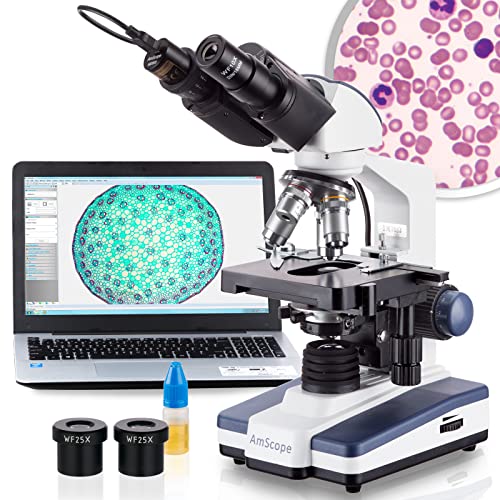
- Binocular compound microscope with 40X-2500X range
- Includes 1.0 MP USB camera and software
- LED lighting with fly-eye lens
Best For: Students and teachers who want digital capture with binocular viewing
Best for Easy Setup
SELFIE CAT 200X-5000X Binocular Compound Microscope
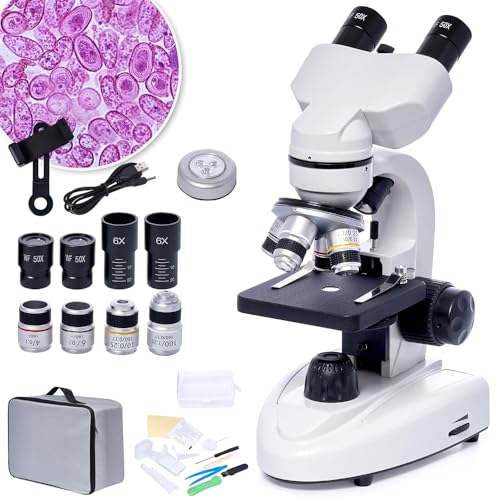
- 200X to 5000X range with four achromatic objectives
- Binocular head rotates 360 degrees and adjusts interpupillary distance
- Includes mechanical stage, coaxial focus, and phone adapter
Best For: Students and families who want a versatile binocular microscope with sharing features
Lab Ready Choice
HSL 40x-2500x Binocular Microscope

- Six magnification settings from 40X to 2500X
- Double-layer mechanical stage and Abbe condenser
- Includes phone mount and shockproof carrying handbag
Best For: Student labs and home learners who want a portable binocular microscope
Budget Research Option
Poothoh 40X-2000X Binocular Compound Microscope

- 40X to 2000X range with three achromatic objectives
- Dual lighting and coaxial coarse/fine focus
- Dual mechanical stages and built-in electronic eyepieces
Best For: Students, beginners, and hobbyists who want a research-style binocular microscope
Lab-Grade Binocular Pick
Sinher XSZ-107BN Compound Microscope

- Binocular head with 45° tilt and 360° swivel
- Metal frame with double-layer mechanical stage
- Includes slides, cover slips, and cleaning paper
Best For: Students and home learners wanting a sturdier, more advanced microscope
Wide-View Classroom Choice
Herwicm Binocular Compound Microscope

- Ultra-wide-angle binocular eyepieces
- Top and bottom LED lighting with soft fill
- Two-layer stage with dual focusing knobs
Best For: Students and beginners who want comfortable viewing and flexible lighting
Portable Starter Upgrade
sino optical XSP-66 Student Microscope
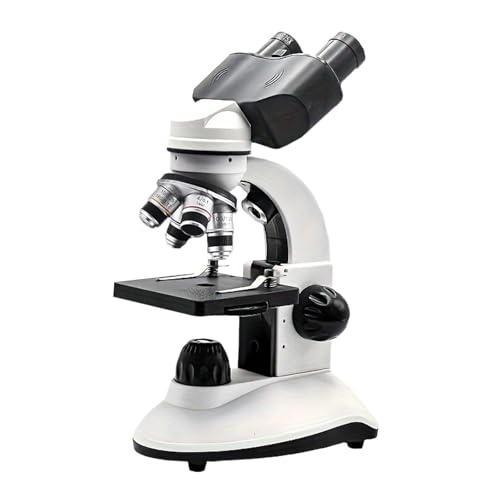
- Dual LED lighting with a 5-color filter wheel
- Includes phone holder, USB cable, and specimens
- Compact ABS body for easier portability
Best For: Beginners and students needing a compact, ready-to-use kit
Editor’s Pick – PalliPartners 100X-2000X Compound Microscope
If you’re comparing binocular microscopes for students, this PalliPartners compound microscope stands out for high magnification and a complete starter kit. It’s aimed at classroom and home learning, with enough optical power for detailed biological observation plus a phone adapter for easy sharing and record-keeping.
Best For: Students and homeschoolers who want a high-power compound microscope with slides and phone sharing.
Pros:
- 100X to 2000X magnification for detailed specimen viewing.
- Includes prepared slides and a universal smartphone adapter.
- 45° inclined head and coaxial coarse/fine focus help reduce strain.
- Dual LED illumination supports classroom and home use.
Cons:
- Not a binocular microscope design, despite being useful for students.
- More focused on biological slides than low-power, three-dimensional objects.
- Runs as a battery-powered unit, so power setup may be less convenient for some labs.
For students who need a strong all-around learning microscope, this model offers a practical mix of image clarity, included accessories, and comfortable handling. It’s a solid choice when the goal is serious slide observation rather than casual viewing.
Premium Binocular – SWIFT SW350B Research-Grade Binocular Microscope
Among binocular microscopes for students, the SWIFT SW350B is the most research-style option here. Its Siedentopf binocular head, broad eyepiece choices, and mechanical stage make it a strong fit for serious slide viewing in high school, university, or clinic-adjacent settings.
Best For: Advanced students who want a sturdy binocular compound microscope with wider magnification flexibility.
Pros:
- Siedentopf binocular head with 30° tilt for comfortable shared use.
- 40X to 2500X magnification with 10X and 25X eyepieces.
- Mechanical stage and Abbe condenser improve slide handling and illumination.
- Carrying handle adds convenience for transport.
Cons:
- Heavier and larger than basic student microscopes.
- More complex than entry-level classroom models.
- Requires AC adapter power, so it’s less portable for casual use.
If your priority is a true binocular compound microscope for deeper study, this SWIFT model delivers the most polished lab-style experience in the group. It’s especially appealing when comfort, repeatable slide work, and stronger optics matter more than simplicity.
Best Value Binocular – JECONE 40-2500X Student Microscope
This JECONE model is a practical pick if you want binocular microscopes for students with a full feature set. It combines dual LED illumination, a rotating color filter wheel, and a phone holder, making it well suited to school labs and home schooling without feeling overly bare-bones.
Best For: Students and families who want a feature-rich binocular microscope for everyday study.
Pros:
- 40X to 2500X magnification with WF25X and 10X eyepieces.
- Dual LED lighting supports both opaque and translucent specimens.
- Five-color filter wheel helps enhance transparent specimens without staining.
- Binocular head with 45° incline and 360° rotation improves comfort.
Cons:
- USB powered, so it depends on a suitable power source.
- Higher feature count may take more time for beginners to learn.
- Bulkier than simpler student microscopes.
For buyers who want a versatile student microscope that covers a lot of teaching scenarios, this JECONE stands out. The extra lighting controls and filters add real usefulness for learning, not just spec-sheet appeal.
Digital Learning Binocular – AmScope B120C-E1 with USB Camera
The AmScope B120C-E1 is a smart choice for students who want binocular microscopes for students with built-in digital capture. It pairs a binocular compound body with a 1.0 MP USB camera, so slide viewing and image review can happen in the same setup.
Best For: Students and educators who want binocular viewing plus computer-connected image capture.
Pros:
- 40X to 2500X magnification suits a wide range of slide work.
- Includes a 1.0 MP USB camera with microscopy software.
- LED lighting with fly-eye lens supports bright, daylight-balanced illumination.
- Economical option from a brand known for microscopes and accessories.
Cons:
- Designed for PC use, so it’s less flexible without a computer nearby.
- AC-powered setup is less portable than battery or USB-only alternatives.
- Best for slide-based viewing rather than casual low-power observation.
If digital sharing, documentation, or classroom demos are part of the goal, this AmScope makes that workflow straightforward. It’s a strong educational microscope when you want binocular viewing plus camera integration in one package.
Best for Easy Setup – SELFIE CAT 200X-5000X Binocular Compound Microscope
If you’re comparing binocular microscopes for students, this SELFIE CAT model stands out for its wide magnification range, binocular comfort, and classroom-friendly controls. The 200X to 5000X range, achromatic objectives, mechanical stage, and coaxial coarse/fine focus make it a flexible option for school projects, home exploration, and lab-style viewing.
Best For: Students and families who want a versatile binocular microscope with a phone adapter for sharing observations.
Pros:
- 200X to 5000X magnification range with four achromatic objectives.
- Binocular head rotates 360 degrees and adjusts interpupillary distance.
- Mechanical stage and coaxial focus knobs support precise specimen control.
- Includes a phone adapter for capturing images and video.
Cons:
- 100X use requires oil immersion.
- Higher magnification options may be more than a basic student user needs.
- Powered by battery, which may be less convenient than a simple plug-in setup.
Overall, this is a strong all-around pick if you want a student microscope that balances comfort, adjustability, and practical sharing features. It is especially appealing when you want a binocular design that reduces eye fatigue during longer observation sessions.
Lab Ready Choice – HSL 40x-2500x Binocular Microscope
For buyers searching for binocular microscopes for students with a more lab-oriented feature set, the HSL model offers a practical mix of magnification options, precise slide control, and carry-friendly extras. Its 40X to 2500X settings, Siedentopf binocular head, double-layer mechanical stage, and included phone mount make it well suited to education and hands-on biological study.
Best For: Student labs and home learners who want a portable binocular microscope with precise slide handling.
Pros:
- Six magnification settings from 40X to 2500X.
- Siedentopf binocular head with 10X and 25X widefield eyepieces.
- Double-layer mechanical stage supports accurate slide positioning.
- Includes a phone mount and a shockproof handbag for portability.
Cons:
- Heavier than some student microscopes at 4.19 kg.
- Requires corded electric power rather than battery use.
- The maximum magnification may be unnecessary for basic classroom work.
This is a good fit if you want a student microscope that feels more like a small lab instrument. The added stage control, condenser, and dimmable LED lighting help support more careful observation work.
Budget Research Option – Poothoh 40X-2000X Binocular Compound Microscope
If you want binocular microscopes for students that lean toward research-style use, this Poothoh model focuses on clear viewing, stable mechanics, and dual lighting. Its 40X to 2000X range, three achromatic objectives, dual mechanical stages, and built-in electronic eyepieces make it suitable for school experiments, beginner science work, and home teaching.
Best For: Students, beginners, and hobbyists who want a research-style binocular microscope with dual illumination.
Pros:
- 40X to 2000X magnification with three achromatic objectives.
- Dual lighting system lets you observe both specimens and objects.
- Coaxial coarse/fine focus and dual mechanical stages support precise viewing.
- Five-color filter bar adds another layer of observation control.
Cons:
- Maximum magnification is lower than some competing binocular models.
- Designed as electric equipment, so it is less portable than smaller student scopes.
- Best fit is more lab-oriented than casual beginner use.
As a student microscope, this model is appealing when you want solid fundamentals over extra accessories. The dual lighting and focus system make it a practical option for learning observation skills with more control.
Lab-Grade Binocular Pick – Sinher XSZ-107BN Compound Microscope
For students who want binocular microscopes for students that feel closer to a real lab setup, the Sinher XSZ-107BN offers a sturdy metal body, binocular viewing, and a full set of educational features. Its 40X-1600X stated magnification range, WF10X/WF20X eyepieces, and 4X/10X/40X/100X objectives give it enough flexibility for classroom slides, home study, and more advanced observation.
Best For: Students and home learners who want a metal-frame compound microscope with a more advanced feature set.
Pros:
- Binocular head with 45-degree tilt and 360-degree rotation for more comfortable viewing
- Double-layer mechanical stage with X-Y controls and scale markings
- NA1.25 Abbe condenser, iris diaphragm, and adjustable transmitted LED lighting
- Includes 100 blank slides, 100 cover slips, and cleaning paper for immediate use
Cons:
- Heavier 9.9-pound metal build is less portable than compact student models
- Requires AC power, so it is not a battery or USB-powered option
- Includes oil-immersion 100X objective, which may be more than casual beginners need
This is a strong choice if you want a more serious compound microscope for student use and value the stability of a metal frame and mechanical stage. It is best suited to learners who expect to do repeated slide work rather than just occasional viewing.
Wide-View Classroom Choice – Herwicm Binocular Compound Microscope
If you are comparing binocular microscopes for students, the Herwicm compound microscope stands out for its ultra-wide-angle binocular eyepieces and dual LED lighting. It is designed to make viewing more comfortable over longer sessions, with WF10x and WF25x eyepieces, a two-layer mechanical stage, and a stated 40X-2500X magnification range for a wide variety of classroom and hobby slides.
Best For: Students, beginners, and hobbyists who want a comfortable binocular microscope with bright top-and-bottom lighting.
Pros:
- Ultra-wide-angle binocular eyepiece design for clearer, less tiring viewing
- Top and bottom LED lights with soft automatic fill light
- Coaxial coarse and fine focus knobs on both sides for easier adjustment
- Telescopic lens protection and a large adjustable stage
Cons:
- Product details list a maximum magnification of 40x, which conflicts with the stated 40X-2500X range
- No slide kit or accessories are highlighted in the supplied notes
- Body materials are mixed metal/plastic rather than a full metal frame
Overall, this is a practical pick for learners who want a binocular microscope with straightforward focusing and flexible lighting. The comfort-focused eyepieces make it especially appealing for longer observation sessions at school or home.
Portable Starter Upgrade – sino optical XSP-66 Student Microscope
For buyers looking at binocular microscopes for students with an easy-to-use, all-in-one setup, the sino optical XSP-66 is built around convenience. It combines a compact ABS body, dual upper and lower LED light sources, WF10X/WF25X eyepieces, a 2X double lens, and a phone holder, making it a flexible option for school labs, home education, and beginner exploration.
Best For: Beginners and students who want a compact microscope kit with smartphone support and dual lighting.
Pros:
- Up and down dual LED light sources plus a 5-color filter wheel
- Includes WF10X and WF25X eyepieces, 2X double lens, and 10 blank specimens
- Phone holder and USB power make it convenient for home use
- Compact ABS body is easier to move and store than heavier lab models
Cons:
- Plastic body is less robust than metal-bodied microscopes
- Smaller form factor may feel less stable than larger classroom units
- Accessory-heavy kit may be more than some casual users need
This model is a smart pick if you want a beginner-friendly microscope that is portable and ready to use out of the box. It favors convenience and student-friendly features over a more rugged laboratory build.
How We Picked the Best Binocular Microscopes for Students
We focused on models that offer a sensible mix of optical quality, ease of use, and student-friendly features. That includes binocular viewing comfort, usable magnification ranges, dependable focus controls, sturdy stages, and lighting that helps beginners see slides clearly.
We also looked for microscopes that are realistic for school labs and home learning, not just high-number specs. For most students, usability matters more than extreme magnification claims.
Quick Comparison
When comparing Binocular Microscopes for Students, think in terms of comfort, image quality, and classroom practicality. Entry-level models are usually best for general biology and first-time users, while higher-spec options may suit advanced coursework, science clubs, or students who want photo capture and broader accessory support.
Best for Most Beginners
A straightforward binocular model with clear optics, dual illumination, and a mechanical stage is often the best starting point.
Best for Advanced Schoolwork
Students who need finer detail, smoother focusing, or better slide handling should look for stronger build quality and wider accessory compatibility.
Key Buying Factors for Binocular Microscopes for Students
Magnification range: More is not always better. For most student use, a practical range with 40X, 100X, 400X, and 1000X-level viewing is enough for common specimens.
Binocular head comfort: A Siedentopf-style head or similar adjustable eyepiece setup can reduce eye strain during longer sessions.
Objectives and eyepieces: Multiple achromatic objectives and quality wide-field eyepieces usually deliver a sharper, more usable image than inflated magnification claims.
Stage and focus controls: A mechanical stage and coaxial coarse/fine focus make slide movement and image sharpening much easier for students.
Lighting: Dual LED or upper/lower illumination helps when viewing both prepared slides and thicker samples.
Accessories: Phone holders, slide kits, and USB imaging can be helpful, but they should not come at the expense of basic optical quality.
Who Should Buy Which Binocular Microscopes for Students?
Beginners and younger students: Choose a simple, sturdy binocular microscope with easy focusing and reliable lighting.
Middle and high school students: Look for a mechanical stage, better eyepieces, and enough magnification for standard biology work.
Advanced students and labs: Pick a model with stronger optics, smoother controls, and optional imaging support if documentation matters.
Home-school families: A versatile, easy-to-use microscope with good accessories can offer the best value and reduce setup frustration.
In short, the best choice is usually the microscope that students will actually use often: comfortable, clear, and simple to operate.