The best compound microscopes for adults make it easier to examine prepared slides, cells, plant tissue, microorganisms, and classroom specimens with useful clarity and control. The right model depends on more than headline magnification.
We compared beginner, educational, and research-oriented microscopes across optical design, focusing, stage movement, lighting, ergonomics, and camera support to help you choose a practical fit.
Best 10 Compound Microscopes for Adults Picks for 2026
Research-Grade Pick
SWIFT SW350B Binocular Compound Microscope

- 40X–2500X range with six magnification levels
- Binocular head with 10X and 25X eyepieces
- Mechanical stage and adjustable Abbe condenser
Best For: Adults and advanced students doing detailed slide work
Beginner-Friendly Value
TOMLOV CM101 Adult Compound Microscope

- Coarse and fine focus for easier specimen adjustment
- Dual LED lighting for transparent and surface objects
- Includes prepared slides, blank slides, and coverslips
Best For: Adult beginners and homeschool or classroom learning
Camera-Ready Choice
SWIFT SW380T Trinocular Compound Microscope

- Trinocular head supports compatible camera attachments
- 40X–2500X range with six magnification levels
- Ultra-precise focusing and binocular viewing
Best For: Adults who want to record, livestream, or share observations
Complete Learning Kit
PalliPartners Binocular Compound Microscope

- 100X–2000X viewing with binocular optics
- Dual LED illumination and coaxial focusing
- Includes 28 slides, dissecting tools, and phone accessories
Best For: Families, homeschoolers, and hands-on biology learners
Laboratory-Grade Trinocular Pick

- 40X-5000X range with achromatic objectives
- Trinocular head with HD USB camera
- Includes extensive slide and specimen accessories
Best For: Adults wanting high magnification and digital, lab-style viewing
Accessible STEM Starter
PalliPartners 100X-2000X Microscope

- 100X-2000X optical magnification
- Dual top and bottom LED illumination
- Includes 28 slides and phone photography accessories
Best For: Home learning, families, and beginner adult hobbyists
Binocular Lab Classic
SWIFT SW380B Compound Microscope

- 40X-2500X magnification with 10X and 25X eyepieces
- Rotatable binocular Siedentopf head
- Metal body, mechanical stage, and precise focusing
Best For: Adults prioritizing comfortable, durable binocular lab viewing
Best Beginner Value
HUTACT 40-2000X Compound Microscope

- 40X-2000X magnification combinations
- Achromatic glass optics with LED lighting
- Slides, storage bag, and one-year warranty included
Best For: Adult beginners, students, and homeschool science
Best Binocular Comfort
Herwicm 40-2500X Binocular Microscope

- Wide-angle binocular eyepieces
- Adjustable top and bottom LED lighting
- Two-layer mechanical stage with coarse/fine focus
Best For: Longer viewing sessions and hands-on biology study
Best Accessory-Rich Kit
BEBANG 100-2000X Biology Microscope
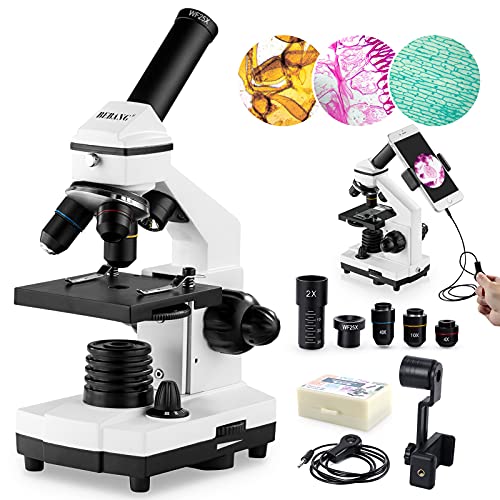
- Six listed magnification settings up to 2000X
- Dual LED lighting with condenser and diaphragm
- Phone adapter, slides, bag, and accessories included
Best For: Students and hobbyists needing a complete starter kit
Research-Grade Pick – SWIFT SW350B Binocular Compound Microscope
For adults seeking compound microscopes for adults with serious magnification range, the SWIFT SW350B combines binocular viewing, achromatic objectives, and a mechanical stage in a sturdy lab-style design. Its six magnification levels extend from 40X to 2500X, making it suitable for detailed slide work across education, clinical study, and advanced hobbies.
Best For: Adults, university students, clinicians, and experienced hobbyists who want a research-oriented microscope for prepared slides.
Pros:
- Binocular Siedentopf head rotates for shared viewing and has an ergonomic 30-degree tilt.
- Six magnification levels use four DIN achromatic objectives.
- Mechanical stage, adjustable Abbe condenser, and variable LED brightness support controlled slide viewing.
- Includes interchangeable wide-field 10X and 25X glass eyepieces.
Cons:
- Its 10.7-pound, lab-style build is less convenient to move frequently.
- AC power and a relatively large footprint may be less suitable for compact workspaces.
The SW350B is a strong choice when optical control and high magnification matter more than portability. It offers a more substantial platform than a basic student microscope, while the carrying handle helps with occasional transport.
Beginner-Friendly Value – TOMLOV CM101 Adult Compound Microscope
The TOMLOV CM101 is a practical entry point for adults comparing compound microscopes for adults for home study, classroom work, or beginner microscopy. Its monocular layout, coaxial coarse and fine focus, dual LED lighting, and included slides make it easy to begin observing specimens without assembling a large lab setup.
Best For: Adult beginners, students, homeschool STEM projects, and users who want both transparent-slide and surface-object illumination.
Pros:
- Coarse and fine focus controls make locating and refining specimens straightforward.
- Bottom and top LEDs support prepared slides as well as leaves, insects, hair, and other surfaces.
- Achromatic 4X, 10X, and 40X objectives pair with 10X and 25X wide-field eyepieces.
- Includes prepared and blank slides, coverslips, a 2X eyepiece magnifier, and a six-position filter disc.
Cons:
- The monocular viewing design may be less comfortable for extended shared viewing than binocular models.
- At 2.7 pounds, its lightweight construction may feel less substantial than a professional lab microscope.
With a compact footprint and a beginner-focused accessory bundle, the CM101 prioritizes accessibility. It is especially useful for adults who want flexible illumination and included materials before investing in a heavier research-style instrument.
Camera-Ready Choice – SWIFT SW380T Trinocular Compound Microscope
For adults who want to document or share microscope observations, the SWIFT SW380T stands out among compound microscopes for adults with its trinocular head. It combines 40X–2500X magnification, binocular viewing, achromatic objectives, and ultra-precise focusing with a dedicated port for compatible camera attachments.
Best For: Clinicians, advanced students, educators, and hobbyists who want to view, record, livestream, or capture specimen images.
Pros:
- Trinocular head accepts an additional eyepiece or microscope camera attachment.
- Ultra-precise focusing supports both coarse and extremely fine adjustments.
- Six magnification levels range from 40X to 2500X using four DIN achromatic objectives.
- Rotatable Siedentopf head and 30-degree eyepiece tilt support shared, more comfortable viewing.
Cons:
- Camera and additional eyepiece attachments are not included.
- Its 4.3-kilogram lab-style body is less portable than a compact beginner scope.
- The AC-powered setup may require dedicated space near an outlet.
The SW380T is the most suitable option here for microscopy documentation and collaborative teaching. Its trinocular architecture adds flexibility for imaging, while the high magnification range and fine focusing keep it useful for detailed slide examination.
Complete Learning Kit – PalliPartners Binocular Compound Microscope
The PalliPartners binocular microscope is a convenient choice for adults comparing compound microscopes for adults that include supplies for hands-on learning. Along with 100X–2000X viewing, it provides dual LED illumination, coaxial coarse and fine focus, specimen slides, dissecting tools, and a phone clip adapter for practical home or classroom exploration.
Best For: Families, adult hobbyists, homeschoolers, and students who want an all-in-one biology and specimen-observation kit.
Pros:
- Binocular optics use 4X, 10X, and 40X objectives with a WF25X eyepiece and 2X Barlow lens.
- Top and bottom LEDs illuminate opaque objects and translucent biological specimens.
- Coaxial coarse and fine focus supports sharper, more controlled adjustments.
- Includes 28 slides, collection and dissecting tools, a phone clip adapter, and Bluetooth remote shutter.
Cons:
- The maximum magnification is 2000X, below the 2500X offered by the SWIFT models.
- The enclosure is listed as plastic, which may feel less robust than a primarily metal lab instrument.
- Phone imaging depends on the included clip adapter and a compatible phone setup.
The PalliPartners model emphasizes convenience and experimentation rather than a strictly professional lab configuration. Its broad accessory package makes it appealing when the goal is to start exploring biology immediately with adults, teens, or supervised younger learners.
Laboratory-Grade Trinocular Pick – Woehrsh 40X-5000X Microscope
For adults seeking compound microscopes for adults with extensive magnification and lab-oriented features, this Woehrsh trinocular model offers a broad 40X-5000X range, a mechanical stage, LED illumination, and an HD USB camera. Its trinocular design also supports viewing while using an electronic eyepiece or camera.
Best For: Adult hobbyists, biology learners, teaching environments, and users who want a highly expandable microscope with included preparation supplies.
Pros:
- Broad 40X-5000X magnification range using multiple eyepieces and lenses.
- Trinocular head, HD USB camera, and 306-degree swivel head support shared or digital viewing.
- Dual mechanical stage, coaxial coarse and fine focus, adjustable interpupillary distance, and LED lighting.
- Includes slides, coverslips, specimens, tools, dishes, and other starter accessories.
Cons:
- The extensive configuration may be more than beginners need.
- Its corded-electric design and 240-volt specification require attention to the intended setup.
- The supplied information does not specify camera software compatibility.
This is the most feature-rich option in the group for adults who value digital imaging, high magnification, and laboratory-style controls. It is a strong choice when expandability matters more than simplicity.
Accessible STEM Starter – PalliPartners 100X-2000X Microscope
For shoppers comparing compound microscopes for adults that can also serve younger learners, the PalliPartners model combines 100X-2000X magnification with dual LED illumination and a ready-to-use slide kit. Its phone adapter and Bluetooth shutter make basic specimen photography convenient.
Best For: Home education, student science projects, adult hobbyists, and families wanting an approachable microscope with prepared and blank slides.
Pros:
- 4X, 10X, and 40X objectives plus a 25X eyepiece and 2X lens provide 100X-2000X settings.
- Top and bottom LED illumination accommodates opaque and translucent specimens.
- Includes 10 prepared slides, 18 blank slides, a phone clip, Bluetooth shutter, and power adapter.
- Coaxial coarse and fine focus supports more precise adjustment than basic setups.
Cons:
- Its 2000X maximum is lower than the Woehrsh and SWIFT options.
- The supplied specifications list a battery-powered source while also including a power adapter, so buyers should confirm the operating arrangement.
- The plastic enclosure may feel less substantial than a metal laboratory microscope.
This model emphasizes convenience and educational value rather than advanced laboratory construction. The included slides, dual lighting, and phone accessories make it a practical starting point for adults and students exploring prepared or homemade specimens.
Binocular Lab Classic – SWIFT SW380B Compound Microscope
Adults choosing compound microscopes for adults may prefer the SWIFT SW380B for its research-grade binocular format and ergonomic viewing position. It provides 40X-2500X magnification, a mechanical stage, LED lighting, and precise focusing in a substantial metal-bodied design.
Best For: Adult hobbyists, biology students, and shared lab use where comfortable binocular viewing and durable mechanical controls are priorities.
Pros:
- 40X-2500X magnification with interchangeable wide-field 10X and 25X glass eyepieces.
- Rotatable Siedentopf binocular head supports shared use and adjustable interpupillary distance.
- 30-degree viewing angle helps reduce neck strain during extended observation.
- Mechanical stage, LED illumination, and ultra-precise focusing suit detailed specimen work.
Cons:
- No camera or slide-accessory bundle is identified in the supplied details.
- Its 11-pound metal construction is less portable than a compact educational scope.
- The AC-powered, 110-volt specification may require setup consideration outside compatible electrical systems.
The SW380B is a focused choice for users who prioritize binocular comfort, mechanical controls, and a research-oriented build. It is less of an all-in-one starter kit, but its viewing ergonomics make it appealing for longer sessions.
Best Beginner Value – HUTACT 40-2000X Compound Microscope
For adults seeking approachable compound microscopes for adults, the HUTACT combines a lightweight metal body, achromatic glass optics, LED illumination, and a straightforward selection of eyepieces and objectives. Its included slides and storage bag make it practical for starting observations at home or in an educational setting.
Best For: Adult beginners, students, homeschoolers, and science enthusiasts who want a portable starter kit.
Pros:
- Offers magnification combinations from 40X to 2000X using the included eyepieces, objectives, and 2X lens.
- Achromatic glass lenses and LED lighting are designed for clear, bright viewing.
- Includes a five-piece prepared slide set, storage bag, and one-year warranty.
- Aluminum-alloy construction provides a lightweight yet sturdy body.
Cons:
- The supplied notes do not specify a mechanical stage or binocular viewing.
- The maximum 2000X figure uses the additional 2X magnifying lens.
This is a sensible entry point for adults who value a complete, easy-to-start package over advanced stage or viewing features. The included samples and compact design make it especially convenient for casual exploration and education.
Best Binocular Comfort – Herwicm 40-2500X Binocular Microscope
Among compound microscopes for adults, this Herwicm model stands out for its binocular wide-angle eyepieces, dual LED lighting, and two-layer mechanical stage. It is designed for longer observation sessions while retaining coarse and fine focusing controls for more precise adjustments.
Best For: Adult beginners, hobbyists, and students who prefer binocular viewing and flexible specimen illumination.
Pros:
- Binocular ultra-wide-angle eyepieces provide a larger field of view for more comfortable observation.
- Top and bottom LED lights support viewing from above or below the specimen.
- Coaxial coarse and fine focus knobs allow responsive focusing adjustments.
- Two-layer mechanical stage includes a spiral moving scale for controlled specimen positioning.
Cons:
- The supplied details do not list included slides or other accessory quantities.
- It requires corded electric power and is larger than some compact beginner models.
Choose this microscope when viewing comfort and stage control matter more than portability. Its binocular setup and dual illumination make it a strong fit for repeated biological observations and hands-on learning.
Best Accessory-Rich Kit – BEBANG 100-2000X Biology Microscope
For adults comparing compound microscopes for adults with ready-to-use accessories, the BEBANG provides six listed magnification settings, coarse and fine focus, dual LED illumination, and a broad starter kit. A phone adapter and slide set also make it convenient to document or share observations.
Best For: Students, adult beginners, hobbyists, and home or school users who want accessories included.
Pros:
- Provides six listed magnification settings from 100X to 2000X.
- Solid metal frame with separate coarse and fine focusing controls supports precise adjustment.
- Dual LED illumination and a 0.65 NA condenser with disc diaphragm support brightfield viewing.
- Includes a phone adapter, 15-piece slide set, carrying bag, and additional operating accessories.
Cons:
- The monocular design may be less comfortable for extended viewing than a binocular model.
- The supplied notes do not specify a mechanical stage.
- Its 120-volt AC-and-battery power arrangement may require more setup than a simple plug-in microscope.
This model is a practical choice for buyers who want more than the microscope alone. Its phone adapter, slides, carrying bag, and dual illumination make it well suited to structured lessons, home teaching, and beginner documentation.
How We Picked the Best Compound Microscopes for Adults
We focused on features that affect real-world viewing rather than maximum magnification alone. Our comparison considers optical magnification ranges, monocular, binocular, and trinocular head designs, coarse and fine focusing, mechanical-stage controls, illumination, included eyepieces, construction, and ease of use. We also separated beginner-friendly instruments from more advanced lab microscopes so the recommendations are easier to match to your experience and intended projects.
Because specifications and included accessories can vary by listing, confirm the current contents, camera compatibility, warranty, and power requirements before buying.
Quick Comparison
| Best For | Look For | Recommended Configuration |
|---|---|---|
| First-time users | Simple controls and stable illumination | Binocular or straightforward monocular model |
| Students and home labs | Mechanical stage and fine focus | 40X–2000X or 40X–2500X system |
| Frequent observation | Comfortable head and durable construction | Research-style binocular microscope |
| Photography or video | Dedicated camera port | Trinocular model with compatible USB camera |
Key Buying Factors for Compound Microscopes for Adults
Magnification and Optical Quality
A broad range is useful, but higher advertised magnification does not automatically reveal more detail. For many prepared slides, 40X to 400X provides the most practical viewing range. Higher powers are more useful when paired with suitable objectives, precise focusing, good lighting, and properly prepared specimens.
Head Design and Viewing Comfort
Binocular microscopes let you use both eyes and are generally more comfortable for extended sessions. A trinocular head adds a camera port while preserving binocular viewing, making it a strong choice for documentation, teaching, or group demonstrations. Monocular models can be simpler and less expensive, but they may be less comfortable during long observations.
Focusing and Stage Control
Fine focus is essential at higher magnifications. A two-layer mechanical stage also makes it easier to position a slide precisely than spring clips alone. Look for smooth, separate coarse and fine controls and a stage that feels stable rather than loose or jerky.
Lighting and Accessories
Adjustable LED illumination is efficient and usually produces consistent light. Check whether the microscope includes the eyepieces, objectives, filters, dust cover, camera adapter, or other accessories you need. A generous working distance and clear field of view can matter as much as the stated magnification.
Who Should Buy Which Compound Microscopes for Adults?
Beginners and casual learners: Choose a simple, stable microscope with LED lighting, fine focus, and an easy-to-use stage. Avoid paying for advanced camera features you will not use.
Adults supporting home education: A binocular model with a mechanical stage and a 40X–2000X or 40X–2500X range offers room to grow across biology lessons and prepared-slide work.
Serious hobbyists and frequent users: Prioritize better ergonomics, smooth controls, sturdy construction, and research-style binocular optics over inflated magnification claims.
Teachers, content creators, and lab users: A trinocular microscope with a compatible HD USB camera can simplify image capture and live demonstrations. Verify the camera interface and software support before purchase.