Choosing the right oscilloscope can make troubleshooting faster, measurements cleaner, and learning electronics far less frustrating.
This roundup of the best digital oscilloscopes for 2026 focuses on practical specs, real-world usability, and overall value across beginner, bench, and advanced setups.
Best 10 Digital Oscilloscopes Picks for 2026
Bench-Ready 200MHz Performer
Siglent SDS1202X-E 200MHz 2-Channel Scope
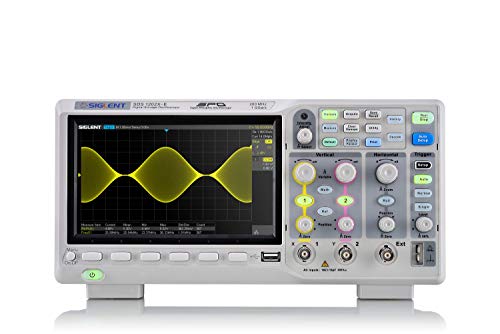
- 200 MHz bandwidth with 2 channels
- 1 GSa/s sampling and 14 Mpts record length
- Serial decode for IIC, SPI, UART, Rs232, CAN, and LIN
Best For: Engineers and technicians needing a capable 2-channel bench scope
Value Lab Workhorse
Hantek DSO2D15 150MHz 2-Channel Scope

- 150 MHz bandwidth with 2 channels
- Arbitrary waveform output and 14 trigger modes
- Supports 5 serial protocol triggers and decodes
Best For: Budget-minded users doing lab, education, or commissioning work
Portable Touchscreen Pick
FNIRSI 1013D Plus 100MHz 2-Channel Scope

- 7-inch touchscreen with gesture control
- 1 GSa/s sampling and 100 MHz x 2 bandwidth
- 6000 mAh battery with around 4 hours of use
Best For: Portable diagnostics and quick signal checks away from the bench
Precision 4-Channel Choice
RIGOL DHO804 70MHz 4-Channel 12-Bit Scope

- 4 analog channels with 12-bit resolution
- Up to 25 Mpts memory and 1.25 GSa/s sampling
- Serial decode for CAN, RS232/UART, I2C, SPI, and 4-bit parallel
Best For: Engineers needing a detailed 4-channel scope for embedded and power work
Best Value 4-Channel Decoder Scope
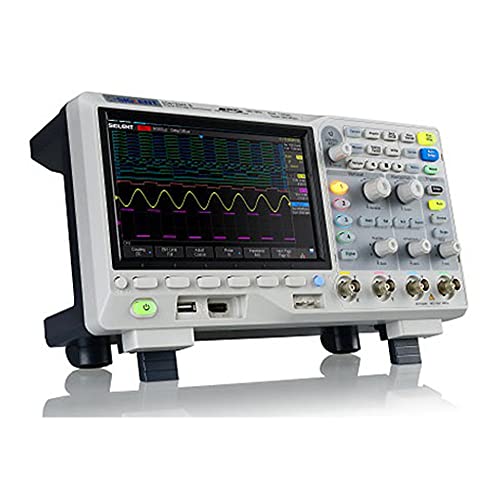
- 4 analog channels with 100MHz bandwidth
- Built-in decoding for I2C, SPI, UART/RS232, CAN, and LIN
- Includes 4 passive probes and calibration certificate
Best For: everyday embedded debugging with common serial bus decoding
High-Resolution Advanced Debug Choice

- 250MHz, 4-channel scope with 12-bit resolution
- Up to 50Mpts memory and 1,000,000 wfms/s UltraAcquire
- Built-in signal generator, Bode plot, LAN, HDMI, and web control
Best For: advanced validation and long-record debug work
Budget 2-Channel Training Scope

- 100MHz bandwidth with 2 channels
- Arbitrary waveform output and 14 trigger modes
- Serial protocol triggers and decodes included
Best For: budget-minded bench work and education
Best Value 4-Channel Pick

- 4 analog channels for broader signal visibility
- Up to 1 GSa/s and 24 Mpts deep memory
- 30,000 wfms/s with RS232/UART, I2C, SPI decode
Best For: electronics debugging, teaching labs, and embedded bring-up
High-Bandwidth 2-Channel Pick

- 200 MHz bandwidth with 2 analog channels
- 1 GSa/s sample rate and 24 Mpts deep memory
- 7-inch graded display plus RS232/UART, I2C, SPI decode
Best For: users who want a 200 MHz bench scope for embedded and lab troubleshooting
Balanced 100MHz Choice

- 100 MHz bandwidth with 2 analog channels
- Up to 1 GSa/s and 24 Mpts memory depth
- 30,000 wfms/s plus RS232/UART, I2C, SPI decode
Best For: students, hobbyists, and technicians doing everyday troubleshooting
Bench-Ready 200MHz Performer – Siglent SDS1202X-E 200MHz 2-Channel Scope
If you want a capable digital oscilloscope for everyday lab work, the Siglent SDS1202X-E offers a strong mix of speed, memory, and decoding features. Its 200 MHz bandwidth, 1 GSa/s real-time sampling, and 14 Mpts record length make it a practical choice for capturing and reviewing common signals with more detail.
Best For: Engineers and technicians who want a 2-channel bench oscilloscope with solid acquisition depth and serial bus support.
Pros:
- 200 MHz bandwidth with 2 channels for general bench troubleshooting.
- 1 GSa/s real-time sampling and up to 14 Mpts record length.
- Supports serial bus triggering and decode for IIC, SPI, UART, Rs232, CAN, and LIN.
Cons:
- Only 2 channels, so it is less suited to multi-rail comparisons than 4-channel models.
- Not a portable battery-powered design.
The SDS1202X-E is a well-rounded option if you need a digital oscilloscope that balances bandwidth and decode features for routine electronics work.
Value Lab Workhorse – Hantek DSO2D15 150MHz 2-Channel Scope
The Hantek DSO2D15 is a cost-effective digital oscilloscope aimed at practical lab and field use. With 150 MHz bandwidth, 2 channels, arbitrary waveform output, and multiple trigger and decode options, it gives budget-conscious users a flexible tool for testing and commissioning.
Best For: Buyers who want an economy oscilloscope for general troubleshooting, education, and commissioning tasks.
Pros:
- 150 MHz bandwidth with 2-channel operation for everyday signal checks.
- Includes arbitrary waveform output and 14 trigger modes.
- Supports 5 serial protocol triggers and decodes.
Cons:
- Only 2 channels, which limits comparison work on more complex systems.
- Heavier than some portable options at 4.2 pounds.
If you want a practical digital oscilloscope without moving into premium territory, this Hantek model covers a wide range of basic lab needs.
Portable Touchscreen Pick – FNIRSI 1013D Plus 100MHz 2-Channel Scope
The FNIRSI 1013D Plus is a portable digital oscilloscope built around a 7-inch touchscreen and battery power. It combines 100 MHz dual-channel bandwidth, 1 GSa/s sampling, and touch-based measurement tools in a compact design that is easier to carry than a typical bench unit.
Best For: Users who need a lightweight, battery-powered oscilloscope for portable signal checks and on-the-go diagnostics.
Pros:
- 7-inch touchscreen with capacitive touch and gesture operation.
- 1 GSa/s sampling, 100 MHz x 2 bandwidth, and complete trigger modes.
- Built-in 6000 mAh battery with about 4 hours of use.
- Includes 1 GB storage for screenshots and waveform data.
Cons:
- 2-channel design may be limiting for more complex multi-signal troubleshooting.
- Portable form factor is less suited to fixed bench workflows.
This FNIRSI model makes sense when portability and touch control matter more than bench-style expandability.
Precision 4-Channel Choice – RIGOL DHO804 70MHz 4-Channel 12-Bit Scope
The RIGOL DHO804 is a digital oscilloscope built for users who want more channel count and finer vertical detail. With 4 analog channels, 12-bit resolution, 1.25 GSa/s sampling, and up to 25 Mpts memory depth, it is well suited to comparing multiple signals and catching small variations.
Best For: Engineers working on embedded systems, power rails, or protocol troubleshooting who want a 4-channel touch oscilloscope.
Pros:
- 4 analog channels with 12-bit vertical resolution for detailed signal viewing.
- Up to 25 Mpts memory depth and 1.25 GSa/s sampling.
- UltraAcquire reaches up to 1,000,000 wfms/s with waveform search/navigation.
- Standard serial trigger/decode supports CAN, RS232/UART, I2C, SPI, and 4-bit parallel.
Cons:
- 70 MHz bandwidth is lower than some other digital oscilloscope options here.
- At 3.92 pounds, it is more bench-oriented than ultra-light portable models.
Overall, the DHO804 stands out when channel count, resolution, and quick event review matter more than raw bandwidth.
Best Value 4-Channel Decoder Scope – Siglent SDS1104X-E 100MHz 4CH
Siglent Technologies SDS1104X-E 100Mhz Digital Oscilloscope 4 Channels Standard Decoder, Grey
Check Price On AmazonIf you want a practical digital oscilloscope for everyday bench work, the Siglent SDS1104X-E offers 100MHz bandwidth, four analog channels, and a built-in standard decoder set for I2C, SPI, UART/RS232, CAN, and LIN. It is a solid fit when you need channel count and protocol decoding in a compact scope package.
Best For: Engineers and hobbyists who need a 4-channel scope with common serial bus decoding for routine embedded debugging.
Pros:
- 4 analog channels with 100MHz bandwidth for general-purpose troubleshooting
- Standard decoder support for I2C, SPI, UART/RS232, CAN, and LIN
- Includes 4 passive probes, USB cable, quick start guide, and calibration certificate
- Compact 12.2 x 5.12 x 5.91 inch footprint
Cons:
- MSO 16 digital channels are listed as an optional feature on the four-channel series
- USB AWG module is also optional on the four-channel series
- Lower bandwidth than higher-end digital oscilloscopes in this roundup
This model stands out if decoding common serial buses matters more than advanced high-speed capture features. It is a straightforward bench oscilloscope for users who want four channels and useful built-in protocol support.
High-Resolution Advanced Debug Choice – RIGOL DHO924S 250MHz 12-Bit
The RIGOL DHO924S is a feature-rich digital oscilloscope built for deeper analysis, with 250MHz bandwidth, 4 analog channels, 12-bit resolution, and up to 50Mpts memory depth. If you need stronger visibility into fast edges, long captures, and more advanced debug tasks, this model brings a lot to the bench.
Best For: Users who want a high-resolution scope for advanced validation, long-record capture, and mixed-signal debug workflows.
Pros:
- 250MHz bandwidth with 4 analog channels and 1.25 GSa/s sampling
- 12-bit resolution and up to 50Mpts memory depth for detailed captures
- UltraAcquire up to 1,000,000 wfms/s with waveform search and event table
- Includes a built-in signal generator, Bode plot analysis, LAN, USB, HDMI, and web control
Cons:
- PLA2216 probe is required for 16 digital channels and is sold separately
- No Slow sweep/Roll support is noted for the S model
- More advanced feature set may be more than casual users need
This is the most capable option here if you value resolution, memory depth, and automation-friendly connectivity. It is especially appealing for users doing embedded, power, and validation work who want more analytical tools in one instrument.
Budget 2-Channel Training Scope – Hantek DSO2C10 100MHz 2CH
The Hantek DSO2C10 is a cost-effective digital oscilloscope aimed at practical bench and education use, offering 100MHz bandwidth, 2 channels, arbitrary waveform output, and a wide set of trigger and serial decoding options. It is a sensible pick when you want core scope functions without moving into a higher-priced platform.
Best For: Students, labs, and budget-conscious users who need a capable 2-channel oscilloscope with trigger and decode features.
Pros:
- 100MHz bandwidth with 2 channels for general test and troubleshooting work
- Arbitrary waveform output adds flexibility for basic signal generation
- 14 trigger modes and 5 serial protocol triggers/decodes
- Positioned as a cost-effective option for education and embedded use
Cons:
- Only 2 channels, so it is less flexible than 4-channel digital oscilloscopes
- Feature set is more basic than premium higher-resolution models
- No bundled accessories are highlighted in the supplied notes beyond product dimensions and weight
If your priority is value and usable core functionality, this Hantek model covers the essentials well. It makes sense for commission, classroom, and general-purpose troubleshooting tasks where advanced premium features are not necessary.
Best Value 4-Channel Pick – Rigol DS1054Z 50MHz 4CH Scope
If you want a practical digital oscilloscope for general electronics work, the Rigol DS1054Z is built around flexible bench use rather than flash. Its 4-channel layout, 50 MHz bandwidth, 1 GSa/s single-channel sampling, and deep memory make it a solid fit for debugging where you need to see both timing context and detail across multiple signals.
Best For: electronics debugging, teaching labs, and power or embedded bring-up where four channels and deep captures matter.
Pros:
- 4 analog channels give you more visibility for multi-signal troubleshooting.
- Up to 1 GSa/s sample rate and 24 Mpts memory help preserve longer captures.
- 30,000 wfms/s capture rate and intensity grading improve visibility of intermittent events.
- Serial decoding for RS232/UART, I2C, and SPI supports common embedded checks.
Cons:
- 50 MHz bandwidth is better suited to general lab work than higher-frequency signals.
- Single-channel performance is the headline, so multi-channel sampling is lower than the maximum.
This is a straightforward value-focused option among digital oscilloscopes, especially if you want a four-channel bench scope with deep memory, good capture behavior, and useful decode tools without moving into a higher-price class.
High-Bandwidth 2-Channel Pick – RIGOL DS1202Z-E 200MHz Scope
The RIGOL DS1202Z-E is a strong choice if you need more bandwidth in a compact 2-channel digital oscilloscope. With 200 MHz bandwidth, 1 GSa/s real-time sampling, deep memory, and a 7-inch intensity-graded display, it’s designed to make glitches, jitter, and longer captures easier to inspect on the bench.
Best For: users who want a 200 MHz bench scope for electronics debugging, embedded work, and lab use.
Pros:
- 200 MHz bandwidth gives more headroom than lower-bandwidth bench scopes.
- Up to 1 GSa/s sample rate and 24 Mpts memory support longer, more detailed captures.
- 30,000 wfms/s capture rate and intensity grading help expose intermittent glitches and jitter.
- Serial bus trigger and decode for RS232/UART, I2C, and SPI suit embedded troubleshooting.
Cons:
- Only 2 channels, so it is less flexible than 4-channel models for multi-signal comparison.
- More bandwidth may be unnecessary for basic classroom or low-frequency work.
For buyers comparing digital oscilloscopes by bandwidth first, this model stands out as a practical step up. It keeps the same deep-memory and capture strengths as the line while offering more room for higher-frequency troubleshooting.
Balanced 100MHz Choice – RIGOL DS1102Z-E 100MHz Scope
The RIGOL DS1102Z-E hits a useful middle ground for digital oscilloscope shopping: 100 MHz bandwidth, 2 channels, and up to 1 GSa/s real-time sampling. It keeps the same deep-memory and waveform-capture strengths as the higher-bandwidth model, making it a sensible pick when you want bench-ready performance without paying for extra bandwidth you may not need.
Best For: students, hobbyists, and technicians who want a balanced 100 MHz scope for everyday troubleshooting.
Pros:
- 100 MHz bandwidth is a practical fit for many general-purpose lab tasks.
- Up to 1 GSa/s sample rate and 24 Mpts memory support detailed captures.
- 30,000 wfms/s waveform capture helps reveal intermittent glitches.
- Serial decode for RS232/UART, I2C, and SPI supports embedded debugging.
Cons:
- 2 channels limit simultaneous signal comparison compared with 4-channel scopes.
- Lower bandwidth than the 200 MHz version if you expect faster signals.
If you want a dependable middle-tier option among digital oscilloscopes, this model is easy to recommend. It balances bandwidth, capture performance, and decode tools in a form that suits common bench and learning environments.
How We Picked the Best Digital Oscilloscopes
We focused on models that balance bandwidth, sample rate, channel count, display quality, trigger performance, and feature set. For buyers comparing Digital Oscilloscopes, usability matters as much as raw specs, so we also considered interface design, portability, and whether a scope is well suited to lab work, repair, or education.
Quick Comparison: What Matters Most
If you mostly repair consumer electronics, a dependable 2-channel model with solid bandwidth is often enough. For mixed-signal work, embedded development, or multi-rail debugging, 4-channel options are more flexible. If you want sharper waveform detail, 12-bit models can offer a meaningful upgrade in vertical resolution. Built-in signal generators and decoding tools are useful bonuses, but they should not replace core oscilloscope performance.
Key Buying Factors for Digital Oscilloscopes
Bandwidth and Sample Rate
Bandwidth should match the fastest signals you expect to measure, with some headroom. Sample rate matters for capturing edges, timing details, and intermittent events. A higher sample rate helps preserve waveform detail at higher frequencies.
Channel Count
Two channels work well for many repair and hobby tasks. Four channels are better for comparing clocks, power rails, and bus activity at the same time.
Resolution and Display
Standard 8-bit scopes are common and adequate for many jobs, while 12-bit models improve visibility on low-amplitude signals and noise-sensitive measurements. A clear display and responsive controls can save time during long debugging sessions.
Features and Workflow
Consider protocol decoding, segmentation, math functions, USB or software support, and whether the scope includes a built-in generator. These extras are valuable when they fit your workflow, but they should support the basics rather than define the purchase.
Who Should Buy Which Digital Oscilloscopes?
Beginners and students often do best with an affordable 2-channel scope that is simple to learn. Makers and home lab users may prefer a value-focused 4-channel model for broader troubleshooting. Engineers and serious hobbyists should look at higher-bandwidth or 12-bit Digital Oscilloscopes when cleaner signal capture and greater measurement confidence matter most. If portability is important, prioritize compact designs and straightforward controls over maximum feature count.
The best choice is the one that matches your signals, your workspace, and how you actually test electronics day to day.