The best jigsaw puzzles for homeschool turn independent play into hands-on learning. Map, space, and themed puzzles can reinforce geography, vocabulary, visual reasoning, and fine-motor skills without feeling like another worksheet.
We compared 10 options across piece count, materials, subject matter, age range, and puzzle format to help you choose the right fit for your child’s learning goals and attention span.
Best 10 Jigsaw Puzzles for Homeschool Picks for 2026
Map & Space Learning Set
4-Pack 100-Piece Educational Puzzles
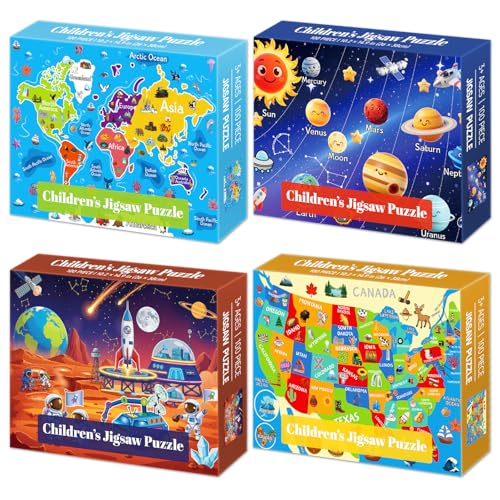
- Four USA, world, solar system, and Mars themes
- 15-by-10-inch finished puzzles with reference posters
- Supports concentration, problem-solving, and hand-eye coordination
Best For: Homeschool learners ages 4–10 studying geography and space
Geography Floor Learning
Melissa & Doug World Map Floor Puzzle

- 33-piece world map for floor assembly
- Finished size is 2 by 3 feet
- Introduces continents and major oceans
Best For: Ages 6+ and geography-focused floor learning
Early Skills Starter Set
Wooden 4-Pack Preschool Puzzles

- Four 20-piece dinosaur, animal, space, and transport puzzles
- Wooden trays and removable guides aid assembly
- Smooth, rounded edges support repeated play
Best For: Preschool homeschool learners ages 3–6
Wooden STEM Map Set
USA, World, Earth & Solar System Puzzles

- Four wooden 24-piece geography and space puzzles
- Frames and removable guides support assembly
- Polished edges and sturdy pieces suit repeated use
Best For: Beginner homeschool learners ages 3–6
Hands-On Geography Starter

- 40 raised pieces feature the fifty states
- Designed for ages 3 and up
- Builds fine-motor and problem-solving skills
Best For: Preschool map-learning activities
World Geography Explorer

- Country-shaped pieces encourage discovery
- Large 26-by-12.5-inch finished map
- Supports geography, teamwork, and motor skills
Best For: World geography and social-studies practice
Big-Picture State Study

- Large 22.8-inch round floor puzzle
- Covers states, capitals, and regional features
- Includes reference poster and storage box
Best For: Ages 4–10 learning U.S. geography
Hands-On Geography Pick
Montessori Mama USA Map Puzzle

- Wooden 37-piece map puzzle
- Covers states, capitals, landmarks, and animals
- Compact beginner activity for ages 4–8
Best For: Younger homeschoolers beginning U.S. geography
Collaborative Floor-Learning Choice

- Large 23.6-by-17-inch finished map
- State-shaped pieces feature all 50 states
- Designed for solo or group learning
Best For: Shared homeschool geography activities for ages 4–10
Illustrated Map Challenge
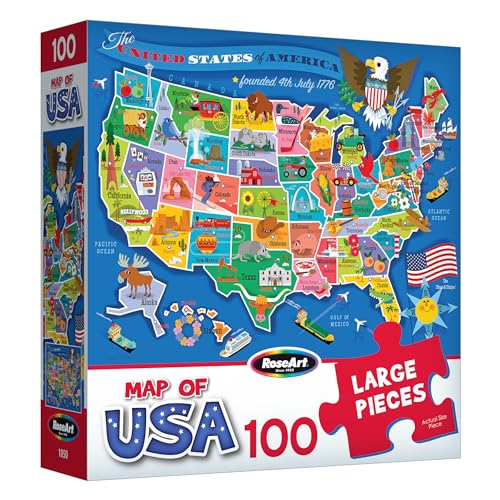
- 100 large pieces form a 24-by-18-inch map
- Includes colorful regional illustrations
- Supports geography and spatial-learning skills
Best For: Ages 6+ ready for a more challenging map activity
Map & Space Learning Set – 4-Pack 100-Piece Educational Puzzles
For families comparing jigsaw puzzles for homeschool, this four-pack combines geography and space topics with a substantial 100 pieces per puzzle. The USA map, world map, solar system, and Mars Adventure designs offer variety, while the included reference posters and lettered backs can make assembly more approachable.
Best For: Homeschool learners ages roughly 4–10 who enjoy geography, astronomy, and repeat tabletop activities.
Pros:
- Includes four educational map and space themes.
- Each completed puzzle measures 15 by 10 inches.
- Thickened cardboard, bright printing, reference posters, and lettered backs support assembly.
- Provides practice with concentration, problem-solving, observation, and hand-eye coordination.
Cons:
- 100 pieces may be demanding for younger preschool learners.
- The set is designed for tabletop use, so it needs a clear assembly surface.
This is a flexible choice when you want one purchase to cover multiple homeschool topics. Its larger piece count suits children ready for a longer challenge, while the varied themes help keep practice sessions from feeling repetitive.
Geography Floor Learning – Melissa & Doug World Map Floor Puzzle
This jumbo world map is a practical option for jigsaw puzzles for homeschool when you want geography learning to happen on the floor. Its 33 large pieces assemble into a 2-by-3-foot map, giving children space to explore continents and major oceans while practicing basic puzzle skills.
Best For: Children ages 6 and up who benefit from a large-format, introductory geography activity.
Pros:
- Large 2-by-3-foot assembled format creates an engaging floor activity.
- Introduces continent and major ocean locations, shapes, and names.
- 33 pieces offer an easier entry point than high-piece-count puzzles.
- Supports hand-eye coordination, problem-solving, and world knowledge.
Cons:
- Only one geography design is included.
- The oversized finished puzzle requires substantial floor space.
Choose this puzzle if geography is the priority and your homeschool setup has room for floor work. The manageable piece count keeps the focus on map exploration rather than an especially complex assembly challenge.
Early Skills Starter Set – Wooden 4-Pack Preschool Puzzles
For early learners using jigsaw puzzles for homeschool, this wooden four-pack keeps activities short and approachable with 20 pieces per puzzle. Dinosaur, animal, space, and transportation themes add variety, while the wooden trays and removable guides help children organize pieces and work independently.
Best For: Preschool children ages 3–6 building early problem-solving, matching, fine-motor, and spatial skills.
Pros:
- Four familiar themes encourage repeated practice.
- 20-piece puzzles provide a manageable preschool challenge.
- Wooden trays keep pieces contained and simplify storage.
- Smooth, rounded edges and sturdy construction support repeated handling.
Cons:
- Shorter puzzles may not challenge advanced older children.
- Small-to-medium puzzle dimensions provide less workspace than floor puzzles.
This set fits naturally into short homeschool rotations, independent work periods, or skill-building stations. Its trays and guides are especially useful when cleanup and organization matter as much as the puzzle activity itself.
Wooden STEM Map Set – USA, World, Earth & Solar System Puzzles
This wooden set is a strong fit for jigsaw puzzles for homeschool centered on geography and early STEM topics. Four 24-piece puzzles cover the USA, world, Earth, and solar system, with colorful illustrations, wooden frames, and removable reference pictures to support guided or independent assembly.
Best For: Beginner learners ages 3–6 exploring maps, planets, spatial reasoning, and matching skills.
Pros:
- Combines USA, world, Earth, and solar system subjects.
- Wooden frames help keep pieces in place during tabletop work.
- Thicker wooden pieces have polished edges for child-friendly handling.
- Reference illustrations support matching, memory, and independent practice.
Cons:
- At 24 pieces per puzzle, the set may be too simple for advanced puzzlers.
- Four related educational themes may be less varied than a mixed-topic set.
Consider this set when you want durable, structured puzzles that connect naturally to geography and space lessons. The frames and guides reduce setup difficulty, making the activities suitable for beginners and repeated homeschool use.
Hands-On Geography Starter – USA Map Lift & Learn Puzzle
For younger learners beginning with jigsaw puzzles for homeschool, this 40-piece USA map board offers a tactile introduction to the fifty states. Raised pieces are designed for small hands, while the map theme supports early geography exploration alongside fine-motor practice.
Best For: Preschool learners ages 3 and up who benefit from simple, hands-on map activities.
Pros:
- Raised, easy-grip pieces support young children’s handling skills.
- Introduces the fifty states through a bright, color-coded map.
- Supports fine-motor skills, hand-eye coordination, concentration, and independent play.
- Portable board format is suitable for one player.
Cons:
- Its 40-piece beginner format may be too easy for older children.
- The manufacturer’s recommended age range is 36 months to 6 years.
This is a practical first map puzzle for homeschool routines, especially when the goal is to combine early geography with confidence-building, problem-solving play rather than extended lesson work.
World Geography Explorer – GeoPuzzle World Map
Families looking for jigsaw puzzles for homeschool with a social-studies focus can use this GeoPuzzle World set to explore countries through a 68-piece map. Country-shaped pieces and a large finished format make geography more interactive for independent practice or shared learning.
Best For: Children ages 6 and up working on world geography, country recognition, and collaborative learning.
Pros:
- Country-shaped pieces connect puzzle play with geographic discovery.
- Large 26-by-12.5-inch map provides a substantial finished display.
- Supports fine-motor development and cognitive growth.
- Portable design works for home, school, or travel activities.
Cons:
- The detailed world map may require adult guidance for younger learners.
- The supplied specifications list the puzzle as a beginner-level activity, so advanced puzzlers may want more challenge.
Its strongest homeschooling value is as an engaging supplement to geography or social-studies lessons, giving children a way to discuss countries and how they fit together while assembling the map.
Big-Picture State Study – 70-Piece USA Map Floor Puzzle
This 70-piece floor puzzle is a useful choice for jigsaw puzzles for homeschool when children are ready for a larger USA map activity. The oversized 22.8-inch round design includes state and regional details, while the reference poster can support guided geography review.
Best For: Children ages 4 to 10 studying the fifty states, capitals, landmarks, and regional features.
Pros:
- Large floor format creates an engaging map-learning workspace.
- Includes a reference poster and storage box for organized practice.
- Map includes states, capitals, landmarks, rivers, mountains, and the Great Lakes.
- Jumbo pieces are easier for young children to see, lift, and place.
Cons:
- The floor-based format needs a suitably open play area.
- At 70 pieces, it may be more demanding for children at the youngest end of the recommended range.
With more geographic detail than a basic state outline puzzle, this option can anchor short homeschool lessons or repeat review sessions while also practicing concentration, logical thinking, and problem solving.
Hands-On Geography Pick – Montessori Mama USA Map Puzzle
For families comparing jigsaw puzzles for homeschool, this wooden USA map offers a compact, hands-on geography activity for children ages 4–8. Its 37 pieces cover all 50 states along with capitals, landmarks, and state animals.
Best For: Younger homeschoolers learning introductory U.S. geography at a tabletop.
Pros:
- Wooden construction is designed for repeated use.
- Includes geography details such as state capitals, landmarks, and animals.
- Supports matching, problem-solving, spatial awareness, and creative thinking.
Cons:
- The 37-piece format may provide less assembly challenge for older children.
- Its 14.8-by-10-inch size is relatively compact for group work.
This is a practical choice when you want a durable, beginner-level puzzle that can complement map lessons without taking up much table space.
Collaborative Floor-Learning Choice – 70-Piece USA Map Puzzle
This 70-piece floor puzzle is a strong option for jigsaw puzzles for homeschool when children need room to work independently or with a parent. Large, state-shaped pieces form a 23.6-by-17-inch map featuring all 50 states, capitals, landmarks, and landscapes.
Best For: Homeschool geography sessions, family learning, and classroom-style activities for ages 4–10.
Pros:
- Large finished size and state-shaped pieces encourage map exploration.
- Supports problem-solving, observation, concentration, memory, and spatial reasoning.
- Can be used independently or as a shared family activity.
- Safety-tested chipboard construction is designed for repeated play.
Cons:
- The larger floor format requires more workspace than a tabletop puzzle.
- Some younger children may need help with the 70-piece challenge.
Choose this version if you want a more substantial map-building experience that creates opportunities for discussion, cooperation, and screen-free geography practice.
Illustrated Map Challenge – RoseArt 100-Piece USA Puzzle
For older children ready for a fuller assembly challenge, this RoseArt puzzle is one of the jigsaw puzzles for homeschool that combines U.S. geography with colorful visual cues. The 100 large pieces create a 24-by-18-inch map showing all 50 states, landmarks, and regional icons.
Best For: Homeschoolers ages 6 and up practicing map skills, memory, and spatial reasoning.
Pros:
- 100 large pieces provide a more involved activity for independent or shared play.
- State illustrations feature animals, foods, landmarks, and other regional details.
- Supports map skills, problem-solving, memory, and spatial awareness.
- Made in the USA with kid-safe finishes.
Cons:
- The 100-piece format may be demanding for younger beginners.
- Its 24-by-18-inch finished size needs a reasonably large work surface.
This puzzle suits homeschool lessons that benefit from visual geography prompts and a longer, more challenging build than smaller introductory map puzzles.
How We Picked the Best Jigsaw Puzzles for Homeschool
We focused on puzzles that combine educational value with practical playability. The roundup includes USA and world maps, solar system designs, landmark and animal illustrations, and broader preschool themes such as dinosaurs and transportation. We also considered whether each puzzle offers features useful in a homeschool setting, including large pieces, floor-friendly formats, wooden construction, self-correcting elements, and clear age guidance.
Piece count matters, but it is not the only measure of difficulty. Piece size, image detail, board thickness, and the child’s previous puzzle experience can make a 70-piece puzzle easier or harder than a smaller, more detailed set.
Quick Comparison
- Best for early learners: Lift-and-learn and large-piece wooden puzzles with simple images.
- Best for geography practice: USA map puzzles that show states, landmarks, animals, or regional illustrations.
- Best for global studies: World map puzzles that introduce continents, countries, and oceans.
- Best for science units: Solar system puzzles featuring planets and space imagery.
- Best for shared play: Large floor puzzles with sturdy pieces and oversized finished designs.
- Best for flexible lessons: Multi-pack sets that provide several subjects or difficulty levels.
Key Buying Factors for Jigsaw Puzzles for Homeschool
Age and Developmental Level
Choose an image and piece size that match the learner, not just the printed age range. Preschoolers typically benefit from chunky wooden pieces or large floor-puzzle pieces, while children six and older may enjoy smaller pieces and more detailed maps.
Educational Goal
For geography lessons, look for labeled states, continents, landmarks, or animals. For science, choose solar system artwork. A themed multi-pack may work best when you want to connect puzzle time with several units throughout the year.
Materials and Durability
Wooden puzzles are useful for frequent preschool use and are easy to handle, while thick cardboard floor puzzles provide a larger visual learning surface. Check that pieces are easy to store and resist bending if the puzzle will be used repeatedly.
Difficulty and Independence
Simple illustrations and fewer, larger pieces support independent completion. More detailed maps and higher piece counts are better for older children, family activities, or guided lessons where you can discuss locations as the puzzle comes together.
Who Should Buy Which Jigsaw Puzzles for Homeschool?
Buy a wooden preschool set or lift-and-learn USA map for children who are developing matching, sorting, and fine-motor skills. Choose a large USA map floor puzzle for an introductory geography unit or cooperative sibling activity. A world map puzzle is a stronger choice for continent and country practice, while a solar system option fits astronomy lessons and space-themed units. Families wanting variety should consider a multi-pack, and older elementary learners may prefer a 68- or 100-piece map with richer detail. Whichever format you choose, keep the activity active by asking children to identify places, describe patterns, or connect the finished puzzle to books and lessons.