The best KVM switches let you control multiple computers with one keyboard, mouse, display setup, and USB accessory collection. The right model can simplify a home office, improve a gaming workstation, or connect several systems without repeatedly swapping cables.
This roundup compares 10 KVM switches across single- and multi-monitor setups, 4K and 8K video, high refresh rates, Thunderbolt 4, remote access, and different computer counts.
Best 10 Kvm Switches Picks for 2026
Best Dual-Monitor HDMI KVM

- Dual-monitor mirrored or extended display
- 8K@60Hz and 4K@120Hz support
- Four-port USB 3.0 hub
Best For: Two-computer workstations with dual HDMI outputs
Best Remote KVM
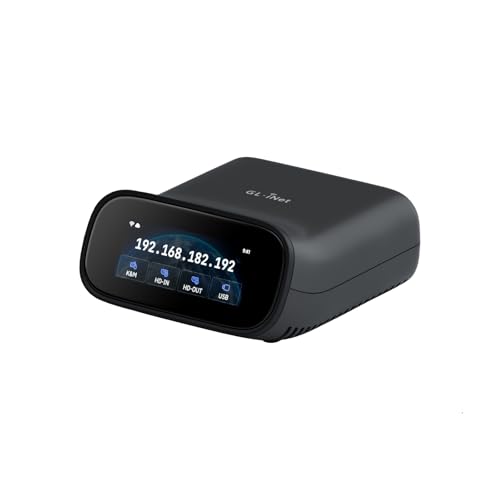
- Wired and dual-band Wi-Fi 6 access
- 4K@30FPS passthrough with two-way audio
- Browser, app, and self-hosted access options
Best For: Remote IT management and home lab administration
Best Thunderbolt KVM
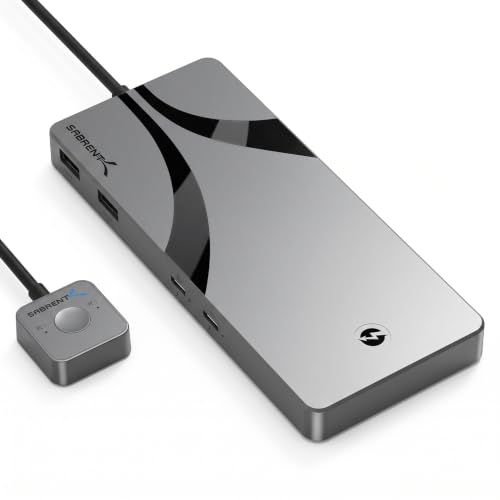
- 40Gbps Thunderbolt 4 connectivity
- Up to 8K@60Hz display output
- 60W laptop charging and seven device ports
Best For: Thunderbolt workstations using Windows or macOS
Best Value Dual-Monitor KVM

- Dual-monitor mirrored or extended modes
- 8K@60Hz and 4K@120Hz support
- Four USB 3.0 peripheral-sharing ports
Best For: Work, gaming, and multitasking with two HDMI-equipped computers
Triple-Display Powerhouse

- Shares three monitors and four USB 3.0 peripherals
- Supports up to 8K@60Hz and high refresh rates
- Includes button and wired-controller switching
Best For: Two-computer, triple-monitor workstations
Simple Single-Screen Switcher

- Shares one monitor between two computers
- Includes three USB-A and one USB-C ports
- Supports 4K@60Hz with wired remote switching
Best For: Straightforward single-monitor office desks
Dual-Monitor Office Hub
UGREEN 4K HDMI Dual-Monitor KVM

- Shares two HDMI monitors between two computers
- Adds four USB 3.0 peripheral ports
- Supports 4K@60Hz with mirror and extend modes
Best For: Two-monitor HDMI home and professional offices
Best for Four-PC Sharing

- Connects four computers to one monitor
- Supports 4K@60Hz video
- Includes four USB 3.0 ports and remote control
Best For: Four-computer workstations needing shared USB peripherals
Best USB Expansion
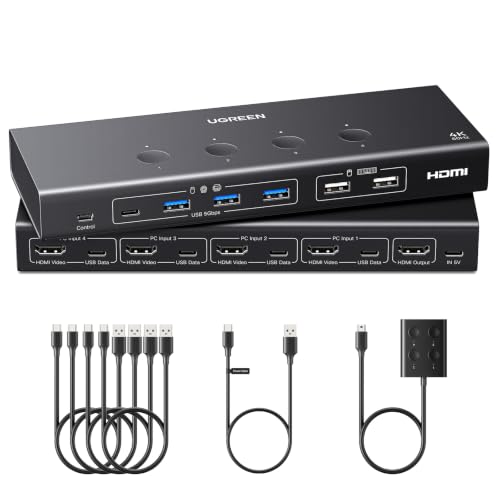
- Shares one monitor across four computers
- Includes six USB ports
- Adds EDID emulation for display continuity
Best For: Office and testing setups with several shared USB devices
Best for Two Computers

- Switches one monitor between two computers
- Supports 4K@60Hz video
- Includes HDMI and USB connection cables
Best For: Home offices and gaming desks with two HDMI computers
Best Dual-Monitor HDMI KVM – 8K 2-Port Dual-Display Switch
This HDMI KVM switch is designed for users who want to control two computers from one desk setup while sharing two monitors and up to four USB peripherals. It supports mirrored or extended displays, with up to 8K at 60Hz and 4K at 120Hz, provided the computers have two HDMI outputs and support the required display modes.
Best For: Dual-monitor workstations that need high-resolution video and shared USB accessories.
Pros:
- Supports extended or mirrored output across two monitors.
- Offers up to 8K@60Hz and 4K@120Hz video performance.
- Four USB 3.0 ports share peripherals at speeds up to 5Gbps.
- Includes a 12V power adapter and wired desktop controller.
Cons:
- Requires two HDMI outputs from each computer for dual-monitor operation.
- Does not support keyboard hotkey switching.
- High-power USB devices may require the included external power supply.
This is a practical choice among kvm switches for a two-computer, two-monitor setup, but buyers should confirm their graphics outputs and display compatibility before purchasing.
Best Remote KVM – GL.iNet Comet Pro Wi-Fi 6 KVM
The GL.iNet Comet Pro is a remote-access KVM for managing computers over wired or dual-band Wi-Fi 6 connections. It adds 4K@30FPS video passthrough, two-way audio, browser-based access, app support, and recovery functions such as BIOS access and remote OS installation.
Best For: Home labs, IT support, and remote administration where physical access is inconvenient.
Pros:
- Supports both 2.4GHz and 5GHz Wi-Fi alongside wired connectivity.
- Provides 4K@30FPS passthrough with two-way audio.
- Works through web-based access without requiring client software.
- Built-in Tailscale and self-hosted cloud options support flexible remote access.
Cons:
- Some capabilities require separately sold ATX Board or Fingerbot accessories.
- Its remote-networking features may be more than a basic local KVM setup needs.
Unlike conventional desk-based kvm switches, this model is focused on secure remote control and recovery. It is especially useful when BIOS-level access or remote power management matters.
Best Thunderbolt KVM – Sabrent 40Gbps TB4 Switch
The Sabrent Thunderbolt 4 KVM Switch is built for users who need to share Thunderbolt, USB, and display connections between two computers. With 40Gbps Thunderbolt connectivity, USB Type-A ports, DisplayPort output support, and up to 60W charging, it suits demanding laptop and desktop workspaces.
Best For: Windows or macOS users with Thunderbolt 4 systems and high-speed peripherals.
Pros:
- Supports Thunderbolt 4 transfer speeds up to 40Gbps.
- Includes three Thunderbolt 4 ports and four USB Type-A ports.
- Can deliver up to 8K@60Hz or 5K@60Hz display output.
- Provides up to 60W PD3.0 charging with an included 24V/5A adapter.
Cons:
- Designed primarily for Windows and macOS systems with compatible Thunderbolt or USB-C support.
- Two-screen use is limited to up to 4K@60Hz.
- The supplied listing specifies no warranty.
This is one of the more capable kvm switches for a Thunderbolt-centered desk, combining device sharing, display output, and laptop charging in one aluminum enclosure.
Best Value Dual-Monitor KVM – 8K HDMI USB 3.0 Switch
This dual-monitor HDMI KVM switch lets one keyboard and mouse control two computers while sharing four USB devices. It supports up to 8K at 60Hz and 4K at 120Hz, plus one-touch switching from the unit or included wired controller, making it a straightforward option for work, gaming, and multitasking setups.
Best For: PC, laptop, and gaming setups needing two monitors and shared USB peripherals.
Pros:
- Supports mirrored and extended dual-monitor modes.
- Handles up to 8K@60Hz and 4K@120Hz video.
- Four USB 3.0 ports provide up to 5Gbps transfer speeds.
- Includes external power and a wired controller for stable switching.
Cons:
- Requires two HDMI outputs and compatible dual-display support on each computer.
- Keyboard hotkey switching is not supported.
- Passive adapters or standard conversion cables may not carry video signals.
For buyers comparing kvm switches for a dual-screen setup, this model offers useful high-refresh-rate support and peripheral sharing at the cost of stricter connection requirements.
Triple-Display Powerhouse – UGREEN 8K Triple-Monitor KVM
Among kvm switches, this UGREEN model is aimed at users who need to move between two computers while sharing three monitors and four USB peripherals. Its DisplayPort and HDMI connectivity supports high-refresh-rate displays, but both computers must support triple-monitor output for the full setup to work.
Best For: Content creators, IT professionals, and home-office users with two triple-display computers.
Pros:
- Shares three monitors and four USB 3.0 devices between two computers.
- Supports up to 8K@60Hz, 4K@240Hz, HDR10+, VRR, FreeSync, and G-Sync when the connected equipment supports them.
- Includes both onboard-button and wired desktop-controller switching.
- Offers mirror and extend display modes and works with Windows and Linux.
Cons:
- Requires each computer to connect with two DisplayPort cables, one HDMI cable, and one USB cable.
- Both computers need suitable triple-display support; converters or docking stations may cause compatibility issues.
- Does not support keyboard hotkey switching or EDID emulation.
This is a feature-rich choice for a demanding multi-monitor workspace, provided your computers, monitors, cables, and power setup meet its requirements. Verify triple-display compatibility before buying.
Simple Single-Screen Switcher – S7232H 4K HDMI KVM
This compact option keeps kvm switches straightforward: two computers share one monitor, keyboard, mouse, and other USB accessories. It combines HDMI and USB switching in one unit, with 4K@60Hz support and no driver installation required.
Best For: Home offices and basic two-computer setups using one HDMI monitor.
Pros:
- Lets two computers share one monitor and common keyboard and mouse.
- Provides three USB-A and one USB-C USB 3.0 ports with speeds up to 5Gbps.
- Supports 4K@60Hz, HDCP 2.2, 3D, and lower resolutions.
- Offers switching from the unit or a wired remote and includes Adaptive EDID.
Cons:
- Supports one shared monitor rather than a multi-monitor setup.
- Uses HDMI video connectivity, so it is not suited to DisplayPort-only systems without additional equipment.
- The notes do not list a power adapter in the package contents.
For a conventional one-monitor desk, this model offers a practical mix of video switching, shared USB connectivity, and convenient remote control without software setup.
Dual-Monitor Office Hub – UGREEN 4K HDMI Dual-Monitor KVM
This UGREEN model is one of the more practical kvm switches for a two-monitor HDMI workstation. It allows two computers to share two monitors and four USB 3.0 peripherals, with support for mirrored or extended displays and convenient wired-controller switching.
Best For: Professional or home-office users with two HDMI monitors and two computers.
Pros:
- Shares two HDMI monitors and four USB 3.0 devices between two computers.
- Supports 4K@60Hz, HDMI 2.0, HDCP 2.2/1.4, 3D, HDR, and HDR10+.
- Includes three USB-A and one USB-C ports for peripherals and storage devices.
- Provides button and desktop-controller switching without drivers.
Cons:
- Both monitors show video from the selected computer; the two screens cannot display different computers simultaneously.
- Requires two HDMI cables and one USB-A cable per computer.
- Does not support keyboard hotkeys or EDID emulation, and output HDMI cables should be within three meters.
This is a well-targeted choice for dual-screen HDMI desks, especially when tidy cable management and shared USB accessories matter. Confirm that both computers support simultaneous dual-display output.
Best for Four-PC Sharing – 4-Port HDMI KVM with Remote
For buyers comparing kvm switches for a four-computer setup, this model combines one-monitor switching with four shared USB 3.0 ports. Its 4K@60Hz support, push-button controls, and included remote make it a practical choice for a tidy workstation or shared-room installation.
Best For: Users who need to control four computers from one HDMI display while sharing USB peripherals.
Pros:
- Supports up to 4K@60Hz and is backward compatible with lower resolutions.
- Shares four USB 3.0 devices, including keyboards, mice, printers, and scanners.
- Offers panel-button and remote-control switching, with a wired infrared extension for flexible placement.
- Works with Windows, Mac OS, Linux, Unix, and other listed systems without drivers.
Cons:
- Does not support hotkey switching.
- HDMI and other signal components must support 4K@60Hz to achieve the highest resolution.
- The setup is limited to one monitor.
This is a feature-focused four-port KVM for users who value high-resolution video, fast USB connectivity, and remote access. It is less suitable if keyboard hotkeys or multi-monitor support are priorities.
Best USB Expansion – UGREEN 4-Port HDMI KVM
This UGREEN model stands out among kvm switches for its six shared USB ports and EDID emulation. It can connect four computers to one monitor while helping preserve display settings during source changes, making it suited to busy office, testing, or teaching environments.
Best For: Users who need four-computer switching, multiple USB peripherals, and more consistent display behavior between switches.
Pros:
- Supports 4K@60Hz, HDMI 2.0, HDR, 3D, and HDCP 2.2/1.4.
- Provides four USB 3.0 ports and two USB 2.0 ports for peripherals and storage devices.
- EDID emulation can retain monitor identification and display configuration during switching.
- Switches through a front button or included wired desktop controller.
Cons:
- Each computer requires both an HDMI cable and a USB A-to-C data cable; cables and power adapter are not included.
- Requires a power connection for stable use and USB peripheral operation.
- Not supported with docking stations.
Choose this KVM if USB capacity and display continuity matter more than a minimal cable setup. Buyers should budget for the required cables and confirm that their computers are compatible with the USB A-to-C connections.
Best for Two Computers – UGREEN 2-Port HDMI KVM
For a simpler dual-computer setup, this compact UGREEN option lets one HDMI monitor and one set of USB peripherals serve two systems. Among kvm switches, it is a practical fit for home offices, gaming rooms, and users who do not need four-way switching.
Best For: Home-office or gaming users switching between two HDMI computers with one monitor, keyboard, and mouse.
Pros:
- Supports up to 4K@60Hz, along with HDR, 3D, HDMI 2.0, and HDCP 2.2/1.4.
- Includes four USB ports and shares peripherals between two computers.
- Offers front-button and wired desktop-controller switching.
- Includes two USB A-to-B cables, two HDMI cables, and the desktop controller.
Cons:
- Does not support EDID emulation or hotkey switching.
- Supports only one monitor and is not a DisplayPort KVM.
- Both USB A-to-B cables must be connected for normal keyboard and mouse operation.
This is the most straightforward choice of the three for a two-computer desk. Its included cables simplify setup, but users wanting automatic display retention, hotkeys, multiple monitors, or docking-station compatibility should consider other options.
How We Picked These Kvm Switches
We selected models that cover the most common workstation and gaming requirements, from simple two-computer HDMI sharing to advanced dual- or triple-monitor setups. We considered video resolution and refresh-rate support, the number and type of connected computers, USB hub capacity, display flexibility, switching methods, and compatibility with modern laptops and desktops.
Because specifications can vary by computer, cable, operating system, and display, treat advertised resolution as a maximum rather than a guarantee for every setup. Check the product’s input, output, and USB requirements before purchasing.
Quick Comparison
- Best for dual monitors: Choose a dual-monitor HDMI KVM with extended-display support.
- Best for high-end USB-C or Thunderbolt systems: The Thunderbolt 4 option is designed for high bandwidth, 4K at high refresh rates, and 8K output.
- Best for remote access: The remote KVM provides Wi-Fi-based control and 4K passthrough.
- Best for three monitors: Consider the UGREEN model supporting three displays.
- Best for four computers: A four-port KVM is more convenient than chaining multiple switches.
- Best for a basic two-computer setup: A single-monitor, two-port HDMI KVM keeps the installation simple and affordable.
Key Buying Factors for Kvm Switches
Video Outputs and Display Support
Start with the number of monitors you need to share. A single-monitor KVM is suitable for a straightforward desk, while dual- and triple-monitor models are better for productivity or simulation work. Verify whether the switch supports mirrored output or independent extended desktops, as these are not interchangeable.
Resolution, Refresh Rate, and Features
4K at 60Hz is sufficient for most office work. Gaming and motion-heavy applications may benefit from 4K at 120Hz or 144Hz. If you need 8K, confirm that the computers, displays, cables, and graphics hardware all support the required HDMI, DisplayPort, or Thunderbolt standard. EDID support can also help preserve window placement and prevent display renegotiation when switching.
USB and Peripheral Sharing
Count the USB devices you plan to share, including a keyboard, mouse, webcam, storage drive, microphone, and printer. USB 3.0 ports are preferable for fast peripherals, but some switches reserve certain ports for keyboard and mouse compatibility. Check whether the switch supplies enough power for bus-powered accessories.
Switching and Compatibility
Buttons, wired controllers, keyboard hotkeys, and software-based controls each suit different desks. Confirm operating-system support and whether your computers use HDMI, DisplayPort, USB-C, or Thunderbolt. Some systems may require adapters, separate charging, or an additional dock.
Who Should Buy Which Kvm Switches?
Office and hybrid-work users should choose a reliable two-computer KVM with the monitor count and USB ports needed for daily peripherals. Content creators and power users will benefit from dual- or triple-monitor support, higher bandwidth, and EDID functionality. PC gamers should prioritize refresh rate, input latency, and direct compatibility with their graphics outputs. IT professionals and multi-PC households should look for four-computer models with a dedicated controller and sufficient USB capacity. Traveling or remote-access users may prefer a network-enabled KVM, provided their Wi-Fi environment and security practices meet the device’s requirements.