Choosing among LCR meters for capacitors means looking beyond a basic capacitance reading. Test frequency, ESR capability, accuracy, auto-ranging, display quality, and probe style can all affect how useful a meter is on a workbench.
This roundup compares 10 practical options for electronics repair, component sorting, prototyping, and hobby projects. Whether you need fast SMD testing or broader RLC measurements, the right model depends on the components and fault conditions you expect to encounter.
Best 10 Lcr Meters for Capacitors Picks for 2026
Advanced Precision Pick

- 19,999-count display with detailed secondary parameters
- 1pF–100mF capacitance range and up to 100kHz testing
- Sorting, calibration, and Kelvin-style measurement fixtures
Best For: Detailed capacitor testing and component screening
Portable Frequency Flexibility Pick
- Automatic or manual component identification
- DC, 1kHz, 15kHz, and 200kHz test frequencies
- Hold function and fine stated measurement resolution
Best For: Portable passive-component checks with flexible frequencies
Quick ESR Troubleshooting Pick

- 0.01Ω–100Ω ESR and low-ohm measurement range
- Auto-ranging operation for capacitor checks
- Dual terminals, ESR reference table, and test clips
Best For: Fast capacitor ESR and in-circuit troubleshooting
Bench Testing Workhorse

- 20,000/2,000-count dual display with Q, D, phase, and ESR
- Five frequencies from 100Hz to 100kHz
- Calibration, limit settings, and series/parallel modes
Best For: Versatile bench testing of passive components
Versatile Bench Tester
- 200pF–2000μF capacitance range
- Zero adjustment for capacitance
- Rotatable LCD and complete accessory kit
Best For: General bench testing and electronics repair
Advanced SMD Choice
- 1pF–22mF capacitor measurement
- Scans from 100Hz to 100kHz
- Shows D, Q, X, and phase values
Best For: SMD testing and detailed component analysis
Simple Wide-Range Option

- 200pF–2000μF capacitance coverage
- Zero adjust, data hold, and auto power-off
- Flip LCD with included clips and battery
Best For: Everyday household and hobbyist troubleshooting
Versatile Component Tester

- Tests capacitance, ESR, resistance, inductance, and more
- Automatic identification and capacitor discharge protection
- Rechargeable USB-C design with SMD adapter
Best For: Multifunction component testing and repair work
High-Frequency Bridge Meter
ET430 100KHz Handheld LCR Meter

- Six test frequencies from 100 Hz to 100 kHz
- 2.8-inch display shows primary and secondary parameters
- 0.3% basic accuracy with one-year warranty
Best For: Frequency-flexible handheld capacitor measurements
Precision SMD Tweezers
FNIRSI LCR-ST1 LCR Meter Tweezers

- Tests capacitors from 1 pF to 22 mF
- Three frequencies and D/Z/Q/R/ESR readings
- Tweezer heads, record storage, and PC data export
Best For: SMD repair and circuit-board troubleshooting
Advanced Precision Pick – FNIRSI LC1020E
For shoppers comparing lcr meters for capacitors, the FNIRSI LC1020E stands out with broad capacitance coverage, multiple test frequencies, and detailed secondary readings. Its 19,999-count display, calibration functions, and sorting mode make it especially useful for repeatable component testing.
Best For: Technicians and hobbyists screening capacitors and other passive components with detailed measurements.
Pros:
- Measures capacitors from 1pF to 100mF and supports frequencies up to 100kHz.
- Displays secondary values such as ESR, Q, D, θ, and X alongside the main reading.
- Includes open/short calibration, adjustable test voltage, and component sorting with tolerance limits.
- Uses Kelvin-style fixtures, a color TFT display, and a rechargeable 3000mAh battery.
Cons:
- Requires careful capacitor discharge and calibration before testing.
- Its many settings may be more than casual users need.
The LC1020E is a strong all-around choice when capacitor testing requires more than a basic pass/fail or ESR check. Its sorting and calibration tools add value for troubleshooting, matching, and batch screening.
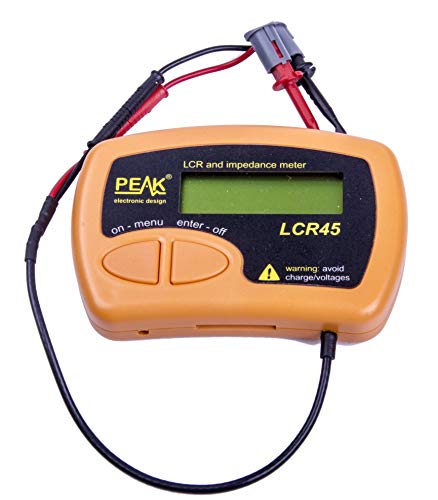
Portable Frequency Flexibility Pick – Peak Atlas LCR45
The Peak Atlas LCR45 is a compact option for anyone shopping for lcr meters for capacitors and other passive components. It combines automatic or manual component identification with selectable frequencies from DC through 200kHz, while its hold function helps preserve readings during inspection.
Best For: Portable component checks where flexible frequency selection and simple operation matter.
Pros:
- Supports automatic or manual component type selection.
- Offers DC, 1kHz, 15kHz, and 200kHz test frequencies.
- Provides fine stated resolution down to 0.2pF, 0.2µH, and 0.2 ohms.
- Includes a fluid menu system and reading hold function.
Cons:
- The supplied notes do not specify a dedicated capacitance range.
- It is corded electric rather than battery powered.
The LCR45 is best suited to users who value a small, straightforward instrument with unusual frequency flexibility. It is a practical bench or service tool when the required measurement range matches the application.
Quick ESR Troubleshooting Pick – Signstek MESR-100 V2
The Signstek MESR-100 V2 is a focused choice among lcr meters for capacitors, prioritizing fast ESR and low-resistance checks. Its auto-ranging design and dual-terminal setup make it convenient for inspecting general capacitors or resistors, including in-circuit testing.
Best For: Rapid capacitor ESR checks and low-ohm troubleshooting.
Pros:
- Measures capacitor ESR from 0.01Ω to 100Ω.
- Supports auto-ranging capacitor ESR and low-ohm measurements.
- Dual terminals help make routine inspections quick and simple.
- Includes a printed ESR table and upgraded test clips.
Cons:
- It is primarily an ESR and low-ohm tester rather than a full-featured LCR analyzer.
- The supplied notes do not list selectable test frequencies or advanced parameters such as Q and D.
Choose the MESR-100 V2 when capacitor health checks are the priority and speed matters more than comprehensive impedance analysis. It is particularly useful for service work and in-circuit troubleshooting.
Bench Testing Workhorse – Extech LCR200
The Extech LCR200 is a versatile bench instrument for buyers evaluating lcr meters for capacitors, resistors, and inductors. It combines 20,000/2,000-count dual-display readings with selectable frequencies, open/short calibration, and series or parallel measurement modes.
Best For: Bench technicians who need broad passive-component measurements and configurable limit testing.
Pros:
- Measures capacitance, inductance, and resistance while displaying Q, D, phase, and ESR.
- Offers five test frequencies from 100Hz to 100kHz.
- Supports open/short calibration, series or parallel modes, and high/low limit settings.
- Includes a built-in fixture, external leads, auto-power-off, and a 9V battery.
Cons:
- At 0.43kg and 7.6 inches long, it is less compact than some handheld options.
- Uses a replaceable 9V battery rather than a rechargeable battery.
The LCR200 offers a well-rounded feature set for routine lab and repair work. Its dual display and limit functions make it especially useful when comparing components or checking them against defined acceptance criteria.
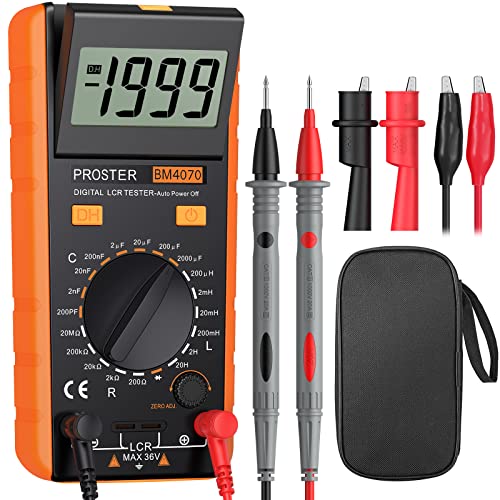
Versatile Bench Tester – Proster BM4070 LCR Meter
For shoppers comparing lcr meters for capacitors, the Proster BM4070 is a traditional, range-based tester with broad capacitance coverage, a zero-adjust function, and additional inductance, resistance, and diode testing. Its rotatable display and included accessories make it practical for bench troubleshooting.
Best For: Hobbyists, repair work, and component testing involving capacitors, inductors, and resistors.
Pros:
- Measures capacitance from 200pF to 2000μF across eight ranges.
- Zero adjustment helps account for stray lead or circuit capacitance.
- Includes data hold, rotatable LCD, auto power-off, test leads, clips, battery, and storage bag.
- Also measures inductance from 200μH to 20H and resistance from 200Ω to 20MΩ.
Cons:
- Uses a manual range-based design rather than the advanced frequency and secondary-parameter displays found on newer testers.
- Runs on a 9V battery.
The BM4070 is a sensible choice when you want wide capacitor coverage and a complete conventional LCR kit. Its 3½-digit display and stated accuracy are suited to general diagnostics, sorting, and hobby electronics rather than advanced impedance analysis.
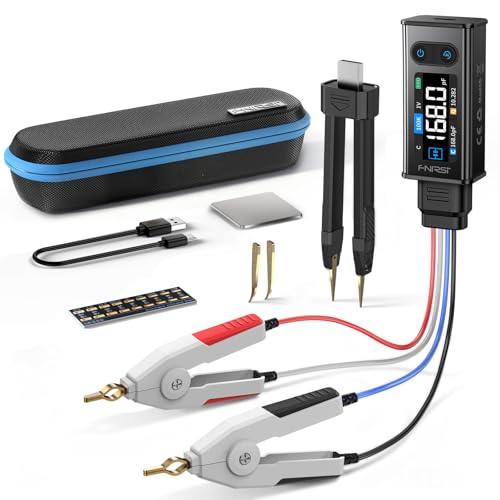
Advanced SMD Choice – FNIRSI LCR-ST2 100kHz Tester
If you need lcr meters for capacitors that can handle both SMD parts and through-hole components, the FNIRSI LCR-ST2 offers automatic testing, multiple scan frequencies, and detailed secondary readings. Its tweezer format is especially convenient for small components.
Best For: SMD work, component verification, and users who want frequency-based capacitor analysis.
Pros:
- Tests capacitors from 1pF to 22mF with 100Hz to 100kHz scan options.
- Displays primary values such as C and Z alongside X, D, Q, and phase.
- Supports auto sorting, comparison, series/parallel modes, and four RMS test levels.
- Rechargeable via USB-C and supplied with Kelvin clips, tweezer tips, hooks, and a storage pouch.
Cons:
- The 1.47-inch display is compact.
- Its advanced features may be more than necessary for basic capacitor checks.
The LCR-ST2 is the strongest fit here for modern component analysis, particularly where frequency response, dissipation, or quality factor matters. The built-in battery, magnet, and interchangeable probes also suit portable electronics work.
Simple Wide-Range Option – CAMWAY Digital LCR Meter
The CAMWAY digital meter is a straightforward option among lcr meters for capacitors, covering small pF components through large electrolytics while adding inductance, resistance, continuity, and diode testing. Its familiar LCD layout and included 9V battery make it ready for general troubleshooting.
Best For: Household, automotive, and hobbyist testing where broad component coverage matters.
Pros:
- Measures capacitance from 200pF to 2000μF and inductance from 200μH to 20H.
- Includes capacitance zero adjustment, data hold, low-power indication, and auto power-off.
- Large flip screen and 3-readings-per-second sampling support bench use.
- Includes crocodile clips, a 9V battery, instruction manual, and certificate.
Cons:
- Uses a basic 1999-count display without the advanced secondary measurements listed for the FNIRSI.
- Runs on a 9V battery.
CAMWAY is a practical pick for broad, everyday component checks at a conventional meter price and feature level. Choose it for straightforward capacitance and inductance measurements rather than high-frequency or detailed impedance work.
Versatile Component Tester – FNIRSI LCR-P1
If you need lcr meters for capacitors that can also identify a broad range of components, the FNIRSI LCR-P1 offers an unusually versatile handheld design. It automatically detects component pin definitions and parameters, measures capacitance, resistance, inductance, and ESR, and includes a replaceable test seat for both small SMD parts and larger devices.
Best For: Hobbyists and repair technicians who want one compact tester for capacitors, transistors, diodes, batteries, and other components.
Pros:
- Measures capacitors and ESR along with resistance, inductance, transistors, diodes, and batteries.
- Automatic discharge and burn protection help when testing undischarged capacitors.
- Includes a color screen, rechargeable 300 mAh battery, USB-C port, SMD adapter, and test hooks.
- Can decode NEC infrared remote-control signals.
Cons:
- It is a multifunction transistor tester rather than a dedicated high-frequency bench LCR meter.
- The supplied notes specify an upper temperature rating of 40 °C.
The LCR-P1 is a strong all-around choice when capacitor testing is only part of the job. Its automatic identification and protection features make it particularly convenient for troubleshooting mixed component collections.
High-Frequency Bridge Meter – ET430 100KHz Handheld LCR Meter
For shoppers comparing lcr meters for capacitors by frequency flexibility, the ET430 stands out with six test frequencies from 100 Hz to 100 kHz. Its 2.8-inch color TFT display shows the primary L, C, or R reading alongside secondary values such as D, Q, phase angle, or ESR.
Best For: Electronics users who want a handheld meter with selectable frequencies and simultaneous primary and secondary parameter readings.
Pros:
- Offers six test frequencies ranging from 100 Hz to 100 kHz.
- Displays capacitance and other readings with secondary D, Q, phase, or ESR parameters.
- Lists 0.3% basic accuracy for component measurements.
- Includes a one-year warranty and supplied power accessories.
Cons:
- The supplied accessories do not include Kelvin test clips.
- Open- and short-circuit calibration is required before use to reduce fixture error.
- The notes identify it as battery powered but do not specify battery capacity or runtime.
The ET430 is a practical pick when adjustable test frequency matters more than an especially small form factor. Remember to perform the recommended open/short setup before taking precision capacitor measurements.
Precision SMD Tweezers – FNIRSI LCR-ST1 LCR Meter Tweezers
The FNIRSI LCR-ST1 is a convenient option among lcr meters for capacitors when you work directly on circuit boards. Its integrated tweezer format supports capacitance, resistance, inductance, and diode testing, while selectable 100 Hz, 1 kHz, and 10 kHz frequencies suit common SMD troubleshooting tasks.
Best For: SMD repair, circuit-board fault finding, and quickly checking small components removed from used boards.
Pros:
- Measures capacitance from 1 pF to 22 mF, plus resistance, inductance, and diodes.
- Reads D, Z, Q, R, and ESR values with automatic component recognition.
- Includes pointed and hook-style tweezer heads for different component access needs.
- Can save test records and export data to a PC through Excel.
Cons:
- Its three test frequencies top out at 10 kHz, below the ET430’s 100 kHz maximum.
- The fixed screen does not flip or rotate.
- The compact tweezer format may be less suitable for larger, high-power components.
The LCR-ST1 makes the most sense for board-level work where probe placement is the main challenge. Its tweezer heads, automatic recognition, and data export features add practical value for repeated SMD testing.
How We Picked These Lcr Meters for Capacitors
We focused on meters that measure capacitance as part of a broader resistance, inductance, and impedance-testing feature set. Selection factors included measurement range, test frequency, ESR or low-resistance functions, automatic component identification, display readability, portability, and the usefulness of included leads or tweezer probes.
Because specifications vary by model and operating mode, treat published accuracy and range figures as best-case guidance. For sensitive or production work, calibration requirements and measurement conditions matter as much as headline specifications.
Quick Comparison
- Best all-around feature set: Choose a 100 kHz meter with automatic identification and multiple parameter readings.
- Best for capacitor health checks: Prioritize ESR measurement and low-resistance resolution.
- Best for SMD work: Tweezer-style meters are faster and easier to position on small components.
- Best for general hobby use: An auto-ranging handheld model with a clear LCD can cover common component checks.
- Best for deeper component analysis: Look for selectable test frequencies and readings such as Q, D, impedance, or phase angle.
Key Buying Factors for Lcr Meters for Capacitors
Capacitance Range and Accuracy
Make sure the meter covers the parts you actually use, from low-picofarad ceramic capacitors to larger electrolytics. Resolution is especially important for small values, while accuracy and repeatability matter when matching components.
ESR and Impedance Testing
A capacitance value alone may not reveal a failing electrolytic capacitor. ESR testing can help identify aging or damaged parts, but it should be used with the capacitor discharged and interpreted alongside voltage rating, leakage, and circuit symptoms.
Test Frequency and Measured Parameters
Different frequencies reveal different characteristics. A 100 kHz instrument is useful for many modern components and impedance checks, while selectable frequencies provide more flexibility. Q factor, dissipation factor, phase angle, and impedance readings are valuable for design and troubleshooting.
Probe Style and Usability
Tweezer probes suit SMD components; test leads are more flexible for through-hole parts and loose components. Auto-ranging, automatic component detection, a readable backlit display, zeroing, and an overrange indicator can make repeated measurements much faster.
Who Should Buy Which Lcr Meters for Capacitors?
Repair technicians should favor models with ESR and low-ohm testing, particularly when diagnosing power supplies and aging electrolytics. DIY builders and students can usually choose an affordable auto-ranging meter with capacitance, resistance, and inductance functions. SMD-focused users will benefit from LCR tweezers that allow one-handed component testing. Designers and advanced hobbyists should consider higher test frequencies, multiple measurement parameters, and better repeatability. Before measuring capacitors installed in a circuit, disconnect power and discharge them safely to protect both the meter and the operator.