Finding a dependable LCR meter under $100 is easier when you focus on the measurements and test frequencies you actually need. The models in this roundup range from compact tweezer testers for SMD work to broader handheld bridges with ESR and high-frequency support.
Use the comparisons below to match features such as auto component recognition, display readability, accuracy, and portability with your electronics bench, repair kit, or classroom needs.
Best 10 Lcr Meters Under 100 Picks for 2026
Best Precision Pick
FNIRSI LC1020E 100kHz LCR Meter

- 19,999-count display with dual parameters
- Tests from 100Hz to 100kHz
- Sorting mode and Kelvin-style fixtures
Best For: Detailed bench testing and component screening
Best Traditional Bench Meter
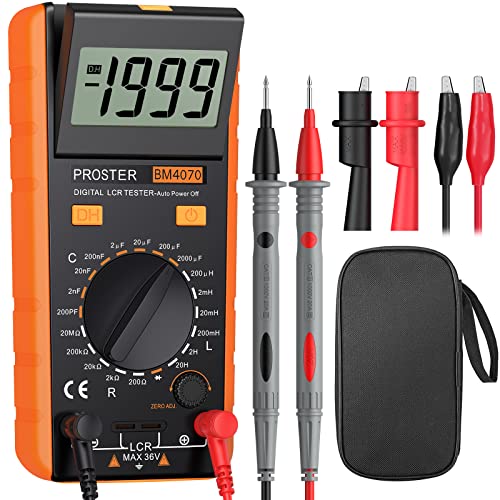
- Manual capacitance and inductance ranges
- Also tests resistance and diodes
- Rotatable LCD and complete accessory kit
Best For: General repair and hobby electronics work
Best Data-Logging Option

- Automatic L, C, and R recognition
- Measures D, Q, and impedance
- USB logging with 100Hz–10kHz testing
Best For: Portable testing and computer-based records
Best Compact Tweezer Meter
FNRSI LCR-ST1 Mini Smart LCR Meter

- Tweezer design for SMD components
- Automatic recognition with ESR, D, Q, Z, and X
- Includes pointed and hook tweezer heads
Best For: SMD testing and highly portable troubleshooting
Best Budget Starter

- Measures L, C, R, continuity, and diodes
- Wide measurement ranges for everyday testing
- Includes clips and a 9V battery
Best For: Home, automotive, and general electrical troubleshooting
Best for Precision Testing

- Up to 0.3% claimed basic accuracy
- Five selectable test frequencies and three levels
- Adds sorting, logging, and a rechargeable battery
Best For: Laboratory, production, batch, and field testing
Best Compact Bridge Meter

- Automatic LCR identification with a TFT display
- Four-wire input for improved measurement reliability
- Six test frequencies plus ESR and impedance parameters
Best For: Portable component testing with bridge-style features
Best Portable Tweezer Pick

- Tweezer-style SMD component testing
- 100 Hz, 1 kHz, and 10 kHz frequencies
- Automatic recognition with data export
Best For: SMD repair and quick circuit-board checks
Best Frequency Range

- Six frequencies up to 100 kHz
- 0.2% listed accuracy with correction
- 2.8-inch backlit TFT display
Best For: Bench testing and PC-assisted measurements
Best Value Bridge Tester

- Six frequencies from 100 Hz to 100 kHz
- Dual-parameter color TFT display
- Shows D, Q, phase angle, and ESR
Best For: Portable component testing with detailed readouts
Best Precision Pick – FNIRSI LC1020E 100kHz LCR Meter
For shoppers comparing lcr meters under 100, the FNIRSI LC1020E stands out with broad component ranges, multiple test frequencies, and a 19,999-count display. It is a strong choice when you need more detailed readings and repeatable component screening.
Best For: Electronics repair, component sorting, and bench testing where dual parameters and higher-frequency measurements are useful.
Pros:
- Measures resistance, capacitance, and inductance with secondary readings such as ESR, Q, D, θ, and X.
- Offers 100Hz, 120Hz, 1kHz, 10kHz, and 100kHz test frequencies.
- Includes sorting mode, open/short calibration, adjustable test voltage, and a rechargeable 3000mAh battery.
- Supports Kelvin-style four-terminal measurements with included professional fixtures.
Cons:
- Requires careful calibration and fully discharged components before testing.
- Its broader feature set may be more than casual users need.
The LC1020E is one of the more feature-rich options in this price-focused group. Its display, calibration tools, and sorting functions make it especially appealing for users who regularly test batches of components.
Best Traditional Bench Meter – Proster BM4070 LCR Meter
The Proster BM4070 is a straightforward option among lcr meters under 100, using selectable ranges for capacitance, inductance, and resistance. Its rotatable LCD and included accessories make it practical for general electronics troubleshooting.
Best For: Hobbyists and repair users who prefer manual range selection, a bench-friendly display, and a complete starter kit.
Pros:
- Measures capacitance from 200pF to 2000μF and inductance from 200μH to 20H.
- Includes resistance and diode testing alongside core LCR functions.
- Rotatable LCD, data hold, auto power-off, and capacitance zero adjustment support convenient use.
- Comes with leads, crocodile clips, a screwdriver, 9V battery, manual, and storage bag.
Cons:
- Uses a lower 1,999-count display than newer high-resolution models.
- Its 9V battery power is less convenient than a built-in rechargeable battery.
The BM4070 favors familiar controls and broad everyday ranges over advanced automatic analysis. It is a sensible pick if you want a conventional LCR meter with useful extras right out of the box.
Best Data-Logging Option – LCR-101A Handheld LCR Meter
The LCR-101A is a portable choice for shoppers seeking lcr meters under 100 with automatic component recognition and computer connectivity. Its backlit display and selectable frequencies make it useful away from a traditional workbench.
Best For: Technicians, engineers, and serious hobbyists who want portable measurements with USB data logging.
Pros:
- Measures capacitance, inductance, resistance, impedance, D, and Q.
- Automatically identifies L, C, or R components and displays key parameters.
- Supports 100Hz, 1kHz, and 10kHz testing for different measurement needs.
- USB connectivity enables logging and exporting readings to a computer; the screen can rotate 180 degrees.
Cons:
- The USB cable needed for computer connectivity is not included.
- Only three selectable test frequencies are listed.
This model is most compelling when measurement records matter as much as the live reading. Its compact format, automatic identification, and PC logging give it a practical edge for field service and organized testing.
Best Compact Tweezer Meter – FNRSI LCR-ST1 Mini Smart LCR Meter
If portability is the priority when comparing lcr meters under 100, the FNRSI LCR-ST1 is designed for quick component checks. Its tweezer format, automatic recognition, and very light body suit small parts and on-the-go troubleshooting.
Best For: SMD testing, compact workspaces, and users who want a lightweight meter with replaceable tweezer heads.
Pros:
- Measures resistance, capacitance, inductance, diodes, and continuity.
- Automatically identifies components and displays ESR, D, Q, Z, and X values.
- Supports 100Hz, 1kHz, and 10kHz frequencies with 0.3V and 0.6V RMS test levels.
- Includes pointed and hook tweezer heads, automatic shutdown, data holding, and PC data transfer.
Cons:
- The 1.4-inch screen is smaller than the displays on larger handheld meters.
- Its listed inductance range tops out at 10H.
The LCR-ST1 trades large-screen ergonomics for speed and portability. It is a convenient choice for SMD work and quick component identification, particularly when a conventional meter feels too bulky.
Best Budget Starter – CAMWAY LCR Meter
If you’re comparing lcr meters under 100 for general troubleshooting, the CAMWAY is a straightforward battery-powered option. It measures inductance, capacitance, resistance, continuity, and diodes, with a 1999-count LCD and useful functions such as data hold, zero adjustment, and auto power-off.
Best For: Home, automotive, and general-purpose electrical troubleshooting.
Pros:
- Measures capacitance from 200 pF to 2000 μF, inductance from 200 μH to 20 H, and resistance from 200 Ω to 200 MΩ.
- Includes continuity and diode testing alongside LCR measurement.
- Comes with crocodile clips, a 9V battery, and a flip-capable large display.
Cons:
- Uses a basic 1999-count LCD rather than a color screen.
- Runs on a replaceable 9V battery instead of a rechargeable battery.
The CAMWAY emphasizes broad everyday coverage and simple operation. Its included accessories and household-focused design make it a practical choice when you want a versatile meter without prioritizing advanced frequency selection or logging.
Best for Precision Testing – LC1020E Digital LCR Meter
For shoppers comparing lcr meters under 100 who want more measurement flexibility, the LC1020E stands out with selectable test frequencies, test levels, and a claimed basic accuracy of up to 0.3%. Its color display, rechargeable battery, component sorting, and data logging features suit more structured testing than a basic handheld meter.
Best For: Laboratory, production-line, batch, and field component testing.
Pros:
- Supports 100 Hz, 120 Hz, 1 kHz, 10 kHz, and 100 kHz test frequencies.
- Offers three test levels and measurement ranges up to 100 H inductance, 100 mF capacitance, and 10 MΩ resistance.
- Provides three-terminal and five-terminal ports, component sorting, data logging, and a 2.8-inch TFT screen.
Cons:
- At 680 g, it is less lightweight than a simple handheld tester.
- Its broader feature set may be more than needed for occasional basic checks.
The LC1020E is the most feature-focused option in this group. Choose it if selectable frequencies, pass/fail sorting, and recorded test results matter more than having the simplest possible interface.
Best Compact Bridge Meter – ZT-DQ01 Handheld LCR Meter
If you want a compact choice among lcr meters under 100, the ZT-DQ01 combines automatic LCR identification with a 2.8-inch TFT display and four-wire measurement input. It also supports multiple test frequencies, impedance ranges, and secondary parameters such as ESR, Q, D, and phase angle.
Best For: Portable component measurement where four-wire testing and a clear display are useful.
Pros:
- Automatically identifies inductance, capacitance, and resistance.
- Supports 100 Hz, 120 Hz, 1 kHz, 10 kHz, 40 kHz, and 100 kHz testing.
- Includes four-wire measurement, electrolytic capacitor mode, adjustable auto power-off, and selectable impedance ranges.
Cons:
- The supplied note warns that restarting may be necessary if the device lags or freezes.
- The notes do not specify a measurement range for inductance, capacitance, or resistance.
The ZT-DQ01 is a strong fit for users who value portability and bridge-style measurement features. Its four-wire input and wide frequency selection are appealing, but buyers who need clearly stated measurement ranges should verify those details before purchasing.
Best Portable Tweezer Pick – FNIRSI LCR-ST1
For shoppers comparing lcr meters under 100, the FNIRSI LCR-ST1 stands out as a compact tweezer-style tester for quick component checks. It measures resistance, capacitance, inductance, and diodes, with selectable 100 Hz, 1 kHz, and 10 kHz test frequencies.
Best For: SMD repair, circuit-board troubleshooting, and testing loose components directly with tweezer probes.
Pros:
- Supports resistance, capacitance, inductance, diode, continuity, ESR, D, Z, and Q readings.
- Offers automatic component recognition and primary and secondary parameter displays.
- Includes pointed and hook tweezer heads, a carrying case, and Type-C charging.
- Can save test records and export data to a PC via Excel.
Cons:
- Its fixed screen does not flip or rotate.
- Its maximum test frequency is 10 kHz, lower than the other meters here.
The LCR-ST1 is a practical choice when portability and direct SMD probing matter more than a larger display or higher-frequency testing.
Best Frequency Range – Handheld LCR Meter 4080
The 4080 is a strong option among lcr meters under 100 for users who need a broad selection of test frequencies. It measures inductance, capacitance, and resistance from a handheld unit, with frequencies ranging from 100 Hz to 100 kHz.
Best For: Engineers and technicians who need flexible frequency selection, PC communication, and a larger color display.
Pros:
- Provides six test frequencies: 100 Hz, 120 Hz, 1 kHz, 10 kHz, 40 kHz, and 100 kHz.
- Lists 0.2% accuracy and includes open- and short-circuit correction.
- Features a 2.8-inch backlit TFT display with dedicated controls.
- Supports PC remote control and data acquisition through Mini-USB.
Cons:
- Its listed dimensions make it less compact than a tweezer-style tester.
- It requires a 5-volt DC power source.
With its wide frequency range, recording mode, and two-year warranty description, the 4080 is suited to more structured bench and service work.
Best Value Bridge Tester – ET430 100KHz LCR Meter
For buyers seeking lcr meters under 100 with a color screen and high-frequency capability, the ET430 offers six test frequencies from 100 Hz to 100 kHz. It displays primary measurements alongside secondary values such as D, Q, phase angle, and ESR.
Best For: Portable electronics testing where dual-parameter viewing and 100 kHz operation are useful.
Pros:
- Measures resistance, capacitance, and inductance with six frequencies up to 100 kHz.
- Uses a 2.8-inch color TFT display for simultaneous primary and secondary readings.
- Lists 0.3% basic accuracy and includes a one-year warranty.
- Supports capacitor mode and free software support.
Cons:
- Open- and short-circuit setup is required before use to reduce fixture error.
- The included accessories do not include Kelvin test clips.
- The supplied component list is limited to basic leads, a power plug, and a manual.
The ET430 balances a broad frequency range and informative display in a portable format, though users needing Kelvin clips will need to source them separately.
How We Picked the Best Lcr Meters Under 100
We selected these models based on the core needs of hobbyists, technicians, students, and repair professionals shopping in this price range. Our comparison emphasizes measurement coverage for resistance, capacitance, and inductance, along with useful extras such as ESR, component identification, selectable test frequencies, auto-ranging, and SMD-friendly probes or tweezers.
Build format and usability also matter. A pocket tester may be ideal for quick board checks, while a larger handheld meter can offer a clearer display, more controls, and a wider testing range. Because specifications and included accessories can vary by listing, verify the current details before buying.
Quick Comparison
For the widest frequency flexibility, consider models offering multiple settings up to 100 kHz. These are useful when component behavior changes with frequency or when you work with switching and higher-speed circuits. Simpler meters with 100 Hz, 1 kHz, or 10 kHz settings can still be excellent for general component identification and routine bench testing.
Tweezer-style options are convenient for surface-mount components and crowded circuit boards. Traditional handheld meters are generally more versatile for loose components, larger leads, and general-purpose measurements. Look for a color screen or backlit LCD if you often work in dim spaces, and check whether the kit includes test leads, probes, a case, or batteries.
Key Buying Factors for Lcr Meters Under 100
Measurement Range and Accuracy
Choose a meter that covers the smallest and largest components you expect to test. Accuracy claims are most useful when paired with stated conditions, so do not compare percentages without considering frequency, range, and calibration requirements.
Test Frequency and Functions
Multiple test frequencies provide more insight into real-world component behavior. ESR, quality factor, dissipation factor, phase angle, and impedance readings can be valuable for capacitor evaluation and troubleshooting, but basic projects may not require every parameter.
Interface and Component Handling
Auto-recognition saves time, especially when testing unfamiliar parts. Tweezer probes simplify SMD work, while conventional leads are better for many through-hole components. A stable stand, easy zeroing, and clear units can make frequent testing less frustrating.
Power and Portability
Battery-powered meters are convenient for field repairs and quick checks. Consider battery life, charging method, automatic shutoff, physical durability, and whether the meter is comfortable to hold for extended sessions.
Who Should Buy Which Lcr Meters Under 100?
Choose a tweezer-style LCR meter if your priority is identifying and measuring SMD components directly on a board. A compact smart tester suits hobbyists who want quick automatic readings with minimal setup. For broader bench work, select a handheld bridge with test leads, more measurement modes, and several frequency options.
If you mainly check capacitors, resistors, and inductors during repairs, a straightforward auto-ranging model can provide the best value. If you troubleshoot power supplies, audio circuits, or higher-frequency designs, prioritize selectable frequencies, ESR, impedance-related readings, and the widest stated range. In every case, compare the included accessories and current specifications before placing an order.