If you need a reliable calculator for math, science, and test day, non programmable scientific calculators are the safest place to start. They focus on essential functions, simple operation, and broad classroom acceptance.
Below, we’ve rounded up 10 strong options for students and everyday users, from basic one-line models to more capable multi-line designs.
Best 10 Non Programmable Scientific Calculators Picks for 2026
Classic Basics

- 10-digit one-line display
- Core scientific and fraction functions
- Battery-powered with slide case
Best For: General math, pre-algebra, algebra, and introductory science
Exam-Friendly Pick

- 273 scientific and math functions
- 10-digit 2-line LCD display
- Compact, battery-powered design
Best For: GCSE students and compact everyday school use
Multi-Line Student Choice
Texas Instruments TI-30XS MultiView

- Four-line MultiView display
- Textbook-style fractions and expressions
- x,y table exploration for functions
Best For: High school math and science students who value screen clarity
Compact Value Option

- 146 essential functions
- Normal, stat, and complex modes
- Protective hard case included
Best For: Students needing a compact, versatile everyday calculator
Casio Solar Compact Pick
Casio fx-260 Solar II for School Math
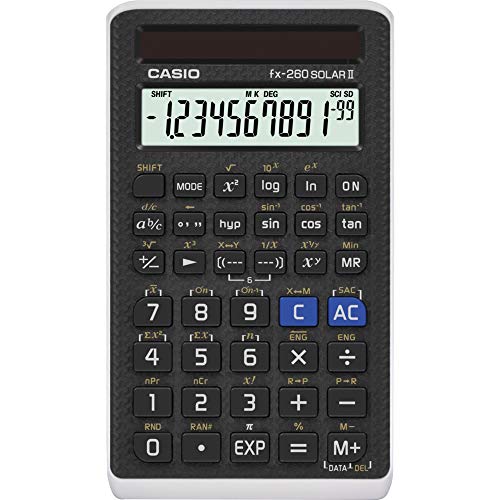
- Compact, lightweight design
- Solar power with battery backup
- Fraction, trig, and inverse trig support
Best For: Students needing a portable calculator for middle school through high school math
Texas Instruments Classroom Pro

- MultiView and MathPrint display
- Advanced math and science functions
- Good fit where graphing is not allowed
Best For: High school and college students in advanced math and science courses
Sharp Test-Day Value
Sharp EL-501XBWH for Core School Math

- 130+ scientific and math functions
- 10-digit LCD with hard cover
- Approved for several major exams
Best For: Students looking for a simple, test-friendly calculator for core math classes
Engineering Pick
Helect 2-Line Engineering Scientific Calculator

- 240 scientific functions
- 2-line display shows input and result
- Sliding protective case included
Best For: School or business users who want a clear, non-graphing scientific calculator
Best Heavy-Duty Pick
SC-216 Non-Graphing Scientific Calculator

- 240 functions for school math
- 2-line 12-digit HD display
- Compact body with hard cover
Best For: Middle and high school students preparing for exams
Advanced Functions Pick
Sharp EL-506TSBBW Scientific Calculator

- 470 functions across 6 modes
- 2-line 12-digit LCD display
- Equation, matrix, and complex tools
Best For: Higher-level math and science students needing advanced non-graphing functions
Classic Basics – Texas Instruments TI-30Xa
If you want a straightforward non programmable scientific calculator for everyday schoolwork, the TI-30Xa keeps things simple and dependable. It covers the core functions most students need for general math, pre-algebra, algebra I and II, trigonometry, and basic science without adding extra complexity.
Best For: Students who need a basic, battery-powered calculator for standard math and science classes.
Pros:
- 10-digit display with a simple one-line layout
- Handles trig, logs, roots, powers, reciprocals, and factorials
- Supports fraction math and 1-variable statistics
- Includes conversions for fractions/decimals and angle formats
Cons:
- One-line display is less flexible than multi-line models
- No advanced visualization or table features
- Basic design may feel limited for higher-level courses
Overall, this is a solid pick if you want a no-frills scientific calculator that covers the essentials and stays easy to use. The included slide case and battery power make it practical for class and homework.
Exam-Friendly Pick – Sharp SH-EL531THBWH
This non programmable scientific calculator is built for students who want lots of functions in a compact format. With 273 total functions and a 2-line LCD, it gives you more room to review calculations while still staying simple enough for standard coursework.
Best For: GCSE and student use where a compact calculator with broad function coverage is needed.
Pros:
- 273 functions for a wide range of math and science tasks
- 10-digit, 2-line LCD display for easier viewing
- Compact size and light weight for school carry
- Includes battery power and comes in blister packaging
Cons:
- Function-heavy layout may take time to learn
- No advanced multi-line graphing or programmable features
- Smaller build may not suit users who prefer larger keys
As a practical student calculator, this Sharp model balances portability with a strong feature set. It is a good fit if you want a straightforward scientific calculator that offers more capability than the most basic options.
Multi-Line Student Choice – Texas Instruments TI-30XS MultiView
For shoppers comparing non programmable scientific calculators, the TI-30XS MultiView stands out for its four-line display and textbook-style layout. It is designed to make it easier to compare calculations, read expressions as written, and explore values without moving into programmable territory.
Best For: High school math and science students who want a clear multi-line display.
Pros:
- MultiView display shows up to four lines at once
- Displays math expressions and stacked fractions in textbook form
- Supports scientific notation with superscripted exponents
- Includes x,y table exploration for functions
Cons:
- Larger and heavier than simpler basic models
- More features than some students need for intro courses
- May take a little longer to learn than a one-line calculator
This is a strong choice if readability matters and you want to review multiple steps on screen. It works especially well for students moving through algebra, geometry, statistics, biology, and chemistry.
Compact Value Option – Sharp EL501X2BWH
If you need a non programmable scientific calculator with a compact, durable build, the Sharp EL-501X2BWH covers a lot of ground for school math. It offers 146 essential scientific, math, and statistics functions, plus mode options that can help students handle a variety of classroom problems.
Best For: Students who want a compact scientific calculator with broad everyday functionality.
Pros:
- 146 essential scientific, math, and statistic functions
- Includes normal, stat, and complex modes
- Supports N-base calculations such as OCT, BIN, DEC, and HEX
- Comes with a protective hard case and battery power
Cons:
- One-line display is less convenient than a multi-line screen
- Build is functional rather than premium
- May be more calculator than needed for basic classes
Overall, this Sharp model is a practical choice when you want a feature-rich scientific calculator in a simple form factor. It is well suited to students who need flexibility without stepping into programmable or graphing models.
Casio Solar Compact Pick – Casio fx-260 Solar II for School Math
If you want a compact, non programmable scientific calculator for everyday schoolwork, the Casio fx-260 Solar II is a practical pick. It is small enough to carry easily, but still covers key functions for pre-algebra through trig, with fraction support and a 10-digit display for clear input and results.
Best For: Students who want a lightweight, solar-powered calculator for middle school, high school algebra, geometry, trig, and general math.
Pros:
- Compact and lightweight design that is easy to carry to class or exams
- Solar power with battery backup for dependable everyday use
- Supports trig, inverse trig, permutations, combinations, factorials, and fraction input
- Large 10-digit display in a small form factor
Cons:
- More basic than higher-end scientific models for advanced coursework
- Smaller size may be less comfortable for users who prefer larger keys
Overall, this is a straightforward choice if you need a non programmable scientific calculator with the essentials covered and minimal bulk. Its school-friendly feature set and solar-plus-battery design make it easy to recommend for students who value simplicity.
Texas Instruments Classroom Pro – TI-36X Pro for Higher Math
Texas Instruments TI-36X Pro Engineering/Scientific Calculator | 9.7 Inch | Black.
Check Price On AmazonThe TI-36X Pro is a strong non programmable scientific calculator for students who need more advanced math features without jumping to a graphing model. Its MultiView display and MathPrint formatting help show calculations and textbook-style expressions clearly, which is useful for science, engineering, and higher-level math classes.
Best For: High school and college students in algebra, statistics, calculus, biology, chemistry, and engineering-focused courses.
Pros:
- MultiView display shows multiple calculations on screen at once
- MathPrint displays stacked fractions and symbols as they appear in textbooks
- Supports fractions, decimals, Pi, degree/radian modes, and number format settings
- Well suited for curricula where graphing calculators are not permitted
Cons:
- Battery powered rather than solar
- May be more calculator than needed for basic math classes
If you want a feature-rich scientific model that stays within non programmable calculator territory, this one stands out for clarity and versatility. It is especially appealing for students who want a dependable tool for multi-subject math and science work.
Sharp Test-Day Value – Sharp EL-501XBWH for Core School Math
The Sharp EL-501XBWH is a simple non programmable scientific calculator built for general math and test prep. It covers more than 130 scientific and math functions, has a 10-digit LCD, and includes a hard cover for protection, making it a practical option for students who want a no-fuss calculator for class and exam use.
Best For: Students who need an affordable scientific calculator for pre-algebra, algebra, geometry, trigonometry, and standardized tests.
Pros:
- More than 130 scientific and math functions
- 10-digit LCD with hard cover for added protection
- Auto power down helps conserve battery life
- Permitted for several major tests, including AP Chemistry, AP Physics, PSAT/NMSQT, and SAT
Cons:
- Battery powered instead of solar
- Less feature-rich than higher-level scientific calculators
This model makes sense if you want a straightforward calculator that handles common school and test needs without extra complexity. Its approved-test compatibility and protective cover make it especially practical for students who carry a calculator every day.
Engineering Pick – Helect 2-Line Engineering Scientific Calculator
Helect 2-Line Engineering Scientific Calculator, Suitable for School and Business (Black)
Check Price On AmazonIf you want a practical non programmable scientific calculators option for school or business, the Helect H1002 keeps things straightforward with a 2-line display, 240 scientific functions, and engineering notation support. It is built to handle everyday classroom math, statistics, and trig work while keeping inputs and results visible at the same time.
Best For: Students or professionals who want a simple, non-graphing calculator with a clear 2-line display and core scientific functions.
Pros:
- 240 scientific functions for general math, trig, and statistics
- 2-line widescreen LCD shows entry and result together
- Supports degrees, radians, grads, and engineering notation
- Sliding protective case helps protect the body and buttons
Cons:
- Battery-powered only, so you will need to replace batteries over time
- Focused on standard scientific use rather than advanced programmable features
The Helect is a solid everyday pick if you want a dependable scientific calculator with a comfortable grip and clear display. It covers the functions most students and office users need without adding unnecessary complexity.
Best Heavy-Duty Pick – SC-216 Non-Graphing Scientific Calculator
SC-216 Non-Graphing Scientific Calculator, Middle/High School, Fraction Key | Non Programmable
Check Price On AmazonThe SC-216 is a straightforward option among non programmable scientific calculators, with 240 functions, a 2-line HD display, and support for trig, statistics, and engineering modes. Its compact design and hard cover make it well suited for school, exam prep, and everyday problem-solving.
Best For: Middle and high school students who need a compact, exam-ready scientific calculator for class and test use.
Pros:
- 240 functions cover trig, statistics, and engineering modes
- 2-line 12-digit display keeps entries and results easy to read
- Compact, ergonomic build with hard cover protection
- Uses 2 AAA batteries and includes a 6-month warranty
Cons:
- Designed for non-programmable use only
- Shorter warranty than some competing calculators
For students who need a basic scientific calculator with the right features and a portable build, the SC-216 is easy to recommend. It focuses on useful math functions and clear visibility rather than advanced extras.
Advanced Functions Pick – Sharp EL-506TSBBW Scientific Calculator
Among non programmable scientific calculators, the Sharp EL-506TSBBW stands out for users who need more depth without moving to a graphing model. It offers a large 2-line display, 470 functions, and multiple modes for normal math, statistics, equations, complex numbers, matrices, and lists.
Best For: Students working through higher-level math and science who want a feature-rich scientific calculator with advanced functions.
Pros:
- 470 functions and 6 modes for broad scientific use
- 2-line 12-digit display shows entries and results together
- Includes equation solvers, matrix, complex, and list calculations
- Home key makes it easy to clear data and start fresh
Cons:
- More feature-heavy than a basic classroom calculator
- Battery-powered, so it is not ideal if you want a rechargeable model
If you want a scientific calculator that goes well beyond the basics, the Sharp EL-506TSBBW is the strongest feature set in this group. It is a good fit for students who need advanced math tools but still want a non-programmable device.
How We Picked These Non Programmable Scientific Calculators
We focused on models that balance function set, ease of use, display clarity, and typical school or exam needs. For Non Programmable Scientific Calculators, the best choices are the ones that solve common problems quickly without adding confusing extras.
We also favored calculators with dependable power options, familiar layouts, and features students actually use, such as fractions, trig, exponents, parentheses, and multi-step memory functions.
Quick Comparison
In general, basic one-line calculators are best for straightforward algebra, geometry, and general science. Two-line and multi-line models are easier to check because they show expressions more clearly. More advanced units suit higher math, engineering, and science classes where extra functions matter.
If you want the simplest exam-friendly option, look for a clean display and a standard scientific function set. If you need faster checking and fewer input mistakes, a multi-line screen is worth the upgrade.
Key Buying Factors for Non Programmable Scientific Calculators
Display Style
Display format matters more than many buyers expect. A one-line display is compact and simple, while a multi-line or textbook-style display makes fractions, equations, and long expressions easier to review. That can save time and reduce errors.
Function Set
Match the calculator to the level of math you’ll actually do. Middle and high school students usually need fractions, powers, roots, trig, and scientific notation. More advanced users may want logs, statistics, constants, and conversion functions. Don’t pay for features you won’t use.
Power Source
Solar-powered models can be convenient and low maintenance, but battery-operated calculators may feel more consistent in low light. Dual-power designs are often a smart middle ground when available.
School and Exam Rules
Always check the rules for your class, teacher, or testing center. The term Non Programmable Scientific Calculators usually signals broad acceptability, but some exams still restrict certain models or functions.
Who Should Buy Which Non Programmable Scientific Calculators?
Choose a basic model if you want a simple, affordable calculator for general math and introductory science. Pick a two-line or multi-line calculator if you value easier proofreading and work with longer formulas often.
Students in higher-level math or science courses should lean toward feature-rich scientific calculators that still remain non-programmable. If you mostly need a dependable backup for class, a compact, low-cost model is usually the best value.
For most buyers, the right choice is the calculator that matches your coursework, is easy to read quickly, and complies with your exam requirements.