Building a strong high school physics lab starts with equipment that is reliable, classroom-friendly, and easy for students to use. The best kits help teachers demonstrate core concepts clearly while giving students hands-on practice.
Below, we focus on practical physics lab equipment for high school that supports mechanics, electricity, waves, optics, and basic lab skills without adding unnecessary complexity.
Best 10 Physics Lab Equipment for High School Picks for 2026
Comprehensive Mechanics Lab Kit

- 26-experiment mechanics set
- Covers force, motion, pressure, buoyancy
- Includes balance, pulleys, trolley, ramp
Best For: High school mechanics labs and guided classroom demonstrations
Friction Car Pair

- Set of 2 friction cars
- Works with incline planes and pulleys
- Low-friction wheels, oil-free bearings
Best For: Motion, friction, and energy-work demonstrations
Boyle’s Law Classroom Model

- Compact gas-law teaching model
- Sized for classroom benches
- Built for repeated educational use
Best For: High school Boyle’s law demonstrations and gas-pressure lessons
Wave Motion Demo Set
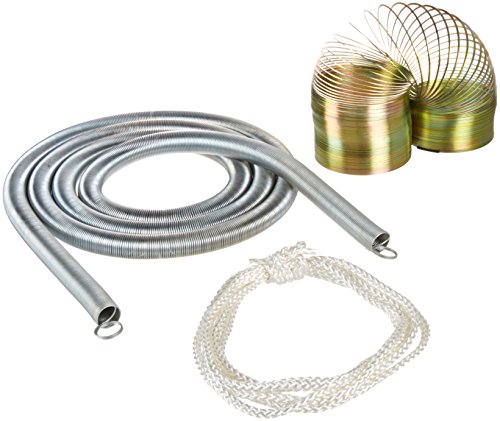
- Two helical springs and string
- Simple classroom wave demonstration
- Made in the United States
Best For: High school wave motion lessons and demonstrations
School Lab Starter Kit
Electricity & Magnetism Basics
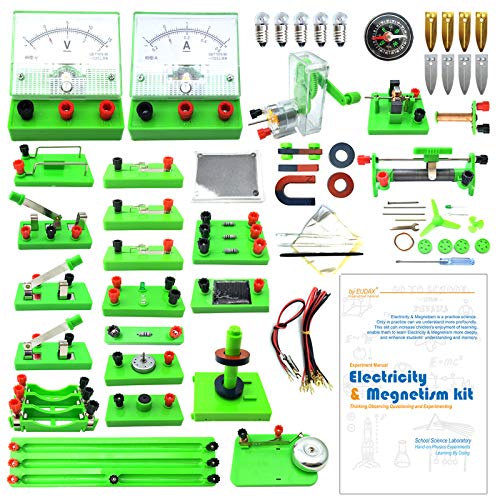
- 79-piece electricity and magnetism kit
- Full-color manual supports guided learning
- Includes circuits, fruit battery, and electromagnet projects
Best For: Grades 9-11 students starting basic physics experiments
Science Decor Pack

- 100 vinyl science stickers in one pack
- Waterproof, UV resistant, and removable
- Good for laptops, bottles, notebooks, and gifts
Best For: Students and teachers wanting science-themed decoration
Advanced Lab Starter

- 55 electricity items and 22 magnetism items
- Includes manual plus special parts like ammeter and switch
- Sturdy double-layer storage box keeps pieces organized
Best For: Junior and senior high school students exploring circuits and magnetic fields
Motion Cart Demo
Mini Adjustable Wheel Friction Dynamics Cart

- Wear-resistant plastic build
- Useful for ramp motion demos
- Helps teach basic motion laws
Best For: High school motion and friction demonstrations
Optics Demo Kit
Geometric Light Refraction Lens Set
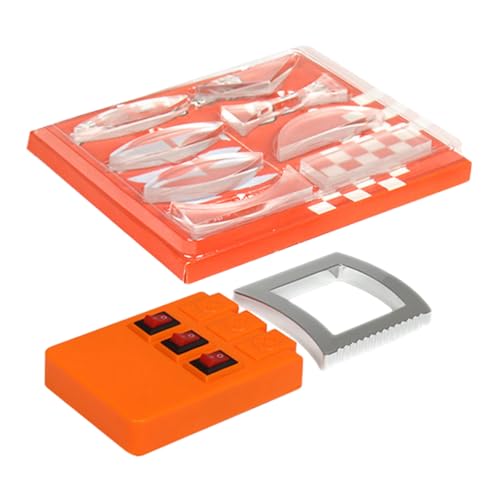
- Includes prism, reflector, and lenses
- Shows reflection and refraction clearly
- Easy to assemble for classroom use
Best For: Visual optics lessons in high school labs
Electricity Lab Set
Basic Electricity & Magnetism Starter Kit

- 55 electrical and 22 magnetism components
- Includes detailed manual and storage box
- Supports many circuit and magnetism projects
Best For: Hands-on electricity and magnetism study in high school
Comprehensive Mechanics Lab Kit – Physics Mechanics Kit
If you need physics lab equipment for high school that covers a wide range of classical mechanics topics, this 26-experiment kit is built for hands-on teaching. It includes core hardware like a tray balance, pulleys, lever ruler, U-tube pressure gauge, spring dynamometer, trolley, and ramp, so students can investigate force, motion, pressure, and buoyancy with practical tools.
Best For: High school mechanics lessons, classroom demonstrations, and structured lab activities covering Newton’s laws, kinematics, gravity, pulleys, levers, pressure, and buoyancy.
Pros:
- Includes a broad set of lab-style components for multiple mechanics experiments.
- Supports core topics such as Newton’s laws, friction, gravity, pressure, and buoyancy.
- Designed for middle and high school use with a manual that explains steps and principles.
- Uses sturdy plastic and metal parts with organized storage for classroom use.
Cons:
- Focused on mechanics rather than a full general physics curriculum.
- Requires teachers or students to follow the manual and assembly steps carefully.
- Some parts are small, so storage and organization matter.
This is a practical all-in-one choice if your priority is building a mechanics-focused lab setup with reusable classroom hardware. It is especially useful when you want students to see physics principles through direct measurement and guided experiments.
Friction Car Pair – Hall's Car Experiment
For physics lab equipment for high school focused on motion and energy, this set of two Hall’s friction cars is a simple, dependable teaching tool. It is designed to be used with an incline plane, weights, and pulleys to study the relationship between energy and work, while the low-friction wheels and oil-free sleeve bearings keep the setup straightforward.
Best For: Demonstrating friction, energy, and work relationships in high school physics labs.
Pros:
- Set of two cars makes it easy to compare motion in paired experiments.
- Works with incline planes, weights, and pulleys for flexible lab setups.
- Low-friction wheels and oil-free sleeve bearings reduce maintenance needs.
- Compact size makes it easy to store and handle in a classroom.
Cons:
- Best used as part of a broader lab setup rather than as a standalone kit.
- Limited to friction and energy/work demonstrations.
- Listed dimensions suggest a basic apparatus rather than a multi-topic system.
This is a focused option when you want a durable, low-maintenance apparatus for motion experiments. It fits well in a high school lab that already has incline planes and other supporting equipment.
Boyle’s Law Classroom Model – Boyle’s Law Demonstrator
If you are shopping for physics lab equipment for high school, this Boyle’s law demonstrator offers a compact way to teach gas behavior in a classroom setting. Its small footprint makes it easy to fit into a lab or demo area, and it is specifically presented as a teaching model for repeated educational use.
Best For: Classroom demonstrations of Boyle’s law and basic gas-pressure concepts in high school science labs.
Pros:
- Purpose-built as a Boyle’s law demonstrator for physics teaching.
- Compact size helps it fit on a classroom bench without taking much space.
- Designed to withstand repeated educational use.
- Simple model format suits direct teacher-led demonstrations.
Cons:
- Single-purpose equipment, so it does not cover a wide range of physics topics.
- Requires careful handling and proper storage, as noted by the manufacturer.
- Best suited to demonstration rather than broad student experimentation.
This is a useful pick if your lessons need a dedicated gas-law model rather than a multipurpose kit. It is most valuable in a high school lab when you want a focused visual demonstration of pressure-volume relationships.
Wave Motion Demo Set – Wave Demonstrator Set
United Scientific WDSET1 Wave Demonstrator Set with Two Helical Springs and Cotton String
Check Price On AmazonFor physics lab equipment for high school that helps students visualize wave behavior, this wave demonstrator set uses two helical springs and cotton string to show motion in a hands-on way. It is a straightforward classroom tool for demonstrating wave concepts, and the included components keep the setup simple for lab use.
Best For: High school wave demonstrations and basic classroom exploration of wave motion.
Pros:
- Includes two helical springs plus cotton string for wave demonstrations.
- Simple setup is well suited to classroom teaching.
- Made in the United States, which may appeal to buyers prioritizing origin.
- Lightweight enough for ordinary lab handling and storage.
Cons:
- Focused narrowly on wave demonstrations rather than general physics.
- Contains only a few components, so it is not an all-in-one kit.
- Best used as a teaching aid rather than a full experimental system.
This set works best when you want a clear, low-complexity way to introduce wave concepts in class. It is a practical addition to a high school physics lab that already has other topic-specific equipment.
School Lab Starter Kit – Electricity & Magnetism Basics
If you’re looking for physics lab equipment for high school that supports hands-on learning, this EUDAX kit gives students a structured way to explore electricity and magnetism. It includes a full-color manual and a broad mix of parts for building simple circuit and magnetism models, making it a practical starter set for classroom discovery work.
Best For: High school students in grades 9-11 who need a guided starter kit for basic electricity and magnetism experiments.
Pros:
- Includes 79 total items for electricity and magnetism activities.
- Comes with a color manual to guide learning and experimentation.
- Covers multiple projects like series circuits, parallel circuits, fruit battery, and electromagnet builds.
- Packaged in a storage bag for easier organization.
Cons:
- Batteries are not included and 3 AA batteries are required.
- Best suited to introductory experiments rather than advanced lab work.
Overall, this is a straightforward classroom-friendly kit for students who need a hands-on introduction to core electromagnetism concepts. It emphasizes guided exploration and practical build projects over complexity, which makes it a solid fit for early high school physics use.
Science Decor Pack – 100 Physics Stickers
For shoppers seeking physics lab equipment for high school that extends beyond bench tools, these science-themed vinyl stickers are a simple way to decorate student gear and classroom items. They are waterproof, removable, and designed for smooth surfaces, so they work well as low-cost science-themed accessories for notebooks, bottles, laptops, and more.
Best For: Teachers, students, and science clubs that want classroom-friendly science decoration and gifts.
Pros:
- Pack includes 100 assorted science stickers with physics, biology, and chemistry themes.
- Made from waterproof, sun proof, UV resistant vinyl.
- Removable and repositionable with no sticky residue.
- Works on laptops, water bottles, notebooks, scrapbooks, and other smooth surfaces.
Cons:
- These are decorative items, not experiment supplies.
- Best used on smooth, clean surfaces only.
This set is more about science motivation and classroom personality than lab function. If you want a small add-on that supports a science-focused environment, it offers plenty of variety and easy everyday use.
Advanced Lab Starter – Circuit and Magnetism Kit
If you need physics lab equipment for high school that goes a bit deeper, this electricity and magnetism kit is built for guided STEM experimentation. It includes a manual that explains each experiment’s steps and required equipment, plus special parts like a sensitive ammeter and magnetic switch for more varied circuit and field investigations.
Best For: Junior and senior high school students who want a more feature-rich electricity and magnetism lab kit.
Pros:
- Includes 55 electricity items and 22 magnetism items.
- Manual explains the experiments, steps, and equipment needed.
- Includes unique parts such as a sensitive ammeter and magnetically controlled switch.
- Comes in a sturdy double-layer storage box with fixed positions for parts.
Cons:
- Three AA batteries are required and not included.
- Sold as a single kit rather than a broad multi-pack classroom set.
This kit is a strong choice when you want a more complete hands-on set for circuits and magnetic fields. Its organized storage, expanded parts list, and experiment guidance make it especially useful for students who want to move beyond the most basic starter activities.
Motion Cart Demo – Mini Adjustable Wheel Friction Dynamics Cart
For physics lab equipment for high school, this mini dynamics cart is a simple way to demonstrate motion on a ramp and compare how a car moves at the high end versus lower positions. Its small plastic build and adjustable wheel friction make it useful for basic classroom demonstrations focused on motion and practical observation.
Best For: High school teachers and students who need a compact cart for motion, ramp, and friction demonstrations.
Pros:
- Made from wear-resistant plastic for repeated classroom use
- Can be released side by side on a ramp to observe movement speed
- Helps students explore basic laws of object motion
- Compact size makes it easy to store and handle in lab settings
Cons:
- Designed as a demonstration model rather than a full experiment system
- Best suited to introductory motion lessons, not advanced mechanics work
This is a straightforward teaching aid for turning textbook motion concepts into a visible class activity. It works best when you want an affordable, hands-on demo rather than a multi-part lab kit.
Optics Demo Kit – Geometric Light Refraction Lens Set
If you’re comparing physics lab equipment for high school, this optics experiment kit is aimed at making reflection, refraction, dispersion, and focusing easier to see in class. The set includes a light source, prism, reflector, and multiple lenses, so it supports a range of basic geometry-of-light demonstrations in a compact classroom format.
Best For: Teachers and students who want a simple, visual optics kit for classroom demonstrations and lab activities.
Pros:
- Includes a linear light source, triangular prism, reflector, and lenses
- Supports demonstrations of reflection, dispersion, and focusing principles
- Concave and convex lenses allow multiple refraction setups
- Designed for easy assembly in classroom or homeschooling use
Cons:
- Plastic construction may be more suited to teaching than precision lab work
- Best for basic optics concepts rather than advanced experiments
Overall, this is a practical starter kit for visual optics lessons. It is a good fit when the goal is to show light behavior clearly without a complicated setup.
Electricity Lab Set – Basic Electricity & Magnetism Starter Kit
For physics lab equipment for high school, this electricity and magnetism kit is built to support hands-on lessons on circuits, electromagnets, and basic electronics. It includes a large component count, a detailed manual, and storage box, making it a practical choice for guided class work and student exploration.
Best For: Junior and senior high school students learning circuits, electromagnetism, and introductory electronics.
Pros:
- Includes 55 electrical components and 22 magnetism components
- Detailed manual explains experiment steps and required equipment
- Supports many projects, including series and parallel circuits
- Comes with a sturdy double-layer storage box for organization
Cons:
- Requires 3 AA batteries, which are not included
- May be more complex than a basic single-topic classroom demo
This kit stands out for breadth, since it covers both electricity and magnetism in one organized set. It is especially useful when a class needs repeatable experiments and room for creative student investigations.
How We Picked the Best Physics Lab Equipment for High School
We prioritized tools that support common high school physics topics, are suitable for repeated classroom use, and offer clear demonstrations for teaching. We also looked for sets that balance durability, educational value, and ease of setup, since time and storage matter in school labs.
Because Physics Lab Equipment for High School is often used across multiple grade levels, we favored versatile kits that can support both teacher-led demos and student activities.
Quick Comparison
Mechanics kits are best for motion, force, and energy lessons. Electricity and magnetism sets cover circuits, electromagnets, and basic current concepts. Wave and optics kits work well for showing reflection, refraction, and wave behavior. Classroom accessories and labels can also help organize and manage a shared lab space.
Key Buying Factors for Physics Lab Equipment for High School
Curriculum Coverage
Choose equipment that matches the topics you actually teach, such as Newton’s laws, pressure, buoyancy, circuits, or light. A broader kit is useful, but only if the included parts are relevant to your syllabus.
Durability and Reusability
High school labs need equipment that can survive frequent handling. Look for sturdy plastic, metal, or well-made components that won’t wear out after a few classes.
Setup Time and Clarity
The best classroom tools are easy to assemble and simple to explain. Clear visual demonstrations are especially valuable when students are seeing a concept for the first time.
Safety and Age Appropriateness
Make sure the kit is suitable for student use and does not require unnecessary risk. For younger students or mixed-level classes, beginner-friendly sets are usually the better choice.
Storage and Organization
Lab supplies should be easy to store between lessons. Compact kits and labeled components reduce lost parts and save prep time.
Who Should Buy Which Physics Lab Equipment for High School?
Teachers running general physics courses should start with a mechanics set and a basic electricity or electromagnetism kit. Schools expanding into more visual demonstrations may also want wave and optics tools. If you are building out a classroom from scratch, choose the most versatile Physics Lab Equipment for High School first, then add topic-specific sets as needed.
For classrooms that need practical, low-friction teaching tools, the best approach is to buy a few strong core kits rather than many specialized items that will see limited use.