The best telescope depends on what you want to see, where you plan to observe, and how much setup you are willing to manage. This roundup compares 10 options ranging from compact beginner refractors to computerized Schmidt-Cassegrain models.
Use the guide below to narrow your choices by aperture, portability, targeting features, optical design, and overall observing goals.
Best 10 Telescopes Picks for 2026
Best for Automated Deep-Sky Viewing

- 8-inch Schmidt-Cassegrain optics
- GoTo database with 40,000+ objects
- SkyAlign setup and automatic tracking
Best For: Committed hobbyists seeking automated, high-aperture observing
Best for Portable Smart Astronomy

- Weighs about 1.85 pounds
- App control with Auto GOTO
- EQ mode and 90-second exposures
Best For: Travelers and beginners who prefer app-based celestial imaging
Best for Smartphone-Guided Backyard Viewing
Celestron StarSense Explorer DX 130AZ
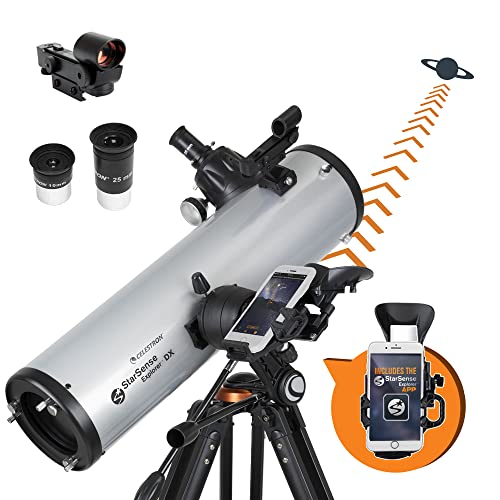
- 130mm Newtonian reflector
- StarSense app guides target location
- Manual mount with slow-motion controls
Best For: Beginners wanting guided, hands-on backyard astronomy
Best for Beginner-Friendly Portability
EACONN 80mm Refractor Telescope

- 80mm coated optics for bright views
- Backpack, tripod, and phone adapter included
- 30x–66x stated magnification range
Best For: Families and beginners wanting a portable starter telescope
Best Guided Pick
Celestron StarSense Explorer LT 114AZ
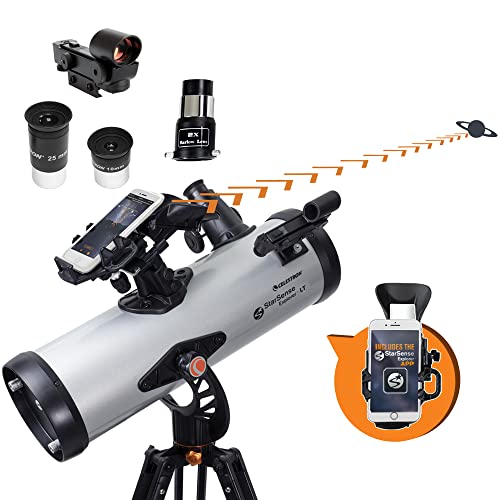
- Smartphone sky recognition guides target finding
- 114mm reflector for lunar, planetary, and deep-sky views
- Includes two eyepieces and a 2x Barlow lens
Best For: Beginners wanting guided stargazing with a larger reflector
Best Accessory Bundle
MEEZAA 90mm Refractor Telescope

- 90mm aperture with fully multi-coated optics
- 32x–240x stated magnification range
- Includes phone adapter, tripod, and carry bag
Best For: Beginners seeking a complete, portable refractor kit
Best Portable Starter

- Lightweight 70mm refractor for day and night use
- No-tool setup with included backpack
- Includes two eyepieces and astronomy software
Best For: Families and travelers wanting simple, portable viewing
Deep-Sky Starter

- 130mm reflector for bright Moon and deep-sky views
- Equatorial mount with slow-motion controls
- Includes two eyepieces and StarPointer finderscope
Best For: Beginners wanting a larger-aperture backyard telescope
Travel Gift Pick
70mm Beginner Refractor Telescope

- Lightweight 3.5-pound design for trips and camping
- Phone adapter and wireless remote included
- 70mm optics with eyepieces and 3X Barlow lens
Best For: Kids and families wanting portable casual viewing
Easy Moon Viewer

- 70mm refractor for Moon and bright-planet views
- Simple alt-azimuth mount with panhandle control
- Supports both nighttime and terrestrial viewing
Best For: Families wanting a simple first telescope
Best for Automated Deep-Sky Viewing – Celestron NexStar 8SE
The Celestron NexStar 8SE is a powerful choice for astronomy enthusiasts who want advanced computerized control without moving to a permanently installed setup. Its 8-inch Schmidt-Cassegrain optics gather substantial light for lunar, planetary, and deep-sky observing, while the GoTo mount can locate and track targets from a database of more than 40,000 objects.
Best For: Experienced beginners and intermediate observers who want automated target finding, strong visual performance, and a telescope that can support future accessories or astroimaging.
Pros:
- 8-inch optics provide detailed views of the Moon, Jupiter, and deep-sky objects.
- Computerized GoTo mount automatically locates and tracks targets.
- SkyAlign simplifies setup by using three bright stars or planets.
- Includes a 2-year US warranty and access to technical support.
Cons:
- Power sources such as batteries, an AC adapter, or PowerTank are not included.
- The computerized system may be more involved than a basic manual telescope.
The NexStar 8SE is one of the more capable telescopes here for users prioritizing aperture and automation. Its compact optical tube is portable, but the computerized mount and alignment process make it better suited to committed hobbyists than casual first-time users.
Best for Portable Smart Astronomy – DWARFLAB Dwarf Mini
The DWARFLAB Dwarf Mini takes a highly portable approach to telescopes, combining a 1.85-pound design with app control and automated target tracking. Instead of using a traditional eyepiece, it uses a Sony IMX662 sensor to capture celestial subjects for viewing and processing through a smartphone app.
Best For: Travelers, families, and beginners who want app-guided astronomy and convenient deep-sky imaging from campsites, backyards, or dark-sky locations.
Pros:
- Lightweight, compact design fits easily in a backpack.
- App includes an interactive sky map and Auto GOTO control.
- Supports AZ and EQ modes, 360-degree pivoting, and exposures up to 90 seconds.
- Built-in light-pollution filtering and cloud processing support imaging in challenging conditions.
Cons:
- Its smartphone-based experience may not suit users who specifically want traditional eyepiece viewing.
- Battery operation requires keeping the rechargeable unit powered during extended sessions.
For portability and ease of use, the Dwarf Mini is distinctive among these telescopes. Its compact sensor-based design makes it especially practical for sharing astronomy with children or taking an imaging setup on the road.
Best for Smartphone-Guided Backyard Viewing – Celestron StarSense Explorer DX 130AZ
The Celestron StarSense Explorer DX 130AZ is a practical middle ground for shoppers comparing beginner telescopes. Its 130mm Newtonian reflector offers useful light-gathering ability, while the StarSense app uses your phone’s camera and sky recognition to guide you toward planets, nebulae, galaxies, and star clusters.
Best For: Beginners who want a traditional eyepiece telescope with smartphone assistance, manual control, and enough aperture for backyard and dark-sky observing.
Pros:
- 130mm reflector provides views of the Moon, Jupiter, Saturn, Orion Nebula, and Andromeda Galaxy.
- StarSense technology identifies the telescope’s position from star patterns.
- Manual altazimuth mount includes dual-axis slow-motion controls.
- Includes both 25mm and 10mm eyepieces plus a preassembled mount and tripod.
Cons:
- Target tracking is manual rather than motorized or computerized.
- At 18 pounds, it is less convenient to transport than compact travel telescopes.
This model is a strong choice when you want the hands-on feel of conventional telescopes but would rather not rely on paper star charts. The app helps with navigation, while the reflector and slow-motion controls preserve a straightforward observing experience.
Best for Beginner-Friendly Portability – EACONN 80mm Refractor Telescope
The EACONN 80mm refractor is designed as an accessible entry point into telescopes, with a compact form, manual altazimuth control, and a carrying backpack. Its coated optics and 80mm aperture are suited to bright views of the Moon and planets, while the included phone adapter adds a simple way to attempt basic smartphone captures.
Best For: Kids, families, and first-time observers who want a lightweight telescope for backyard use, travel, landscape viewing, and basic phone-assisted photography.
Pros:
- 80mm aperture and fully coated optics are designed for brighter, clearer images.
- Includes 20mm and 9mm eyepieces with stated 30x to 66x magnification.
- Backpack and adjustable tripod make the setup easy to carry.
- Manual positioning gimbal and 5×24 finder scope support straightforward aiming.
Cons:
- Manual operation does not provide automated target finding or tracking.
- The 80mm aperture is more limited for faint deep-sky objects than larger telescopes.
- Included accessories may require some setup and alignment practice.
Among beginner telescopes, the EACONN stands out for its travel-friendly package and simple operation. It is a sensible pick for casual family observing, though users seeking more detailed deep-sky views or automated guidance should consider a larger or computerized model.
Best Guided Pick – Celestron StarSense Explorer LT 114AZ
If you want a beginner-friendly telescope with built-in guidance, the Celestron StarSense Explorer LT 114AZ combines a 114mm Newtonian reflector with smartphone-powered sky navigation. Its app helps identify worthwhile targets while the manual altazimuth mount keeps operation straightforward.
Best For: Beginners who want guided stargazing and brighter views of the Moon, planets, and selected deep-sky objects.
Pros:
- StarSense app uses sky recognition to help locate celestial targets.
- 114mm reflector supports views of the Moon, Jupiter, Saturn, Orion Nebula, and Andromeda Galaxy.
- Includes 25mm and 10mm eyepieces, a 2x Barlow lens, tripod, and finderscope.
- Includes a two-year US warranty and unlimited support from US-based experts.
Cons:
- The manual mount requires you to track objects yourself.
- Using the guided features requires a compatible smartphone.
This is a strong choice among telescopes for users who want more light-gathering ability than a small travel model without giving up guided setup. The manual mount and smartphone navigation offer a practical balance for learning the night sky.
Best Accessory Bundle – MEEZAA 90mm Refractor Telescope
The MEEZAA 90mm refractor is a versatile option for adults and astronomy beginners seeking a complete telescope kit. Its 800mm focal length, fully multi-coated optics, phone adapter, tripod, and carry bag make it suited to backyard observing and portable use.
Best For: Beginners who want a ready-to-use refractor with phone photography accessories and flexible magnification.
Pros:
- 90mm aperture and fully multi-coated lenses are designed to improve brightness and clarity.
- 10mm and 25mm eyepieces plus a 3x Barlow lens provide stated magnification from 32x to 240x.
- Includes a phone adapter, adjustable stainless steel tripod, and carry bag.
- Product notes state that 90% of users assemble it in 10 minutes with the paper manual.
Cons:
- The mount and focus are manual, so tracking and adjustment require hands-on operation.
- The included Kellner eyepieces are a basic accessory configuration.
Among telescopes aimed at first-time observers, this MEEZAA model stands out for its generous accessory package and 90mm aperture. It is a practical pick if portability and smartphone capture matter as much as basic sky viewing.
Best Portable Starter – Celestron Travel Scope 70
The Celestron Travel Scope 70 is a lightweight telescope designed for quick setup and easy transport. Its 70mm refractor, included backpack, and no-tool assembly make it suitable for casual astronomy, family use, and daytime viewing.
Best For: Beginners, families, and travelers who want a simple telescope for Moon, planet, and daytime observations.
Pros:
- 70mm fully coated refractor provides views of lunar, planetary, and daytime subjects.
- Sets up without tools and packs into the included backpack.
- Includes 20mm and 10mm eyepieces for wider and closer views.
- Comes with a finderscope, star diagonal, Starry Night software, and a two-year limited warranty.
Cons:
- The 70mm aperture gathers less light than the larger telescopes in this roundup.
- The manual altazimuth mount requires user-directed tracking.
This is one of the most convenient telescopes for casual observers who value portability over advanced deep-sky capability. The included backpack and fast setup make it especially appealing for camping, travel, or shared family use.
Deep-Sky Starter – Celestron AstroMaster 130EQ
The Celestron AstroMaster 130EQ is a strong choice among telescopes for beginners who want to move beyond basic Moon viewing. Its 130mm Newtonian reflector, equatorial mount, and included eyepieces support bright views of planets and deep-sky objects, while the manual controls provide a hands-on introduction to locating targets.
Best For: Beginners seeking a larger-aperture telescope for backyard Moon, planetary, and deep-sky observing.
Pros:
- 130mm optics provide strong light-gathering ability for bright Moon and deep-sky views.
- Equatorial mount includes slow-motion controls for more precise manual pointing.
- Includes 20mm and 10mm eyepieces, a StarPointer finderscope, and astronomy software.
- Offers tool-free setup and a two-year US warranty with US-based support.
Cons:
- At 17 pounds, it is less convenient to transport than lightweight tabletop or travel telescopes.
- The equatorial mount may require more learning than a simple alt-azimuth design.
The AstroMaster 130EQ is the most capable deep-sky-oriented option in this group. Choose it when optical reach and tracking-style manual controls matter more than portability or the simplest possible setup.
Travel Gift Pick – 70mm Beginner Refractor Telescope
This lightweight refractor is one of the more travel-friendly telescopes for families, campers, and first-time observers. Its 70mm fully multi-coated optics, simple manual setup, phone adapter, and included accessories make it suited to casual Moon, planet, scenery, and wildlife viewing.
Best For: Kids, families, and beginners who want a portable telescope with smartphone photography accessories.
Pros:
- Lightweight 3.5-pound design suits camping, road trips, and other outdoor use.
- 70mm fully multi-coated optics support daytime viewing and bright celestial targets.
- Includes 20mm and 6mm eyepieces plus a 3X Barlow lens for listed 15X–150X magnification.
- Comes with a phone adapter, wireless camera remote, finderscope, tripod, and star chart.
Cons:
- Its 70mm aperture is better suited to the Moon, bright planets, and scenery than demanding deep-sky observing.
- Manual focusing and tripod operation still require the user to locate and center targets.
The ToyerBee telescope emphasizes accessibility and portability rather than advanced mount features. It is a practical gift-style package for casual observing and sharing photos from a backyard or campsite.
Easy Moon Viewer – Celestron AstroMaster 70AZ
The Celestron AstroMaster 70AZ is a straightforward option for beginners comparing telescopes for Moon, planet, and daytime viewing. Its 70mm refractor, intuitive alt-azimuth mount, and panhandle control keep operation simple, while the included erect-image diagonal also supports terrestrial observation.
Best For: Adults and kids who want an easy-to-use telescope for Moon, bright planets, and land-based viewing.
Pros:
- Fully coated 70mm optics are designed for crisp Moon, planetary, star-cluster, and terrestrial views.
- Alt-azimuth mount and panhandle provide intuitive up, down, and side-to-side control.
- Includes 20mm and 10mm eyepieces, an erect-image diagonal, and StarPointer finderscope.
- Quick, tool-free setup and an adjustable tripod make it approachable for adults and kids.
Cons:
- The 70mm aperture is aimed at bright targets and is less suitable for deep-sky observing than a larger reflector.
- Manual operation requires users to point and refocus the telescope themselves.
The AstroMaster 70AZ prioritizes simplicity over advanced observing capability. It is the better fit for households that want an uncomplicated first telescope that can also handle daytime landscapes and wildlife.
How We Picked These Telescopes
We selected these Telescopes to cover the main needs of first-time and advancing observers: simple moon and planet viewing, family use, smartphone-assisted navigation, portable travel, deep-sky observing, and computerized tracking. We considered aperture, optical design, mount stability, portability, setup complexity, and the practical value of included accessories.
Because specifications and packages can vary by seller, verify the current mount, eyepieces, tripod, phone adapter, backpack, and warranty before ordering. A larger aperture can reveal more detail, but a stable mount and convenient setup often matter just as much in real-world use.
Quick Comparison
| Best For | Recommended Type | What to Prioritize |
|---|---|---|
| Moon and planets | 70–90mm refractor | Sharp optics, stable tripod, easy setup |
| Beginners seeking more reach | 114–130mm Newtonian | Aperture, collimation requirements, mount quality |
| Deep-sky viewing | 130mm Newtonian or larger | Light-gathering ability and dark-sky portability |
| Guided object finding | Smartphone-guided telescope | App compatibility and alignment process |
| Convenience and tracking | Computerized telescope | Power source, alignment, database, and mount stability |
| Travel and casual use | Compact refractor or smart telescope | Weight, storage, and included carrying equipment |
Key Buying Factors for Telescopes
Aperture and Optical Design
Aperture is the diameter of the main optical element and strongly affects brightness and resolution. Refractors are generally straightforward and low-maintenance, while Newtonian reflectors often provide more aperture for the money but may require occasional collimation. Schmidt-Cassegrain designs offer compact, versatile optical tubes, usually at a higher price.
Mount Stability and Tracking
A shaky mount can make even good optics frustrating to use. Look for a tripod or mount that feels secure when focusing. Alt-azimuth mounts are typically easiest for beginners; equatorial mounts can support more advanced tracking but require additional setup. Computerized mounts help locate and follow objects, but they add alignment steps, batteries, and electronics.
Portability and Setup
Consider whether you will observe from a backyard, balcony, campsite, or dark-sky site. A telescope that is quick to carry outside is more likely to be used regularly. Check the assembled weight, storage footprint, tripod length, and whether the package includes a backpack or case.
Magnification and Accessories
Ignore exaggerated maximum-magnification claims. Useful magnification depends on aperture, atmospheric conditions, and optical quality. Prioritize a sound mount, practical eyepieces, a finder or phone-guidance system, and a comfortable viewing position over a long list of accessories.
Who Should Buy Which Telescopes?
Choose a compact refractor if you want uncomplicated moon, planet, and landscape viewing with minimal maintenance. These are good choices for children, families, and casual observers.
Choose a 114mm or 130mm Newtonian if you want more light-gathering power for star clusters and brighter deep-sky objects and do not mind learning basic setup and maintenance.
Choose a smartphone-guided model if finding objects is your biggest concern. App-assisted navigation can shorten the learning curve, although it still requires a properly aligned and stable mount.
Choose a computerized Schmidt-Cassegrain if you want a versatile, higher-end instrument with automated targeting and tracking. It is best for buyers prepared to learn alignment, power management, and more involved operation.
Choose a smart telescope if portability and app-based imaging matter more than traditional eyepiece viewing. These models suit users who want an easy way to capture and share celestial targets.