Choosing the right physics kit can make abstract concepts click fast. The best options help students see force, motion, balance, and energy in action instead of only reading about them.
Below, we focus on physics mechanics kits for students that are useful, durable, and genuinely educational for different ages and skill levels.
Best 10 Physics Mechanics Kits for Students Picks for 2026
Classical Mechanics Lab Pick
Physics Mechanics Kit with 26 Experiments

- 26-experiment mechanics set
- Covers Newton’s laws, kinematics, gravity, pressure, buoyancy
- Includes manual and lab-grade tools
Best For: Middle and high school mechanics labs
Electricity and Magnetism Starter
School Physics Labs Circuit Kit
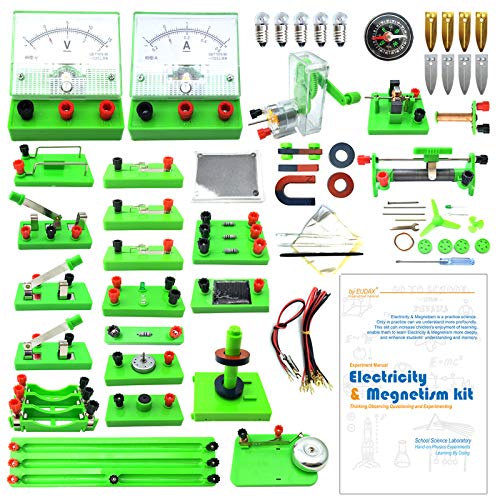
- 79-piece electricity and magnetism kit
- Includes color manual and storage bag
- Builds circuits, electromagnets, and more
Best For: Grades 9-11 electricity and magnetism labs
Structures and Forces Pick
Structural Engineering Bridges & Skyscrapers

- 20 buildable force-and-structure models
- Shows compression, tension, load, and force
- Includes 285+ pieces plus illustrated manual
Best For: Hands-on structural force lessons
Advanced Momentum Lab Pick

- Measures projectile velocity two ways
- Demonstrates inelastic collisions and energy loss
- Built for AP/college mechanics labs
Best For: Advanced momentum and energy experiments
Introductory Mechanical Engineering Kit
Thames & Kosmos Machines & Vehicles

- 20 hands-on builds plus 22 extra experiments
- Covers force, motion, gravity, gears, and energy
- Reusable parts with illustrated 80-page manual
Best For: Students ages 8+ starting with mechanical engineering
Classroom Dynamics Starter Set

- Tracks motion concepts like velocity, force, and momentum
- Includes trolleys, masses, timer, and stopwatch
- Economical starter set for dynamics lessons
Best For: Classroom or homeschool dynamics lessons
Comprehensive Mechanical Physics Kit
Thames & Kosmos Physics Workshop

- 38 models and 37 experiments across five chapters
- Covers gravity, levers, pulleys, gears, pendulums, and more
- 104-page manual includes real equations and charts
Best For: Students ready for a deeper physics curriculum
Pulley Practice Kit
Double and Single Pulleys for Middle School

- 8 double and 8 single pulleys for flexible setups
- Includes straps, hooks, and storage cases
- Sturdy build for repeated classroom use
Best For: Middle school hands-on pulley lessons
Heavy-Duty Block Set

- 2 fixed and 2 movable pulleys with ropes and hooks
- Heavy-duty iron and metal construction
- Clear storage case keeps parts organized
Best For: Simple machine demos in school or homeschool
Complete Mechanics Lab Kit
Balance, Pulleys, Ramp and Scales

- Includes balance, weights, pulleys, ramp, and measuring tools
- Supports 30+ classic physics experiments
- Manual helps guide classroom or lab use
Best For: Broad mechanics lessons for junior school students
Classical Mechanics Lab Pick – Physics Mechanics Kit with 26 Experiments
If you want physics mechanics kits for students that cover the core ideas in one organized set, this lab kit is built for hands-on classroom work. It brings together common mechanics tools for exploring Newton’s laws, kinematics, gravity, pressure, buoyancy, pulleys, and levers, so students can connect theory to measurable results.
Best For: Middle and high school students who need a broad classical mechanics lab kit for classroom experiments, lab practice, or guided home study.
Pros:
- Includes 26 experiments with tools like a tray balance, pulleys, lever ruler, U-tube pressure gauge, spring dynamometer, trolley, and ramp.
- Covers major mechanics topics including force balance, friction, pressure, buoyancy, pulleys, levers, and motion.
- Comes with a detailed manual that explains operation steps and principle analysis.
- Built from plastic and metal for durable, long-term classroom use.
Cons:
- Focused on mechanics only, so it is not a general physics kit.
- Best suited to guided experiments rather than freeform play.
- Requires space and storage for multiple lab components.
This is a strong option if you want a structured mechanics set that supports real lab teaching rather than just demonstration pieces. Its value is in the range of experiments and the included reference material, which help students build a more systematic understanding of classical mechanics.
Electricity and Magnetism Starter – School Physics Labs Circuit Kit
For physics mechanics kits for students that branch into electricity and magnetism, this school lab set offers a broad hands-on introduction. It includes a full-color manual and a large mix of parts for building circuits, testing magnetism, and exploring basic electromagnetism concepts in a practical way.
Best For: Grades 9-11 students who want a hands-on electricity and magnetism discovery kit for classroom labs or structured STEM exploration.
Pros:
- Includes 79 total items plus a color manual and storage bag.
- Supports projects such as series and parallel circuits, fruit battery, Ohm’s law, Oersted experiment, electromagnet, and electric bell making.
- Designed to help students learn, think, and explore basic electricity and magnetism.
- Provides a ready-to-start set with repair tools included.
Cons:
- Batteries are not included, and it requires 3 AA batteries to operate.
- More focused on electricity and magnetism than on broader mechanics topics.
- Best for guided experiments rather than open-ended invention alone.
This kit is a practical choice for a classroom or lab program that wants students building simple electrical and magnetic models rather than only reading about them. The mix of parts and manual support make it useful for structured, experiment-based learning.
Structures and Forces Pick – Structural Engineering Bridges & Skyscrapers
When comparing physics mechanics kits for students, this engineering set stands out for teaching force through building. Students can assemble 20 models that demonstrate load, compression, tension, and related structural ideas, making abstract mechanics concepts easier to see in a physical model.
Best For: Elementary and middle school students who want a hands-on introduction to structural forces through bridge and skyscraper models.
Pros:
- Builds 20 different models that teach force, load, compression, and tension.
- Includes over 285 interchangeable building pieces for repeated use.
- Comes with a 36-page illustrated experiment manual and assembly guide.
- Won the Parents’ Choice Gold Award, adding credibility for educational use.
Cons:
- More focused on structural engineering than on general physics lab experiments.
- Skill level is intermediate, so younger learners may need help.
- Not designed around electrical, motion, or fluid mechanics topics.
This kit is a smart pick if your goal is to teach force and structural behavior through building rather than through traditional measurement-based labs. It offers a strong mix of guided models and reusable parts that can support multiple lessons.
Advanced Momentum Lab Pick – Ballistic Pendulum Tester
If you need physics mechanics kits for students at the AP or college level, this ballistic pendulum tester is aimed at advanced momentum and energy labs. It is designed to study inelastic collisions, projectile velocity, conservation of momentum, and conservation of energy with multiple calculation methods for deeper analysis.
Best For: AP Physics and introductory college mechanics students studying momentum, energy, projectile motion, and lab uncertainty analysis.
Pros:
- Supports dual-method projectile velocity determination using momentum and energy.
- Demonstrates inelastic collisions, recoil velocity, and kinetic energy loss.
- Includes an angle indicator for accurate recoil angle measurement and repeated trials.
- Built to support uncertainty, percent difference, and experimental reproducibility analysis.
Cons:
- Designed for advanced learners rather than beginners.
- Listed age range is adult, so it is not a child-focused classroom toy.
- Single-apparatus format means it covers a narrow slice of mechanics.
This is the most specialized option in the group, but it is also the most rigorous for momentum-focused labs. If your course needs a real apparatus for conservation law experiments and data analysis, this tester is a strong fit.
Introductory Mechanical Engineering Kit – Thames & Kosmos Machines & Vehicles
If you’re comparing physics mechanics kits for students, this Thames & Kosmos set is a practical starter option for learning force and motion through building. It introduces mechanical engineering with 20 hands-on models and 22 extra experiments, making it easy to mix construction with concept review.
Best For: Students ages 8+ who want an introductory, hands-on mechanical engineering kit with clear step-by-step guidance.
Pros:
- Includes 20 buildable models plus 22 supplemental experiments.
- Covers forces, gravity, weight, simple machines, energy, momentum, gears, and more.
- Reusable parts can be reconfigured into models like a crane, windmill, elevator, and ATV.
- 80-page full-color manual gives illustrated assembly steps and explanations.
Cons:
- Focused on introductory learning rather than advanced mechanics.
- Plastic-based kit may be less suitable if you want laboratory-style equipment.
This is a strong pick for families or classrooms that want a broad, build-first introduction to mechanical engineering. It emphasizes everyday applications of physics, which helps students connect the models to real-world machines.
Classroom Dynamics Starter Set – Eisco Labs Physics/Mechanics
For physics mechanics kits for students that lean toward classic dynamics experiments, this Eisco Labs starter set focuses on measurement and motion. It includes a track with pulley, trolleys, masses, and timing tools so students can explore core physics ideas in a structured way.
Best For: Students and educators who want an economical dynamics kit for teaching motion, forces, and collisions.
Pros:
- Covers position, velocity, acceleration, force, momentum, and energy conservation.
- Includes a 1.2m track with pulley plus standard and spring-loaded trolleys.
- Comes with masses, ticker tape timer, carbon discs, cotton reel, spirit level, and stopwatch.
- Economical option for teaching dynamics fundamentals.
Cons:
- More of a starter set than a large build-heavy STEM kit.
- Best suited to guided physics activities rather than open-ended construction.
This kit is a straightforward choice if your priority is showing students how motion behaves in real experiments. It is especially useful when you want a compact setup for classroom demonstrations or introductory lab work.
Comprehensive Mechanical Physics Kit – Thames & Kosmos Physics Workshop
If you want physics mechanics kits for students that go beyond a simple starter project, this Thames & Kosmos workshop offers a deeper mechanical physics progression. With 38 models, 37 experiments, and 305 pieces, it covers a wide range of topics from gravity and inertia to centrifugal force.
Best For: Students ages 8+ who are ready for a more complete, hands-on mechanical physics curriculum.
Pros:
- Includes 38 models and 37 experiments across five physics chapters.
- Covers gravity, mass, levers, pulleys, gears, pendulums, centrifuges, and more.
- 104-page full-color manual explains concepts with real physics equations and data charts.
- NGSS-aligned and designed for homeschool, classroom enrichment, or independent learning.
Cons:
- Larger and more involved than an entry-level kit.
- May be more than casual users need if they only want a few simple builds.
This is the most curriculum-like option of the three, with enough depth to support repeated use as students progress. It works well when you want hands-on builds that still connect to formal physics concepts and equations.
Pulley Practice Kit – Double and Single Pulleys for Middle School
If you’re comparing physics mechanics kits for students, this pulley set is a straightforward way to teach force, motion, and mechanical advantage through hands-on setup. It includes both single and double pulleys plus straps and hooks, so students can build different configurations and see how pulley systems change effort in a practical way.
Best For: Middle school learners who need a compact, hands-on pulley system for classroom or home study.
Pros:
- Includes 8 double pulleys, 8 single pulleys, 8 straps, 16 hooks, and 4 holder cases.
- Designed for flexible pulley configurations with easy rope and hook attachment.
- Compact storage case makes it easy to carry and organize.
- Built with sturdy materials for repeated educational use.
Cons:
- Focused mainly on pulley experiments rather than broader mechanics topics.
- Best suited to middle school-level instruction.
- Small parts mean setup and cleanup need some supervision.
Overall, this is a practical choice if your main goal is to demonstrate pulley mechanics clearly and repeatedly. It keeps the learning focused, portable, and easy to reset between activities.
Heavy-Duty Block Set – Metal Fixed & Movable Pulleys
For buyers searching for physics mechanics kits for students, this 10-piece pulley block set offers a simple, durable way to demonstrate mechanical advantage and simple machines. The fixed and movable pulleys, ropes, and hooks make it easy to set up single, double, or compound arrangements in classrooms, labs, or at home.
Best For: Teachers and homeschoolers who want a sturdy pulley kit for simple machine demonstrations.
Pros:
- Comes with 2 fixed pulleys, 2 movable pulleys, 2 ropes, and 4 hooks.
- Heavy-duty iron brackets and metal wheels are built for repeated use.
- Transparent storage case helps keep all parts organized.
- Flexible hook-and-rope setup works in multiple learning spaces.
Cons:
- Limited to pulley-based mechanics experiments.
- No bulky stand included, so hanging points are needed.
- Smaller kit size means less variety than full lab sets.
This kit is a strong pick if durability and straightforward pulley demonstrations matter most. It keeps the focus on visible force reduction and simple machine concepts without adding unnecessary complexity.
Complete Mechanics Lab Kit – Balance, Pulleys, Ramp and Scales
If you want physics mechanics kits for students that go beyond one experiment, this lab kit is the most comprehensive option here. It combines a balance scale, weights, pulleys, a sliding ramp, spring scale, and measuring tools, making it useful for a wide range of classroom mechanics activities and guided lab work.
Best For: Junior school students and teachers who need an all-in-one mechanics lab for multiple experiments.
Pros:
- Includes a wide mix of tools such as balance scales, pulleys, ramp, spring scale, and rulers.
- Supports over 30 classic physics experiments across mechanics and measurement topics.
- Comes with a detailed manual and principle explanations.
- Made with smooth, durable plastic and metal parts for repeated use.
Cons:
- More complex than a simple starter kit.
- Age listing is inconsistent with the junior school focus.
- Many parts may require more setup time and organization.
This is the best fit if you want breadth rather than a single-topic demo kit. It gives students multiple ways to connect measurement, force, friction, buoyancy, and motion in one structured package.
How We Picked These Physics Mechanics Kits for Students
We looked for kits that support core mechanics topics such as force, motion, simple machines, pulleys, ramps, momentum, and basic measurement. Strong picks also needed clear educational value, sturdy parts, and enough variety to work in classrooms, homeschool labs, or small group demonstrations.
For Physics Mechanics Kits for Students, the most useful sets balance hands-on experimentation with repeatability. Kits that include multiple components or experiment types tend to offer better long-term value because they can grow with the learner.
Quick Comparison: What Each Type Is Best for
Some kits are better for introductory classroom labs, while others are more specialized. Pulley and force kits are ideal for Newton’s laws and mechanical advantage. Ramp and balance kits help with motion, gravity, and energy concepts. Larger STEM sets with multiple builds are better for broad exploratory learning. More advanced apparatus, such as collision or dynamics systems, is best for older students and deeper lab work.
Key Buying Factors for Physics Mechanics Kits for Students
Age and Curriculum Fit
Match the kit to the student’s grade level and the physics topics being taught. Younger learners usually need simpler, visual experiments, while middle and high school students can handle more measurement, setup, and analysis.
Experiment Range
Look for kits that cover more than one concept. A good mechanics kit should support lessons on forces, motion, gravity, levers, pulleys, energy transfer, or structural stability. More experiment variety usually means better classroom flexibility.
Component Quality
Sturdy parts matter, especially for repeated use. In Physics Mechanics Kits for Students, pulleys, scales, weights, ramps, and connectors should feel reliable and easy to assemble. Poor construction can make results inconsistent and frustrate learners.
Measurement and Observation Tools
The best learning happens when students can measure and compare results. Useful accessories include force gauges, balances, scales, springs, weights, and marked ramps. These tools help connect experiments to real physics principles.
Ease of Setup and Storage
For teachers and parents, quick setup is a major advantage. Kits with organized storage, clear labels, or durable cases save time and reduce missing parts. This is especially important for shared classroom use.
Who Should Buy Which Physics Mechanics Kits for Students?
Choose a broad introductory kit if you want an all-purpose classroom or homeschool option. Pick a pulley or force-focused set if your lessons center on mechanical advantage and Newtonian mechanics. Select a dynamics or collision apparatus if you need more advanced lab-style investigation. For hands-on STEM exploration, larger multi-build kits are often the most engaging choice.
If you want the most versatile option, look for a kit that combines simple machines, measurement tools, and multiple experiments. That gives students a stronger foundation and makes the kit useful across several lessons, not just one topic.