The best portable telescopes make it easier to explore the Moon, planets, and brighter deep-sky objects without committing to a large, complicated setup. The models in this roundup range from lightweight beginner refractors to smartphone-guided and electronically assisted options.
Use the buying guide below to compare aperture, portability, mounts, accessories, and ease of use so you can choose a telescope that matches your observing goals and experience level.
Best 10 Portable Telescopes Picks for 2026
Best Lightweight Starter

- 70mm fully coated refractor
- No-tool setup with backpack
- Includes 20mm and 10mm eyepieces
Best For: Beginners and families who want easy day-and-night observing
Best Large-Aperture Refractor

- 90mm fully coated objective lens
- 32x–240x stated magnification range
- Carry bag and phone adapter included
Best For: Adults and families seeking brighter, versatile viewing
Best Smartphone-Guided Option
Celestron StarSense Explorer LT 114AZ
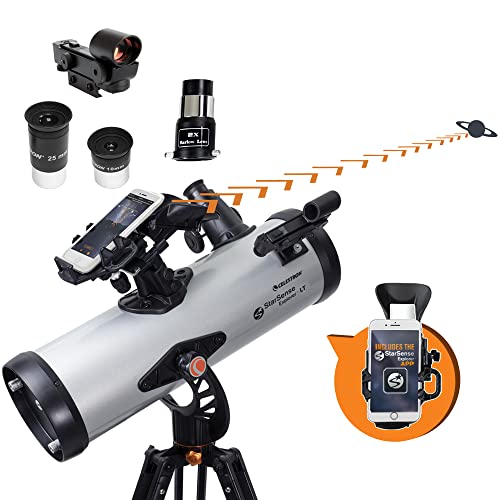
- App-guided celestial navigation
- 114mm Newtonian reflector
- Includes two eyepieces and 2x Barlow lens
Best For: Beginners wanting guided access to lunar, planetary, and deep-sky targets
Best Family Travel Kit

- 80mm fully coated optics
- Backpack, phone adapter, and moon filter
- 30x and 66x eyepiece options
Best For: Families and beginners seeking a portable, accessory-rich kit
Best Overall Portable Telescope

- 70mm coated optics for bright, clear viewing
- Backpack and quick no-tool setup
- Includes phone adapter, remote, and Moon filter
Best For: Beginners, families, and travel
Best Digital Portable Telescope
Smart Telescope with 4K Camera
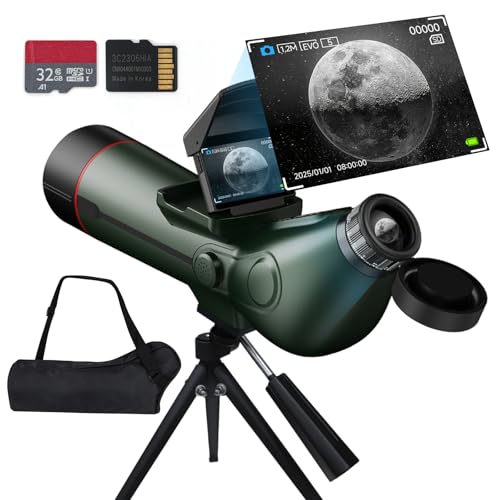
- 80mm aperture and 300mm focal length
- Built-in 4K photo and video capture
- Dual screens and up to six-hour battery life
Best For: Digital viewing, recording, and nature observation
Best Portable Telescope for Kids

- 70mm coated optics for bright beginner views
- Three eyepieces and 3x Barlow lens included
- Phone adapter, tripod, finder, and remote
Best For: Kids, families, and first-time observers
Best Portable Telescope for Bright, Versatile Views

- 80mm aperture for brighter beginner views
- Includes backpack, tripod, finder scope, and phone adapter
- Useful for astronomy and daytime observation
Best For: Beginners and families wanting a versatile travel telescope
Best Portable Telescope for High-Magnification Beginner Viewing

- 15x–150x stated magnification range
- Tool-free setup with tripod and finder scope
- Phone adapter and wireless remote included
Best For: Beginners taking a telescope camping or on road trips
Best Portable Telescope Gift for Kids

- Beginner-friendly tool-free setup
- 15x–150x stated magnification with multiple optics
- Phone adapter, remote, tripod, and gift box included
Best For: Kids and families starting astronomy together
Best Lightweight Starter – Celestron Travel Scope 70
For shoppers seeking portable telescopes that are quick to use, the Celestron Travel Scope 70 offers a lightweight 70mm refractor with no-tool setup, dual eyepieces, and a backpack for travel.
Best For: Beginners, families, and daytime or nighttime observing on the go.
Pros:
- 70mm fully coated optics provide clear views of the Moon, planets, and daytime scenery.
- Sets up quickly without tools and includes a full-height tripod.
- 20mm and 10mm eyepieces support wide and closer views.
- Includes a padded backpack, software, and a two-year warranty.
Cons:
- The 70mm aperture is smaller than the apertures of the other telescopes in this roundup.
- Manual focusing and an altazimuth mount require hands-on tracking.
This is a practical entry-level choice when portability and simplicity matter most. Its included backpack and beginner-oriented accessories make it especially convenient for casual stargazing and family use.
Best Large-Aperture Refractor – Dianfan 90mm Telescope
Among portable telescopes, the Dianfan 90mm model stands out for its large objective lens, 800mm focal length, phone adapter, and included carry bag. It is designed for brighter views while remaining suitable for beginners.
Best For: Adults and families wanting a larger-aperture refractor for astronomy and terrestrial viewing.
Pros:
- 90mm fully coated objective lens gathers more light for brighter, clearer images.
- Two eyepieces and a 3x Barlow lens provide a stated 32x–240x magnification range.
- Includes a stainless steel tripod, carry bag, phone adapter, and phone holder.
- The 45-degree zenith mirror supports upright terrestrial viewing.
Cons:
- At 4.7 kg, it is considerably heavier than the lightweight Celestron Travel Scope.
- The longer 800mm focal length and 80cm optical tube may be less convenient for compact travel.
- Assembly takes about 15 minutes according to the supplied notes.
The Dianfan offers a strong balance of aperture and versatility, particularly for shoppers prioritizing brighter views and smartphone use. Its larger, heavier setup is best suited to planned trips rather than ultra-light packing.
Best Smartphone-Guided Option – Celestron StarSense Explorer LT 114AZ
The Celestron StarSense Explorer LT 114AZ adds smartphone guidance to portable telescopes, helping beginners locate celestial targets through the StarSense Explorer app. Its 114mm Newtonian reflector is also equipped for lunar, planetary, and selected deep-sky viewing.
Best For: Beginners who want app-assisted navigation and a reflector suited to brighter deep-sky targets.
Pros:
- StarSense technology uses sky recognition to guide users to stars, planets, nebulae, and more.
- The 114mm reflector is designed for sharp views of the Moon, Jupiter, Saturn, Orion Nebula, and Andromeda Galaxy.
- Includes 25mm and 10mm eyepieces plus a 2x Barlow lens.
- Manual altazimuth mount includes altitude slow-motion adjustment for tracking.
Cons:
- At 10.4 pounds, it is heavier than the smaller portable models here.
- It requires a compatible smartphone for its guided navigation feature.
- The manual mount still requires hands-on target tracking.
This model is a compelling pick when finding objects is the main challenge. The phone-guided system can shorten the learning curve, while the 114mm reflector offers more light-gathering capacity than the smaller refractors.
Best Family Travel Kit – Celticbird 80mm Refractor
For families comparing portable telescopes, the Celticbird 80mm refractor combines a manageable size with an adjustable tripod, backpack, phone adapter, and moon filter. Its simple controls and included accessories are aimed at beginners and children ages 8–12.
Best For: Families, beginner observers, and travelers who want a ready-to-carry astronomy kit.
Pros:
- 80mm fully coated optics are designed to gather more light and improve image clarity.
- Backpack stores the telescope and accessories for convenient transport.
- Includes 20mm and 9mm eyepieces for stated 30x and 66x magnification.
- Comes with a phone adapter, 5×24 finderscope, moon filter, and adjustable tripod.
Cons:
- The stated magnification range is narrower than the Dianfan model’s advertised range.
- The aluminum tripod may be less substantial than a heavier stainless steel design.
- Manual focusing and an altazimuth mount require user adjustment and tracking.
The Celticbird is a well-rounded family package for buyers who value portability and included accessories. Its 80mm aperture offers a step up from smaller beginner scopes without making the kit excessively difficult to carry.
Best Overall Portable Telescope – Celestron Travel Scope 70 DX
The Celestron Travel Scope 70 DX is one of the most well-rounded portable telescopes for beginners who want simple setup, useful accessories, and day-to-night viewing. Its 70mm aperture, coated glass optics, full-height tripod, and included backpack make it practical for travel, family stargazing, and daytime observation.
Best For: Beginners, families, and travelers who want a lightweight telescope with smartphone imaging accessories.
Pros:
- 70mm aperture and fully coated optics for clear Moon, planet, and daytime views
- Quick, no-tool setup with a tripod and padded backpack
- Includes two eyepieces, a 2x Barlow lens, Moon filter, smartphone adapter, and Bluetooth remote
- Backed by a two-year limited warranty and U.S.-based support
Cons:
- Manual focus requires hands-on adjustment
- Its beginner-oriented altazimuth mount is not designed for advanced tracking
With its travel-ready design and generous accessory package, this is a strong choice for casual astronomy and general outdoor viewing. The included software and phone accessories also give beginners an easy way to identify objects and capture basic images.
Best Digital Portable Telescope – Smart Telescope with 4K Camera
This smart telescope takes a digital approach to portable viewing, combining an 80mm aperture and 300mm focal length with autofocus, dual screens, and built-in photo and video capture. It is suited to users who want to view and record celestial or distant subjects without relying on a separate smartphone.
Best For: Beginners and nature observers who prioritize built-in digital viewing, photography, and video recording.
Pros:
- 80mm aperture with a 300mm focal length for bright, detailed views
- Built-in 4K camera with one-touch photo and video modes
- Dual-screen design includes an adjustable eyepiece and foldable external display
- 4500mAh battery provides up to six hours of operation
Cons:
- Requires a nonstandard battery and electronic power management
- Digital features may be more complex than a basic manual telescope
- The supplied dimensions appear inconsistent, so confirm packed size before travel
This model is most appealing when immediate digital results matter more than a traditional telescope experience. Autofocus, internal storage support up to 512GB, and the dual-screen setup make it especially convenient for sharing observations and recordings.
Best Portable Telescope for Kids – Koolpte 70mm Travel Refractor
The Koolpte 70mm/400mm refractor is a beginner-friendly option among portable telescopes, with a straightforward manual design and a broad accessory set. Its coated optics, adjustable tripod, phone adapter, and wireless remote support both family stargazing and daytime landscape viewing.
Best For: Kids, families, and first-time users seeking a portable telescope with flexible magnification and phone capture.
Pros:
- 70mm aperture and anti-reflection-coated lenses support bright, high-contrast images
- Three eyepieces and a 3x Barlow lens offer a stated 20x-200x magnification range
- Includes adjustable aluminum tripod, phone adapter, wireless remote, and 5×24 finder scope
- Scratch-resistant lens coatings add durability for beginner use
Cons:
- Manual focus and an altazimuth mount require hands-on adjustments
- High magnification can be more difficult for beginners to steady and focus
- Warranty coverage is limited to one year
This kit offers a useful balance of accessibility and included equipment for families. The finder scope can help users locate targets, while the phone adapter and remote make basic photos and videos easier to capture.
Best Portable Telescope for Bright, Versatile Views – EACONN 80mm Refractor
For shoppers seeking portable telescopes with a little more light-gathering ability, the EACONN combines an 80mm aperture with a 600mm focal length. Its adjustable tripod, carrying backpack, phone adapter, and included finder scope make it a practical option for beginner astronomy, travel, and daytime viewing.
Best For: Beginners and families who want a portable telescope for moon viewing, basic planetary observation, bird watching, and landscape viewing.
Pros:
- 80mm fully coated optical glass lens is designed to provide bright, clear images.
- Includes K20mm and K9mm eyepieces, offering approximately 30x–66x magnification.
- Comes with a 5×24 finder scope, smartphone adapter, adjustable tripod, and carrying backpack.
- Rough-adjustment and positioning gimbal helps users aim the telescope more easily.
Cons:
- Manual focus and an altazimuth mount may require hands-on adjustment.
- Its 600mm optical tube may be less compact than shorter travel designs.
The larger aperture is the main draw here, while the included accessories make the package approachable for new users. It is a solid choice if you want a portable setup that can serve both astronomy and daytime observation.
Best Portable Telescope for High-Magnification Beginner Viewing – ToyerBee 70mm Refractor
This ToyerBee model is one of the more travel-oriented portable telescopes, with a lightweight 70mm refractor, tool-free setup, and accessories for phone photography. Its 300mm focal length and included eyepieces and Barlow lens provide a broad stated magnification range for moon, planet, and daytime viewing.
Best For: Kids, adults, and beginners who want an easy-to-set-up telescope for camping, road trips, backyard astronomy, and casual phone photos.
Pros:
- Fully multi-coated optics are designed to maximize light transmission and image sharpness.
- 15x–150x stated magnification range using two eyepieces and a 3x Barlow lens.
- Includes a 5×24 finder scope, tripod, universal phone adapter, and wireless camera remote.
- Tool-free setup, star chart, gift packaging, and lifetime maintenance support beginner use.
Cons:
- The 70mm aperture gathers less light than the 80mm model in this roundup.
- At 3.5 pounds, it may be less convenient to carry than the lightest compact options.
With a wide accessory package and straightforward setup, this telescope emphasizes accessibility and portability. The high stated magnification is useful for detail-oriented viewing, while the 70mm aperture remains suited to common beginner targets such as the Moon and bright planets.
Best Portable Telescope Gift for Kids – Jvcla 70mm Refractor
For families comparing portable telescopes as gifts, the Jvcla offers beginner-friendly setup and a broad accessory kit in a compact refractor package. The 70mm fully multi-coated optics, 300mm focal length, phone adapter, and wireless remote support both simple stargazing and daytime exploration.
Best For: Children, families, and first-time users looking for a gift-ready telescope for the Moon, stars, wildlife, and distant scenery.
Pros:
- Fully multi-coated optics are designed to improve brightness, contrast, and glare control.
- 15x–150x stated magnification range supports wide target locating and closer lunar views.
- Tool-free setup, sturdy tripod, and 5×24 finder scope help beginners start observing quickly.
- Phone adapter, wireless remote, gift box, and lifetime maintenance add practical value.
Cons:
- Manual focus requires the user to make adjustments while observing.
- The finder scope’s inverted image may be confusing until users become familiar with it.
This model stands out as a gift-focused option with simple assembly and phone-sharing features. Its accessory set makes it approachable for family activities, while the optical and magnification specifications cover common beginner viewing goals.
How We Picked the Best Portable Telescopes
We focused on telescopes that balance useful optical performance with manageable size, weight, and setup time. The selection includes compact refractors, a reflector design, smartphone-guided equipment, and electronic models to cover different budgets and observing styles.
We also considered aperture, focal length, mount stability, included accessories, portability features such as backpacks or compact tripods, and suitability for beginners. Marketing claims about extreme magnification were treated cautiously because a telescope’s practical performance depends more on optics, atmospheric conditions, and a steady mount.
Quick Comparison
| Best For | What to Prioritize | Most Suitable Type |
|---|---|---|
| First-time users | Simple controls and included accessories | Small refractor |
| Travel and camping | Low weight, compact storage, and a carrying case | 70mm-class travel telescope |
| Moon and planets | Larger aperture and a stable mount | 80mm to 114mm telescope |
| Phone-assisted observing | Reliable alignment or smartphone guidance | Guided or digital telescope |
| Family use | Fast setup and forgiving controls | Portable beginner refractor |
Key Buying Factors for Portable Telescopes
Aperture and Optical Design
Aperture determines how much light a telescope gathers and affects detail and brightness. A 70mm telescope is convenient for the Moon, bright planets, and daytime viewing, while 80mm or larger models can provide more resolving power when conditions and mount quality allow. Refractors are typically straightforward and low maintenance; Newtonian reflectors can offer more aperture for the money but may require additional care and collimation.
Mount Stability and Controls
A shaky tripod can undermine otherwise good optics. Look for a mount that feels solid when focusing and tracking an object. Altazimuth mounts are usually easiest for beginners, while smartphone-guided systems can simplify locating targets. High advertised magnification is useful only when the mount and atmosphere support it.
Portability and Setup
Check the packed size, total weight, tripod design, and whether a backpack or carrying case is included. For frequent travel, a slightly smaller telescope that can be assembled quickly may be more useful than a larger model that stays at home.
Accessories and Phone Compatibility
Eyepieces, a phone adapter, finder, diagonal, and a usable tripod add value. Smartphone adapters are helpful for casual photography, but they do not replace a stable mount. Electronic models may reduce manual searching, though they can require batteries, charging, app setup, or a stronger learning curve.
Who Should Buy Which Portable Telescopes?
Choose a compact 70mm refractor if you want an affordable, lightweight introduction to astronomy or need equipment for travel and family use. Choose an 80mm to 90mm model if you want a little more light-gathering ability while keeping the setup reasonably portable. Choose a 114mm reflector if brightness and deeper-sky capability matter more than minimal size and maintenance.
Choose a smartphone-guided or digital telescope if locating objects is your main frustration and you are comfortable using an app or electronic controls. Regardless of type, prioritize a stable mount, realistic optical specifications, and return support over inflated magnification numbers. A dark observing location and clear skies often improve results more than moving to a much larger telescope.