Choosing among today’s power amplifiers is easier when you start with your speakers, venue, and real-world output needs. The right model can deliver clean headroom, reliable operation, and straightforward system integration without unnecessary cost or weight.
This roundup compares 10 options ranging from lightweight DSP-equipped amps to rack-mount models built for DJs, PA systems, and fixed installations. Use the guide below to narrow the list by power, connectivity, portability, and system compatibility.
Best 10 Power Amplifiers Picks for 2026
High-Power Workhorse

- Up to 4,000 watts in bridge mode
- ATR technology for punch and clarity
- Switchable limiters and LED monitoring
Best For: High-output passive-speaker systems and fixed or mobile sound setups
Lightweight DJ Amp
- Only 5 pounds for easier transport
- Two-channel stereo design
- Crossovers, DDT, and Speakon outputs
Best For: Portable DJ, band, and venue sound systems
Quiet Reference Amp

- 2 x 400 watts into 4 ohms
- Convection cooling for quiet operation
- Bridged mono and clip monitoring
Best For: Studios, post-production, HiFi, and quiet live-sound applications
Smart Lightweight DSP Amp
Yamaha PX3 Dual Channel Power Amplifier

- 2 x 500 watts at 4 ohms
- Onboard DSP with D-Contour
- Config Wizard and event logging
Best For: Mobile systems needing lightweight amplification and DSP control
Reliable Stereo Power

- 750-watt two-channel amplifier
- Accelerated Transient Response
- Tabletop mounting design
Best For: Stereo systems needing high output
Flexible DJ Power

- 1400W RMS at 4 ohms
- Stereo, parallel, and bridge modes
- LCD monitoring and crossover
Best For: DJ and live sound systems
Professional PA Choice

- 300W per channel at 4 ohms
- 600W bridged at 8 ohms
- Forced-air cooling and flexible I/O
Best For: DJ, PA, and stage setups
Best High-Power Choice

- 2000W peak two-channel output
- Wide 10Hz–50kHz response with stated <0.1% THD
- Rack-mountable with XLR and 1/4-inch inputs
Best For: DJs, musicians, and passive-speaker PA systems
Best for Large Events
- 3000W peak and 800W RMS output
- Stereo and bridged modes with built-in crossover
- XLR, RCA, 1/4-inch, Speakon, and banana connections
Best For: DJs, live events, and touring audio systems
Best Versatile Option

- 2000W bridged or 1000W per channel
- Bluetooth and USB-A MP3 playback
- TRS, XLR, Speakon, and binding-post connections
Best For: Flexible PA systems with wireless playback
High-Power Workhorse – Behringer EUROPOWER EP4000
The Behringer EUROPOWER EP4000 is a high-output choice for buyers comparing power amplifiers for demanding passive-speaker setups. It delivers two-channel power, bridge-mode flexibility, switchable limiters, and clear front-panel monitoring.
Best For: DJs, bands, venues, and installations needing substantial output and overload protection.
Pros:
- Provides 2 x 1,400 watts into 4 ohms and 4,000 watts into 4 ohms in bridge mode
- ATR technology is designed for punch and clarity
- Switchable limiters help protect against overload
- Detented gain controls and Power, Signal, and Clip LEDs support precise monitoring
Cons:
- At 38.4 pounds, it is relatively heavy for portable setups
- The chassis is nearly 19 inches wide and intended for substantial rack or surface space
The EP4000 stands out when maximum headroom matters more than low weight. Its monitoring and protection features make it a practical fit for users who can accommodate a heavier amplifier.
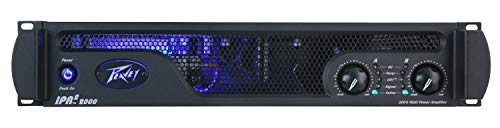
Lightweight DJ Amp – Peavey IPR2 2000
The Peavey IPR2 2000 is a compact option for shoppers seeking power amplifiers that are easier to transport. Its two-channel design, Class D topology, independent crossovers, and Speakon outputs suit stereo sound systems.
Best For: DJs, bands, and venues that need a portable two-channel amplifier for passive speakers.
Pros:
- Lightweight 5-pound design is easy to carry
- Two independent channels support stereo setups
- Fourth-order Linkwitz-Riley crossovers add system flexibility
- DDT and Speakon output connectors are included
Cons:
- The supplied warranty description lists only 90 days
- Specific per-channel impedance power figures are not provided in the supplied notes
With its low weight and practical two-channel layout, the IPR2 2000 is a sensible choice when portability is a priority. Confirm the detailed power requirements for your speakers before buying.
Quiet Reference Amp – Behringer A800
The Behringer A800 is a reference-class choice among power amplifiers for studios, post-production, live sound, and HiFi use. It combines two-channel operation with convection cooling, low-impedance drive capability, and front-panel performance indicators.
Best For: Recording studios, post-production rooms, HiFi systems, and quiet live-sound installations.
Pros:
- Delivers 2 x 400 watts into 4 ohms
- Can provide 800 watts into 8 ohms in bridged mono operation
- Convection cooling supports noise-free operation
- Level meters and clip indicators help monitor performance
Cons:
- Its 800-watt rating is lower than the higher-output amplifiers in this roundup
- It weighs about 4 kilograms, so it is not the lightest option listed
The A800 is best suited to users who value quiet operation and reference-oriented flexibility. Its bridged mode adds useful configuration options when a single higher-power output is preferred.
Smart Lightweight DSP Amp – Yamaha PX3 Dual Channel Power Amplifier
The Yamaha PX3 brings onboard processing to the power amplifiers category, pairing two-channel output with DSP features and a lightweight chassis. Its D-Contour processing, Config Wizard, panel lock, and event logging support streamlined system setup.
Best For: Mobile sound systems and users who want DSP-assisted configuration without a heavier amplifier.
Pros:
- Provides 2 x 500 watts at 4 ohms
- Weighs 19.6 pounds and is 50% lighter than previous Yamaha P Series amplifiers
- Includes onboard signal processing with D-Contour
- Config Wizard, panel lock, and event logging add useful system-management tools
Cons:
- Supplied notes do not specify bridged-mode output
- Its feature set may be more involved than needed for simple amplification-only systems
The PX3 is a strong middle ground for buyers who want manageable weight and built-in processing. It offers more system-control features than a basic power amplifier while retaining a practical two-channel format.
Reliable Stereo Power – Behringer KM750
The Behringer KM750 is a practical choice among power amplifiers for users who need a two-channel design with up to 750 watts of output and Accelerated Transient Response. Its tabletop mounting option and substantial 18.7-pound build suit straightforward stereo amplification setups.
Best For: Stereo systems and users seeking a high-output two-channel amplifier with ATR.
Pros:
- 750-watt, two-channel power amplifier.
- Accelerated Transient Response is included.
- Tabletop mounting provides flexible placement.
- FCC specification met.
Cons:
- At 18.7 pounds, it is relatively heavy for a compact setup.
- The supplied notes do not specify stereo output by impedance.
The KM750 emphasizes substantial output and a simple two-channel layout. Confirm your speaker requirements and available placement before choosing it for a system.
Flexible DJ Power – Rockville D12
The Rockville D12 stands out among power amplifiers for DJ, live-event, and home-audio applications with 1400W RMS at 4 ohms, stereo and bridged modes, and a switchable crossover. Its lightweight Class D chassis adds rack-mounting flexibility and real-time LCD monitoring.
Best For: DJs, live sound users, and passive speaker or subwoofer systems needing flexible routing.
Pros:
- Provides 1400W RMS at 4 ohms and 700W RMS at 8 ohms.
- Supports stereo, parallel, and bridge modes.
- LCD shows channel volume in dB and operating temperature.
- 1.5U rack-mountable Class D design weighs 9.7 pounds.
Cons:
- The supplied voltage specification is 100 volts, so compatibility should be checked.
- Its feature-rich controls may be more than a basic stereo setup requires.
With crossover settings, limiter functionality, multiple operating modes, and flexible inputs and outputs, the D12 is built for adaptable sound systems. Verify speaker impedance and electrical compatibility before installation.
Professional PA Choice – Crown XLi800
Crown XLi800 Two-channel, 600-Watt Bridged 8Ω Power Amplifier. Professional DJ, PA, Stage Amp. Black
Check Price On AmazonThe Crown XLi800 is a straightforward two-channel option among power amplifiers, delivering 300 watts per channel at 4 ohms and up to 600 watts when bridged at 8 ohms. Selectable input voltage, forced-air cooling, and flexible I/O support professional DJ, PA, and stage applications.
Best For: DJs, PA users, and stage setups needing a conventional two-channel amplifier with bridge operation.
Pros:
- 300W continuous per channel at 4 ohms.
- 600W bridged output at 8 ohms.
- Selectable input voltage supports installation flexibility.
- Forced-air cooling and flexible I/O are included.
Cons:
- At 25.1 pounds, it is the heaviest amplifier in this selection.
- The supplied notes list 120 volts, so electrical requirements should be confirmed.
- It is freestanding rather than specified as rack-mountable.
The XLi800 focuses on familiar professional-amplifier features and bridge capability rather than a lightweight design. It is a sensible fit when dependable two-channel operation and selectable voltage matter more than portability.
Best High-Power Choice – MUSYSIC SYS-2000
If you need power amplifiers for a PA system, passive speakers, or a rack-mounted audio setup, the MUSYSIC SYS-2000 offers a professional two-channel design with 2000W peak output. Its wide frequency response, low stated THD, and ATR Technology are aimed at clean, punchy performance for demanding music playback and live use.
Best For: DJs, musicians, live performers, and users powering passive speakers indoors or outdoors.
Pros:
- 2000W peak output with two-channel operation
- 10Hz–50kHz frequency response and stated THD below 0.1%
- XLR and 1/4-inch inputs, rack-mountable 2U chassis, and thermal protection
- ATR Technology supports fast, punchy bass response
Cons:
- Its 13-pound, 19 x 12 x 4-inch rack format may be more equipment than casual listeners need
- The notes specify peak output but do not provide detailed continuous power ratings by impedance
The SYS-2000 is a sensible pick when clean signal handling, rack installation, and substantial peak headroom matter. Verify speaker impedance and the desired continuous output before matching it to your system.
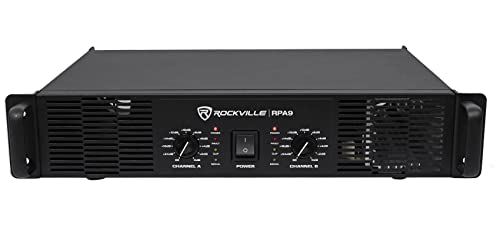
Best for Large Events – Rockville RPA9
Among power amplifiers for DJs, live events, and touring setups, the Rockville RPA9 stands out with 3000W peak and 800W RMS output. Its rugged 2U chassis, multiple input types, flexible speaker outputs, and cooling system make it suited to installations that need practical connectivity and sustained operation.
Best For: DJs, mobile entertainers, large venues, and professional audio racks.
Pros:
- 3000W peak and 800W RMS output for high-output applications
- XLR, 1/4-inch, and RCA inputs support varied source equipment
- Speakon and banana outputs, with stereo and bridged modes
- Dual fans and heat-sink design help control heat during extended use
Cons:
- Its professional rack-mounted design may be excessive for a small home system
- The supplied notes do not specify frequency response or distortion figures
The RPA9 is a strong practical option when output, connection flexibility, and cooling are higher priorities than compact size. Its built-in crossover and stereo/bridged operation also provide useful configuration flexibility.
Best Versatile Option – Pyle PTA1000BT
The Pyle PTA1000BT is one of the more flexible power amplifiers for users who want both traditional rack connectivity and convenient music playback. It provides 1000W per channel in stereo or up to 2000W in bridged mode, plus Bluetooth, USB-A MP3 playback, front-panel metering, and multiple speaker outputs.
Best For: Home and small-to-medium PA setups needing Bluetooth and flexible speaker connections.
Pros:
- 2000W maximum bridged output or 1000W per channel in stereo
- Bluetooth supports wireless streaming from phones, tablets, laptops, and computers
- TRS, XLR, Speakon, and binding-post connections offer system flexibility
- Cooling fans, LCD display, and LED level/protection indicators add convenience
Cons:
- The supplied notes list a 220V voltage specification alongside a 120V minimum supply, so power compatibility should be checked carefully
- Its 6.94 kg rack-mounted chassis may still be more than a simple home setup requires
The PTA1000BT is appealing when an amplifier needs to handle wired sources, wireless streaming, and different speaker configurations in one chassis. Confirm your local power requirements and speaker impedance before purchase.
How We Picked These Power Amplifiers
We focused on models suited to common live-sound, DJ, rehearsal, mobile PA, and installation scenarios. The selection considers rated output, channel flexibility, bridge operation, input and speaker connections, rack compatibility, portability, onboard DSP, and the practical needs of different speaker systems.
Power ratings can be presented under different impedance and measurement conditions, so they should not be compared as if every number represents the same test. Always check the manufacturer’s specifications and match the amplifier to the speaker’s continuous and program ratings.
Quick Comparison
| Best For | What to Prioritize | Models to Consider |
|---|---|---|
| Large PA systems | High output, protection circuitry, dependable cooling | Behringer EP4000, Peavey IPR2 2000 |
| Portable rigs | Low weight, efficient Class D design, simple setup | Yamaha PX3, Peavey IPR2 2000 |
| DSP-based control | Built-in processing, flexible configuration | Yamaha PX3 |
| DJ and rack systems | Rack mounting, balanced inputs, Speakon outputs | Rockville D12, Rockville RPA9, Crown XLi800 |
| Budget installations | Useful connectivity and adequate channel power | Behringer A800, KM750, Pyle amplifier |
Key Buying Factors for Power Amplifiers
Output and Impedance
Confirm the amplifier’s output at your speakers’ impedance, typically 8 or 4 ohms. A little headroom helps reduce clipping, but excessive power can damage speakers if the system is mismanaged. Check whether bridged mode is supported and whether it changes the minimum safe impedance.
Class, Weight, and Cooling
Class D models are often lighter and more efficient, making them attractive for mobile rigs. Traditional designs may be heavier but can still suit permanent racks or users who prioritize a particular sonic and operational profile. Fan noise, ventilation, and thermal protection also matter in enclosed spaces.
Connections and Controls
Balanced XLR or TRS inputs help reduce noise over longer cable runs, while Speakon outputs provide a secure connection for many PA speakers. Front-panel gain controls, signal and clip indicators, USB or Bluetooth features, and DSP can simplify setup, but only if they fit your workflow.
Protection and Reliability
Look for safeguards against overheating, short circuits, overloads, and DC faults. For touring or frequent use, construction quality, serviceability, warranty coverage, and a proven cooling layout may be more valuable than a higher headline wattage.
Who Should Buy Which Power Amplifiers?
Choose the Behringer EP4000 or Peavey IPR2 2000 when you need substantial output for a conventional PA and can accommodate a larger rack component. The Yamaha PX3 is a strong fit for users who want lighter transport and integrated DSP control.
For home studios, smaller venues, and reference-style setups, the Behringer A800 offers a more restrained power profile. The KM750, Crown XLi800, Rockville D12, and Rockville RPA9 are practical choices for DJ, rehearsal, and rack-mounted systems where straightforward two-channel operation is the priority.
Finally, consider the generic 2,000-watt amplifier and Pyle model only after verifying their actual output specifications, connectivity, cooling, and compatibility with your speakers. They may appeal to budget-focused buyers, but system matching and realistic ratings should come before the largest number on the product page.