The best power strips for computers do more than add outlets. They help organize a workstation, protect connected electronics from surges, and provide convenient charging for peripherals and mobile devices.
We selected 10 options with different outlet counts, cord lengths, surge ratings, USB configurations, and mounting styles so you can match a power strip to your desk, gaming setup, home office, or shared workspace.
Best 10 Power Strips for Computers Picks for 2026
Reliable High-Capacity Pick
Amazon Basics 12-Outlet Surge Protector

- 12 AC outlets and an 8-foot cord
- 4000-joule surge protection
- Safety shutters and rear keyhole mount
Best For: Home offices, gaming rooms, and multi-device workstations
Flexible Charging Station

- 12 AC outlets plus 6 USB ports
- Wide spacing for bulky adapters
- Flat 45-degree plug and 2400-joule protection
Best For: Computer desks and charging-heavy dorm or office setups
Compact Fast-Charging Choice

- 12 AC outlets with USB-C and USB-A
- 20W USB-C fast charging
- 2100-joule protection and mountable design
Best For: Desks and side tables with computers and mobile devices
Maximum Outlet Capacity
QINLIANF 24-Outlet Surge Protector

- 24 AC outlets and 4 USB ports
- 4100-joule surge protection
- 6-foot flat-plug cord and ETL listing
Best For: Large gaming setups, offices, and high-device-count workstations
Best High-Capacity Pick
SUPERDANNY 28-Outlet Power Strip

- 22 AC outlets plus six USB ports
- Wide spacing for bulky adapters
- Mountable design with 2,100J surge protection
Best For: Large computer, gaming, and media setups
Best Heavy-Duty Protection
Belkin 12-Outlet Surge Protector

- 12 widely spaced AC outlets
- 3,940-joule surge protection rating
- 8-foot cord with angled plug
Best For: Home-office desks needing strong AC protection
Best Desk-Mounted Pick

- Clamps onto desks up to 1.96 inches thick
- Four USB-C PD and two USB-A ports
- Five outlets with 1,200J surge protection
Best For: Organized desks needing accessible USB-C charging
Best Long-Reach Option

- 10-foot cord with flat, angled plug
- 12 widely spaced AC outlets
- Wall-mountable with four USB ports
Best For: Home offices, dorms, and desks needing extra reach
Best Surge Rating
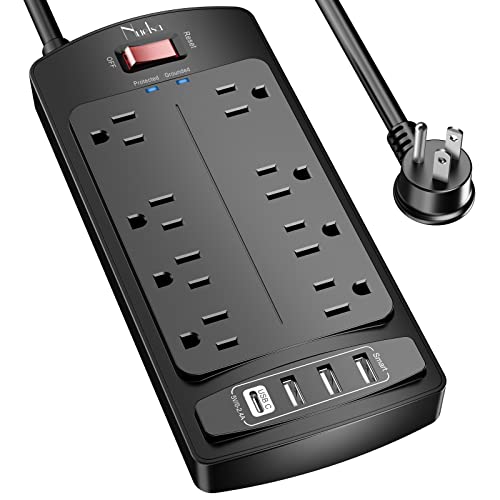
- 2,700-joule surge protection
- Eight AC outlets plus USB-C
- Six-foot flat-plug cord
Best For: Desks prioritizing surge protection and USB-C charging
Best Simple Pick
18-Outlet Computer Power Strip
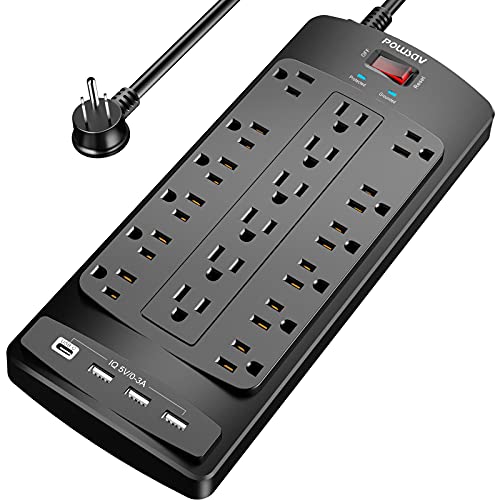
- 18 widely spaced AC outlets
- 2,100-joule surge protection
- Six-foot cord with cable ties
Best For: Gaming desks and multi-device workstations
Reliable High-Capacity Pick – Amazon Basics 12-Outlet Surge Protector
For shoppers comparing power strips for computers, this Amazon Basics model offers 12 AC outlets, a long 8-foot cord, and 4000-joule surge protection. Its straightforward design suits a busy desk, office, or gaming setup where dependable outlet capacity matters.
Best For: Home offices, gaming rooms, and workstations with many AC-powered devices.
Pros:
- 12 outlets provide room for computers, monitors, peripherals, and other electronics.
- 4000 joules of surge protection plus a 15-amp circuit breaker.
- 8-foot cord, safety shutters, power switch, and rear keyhole mount.
Cons:
- No USB charging ports are listed.
- The rectangular design may take more desk or floor space than a compact strip.
Choose this model if your priority is broad AC connectivity and a long reach rather than built-in USB charging. The wall-mount option also makes it practical for organizing a fixed computer station.
Flexible Charging Station – QKP 12-Outlet USB Power Strip
This QKP model is a versatile option among power strips for computers, combining 12 AC outlets with three USB-A and three USB-C ports. Its wide spacing and flat angled plug are useful when a desk setup includes bulky laptop chargers and several mobile devices.
Best For: Desks, dorm rooms, and home offices needing both AC outlets and USB charging.
Pros:
- 18-in-1 layout with 12 AC outlets and six USB ports.
- 1.7-inch outlet spacing accommodates larger power bricks.
- 2400-joule surge protection, resettable overload protection, and a 45-degree flat plug.
Cons:
- The combined USB output is rated at 5V/3.1A for the USB-A group and USB-C group.
- Its white-and-gray finish may not blend with every setup.
For a computer desk that also serves as a charging station, this strip provides useful flexibility without requiring multiple wall chargers. The three-sided arrangement can make connected plugs easier to access.
Compact Fast-Charging Choice – Anker 351 Power Strip
The Anker 351 is a practical pick for power strips for computers when you want plentiful AC outlets along with a dedicated USB-C charging port. It provides 12 outlets, a 5-foot cord, and an outlet layout designed to accommodate bulkier plugs.
Best For: Desks, bedside tables, and sofa-side setups with computers and mobile devices.
Pros:
- 12 AC outlets plus one USB-C and two USB-A ports.
- 20W USB-C port supports fast charging for compatible devices.
- 2100-joule surge protection, overload protection, mounting hardware, and an 18-month warranty.
Cons:
- The total USB output is shared and limited to 15W across the USB ports.
- The 5-foot cord offers less reach than some 6- or 8-foot alternatives.
This is a balanced option for a computer workstation that needs many standard outlets but only occasional USB charging. Its extra outlet spacing and mountable design help keep a smaller desk organized.
Maximum Outlet Capacity – QINLIANF 24-Outlet Surge Protector
When a computer setup includes numerous monitors, peripherals, chargers, and other electronics, the QINLIANF offers unusually high capacity. This power strip provides 24 AC outlets, four USB ports, a 6-foot cord, and 4100-joule surge protection.
Best For: Large computer desks, gaming setups, offices, and shared electronics stations.
Pros:
- 24 AC outlets provide extensive connection capacity.
- Four USB ports include two USB-C ports, with smart charging support.
- 4100-joule surge protection, overload protection, ETL listing, and a 6-foot flat-plug cord.
Cons:
- The large outlet count can make the unit bulky for compact desks.
- The USB-C ports do not support devices requiring 9–22V charging.
- Its 15-amp rating still limits the total connected load.
This model makes the most sense when outlet capacity is the main priority. It is overkill for a basic computer desk, but its broad layout can simplify a workstation or gaming area with many connected devices.
Best High-Capacity Pick – SUPERDANNY 28-Outlet Power Strip
For computer setups with multiple monitors, peripherals, chargers, and accessories, the SUPERDANNY is one of the most expansive power strips for computers. It combines 22 AC outlets with six USB ports, including USB-C, in a mountable design suited to gaming rooms, offices, and media centers.
Best For: Large computer, gaming, and media setups that need many outlets and built-in USB charging.
Pros:
- Provides 22 grounded AC outlets and six USB ports, including one USB-C port.
- Widely spaced outlets help accommodate larger adapters and plugs.
- Includes 2,100-joule surge protection, overload protection, and other listed safety features.
- Can be wall-mounted and uses a 45-degree angled flat plug with a 6.5-foot cord.
Cons:
- The side outlets cannot be rotated.
- Its large outlet count may be more than a compact desk setup requires.
Choose this model when outlet capacity and flexible placement matter most. Its extensive connectivity is especially useful for a computer workstation or gaming setup with many connected devices.
Best Heavy-Duty Protection – Belkin 12-Outlet Surge Protector
The Belkin 12-outlet model is a practical choice for home offices and workstations that need dependable protection for computers and peripherals. It offers widely spaced AC outlets, an 8-foot cord, and a safety indicator in a compact, wall-mountable design.
Best For: Home-office computer setups that prioritize strong surge protection and a long cord.
Pros:
- Offers 12 AC outlets with widely spaced areas for larger plugs and chargers.
- Provides a listed 3,940-joule surge protection rating.
- The 8-foot cord has a 3-prong angled plug for tight spaces.
- UL-listed, wall-mountable, and backed by a two-year limited warranty plus connected-equipment coverage.
Cons:
- It does not include built-in USB charging ports.
- It has fewer outlets than the SUPERDANNY option.
This Belkin is a balanced option for computer desks where AC outlets and surge protection are more important than USB charging. The long cord and angled plug also make positioning easier around a workstation.
Best Desk-Mounted Pick – Clamp-On USB-C Power Station
For a tidy workstation, this clamp-on model offers a convenient alternative to traditional power strips for computers. It attaches to a desk edge and combines five AC outlets with four USB-C PD ports and two USB-A ports, keeping charging access close to the keyboard and monitor area.
Best For: Desks that need accessible USB-C charging and a secured, space-saving power station.
Pros:
- Clamps to desk edges up to 1.96 inches thick for a semi-permanent mounting solution.
- Includes five widely spaced AC outlets and six USB charging ports.
- Provides four USB-C PD ports rated up to 20W each, with 40W total USB output.
- Uses a 6-foot flat plug cord and includes 1,200-joule surge protection.
Cons:
- The clamp requires a desk with 0.4 to 0.5 inches of clearance from the wall.
- USB output is shared, so the total is 40W rather than 20W per USB-C port simultaneously.
- It has fewer AC outlets and a lower surge rating than the other options here.
This power station is best when desk organization and convenient device charging are priorities. Confirm your desk thickness and rear clearance before buying to ensure the clamp will fit properly.
Best Long-Reach Option – 12-Outlet USB Power Strip
For computer setups located away from the wall, this power strip for computers combines 12 widely spaced AC outlets with a 10-foot extension cord. Its three-sided layout helps accommodate larger adapters, while the flat, angled plug can fit behind furniture.
Best For: Home offices, dorm rooms, and desks that need extra reach, widely spaced outlets, and wall-mounting flexibility.
Pros:
- 12 AC outlets and four USB charging ports provide substantial device capacity.
- 10-foot cord and 45-degree flat plug support flexible placement.
- Wide spacing and three-sided design help reduce adapter blockage.
- Can be mounted with the included screws or used on a desktop.
Cons:
- The 1,050-joule surge rating is lower than some competing options.
- The USB ports share a 3A total output and are intended for charging compatible USB devices.
This is a practical choice when cord length and outlet spacing matter more than maximum surge capacity. Its overload, short-circuit, overcurrent, overvoltage, and overheating protections add useful safeguards for everyday indoor computer equipment.
Best Surge Rating – 8-Outlet USB-C Power Strip
This power strip for computers pairs eight AC outlets with four USB ports, including one USB-C port, and provides a 2,700-joule surge rating. The six-foot cord and flat plug suit standard office, entertainment, and desk arrangements.
Best For: Computer users who want a strong surge rating, USB-C charging, and a compact six-foot reach.
Pros:
- 2,700 joules of surge protection offers the highest rating among these options.
- Four USB ports include a USB-C port with up to 3A output.
- Eight AC outlets support computers, monitors, routers, and other electronics.
- ETL-listed construction includes overload protection and a protected indicator light.
Cons:
- Eight AC outlets provide less capacity than the larger 12- and 18-outlet models.
- The six-foot cord may be limiting for setups positioned far from an outlet.
- The USB-C port does not support devices requiring 9–22V charging voltage.
Choose this model when surge protection is a priority and eight outlets are sufficient. Its USB-C addition is convenient for compatible devices, while the six-foot cord keeps cable management simpler than a longer extension.
Best Simple Pick – 18-Outlet Computer Power Strip
When a computer workstation has numerous accessories, this power strip for computers offers 18 widely spaced AC outlets and four USB ports. Its six-foot heavy-duty cord, flat plug, and included cable ties help support a busy desk or gaming setup.
Best For: Gaming desks, workstations, and multi-device setups that need the greatest number of outlets.
Pros:
- 18 AC outlets provide exceptional capacity for computers and peripherals.
- Widely spaced outlets help accommodate multiple plugs and adapters.
- Includes four USB ports and reusable cable ties for cord organization.
- Offers 2,100 joules of surge protection with overload protection and ETL certification.
Cons:
- Its large 11.7-by-4.9-inch footprint may take up substantial desk or wall space.
- The six-foot cord is shorter than the 10-foot option in this roundup.
- It may be more capacity than a small computer setup requires.
This is the strongest fit for an equipment-dense workstation where outlet count is the deciding factor. The 2,100-joule rating, protected indicator, and overload protection provide useful coverage, while the cable ties help keep the long cord manageable.
How We Picked the Best Power Strips for Computers
We compared these power strips by the features that matter most in computer setups: outlet capacity, surge protection rating, cord length, plug design, USB charging, construction, and installation flexibility. We also considered whether each model suits a compact desk, a multi-device workstation, or a demanding gaming and home-office arrangement.
Specifications such as joule ratings, amperage, wattage limits, certification listings, and USB output should be checked against your equipment and local electrical requirements. A higher outlet count is useful, but it does not mean the strip can safely power unlimited high-wattage devices at once.
Quick Comparison
| Best For | Features to Prioritize | Good Match From This List |
|---|---|---|
| Standard home office | 8–12 outlets, dependable surge protection, long cord | Amazon Basics or Belkin |
| Many peripherals | 18–24 outlets and spaced receptacles | QINLIANF or SUPERDANNY |
| USB-C charging | USB-C ports and clearly stated power output | 6-foot USB-C model or Anker |
| Small or organized desks | Flat plug, compact layout, or clamp mount | Nuetsa or desk-clamp model |
| Long-distance placement | 10-foot cable and adequate load rating | 10-foot surge protector |
Key Buying Factors for Power Strips for Computers
Outlet Count and Spacing
Count your computer, monitors, speakers, router, printer, chargers, and accessories before buying. Widely spaced outlets are especially useful for bulky power adapters. Avoid choosing solely by the largest number of sockets if your desk has limited room.
Surge Protection and Electrical Ratings
Joule ratings indicate how much surge energy a protector is designed to absorb over its service life; they are not a guarantee against every electrical event. Look for clearly stated amperage and wattage limits, recognized safety listings such as UL or ETL where applicable, and protection indicators or status lights.
Cord Length and Plug Design
An 8- or 10-foot cord can reach a distant wall outlet, while a 6-foot cord may reduce excess cable on a compact desk. Flat plugs fit more easily behind furniture, but the strip should still remain accessible and not be pinched or covered.
USB and USB-C Charging
USB ports are convenient for phones, accessories, and low-power devices. Check total output and per-port limits rather than assuming every USB-C port supports laptop-class charging. For demanding USB-C devices, compare the stated PD wattage with the device’s charging requirement.
Placement and Load Management
Keep the strip ventilated, never daisy-chain power strips, and connect high-draw equipment only within the stated rating. Computers and monitors are generally appropriate, but heaters, refrigerators, and other high-wattage appliances may exceed what a typical desktop strip is designed to handle.
Who Should Buy Which Power Strips for Computers?
Choose a conventional 8- or 12-outlet model if you need dependable coverage for a home office or basic computer desk. Pick a high-outlet strip when multiple monitors, peripherals, chargers, and networking devices share one area. A USB-C model is best when reducing charging bricks matters, while a clamp-mounted unit makes sense for a clean desk edge and easy access.
If your outlet is far from the workstation, prioritize cord length before extra USB ports. For gaming rooms or larger setups, focus on outlet spacing, surge capacity, and a clearly stated 15-amp or equivalent load rating. Whichever model you choose, leave capacity for future devices and replace the strip if it shows heat damage, a loose outlet, or signs that its protection has been exhausted.