Copying files to multiple USB drives one at a time wastes time and increases the chance of errors. The right standalone duplicator can streamline media distribution, backups, event materials, software deployment, and drive sanitization.
This roundup compares 10 USB duplicators for bulk copying, including compact desktop models and high-output systems. Use the buying guide below to match port count, speed, compatibility, and workflow features to your needs.
Best 10 USB Duplicators for Bulk Copying Picks for 2026
Compact Technician Pick

- Standalone copying for two target drives
- File, sector, and erase modes
- LCD verification and error scanning
Best For: Small-volume IT and technician workflows
Balanced 15-Drive Workhorse

- Handles up to 15 target drives
- Bit-by-bit standalone copying
- Synchronous and asynchronous modes
Best For: Regular business and service-provider batches
Feature-Rich High-Volume Pick

- Copies or erases 15 USB drives
- LCD monitoring and Copy & Compare
- Supports sector cloning and sanitization
Best For: IT teams needing verification and erase controls
Maximum Batch Capacity

- Supports up to 31 target drives
- Standalone bit-by-bit copying
- Synchronous and asynchronous modes
Best For: High-volume production batches
Best High-Capacity Pick
EZ Dupe USB Cyclone 1-to-15 Duplicator

- Copies to up to 15 USB devices simultaneously
- Supports USB flash drives plus external HDDs and SSDs
- Includes multiple copy and DoD erase modes
Best For: High-volume duplication and mixed USB drive workflows
Best Compact Starter
BestDuplicator UB300 1-to-2 USB Copier

- Duplicates one source to two targets
- Offers quick and bit-for-bit copy modes
- Portable standalone design with LCD controls
Best For: Small USB 1.1 and 2.0 duplication jobs
Best Touchscreen Workflow
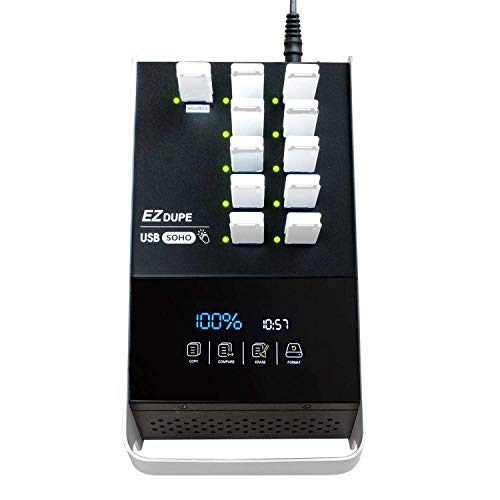
- Handles up to 10 USB duplication targets
- Supports USB 2.0, 3.0, and 3.1 thumb drives
- Uses a touchscreen for copy, compare, format, and erase
Best For: Routine office and content-team duplication
Best Standalone 1-to-5 USB Duplicator

- Copies up to five USB drives without a computer
- Supports sector, file-system, and erase modes
- Includes LCD monitoring and Copy-and-Compare verification
Best For: IT teams needing standalone duplication and drive erasure
Best Computer-Connected 1-to-10 USB Duplicator

- Duplicates up to 10 USB drives simultaneously
- Copies from images, drives, files, or folders
- Supports Windows and Mac with included software
Best For: Computer-based bulk duplication on Windows or Mac
Best Compact 1-to-4 Standalone USB Duplicator
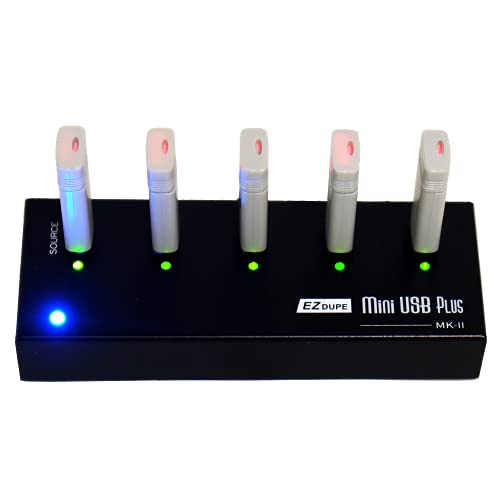
- Copies up to four USB drives without a computer
- Supports USB 1.0, 2.0, and 3.0 media
- Offers asynchronous copying for continuous small-batch work
Best For: Portable plug-and-use duplication of smaller USB batches
Compact Technician Pick – StarTech 1:2 USB Duplicator
For small-batch USB duplicating, the StarTech 1:2 is a compact standalone option that copies or erases two drives at a time without a computer. It supports system and file copying, sector-by-sector cloning, and several erase modes, making it a practical choice for technicians seeking usb duplicators for bulk copying on a modest scale.
Best For: IT technicians, support teams, and small-volume USB boot-drive or data-copying tasks.
Pros:
- Copies to two USB drives simultaneously without a computer.
- Supports file-based and sector-by-sector duplication.
- Includes Copy & Compare verification, error scanning, and multiple erase modes.
- Asynchronous mode lets users replace finished drives without stopping, for source content under 64 MB.
Cons:
- Only two target ports limit throughput for larger production runs.
- Asynchronous copying is limited to source content under 64 MB.
- External USB storage devices may need their own power source.
Choose this model when portability and drive-management features matter more than maximum output. Its LCD controls and verification options add useful oversight for smaller duplication jobs.
Balanced 15-Drive Workhorse – Systor 1:15 USB Duplicator
The Systor SYS-USBD-15 is a standalone 1-to-15 USB duplicator built for substantially larger batches than compact two-port units. It performs bit-by-bit copying at speeds up to 2GB per minute and supports both synchronous and asynchronous modes, making it a capable option among usb duplicators for bulk copying.
Best For: Businesses, service providers, and teams producing up to 15 matching USB drives per batch.
Pros:
- Copies one source to up to 15 USB drives at once.
- Requires no computer or software.
- Supports bit-by-bit duplication for direct source replication.
- Offers synchronous and asynchronous copy modes plus hot-swappable operation.
Cons:
- Its listed transfer rate is up to 2GB per minute, or 33MB per second.
- USB 2.0 connectivity may be less suitable for newer high-speed media.
- Provides fewer detailed monitoring features in the supplied notes than the LCD-equipped StarTech models.
This is a sensible middle-ground choice when 15 targets provide enough capacity for regular production batches. Its standalone design and asynchronous support can help simplify repetitive copying work.
Feature-Rich High-Volume Pick – StarTech 1:15 USB Duplicator
The StarTech USBDUPE115 combines 15 target ports with LCD controls, copy verification, error scanning, and drive-erasure functions. It copies at a listed 1.5GB per minute and supports both file-based and sector-by-sector workflows, giving teams a versatile tool for usb duplicators for bulk copying without a computer.
Best For: IT professionals managing boot-drive production, USB sanitization, and verification-heavy duplication jobs.
Pros:
- Duplicates or erases up to 15 USB drives simultaneously.
- Supports FAT16/32, NTFS, Linux ext2/ext3/ext4 file copying and whole-drive cloning.
- LCD menu displays drive information, performance, and error or bad-sector scans.
- Copy & Compare helps verify cloned drives, while asynchronous mode supports source content under 128 MB.
Cons:
- Its listed copy rate is 1.5GB per minute, below the Systor models’ stated 2GB per minute.
- The unit is larger and heavier than the compact StarTech 1:2 model.
- External USB storage may require a separate power source.
For buyers who want more than raw port count, this StarTech adds useful monitoring, verification, and sanitization controls. It is especially well suited to controlled IT workflows where copied-drive consistency matters.
Maximum Batch Capacity – Systor 1:31 USB Duplicator
With 31 target ports, the Systor SYS-USBD-31 is designed for the largest batches in this selection. It operates independently of a computer, performs bit-by-bit copying at up to 2GB per minute, and supports synchronous and asynchronous modes for high-volume usb duplicators for bulk copying.
Best For: Businesses and production environments that need to create up to 31 matching USB drives in a batch.
Pros:
- Provides the highest target capacity in this roundup, with 31 ports.
- Copies at speeds up to 2GB per minute, according to the supplied specifications.
- Standalone operation avoids computer and software requirements.
- Supports bit-by-bit copying, synchronous and asynchronous modes, and hot swapping.
Cons:
- Its listed USB interface is USB 1.1.
- The 31-port capacity may be more than needed for smaller operations.
- The supplied notes do not specify LCD monitoring or copy-verification features.
Select this model when maximizing the number of simultaneous targets is the priority. It offers the strongest batch capacity here, though buyers should weigh its listed interface and feature set against their media and workflow requirements.
Best High-Capacity Pick – EZ Dupe USB Cyclone 1-to-15 Duplicator
For teams needing usb duplicators for bulk copying, the EZ Dupe USB Cyclone provides up to 15 target slots and supports USB 1.0 through USB 3.1 flash media plus external HDDs and SSDs. Its standalone design requires no computer or software, while independent bandwidth helps keep one slower device from reducing overall copy speed.
Best For: Businesses, media teams, and technicians handling larger duplication batches, mixed USB media, or drive-erasure workflows.
Pros:
- Duplicates to up to 15 USB devices at once.
- Supports flash drives and USB external HDDs or SSDs, including capacities above 2TB.
- Offers four copy modes and four erase modes, including DoD 3-pass and 7-pass options.
- Standalone operation and one-touch copy, compare, erase, and format controls.
Cons:
- Its stated speed is up to 45MB/s, so actual performance depends on the connected USB media.
- At about 7 pounds, it is less convenient for frequent portable use.
The Cyclone is the most production-oriented option here, especially when throughput, broad compatibility, and secure erase controls matter more than a compact footprint.
Best Compact Starter – BestDuplicator UB300 1-to-2 USB Copier
The BestDuplicator UB300 is a straightforward choice for usb duplicators for bulk copying when a small two-target setup is sufficient. It works independently of a computer, supports Quick Copy and bit-for-bit Whole Media Copy, and uses an LCD with button controls to show duplication status.
Best For: Schools, IT departments, technicians, and field users duplicating small batches of USB 1.1 or USB 2.0 flash drives.
Pros:
- Copies one source USB drive to two target drives simultaneously.
- Supports both data-only Quick Copy and bit-for-bit Whole Media Copy.
- Includes capacity checks, device information, speed testing, and erase functions.
- Compact, lightweight standalone design with LCD and individual port indicators.
Cons:
- Only provides two target ports, limiting batch size.
- Designed for USB 1.1 and USB 2.0 media rather than newer USB generations.
- Best results are achieved when source and target drives have similar capacities.
The UB300 favors simplicity and portability over scale, making it a practical fit for occasional or modest duplication jobs rather than large production runs.
Best Touchscreen Workflow – EZ Dupe SOHO Touch 1-to-10
The EZ Dupe SOHO Touch combines a 10-port layout with a touchscreen interface, making it a convenient option for usb duplicators for bulk copying when easy day-to-day control is important. It supports USB 2.0, 3.0, and 3.1 thumb drives and includes copy, compare, format, and erase functions.
Best For: Offices, content teams, and operators who want higher-volume USB duplication with a simplified touchscreen workflow.
Pros:
- Duplicates USB flash media across up to 10 target positions.
- Supports USB 2.0, 3.0, and 3.1 thumb drives.
- Touchscreen menu simplifies copying, comparison, formatting, and erasing.
- Independent interface design and intelligent copy features support regular operation.
Cons:
- Its stated duplication speed is up to 35MB/s.
- The supplied notes focus on USB flash media rather than external hard-drive support.
- It has no battery and requires a power connection during use.
The SOHO Touch is a balanced middle ground: it offers substantially more capacity than a two-port copier while keeping operation approachable through its touchscreen controls.
Best Standalone 1-to-5 USB Duplicator – StarTech USBDUP15
For USB duplicators for bulk copying, the StarTech USBDUP15 is a practical standalone option for copying or erasing up to five USB drives without a computer. It supports system-and-file copying, sector-by-sector duplication, drive verification, and several erase modes.
Best For: IT technicians and teams that need to create, verify, sanitize, or refresh multiple USB drives independently of a computer.
Pros:
- Copies to up to five USB drives simultaneously.
- Supports USB 3.0, USB 2.0, and USB 1.1 flash media.
- Offers sector-by-sector copying, file-system copying, and multiple erase modes.
- Copy-and-Compare verification and LCD monitoring help check results.
Cons:
- Asynchronous copying is limited to source content under 64 MB.
- Some external USB storage devices require their own power source.
- Its 1.5 GB/min copy rate may be slower than faster computer-connected workflows.
The USBDUP15 stands out when standalone operation and drive sanitizing matter as much as duplication. Its verification and erase features make it especially useful for controlled IT workflows.
Best Computer-Connected 1-to-10 USB Duplicator – DupliM Mini
For USB duplicators for bulk copying, the DupliM Mini is designed for computer-connected workflows, letting users duplicate up to 10 USB 3.0 or 2.0 drives at once. Its software can copy from image files, flash drives, or selected files and folders.
Best For: Windows and Mac users who want high-capacity USB duplication managed through a computer and software suite.
Pros:
- Duplicates up to 10 USB drives simultaneously.
- Works with image files, flash drives, or selected folders and files.
- Uses USB 3.0 technology for fast duplication workflows.
- Includes software, power adapter, USB 3.0 cable, and U.S.-based technical support.
Cons:
- Requires a connected Windows or Mac computer.
- Requires a compatible system with at least a 1.8 GHz dual-core processor and 2GB RAM.
- Its one-year warranty is shorter than some competing options.
The DupliM Mini is a strong fit when copying ten drives at a time is more important than standalone portability. Its image-file and folder-selection support also gives computer-based workflows useful flexibility.
Best Compact 1-to-4 Standalone USB Duplicator – EZ Dupe Mini USB Plus MK II
For USB duplicators for bulk copying in a compact setup, the EZ Dupe Mini USB Plus MK II copies up to four USB flash drives at once without a computer. It supports USB 1.0, 2.0, and 3.0 media and adds asynchronous copying for replacing finished drives without waiting for a full batch.
Best For: Users who need portable, plug-and-use duplication for small batches of USB flash drives.
Pros:
- Copies up to four USB flash drives simultaneously.
- Standalone operation requires no computer.
- Supports asynchronous copying for a more continuous workflow.
- Supports USB 1.0, 2.0, and 3.0 media and capacities above 2TB.
Cons:
- Handles fewer simultaneous drives than the five- and ten-port alternatives.
- Copy speed depends on the connected USB drives.
- External USB storage requires its own power source.
The EZ Dupe is a convenient middle ground for users who want standalone operation without a larger multi-port unit. Its asynchronous mode is useful when small batches need to keep moving throughout the day.
How We Picked the Best USB Duplicators for Bulk Copying
We focused on standalone duplicators that can copy USB media without requiring a computer for every batch. The selection covers different production volumes, from portable one-to-four and one-to-five designs to 15- and 31-target systems. We also considered advertised transfer rates, USB-generation compatibility, standalone operation, LCD or touchscreen controls, data erasing and sanitizing features, and support for flash drives, SSDs, or external hard drives where specified.
Because real-world performance depends on the source drive, target media, file size, and data type, published speed ratings should be treated as maximums rather than guaranteed results.
Quick Comparison
- Small batches: Two-, four-, and five-target duplicators suit occasional copying, field work, and compact workspaces.
- Regular production: Ten- and 15-target systems provide a practical balance between throughput, footprint, and cost.
- Large batches: A 31-target duplicator minimizes operator involvement when many identical drives are needed.
- Sanitization: Models with erase or sanitizer modes are useful for reusing drives or preparing them for another user.
- Broader media support: Check the specifications carefully if you need to clone external hard drives or SSDs in addition to USB flash drives.
Key Buying Factors for USB Duplicators for Bulk Copying
Port Count and Workflow
More target ports can dramatically reduce batch time, but they also increase the unit’s size and cost. Choose based on your normal batch size rather than the largest job you might run once a year. A smaller duplicator may be easier to store and transport, while a 15- or 31-target model is better for recurring production.
Copy Speed and Source Media
Compare the advertised GB-per-minute or MB-per-second rating, but also verify the interface standard and whether the device copies asynchronously or waits for every target. Slow or mismatched flash drives can become the bottleneck, even when the duplicator has a high headline speed.
Compatibility and Verification
Confirm that the duplicator supports the USB versions and drive types you use. Look for functions such as capacity checking, bad-sector handling, data comparison, or verification if accuracy is more important than maximum speed. The target drives should generally have at least the source drive’s usable capacity.
Controls, Power, and Erasing
An LCD or touchscreen can make standalone operation easier, especially when staff members will run repeated jobs. Consider power requirements, cooling, physical footprint, and whether secure erase or sanitization modes meet your organization’s process.
Who Should Buy Which USB Duplicators for Bulk Copying?
Choose a compact two- to five-target model for occasional duplication, classroom or field use, small offices, and users who value portability. Choose a 10- or 15-target unit for photographers, event teams, repair shops, educators, and small production operations handling regular batches. Choose a 31-target system when throughput and reduced hands-on time matter more than desk space. If you need to clone external storage rather than only USB flash media, prioritize a model whose specifications explicitly list HDD or SSD support. Finally, select a sanitizer-equipped duplicator if securely clearing returned, loaned, or reused drives is part of your workflow.