USB duplicators with offline operation let you copy or erase drives without a computer, making them useful for IT teams, media production, training, field work, and repeatable device deployment.
This roundup compares 10 standalone flash-drive, SSD, and hard-drive duplicators by capacity, speed, port count, drive compatibility, and ease of use.
Best 10 USB Duplicators with Offline Operation Picks for 2026
Best USB Flash Drive Workhorse

- Copies or erases two USB drives without a computer
- Supports file, sector-by-sector, and overwrite modes
- LCD monitoring and Copy & Compare verification
Best For: IT technicians handling small USB duplication and sanitization jobs
Best High-Volume USB Duplicator

- Copies one USB source to up to seven targets offline
- Supports bit-by-bit, synchronous, and asynchronous modes
- Listed speed remains consistent as loads increase
Best For: Business and IT teams producing multiple USB copies
Best Multi-Drive SATA Dock

- Offline clones compatible SATA drives without a computer
- Holds up to four 2.5-inch or 3.5-inch drives
- Also works as a USB 3.0 multi-drive dock
Best For: SATA cloning, backups, and multi-drive desktop management
Best Professional USB Duplicator
Vinpower 1-to-3 USB Duplicator
- Standalone USB copying without a computer
- Smart Copy and bit-by-bit Raw Copy modes
- DoD erasing and read-error skipping
Best For: Professional USB duplication, erasing, and recovery workflows
Best NVMe Offline Cloner

- Standalone bit-for-bit NVMe cloning
- Supports M-Key 2230 to 22110 SSDs
- Up to 8TB per bay and 10Gbps USB
Best For: NVMe SSD upgrades, migrations, and large-file transfers
Best Portable Multi-Copy Option
EZ Dupe 1-to-4 Mini USB Plus MK II
- Offline copying to up to four USB drives
- Asynchronous duplication reduces waiting
- Supports USB 1.0, 2.0, and 3.0 media
Best For: Portable multi-drive USB distribution and small-batch copying
Best Overall

- Copies or erases up to five USB drives
- Supports file and sector-by-sector modes
- LCD verification and drive testing tools
Best For: IT teams needing duplication plus sanitation features
Best High-Capacity Pick
EZ Dupe 1:7 Mini USB Plus MK III

- Copies to up to seven drives simultaneously
- Up to 2.5 GB/min rated copy speed
- Supports asynchronous drive replacement
Best For: High-volume USB distribution without a computer
Best Compact Option

- Duplicates one drive to two targets offline
- Includes copy, erase, and media-test functions
- Supports cards through a USB reader
Best For: Small-scale duplication and field deployment
Best USB Flash Drive Workhorse – StarTech 1:2 USB Duplicator
For technicians who need usb duplicators with offline operation, the StarTech USBDUP12 provides a compact way to copy or erase two USB drives without a computer. It supports system-and-file copying, sector-by-sector duplication, several erase modes, and an LCD interface for monitoring results.
Best For: IT professionals managing boot drives, USB sanitization, and small-batch duplication.
Pros:
- Standalone 1-to-2 duplication and erasing requires no computer.
- Supports FAT16/32, NTFS, Linux ext2/ext3/ext4, and whole-drive copying.
- Includes Copy & Compare, error scanning, LCD status, and three-pass overwrite options.
- Asynchronous mode lets you replace completed drives without stopping, for source content under 64 MB.
Cons:
- Limited to two target drives at a time.
- Asynchronous copying requires source content under 64 MB.
- External USB devices may need their own power source.
This is a practical, purpose-built choice when USB drive duplication and secure erasing matter more than high-volume throughput. Its verification and overwrite features add useful control for routine IT workflows.
Best NVMe Upgrade Companion – ACASIS M.2 NVMe Cloner
The ACASIS dual-bay NVMe cloner is designed for usb duplicators with offline operation when upgrading or replacing an M.2 drive. Its one-button cloning process needs no computer, while the aluminum enclosure and included power supply support extended drive-handling tasks.
Best For: Users cloning compatible M.2 NVMe SSDs for computer upgrades or replacements.
Pros:
- Offline cloning works without a computer, software, or driver installation.
- Supports two M.2 NVMe drives in 2230, 2242, 2260, and 2280 sizes.
- Offers USB 3.2 Gen 2×2 connectivity and supports drives up to 8TB.
- Tool-free installation and an aluminum design help simplify setup and heat dissipation.
Cons:
- Supports NVMe drives only; SATA SSDs are not compatible.
- The target drive must have greater capacity than the source for offline cloning.
- S.M.A.R.T. monitoring and TRIM are unavailable during offline cloning.
Choose this model if your workflow centers on M.2 NVMe upgrades rather than USB flash media or SATA disks. Confirm drive type and target capacity first, and consider additional cooling for large or lengthy cloning jobs.
Best High-Volume USB Duplicator – Systor 1-to-7 USB Sanitizer
For teams needing usb duplicators with offline operation at a larger scale, the Systor SYS-USBD-7 can copy one source USB drive to seven targets without a computer or software. It supports synchronous and asynchronous modes and maintains its stated copy speed as the number of loaded drives increases.
Best For: Businesses, IT departments, and service providers producing multiple identical USB drives.
Pros:
- Duplicates one source to up to seven USB targets as a standalone unit.
- Supports bit-by-bit copying for complete drive duplication.
- Offers synchronous and asynchronous copy modes.
- Designed for USB 1.1, 2.0, and 3.0 flash drives, with optional 2.5-inch external hard-drive support.
Cons:
- Its listed transfer rate is up to 2GB per minute, or 33MB per second.
- The unit weighs about 10 pounds and uses a desktop form factor.
- USB 1.1 is listed as the hard-disk interface.
The Systor is the strongest fit here for repeated multi-drive jobs because it provides seven target bays and maintains consistent copy speed as loads increase. Its larger desktop footprint makes it better for a fixed workstation than occasional home use.
Best Multi-Drive SATA Dock – SABRENT 4-Bay Clone Dock
The SABRENT DS-U3B4 extends the idea of usb duplicators with offline operation to 2.5- and 3.5-inch SATA storage. It can clone drive to drive without a computer, while also serving as a four-bay USB 3.0 dock for accessing, backing up, and managing multiple disks.
Best For: Users who need offline SATA cloning plus flexible multi-drive access from one desktop dock.
Pros:
- Clones directly between drives without a computer, with LED progress indicators.
- Accepts up to four 2.5-inch or 3.5-inch SATA HDDs and SSDs.
- Trayless, tool-free drive insertion simplifies swapping and maintenance.
- USB 3.0 host connectivity supports transfers up to 5Gbps and works with USB 2.0 systems.
Cons:
- Designed for SATA drives rather than M.2 NVMe or USB flash duplication.
- The dock must be powered off when inserting or removing drives.
- Offline cloning is drive-to-drive rather than a multi-target duplicator.
This is a versatile option when cloning is only one part of the job. Its four bays make it useful for backups and drive management, while the offline clone mode handles straightforward SATA-to-SATA migrations without software.
Best Professional USB Duplicator – Vinpower 1-to-3 USB Duplicator
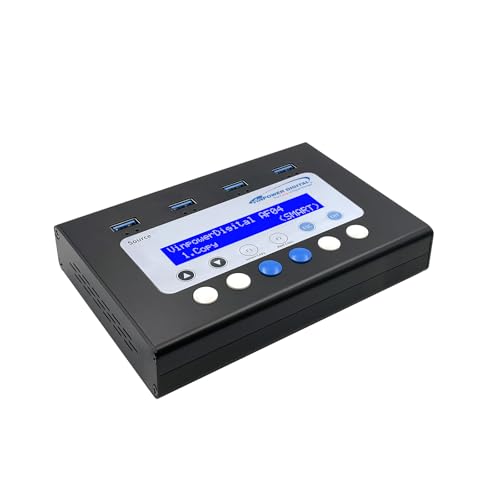
For buyers seeking usb duplicators with offline operation, the Vinpower Flash Memory USB Duplicator provides standalone copying without a computer. Its 1-to-3 layout supports Smart Copy for accessible files or Raw Copy for bit-by-bit cloning, while built-in erasing and read-error handling add useful professional capabilities.
Best For: Businesses, IT teams, and organizations that regularly duplicate, erase, or recover data from USB flash drives.
Pros:
- Standalone operation helps avoid connecting source media to a PC.
- Supports Smart Copy and Raw Copy for different duplication needs.
- Includes DoD 5220.22-M erasing and Read Error Skip technology.
- Compact design with three USB ports.
Cons:
- Designed for USB flash drives rather than M.2 SSDs or other media.
- Provides up to three target copies at a time.
This is the most feature-rich choice of the three for professional USB workflows. Choose it when secure erasing, raw cloning, and recovery-oriented copying matter as much as offline convenience.
Best NVMe Offline Cloner – MAIWO Dual-Bay M.2 Duplicator
The MAIWO is a strong option for buyers comparing usb duplicators with offline operation for M.2 storage. Insert a source and target M-Key NVMe SSD, press the clone button, and make a standalone bit-for-bit copy without a computer. Its USB 3.2 Gen 2 interface also supports fast computer-connected transfers.
Best For: Users migrating operating systems, duplicating NVMe SSDs, or handling large storage transfers with compatible M.2 drives.
Pros:
- Standalone cloning requires no computer during the duplication process.
- Supports M-Key NVMe sizes from 2230 through 22110.
- Each bay supports up to 8TB, with two SSDs accessible simultaneously.
- Open-air design helps manage heat during extended use.
Cons:
- Limited to compatible M-Key NVMe SSDs, not USB flash drives.
- The target SSD must be equal to or larger than the source.
- Standalone cloning is a source-to-target process rather than multi-target duplication.
Choose the MAIWO if your duplication needs center on NVMe SSD upgrades or migrations rather than thumb drives. It combines offline cloning with broad M.2 size support and a high-speed USB connection for dock use.
Best Portable Multi-Copy Option – EZ Dupe 1-to-4 Mini USB Plus MK II
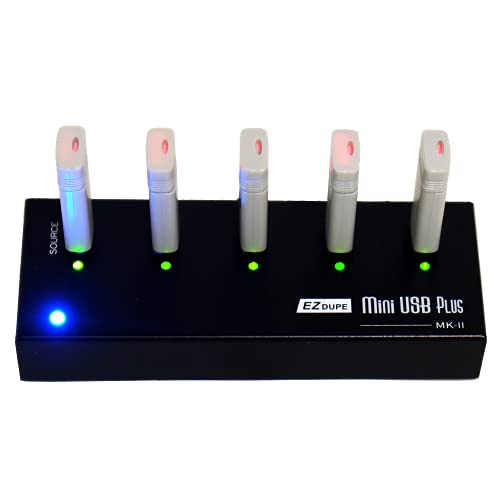
The EZ Dupe Mini USB Plus MK II is a practical pick for usb duplicators with offline operation when you need several flash-drive copies at once. It works without a computer, supports USB 1.0, 2.0, and 3.0 media, and can copy to up to four drives asynchronously at a rated speed of up to 2.5GB per minute.
Best For: Portable distribution of files, presentations, or other USB content to multiple flash drives.
Pros:
- Standalone plug-and-use operation needs no computer.
- Copies to up to four USB flash drives simultaneously.
- Asynchronous copying lets finished drives be replaced while others continue.
- Supports USB 1.0, 2.0, 3.0, and drives above 2TB capacity.
Cons:
- Copy speed depends on the connected drives and is rated up to 45MB/s.
- External USB hard drives require their own power source.
- It is intended for USB media rather than NVMe SSD cloning.
This model emphasizes portability and throughput across multiple USB targets. It is a good fit for recurring small-batch duplication, especially when replacing completed drives without waiting for the entire set.
Best Overall – StarTech 1:5 USB Duplicator
For technicians and IT professionals comparing usb duplicators with offline operation, the StarTech USBDUP15 offers five target ports, multiple copy modes, and built-in erase tools without requiring a computer. Its LCD and status indicators make it practical for routine duplication, drive sanitation, and verification.
Best For: IT departments and technicians who need flexible USB duplication and erasure in a standalone unit.
Pros:
- Duplicates or erases up to five USB drives at once.
- Supports system/file copying and sector-by-sector cloning.
- Includes Quick Erase, single-pass, and three-pass overwrite options.
- LCD monitoring, error scanning, and Copy & Compare verification add useful controls.
Cons:
- Asynchronous copying is limited to source content under 64 MB.
- External USB storage may need its own power source.
- Its 1.5 GB/min copy rate is slower than the faster EZ Dupe option listed here.
The StarTech is the most versatile choice when duplication is only part of the job. Its broader file-format support and erase functionality make it especially useful for managed workflows, though buyers focused mainly on maximum throughput may prefer a newer model.
Best High-Capacity Pick – EZ Dupe 1:7 Mini USB Plus MK III
The updated EZ Dupe Mini USB Plus MK III is a strong option for usb duplicators with offline operation when speed and output count matter. It copies to up to seven USB drives simultaneously, works without a computer, and supports USB flash media plus externally powered USB storage.
Best For: Users distributing the same data to large batches of USB drives.
Pros:
- Copies to as many as seven USB drives at the same time.
- Rated for up to 2.5 GB/min or 45 MB/second, depending on drive speed.
- Supports USB 1.0, 2.0, and 3.0 flash drives.
- Asynchronous copying lets users replace finished drives without waiting for the entire set.
Cons:
- External USB hard drives require their own power source.
- Actual performance depends on the read/write speeds of the connected flash drives.
- The supplied notes do not list dedicated erase or verification functions.
Choose the EZ Dupe when batch size and throughput are the priorities. Its seven-port design and asynchronous workflow can reduce interruptions during repeated copying, while its compatibility with larger external storage expands its possible use cases.
Best Compact Option – BestDuplicator UB300 1:2
For straightforward usb duplicators with offline operation, the BestDuplicator UB300 provides a compact 1-to-2 setup that copies USB drives without Windows or Mac software. Its LCD, button controls, and port indicators help make basic duplication and media checks easy to manage.
Best For: Small offices, schools, and field technicians performing occasional two-drive duplication.
Pros:
- Duplicates one USB drive to two targets simultaneously without a computer.
- Offers Quick Copy and whole-media, bit-for-bit cloning modes.
- Includes capacity checks, device information, speed tests, and erase functions.
- Can work with SD, microSD, CF, Mini SD, and MMC cards through a compatible USB reader.
Cons:
- Designed for USB 1.1 and USB 2.0 media rather than newer USB standards.
- Only supports two target drives at once.
- Best performance comes from source and target media with similar capacities.
The UB300 is a sensible low-volume choice for buyers who value a small footprint and useful testing tools over maximum scale. Its card-reader compatibility also adds flexibility, but its two-port, USB 2.0-focused design is less suited to large production runs.
How We Picked the Best USB Duplicators with Offline Operation
We focused on standalone devices that can copy, clone, verify, or erase storage without requiring desktop software. The selection includes dedicated flash-drive duplicators, multi-bay drive docks, and M.2 NVMe cloners so buyers can match the hardware to their media type and workload.
We also considered simultaneous target count, advertised transfer speed, interface generation, supported drive formats, display or controls, portability, and practical use cases. Speed claims vary with the source drive, target media, file mix, and whether the device performs verification, so treat published figures as maximums rather than guaranteed results.
Quick Comparison
| Best For | What to Prioritize | Recommended Style |
|---|---|---|
| Occasional flash-drive copying | Simple controls and low cost | 1:2 or 1:4 standalone duplicator |
| Small production runs | More target ports and verification | 1:7 duplicator or larger |
| Secure reuse of USB media | Dedicated erase and sanitization modes | Duplicator with built-in eraser functions |
| NVMe SSD upgrades | Drive compatibility and USB 3.2 bandwidth | Dual-bay M.2 cloner |
| Mixed bare-drive workflows | Bay layout and cloning support | Multi-bay SATA or NVMe dock |
Key Buying Factors for USB Duplicators with Offline Operation
Media Compatibility
Confirm whether the unit accepts USB flash drives, SATA disks, M.2 NVMe modules, or only a specific physical format. An NVMe cloner is not a substitute for a flash duplicator, and M.2 keying, length, and protocol support can differ.
Target Count and Throughput
More target ports increase batch capacity, but they do not always increase per-drive speed. Check the advertised rate, USB generation, and whether all ports can run simultaneously. For a few drives at a time, a compact 1:2 or 1:3 unit may be more economical and easier to store.
Copy Modes, Verification, and Erasure
Sector-by-sector copying is useful for bootable or structurally complex media, while file-based modes may be faster for ordinary data. Verification helps catch failed copies. If drives will be reassigned, look for clear erase or sanitization options and confirm the supported erase standard.
Controls and Workflow
An LCD or button-driven interface makes offline operation practical, especially where a computer is unavailable. Consider status feedback, error reporting, source protection, and whether the duplicator requires a master drive or can clone directly between installed drives.
Who Should Buy Which USB Duplicators with Offline Operation?
Choose a compact flash duplicator for classroom kits, installers, technicians, and occasional USB deployment. Choose a higher-port model when you regularly prepare many identical drives and want fewer copy cycles. Choose an NVMe cloner for SSD upgrades, drive migration, or two-drive cloning rather than ordinary thumb-drive production. Choose a multi-bay dock when flexible hard-drive access matters more than a dedicated flash-media workflow. Finally, prioritize sanitization features if the device will be used to clear customer, employee, or loaner media before reuse.